Pagsusuri ng Kakayahang Multi-Application ng Makinarya sa Paggawa ng Laryo
Pangunahing Pagkakaiba: Mga Detalye ng Pagganap sa Iba't Ibang Aplikasyon
Ang pangunahing hamon ay nasa radikal na magkakaibang mga pangangailangan sa inhinyeriya na inilalagay sa mga laryo na ginagamit sa mga dingding, simento, at kalsada. Ang mga ito ay hindi lamang mga baryasyon sa estetika kundi mga produktong pinamamahalaan ng hiwalay na pisikal at pamantayan sa tibay.
1.1 Structural Wall Units: Disenyo para sa Timbang at Paglilimita
Ang mga ladrilyo na idinisenyo para sa pader, maging pundasyon o pang-ibabaw lamang, ay inaayon para sa partikular na mga gamit.
- Pangunahing Tungkulin:Upang makabuo ng patayo at tuluy-tuloy na hadlang na nagbibigay ng istrukturang suporta, thermal at acoustic insulation, paglaban sa panahon, at aesthetic na tapusin.
- Pangunahing Sukatan ng Pagganap
- Lakas ng Pagpigil: Must withstand the dead load of the structure above and lateral forces. Typically governed by standards like ASTM C90 for concrete masonry units, specifying minimum net area compressive strength.
- Water Absorption and Permeability: Critical for durability in freeze-thaw cycles and long-term resistance to moisture ingress.
- Dimensional Stability: Uniform dimensions are vital for mortar joint consistency, structural alignment, and construction speed.
- Thermal Performance: Often influenced by design (e.g., hollow cores for insulation).
1.2 Pavement and Landscape Units: Designed for Pedestrian Traffic and Aesthetics
Pavers, slabs, and tiles for walkways, patios, and plazas face a different set of challenges.
- Pangunahing Tungkulin: To create a durable, level, and visually appealing walking surface that withstands foot traffic, weathering, and occasional light vehicular load (e.g., car tires on a driveway).
- Pangunahing Sukatan ng Pagganap
- Abrasion Resistance & Surface Hardness: The surface must resist wearing smooth or losing color from foot traffic.
- Flexural Strength: As a unit resting on a sand or mortar bed, it must resist breaking under point loads (e.g., high heels, furniture legs) without continuous underlying support.
- Freeze-Thaw Durability: Especially critical in colder climates, as pavers are fully exposed to saturation and temperature cycles.
- Slip Resistance: Surface texture is often engineered for safety when wet.
- Precise Thickness and Interlock: Uniform thickness ensures a level surface; interlocking shapes provide structural integrity through mechanical bonding.
1.3 Road and Heavy-Duty Paving Units: Built for Extreme Mechanical Stress
Blocks for roads, industrial yards, ports, and logistics centers are engineered for the most severe conditions.
- Pangunahing Tungkulin: To form a rigid, interlocking pavement system capable of distributing massive dynamic loads from heavy trucks, container handlers, and constant traffic.
- Pangunahing Sukatan ng Pagganap
- Extremely High Compressive & Tensile Strength: Must withstand immense point pressures and shear forces without cracking or spalling.
- Exceptional Abrasion Resistance: To combat wear from tires and braking over decades.
- Load-Bearing Interlock Design: The shape (often complex, like a zig-zag or offset pattern) is critical for transferring horizontal loads across the pavement, preventing rutting and movement.
- Minimal Water Absorption: Near-impermeability is required to prevent damage from de-icing salts, fuel/oil spills, and freeze-thaw action under load.
The Machine Platform: Core Compatibility and Necessary Adaptations
A well-engineered brick machine provides the fundamental process—compaction and molding—but requires specific adaptations to produce these divergent products to specification.
2.1 The Non-Negotiable Core: High-Pressure Compaction
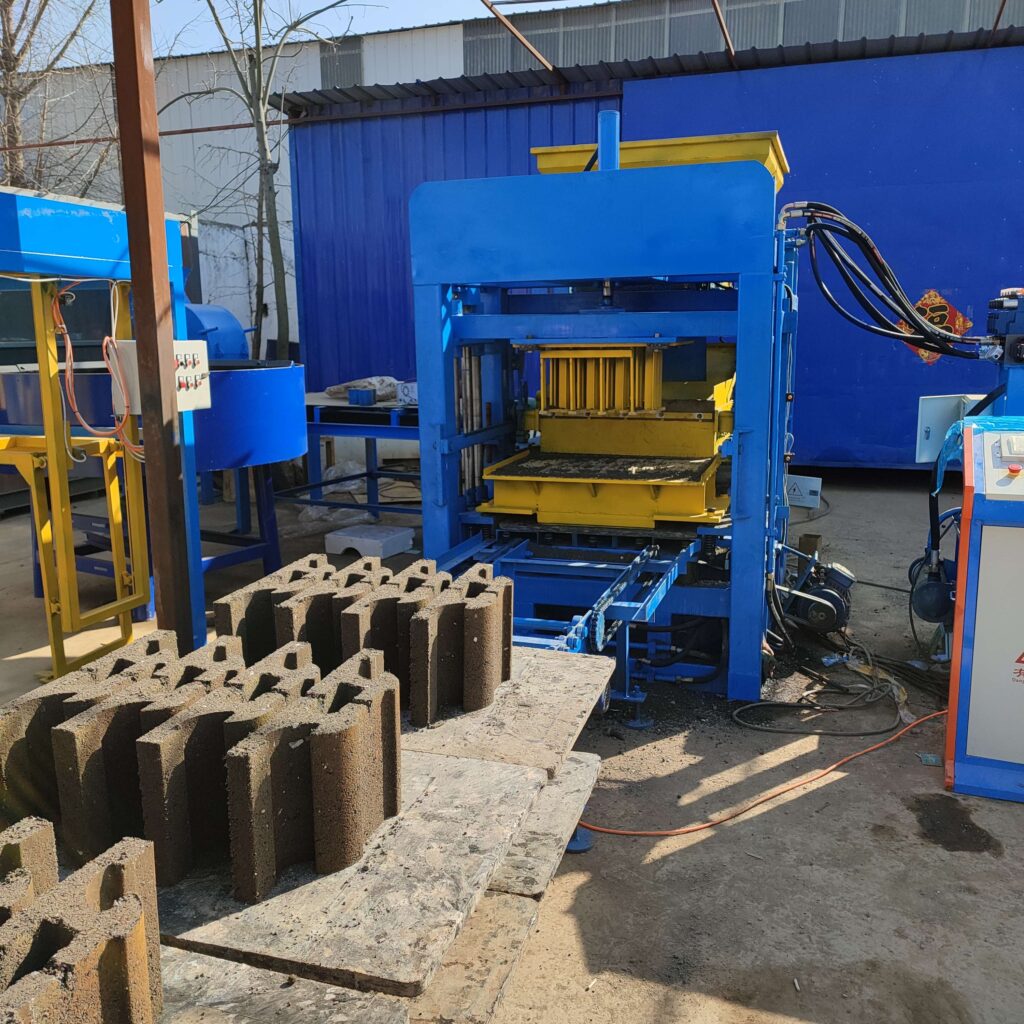
The common denominator for all three applications is the need for high-density compaction. A machine must be capable of generating sufficient pressure—whether through hydraulic rams, high-frequency vibration, or a combination of both—to produce a low-void, high-strength product. Machines designed for only lightweight, low-strength blocks cannot cross over into paving or road segments.
2.2 The Key to Versatility: Modular Mold Systems
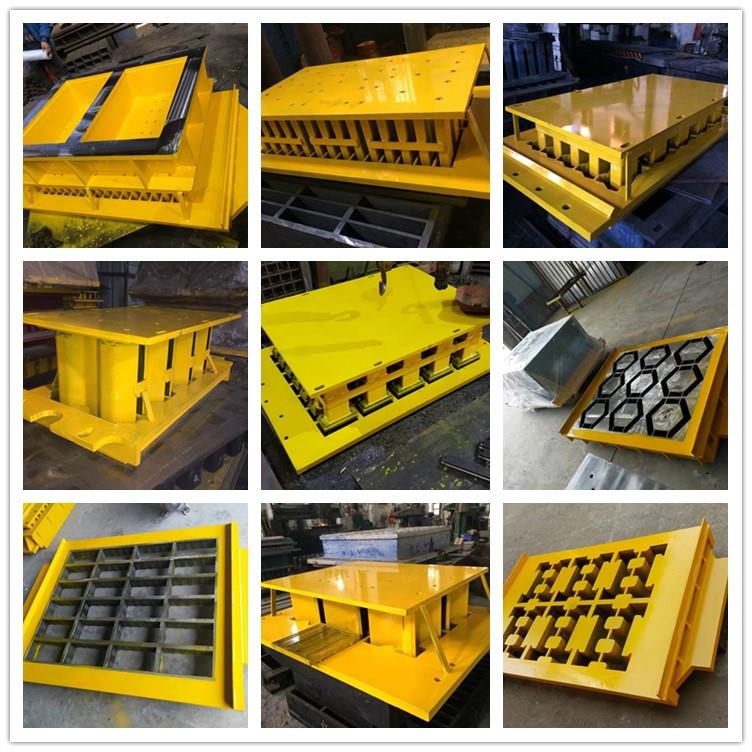
The most critical adaptation is the mold. Producing different products requires different mold boxes.
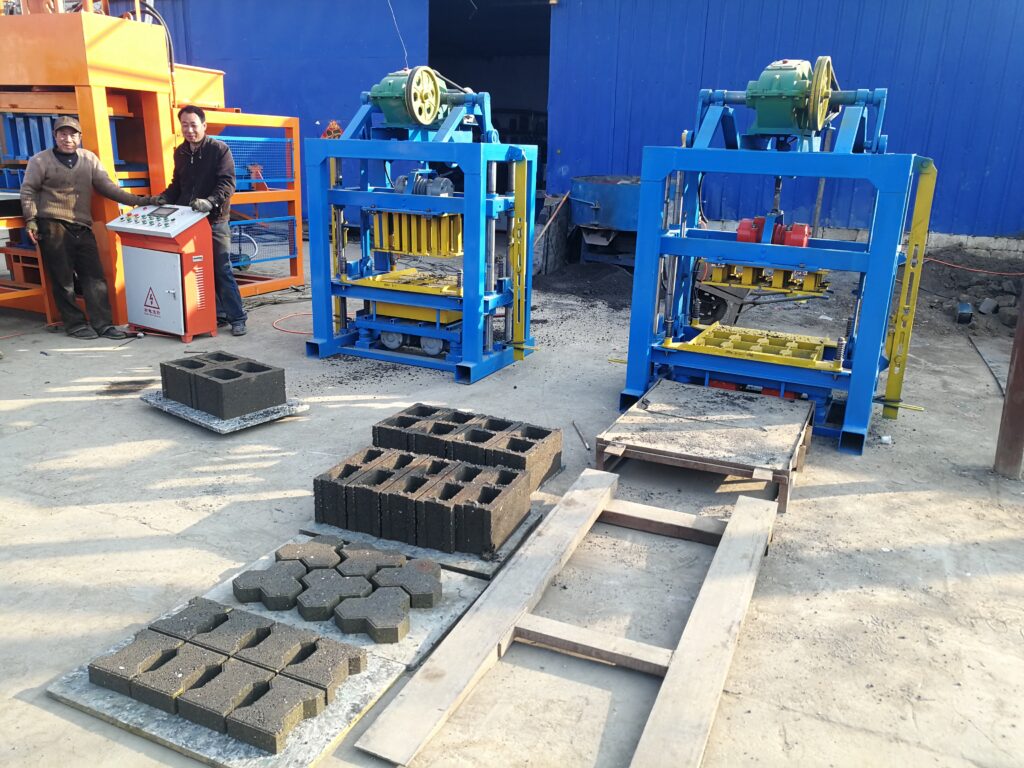
- Wall Brick Molds: Typically produce larger, often hollow units. The mold design includes core formers to create the voids.
- Paver Molds: Produce solid units of specific thickness (usually 60mm or 80mm) and can range from simple rectangles to complex interlocking shapes like herringbone or fan patterns.
- Road Block Molds: Are designed for thick (often 100mm or more), heavily interlocking shapes like double-T or dumbbell configurations. These molds are subjected to extreme wear and must be constructed from the highest-grade tool steel.
- Quick-Change Systems: Industrial-grade machines offer quick-change mold carriages or tables. This allows an operator to detach one mold assembly and attach another in a matter of hours, not days, facilitating production changeovers between product lines.
2.3 Auxiliary System Adjustments
Beyond the mold, other machine parameters may need adjustment.
- Vibration Profile: The frequency and amplitude of vibration may be tuned for different mix designs and product thicknesses to ensure optimal compaction without segregation.
- Sistema ng Pag-e-eject The mechanism for pushing the finished product out of the mold must accommodate different shapes and depths without damaging delicate edges or interlocking features.
- Handling and Stacking: Automated downstream handling systems (conveyors, stackers) may require reprogramming or attachment changes to handle different product dimensions and stack patterns securely.
The Decisive Factor: Material Science and Mix Design
Even with a capable machine and correct mold, the raw material recipe is what ultimately determines performance suitability.
3.1 Formulating for Application-Specific Performance
A single, generic mix cannot produce optimal products for all three applications.
- Wall Mix: May utilize a wider gradation of aggregates and can incorporate lightweight or insulating materials. Strength requirements are defined but not as extreme as for roads.
- Paver Mix: Requires hard, durable aggregates (like granite or basalt chips) to achieve high abrasion resistance and surface hardness. Pigments for color are integrally mixed, requiring precise dosing.
- Road Block Mix: Demands the highest cement content and the hardest, most mechanically strong aggregates. It may include specialized admixtures for ultra-low water absorption and very high early strength. The mix is often a zero-slump, dry mix that relies heavily on extreme pressure for consolidation.
3.2 The Economic and Logistical Reality of Mix Changes
Changing the mix design on a production line is a significant undertaking.
- System Purge: Thoroughly cleaning the mixer, conveyors, and hoppers to prevent contamination from one mix to the next (e.g., preventing grey aggregate from contaminating a colored paver mix) is time-consuming and results in material waste.
- Raw Material Inventory: A plant aiming to serve all three markets must stock a broader range of materials—different aggregate types, pigments, cement classes, and admixtures—increasing inventory holding costs and complexity.
Strategic Business Implications for Distributors and Suppliers
The decision to pursue a multi-application strategy with one machine has significant commercial ramifications.
4.1 Evaluating the “One Machine” Claim from a Supplier
A distributor must probe beyond the surface. Key due diligence questions include:
- “Can you provide performance test certificates (for compressive strength, abrasion, freeze-thaw) for all three product types produced from the same machine base unit?”
- “What is the procedure and time required for a complete mold and mix changeover from wall blocks to pavers?”
- “What is the maximum compaction force (in kN or tons) your machine can apply, and is it sufficient for road-grade blocks per ASTM C936 or equivalent?”
4.2 The Specialization vs. Versatility Trade-Off
- Specialized High-Volume Lines: For suppliers focused on a single market (e.g., pavers), a dedicated machine optimized for that one product will typically achieve higher output, lower per-unit cost, and peak quality for that niche.
- Versatile, Lower-Volume Strategy: A machine capable of producing all three types is ideal for a regional supplier serving diverse local markets, allowing them to respond flexibly to demand without investing in three separate lines. The trade-off is often lower overall output per product type due to changeover downtime and less-than-optimal specialization.
Konklusyon
The capability of a single brick machine to produce units for walls, pavements, and roads is fundamentally a question of machine design sophistication, modular adaptability, and material science rigor. While a robust, high-pressure machine with a quick-change mold system provides the mechanical possibility, the true determinant of success is the disciplined application of distinct, engineered mix designs and a rigorous quality control regimen for each product family.
For the distributor or procurement manager, this creates a clear evaluative framework. The goal is not to find a mythical machine that makes everything perfectly with one generic setting, but to identify a technology partner whose equipment platform offers the validated flexibility to produce to multiple specification standards, supported by the engineering expertise to formulate the correct mixes. This approach allows a business to diversify its product offering and capture value across multiple construction segments, provided it is managed with an acute understanding of the technical and operational complexities involved. In essence, the machine provides the versatile stage, but expert knowledge directs the performance for each specific application.
FAQ
Q1: What is the most significant compromise when using one machine for multiple applications?
A: The primary compromise is peak production efficiency and output optimization. A machine dedicated to one product type can have its cycle time, vibration profile, and handling systems fine-tuned for maximum speed and minimal waste. A multi-purpose machine must use settings that are a “capable compromise” for different products, and time is lost during changeovers for mold swaps and system purges. You trade some specialization efficiency for market flexibility.
Q2: Can the same brick be used for both walls and pavements?
A: Almost never. A standard wall brick lacks the abrasion resistance, surface hardness, and often the flexural strength required for pavement use. Its higher water absorption could lead to rapid deterioration under freeze-thaw cycles on the ground. Conversely, a solid, high-strength paver is over-engineered and unnecessarily expensive for most wall applications and may not have the required thermal or structural properties (like core voids) for efficient wall construction.
Q3: How long does a typical changeover from producing wall blocks to producing pavers take on a versatile machine?
A: For a well-designed industrial system with a quick-change mold carriage, the physical mold swap can take 2-4 hours. However, the total changeover time must include:
- Purging and cleaning the mixing and feeding system of the previous mix (1-2 hours).
- Calibrating the machine’s vibration and pressure settings for the new product.
- Producing and checking initial samples for dimensional and weight compliance.
A full, efficient changeover from one product family to another typically requires a full production shift (8 hours) to complete properly without cross-contamination.
Q4: As a distributor, should I stock all product types from a single supplier using one machine?
A: This strategy has pros and cons.
- Mga Pakinabang: Simplified supplier management, potential for bundled pricing, and guaranteed color/texture matching if architectural projects use the same material on walls and hardscape.
- Mga Disadvantage: You are tied to the production schedule and potential bottlenecks of a single factory. If they have a surge in demand for road blocks, your supply of pavers may be interrupted due to production line changeovers. It is often prudent to have a primary versatile supplier but maintain relationships with specialized suppliers for high-volume or critical project needs in each segment.
Q5: What is the single most important technical specification to check when assessing a machine’s claim of versatility?
A: The maximum compaction force (expressed in kN, tons, or psi of mold area) is paramount. Producing road-quality blocks requires immense pressure—often double or triple that required for standard wall blocks. If a machine’s maximum force is only sufficient for wall units, it will be physically incapable of producing the density required for true heavy-duty paving blocks, regardless of mold or mix design. Always ask for the machine’s verified compaction force specification and compare it to the industry standards for the toughest product you intend to make.