
The Ultimate Guide to Pallet Block Machines: Types, Benefits, and How to Choose
Panimula
If you’re in the pallet manufacturing or wood processing business, you’ve likely hit a familiar ceiling. Manual block cutting is slow, inconsistent, and labor-intensive, creating a bottleneck that limits your growth and eats into your profits. The search for a more efficient, cost-effective production solution isn’t just a desire—it’s a business imperative.
This is where the pallet block machine enters the scene, transforming a centuries-old craft into a streamlined, modern manufacturing process. From small workshops looking to scale to large factories aiming to dominate their market, this single piece of equipment can be the pivotal investment that redefines an operation.
As industry veterans who have witnessed the evolution from hand tools to computer-controlled automation, we’ve crafted this guide to cut through the noise. We’ll move beyond sales brochures to deliver actionable, expert insights. Our goal is simple: to equip business owners, workshop managers, and savvy investors with the comprehensive knowledge needed to make a confident, informed decision about integrating a pallet block machine into their workflow.
What is a Pallet Block Machine? Core Function and Industry Impact
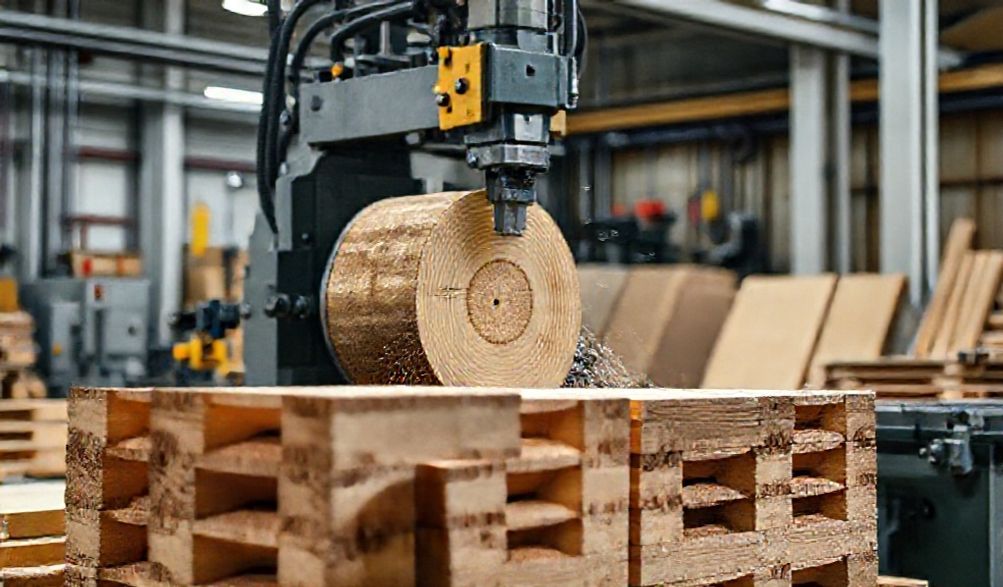
At its heart, a pallet block machine is a specialized woodworking device designed to automate the production of pallet blocks—the small, rectangular wooden pieces that form the critical structural supports of a pallet. These blocks are the unsung heroes of the logistics world, bearing the immense weight of global commerce.
Ang Pangunahing Prinsipyo ng Pagpapatakbo
The core function is elegantly straightforward. The machine takes raw wood feedstock—which can range from full logs and slab wood to mill off-cuts—and processes it into uniform blocks of a predetermined size.
Narito ang pinadaling paliwanag ng proseso:
1. Pagpapakain: Raw material is placed into an infeed system.
2. Pagpoposisyon at Pagpipikit The wood is secured to prevent movement.
3. Pagpuputol: A saw unit (circular or band saw) makes the cross-cuts to define block length.
4. Pag-eject: The finished block is discharged, ready for the next stage of pallet assembly.
This automated cycle repeats continuously, turning irregular wood pieces into a steady, predictable stream of standardized components.
Mga Pangunahing Bahagi at ang Kanilang mga Tungkulin
Ang pag-unawa sa mga pangunahing bahagi ay naglilinaw sa paggana ng makina:
* Infeed System/Conveyor: This is the “loading dock.” It guides raw wood into the machine consistently. Think of it as the autoloader for the entire system.
* Cutting/Sawing Unit: The “heart” of the operation. This houses the powerful motor and saw blades that perform the actual cutting. The type of blade (multi-circular vs. band saw) defines the machine’s speed and finish.
* Clamping & Pressing Mechanism: The “strong hands.” Often hydraulic, this system holds the wood rock-steady during cutting to ensure precision and safety. In some machines, it also compresses the wood to improve block density.
* Control Panel: The “brain.” This interface, ranging from simple buttons to digital touchscreens, allows the operator to set dimensions, control the cycle, and monitor machine status.
Why Automation is a Game-Changer
Contrasting manual and automated production reveals a stark picture:
* Output Volume A skilled worker might produce a few hundred blocks in a day. A basic automatic machine can produce 1,500 to 3,000 blocks per hour. The scale is incomparable.
* Labor Efficiency: One machine, operated by a single worker, can replace multiple manual cutting stations, drastically reducing labor costs and management complexity.
* Material Yield: Manual cutting leads to guesswork and inconsistent off-cuts. A machine’s precision maximizes the usable wood from each log or slab, directly converting saved material into profit.
Exploring the Different Types of Pallet Block Machines
Not all pallet block machines are created equal. The right type for you depends entirely on your production scale, budget, and technical capacity.
Manu-mano kumpara sa Semi-Awto kumpara sa Ganap na Awto na Makina
- Manual na Makina: Require the operator to feed each piece of wood and activate each cut cycle. Lowest upfront cost, suitable for very low-volume or custom work, but output and labor efficiency gains are minimal.
- Semi-Automatikong Makina: The operator loads the raw material, but the cutting, clamping, and ejection sequence is automated. Offers a excellent balance, providing significant productivity boosts over manual methods while remaining affordable and relatively simple to operate. Ideal for small to mid-sized workshops.
- Ganap na Awtomatikong Makina: Integrated with automated feeders and conveyors. Logs or slabs are loaded in bulk, and the machine runs with minimal intervention. Designed for high-volume, 24/7 production lines in large factories. Highest output but also highest investment.
Hydraulic Press Block Machines
This technology focuses on creating a superior product. After cutting to length, the wood block is subjected to high hydraulic pressure.
* Pangunahing Pakinabang: Compresses the wood fibers, creating a block with higher density and dimensional stability. This results in stronger, more durable pallets that are less prone to splitting.
* Pinakamainam Para Sa: Operations using mixed or harder wood species, or those whose customers demand premium, high-load-capacity pallets.
Multi-Blade Circular Saw Machines
These are the speed demons of pallet block production.
* Pangunahing Pakinabang: A single pass through a gang of spaced circular saws can produce multiple blocks from a longer piece of wood simultaneously. This makes them exceptionally fast for high-volume runs of standard block sizes.
* Pinakamainam Para Sa: Large-scale manufacturers using softwoods (like pine or spruce) who need massive, consistent output of common block dimensions.
CNC-Integrated Block Machines
Representing the high-end of technology, these machines incorporate Computer Numerical Control.
* Pangunahing Pakinabang: Ultimate flexibility and precision. Operators can program custom block lengths, diameters, and even complex cutting patterns via software. Changeovers between sizes are quick and digital.
* Pinakamainam Para Sa: Specialty pallet manufacturers, operations producing block for other uses (e.g., landscaping timbers), or large factories that require extreme flexibility and traceability in their production.
Critical Benefits of Investing in a Pallet Block Machine
The decision to invest is justified by a compelling array of tangible benefits that impact your bottom line and operational health.
Dramatic Increase in Production Efficiency
The numbers speak for themselves. Replacing manual labor with a semi-automatic machine can easily increase your block output by 500% or more. This eliminates your primary production bottleneck, allowing you to fulfill larger orders, reduce lead times, and take on more business without proportionally increasing your workforce.
Significant Reduction in Material Waste
Precision is profitable. Manual cutting inevitably leads to errors and suboptimal cutting patterns. A machine’s consistent accuracy ensures you get the maximum number of usable blocks from every log, slab, or off-cut. An improvement in material yield of just 5-10% can pay for the machine’s maintenance costs annually.
Walang Kapantay na Pagkakapare-pareho at Kontrol sa Kalidad
Every block is identical. This uniformity is critical for the next stage: automated nailing or assembly. Consistent blocks lead to:
* Stronger, more reliable pallets with even weight distribution.
* Fewer jams or stoppages in automated nailing machines.
* Higher customer satisfaction and fewer returns due to pallet failure.
Enhanced Worker Safety and Ergonomic Benefits
Moving from manual chainsaws or chop saws to an automated machine is a major safety upgrade. It significantly reduces:
* Risks of kickback and direct contact with cutting blades.
* Repetitive strain injuries from handling heavy wood and tools all day.
* Exposure to high noise and vibration levels.
The machine’s guards, two-hand controls, and enclosed cutting areas create a fundamentally safer work environment.
How to Choose the Right Pallet Block Machine for Your Business
Selecting a machine is not about buying the biggest or the cheapest. It’s about finding the perfect tool for your specific job.
Pagsusuri sa Iyong Pangangailangan sa Produksyon
Simulan sa pagsagot sa mga pangunahing tanong na ito:
* Target Daily/Weekly Output: How many blocks do you need to produce now? In 2 years?
* Primary Wood Species: Are you cutting soft pine, hard oak, or recycled mixed wood? This affects required power and blade type.
* Available Space & Power: Do you have the factory floor space and the electrical supply (e.g., 3-phase power) for the machine you’re considering?
* Block Dimensions: What are the most common block sizes (length, width, height) you need to produce?
Key Specifications to Compare
Create a comparison spreadsheet with these columns:
* Max Log Diameter: Can it handle your largest common feedstock?
* Block Length Range: Does it cover all the sizes you need?
* Motor Power (kW/HP): Indicates cutting capability and throughput.
* Cycles Per Hour: The manufacturer’s estimated output under ideal conditions.
* Required Manpower: How many operators are needed to run it efficiently?
* Bakas ng Paa: The physical space it will occupy.
New vs. Used Equipment: A Balanced View
- New Machine Pros: Latest technology, full warranty, energy-efficient motors, manufacturer training, and reliable after-sales support.
- New Machine Cons: Higher initial capital outlay.
- Used Machine Pros: Lower purchase price, potentially faster availability.
- Used Machine Cons: Unknown maintenance history, risk of unexpected breakdowns, potentially outdated/inefficient technology, limited or no warranty, difficulty sourcing obsolete spare parts.
For most businesses, the reliability and support of a new machine from a reputable maker provide greater long-term value.
Evaluating Manufacturer Reputation and Support
The machine is only as good as the company behind it. Your due diligence is critical:
1. Research History: How long has the manufacturer been in business? Do they specialize in woodworking machinery?
2. Seek Authentic Reviews: Look for customer testimonials or case studies. Ask for references you can contact directly.
3. Verify Support Structure: What does after-sales service include? Is there local technical support? How readily available are spare parts (blades, hydraulic seals, sensors)? Is operator training provided?
A manufacturer that offers comprehensive support is investing in your long-term success, not just making a one-time sale.
Operational Best Practices and Maintenance Essentials
A machine is a long-term asset. Proper care ensures it remains productive and profitable for years.
Daily and Weekly Maintenance Checklists
Daily (Start of Shift):
* Visually inspect blades for damage or excessive dulling.
* Check hydraulic fluid levels and look for leaks.
* Ensure all safety guards and interlocks are functional.
* Clear sawdust and debris from the cutting area and ejection path.
Weekly:
* Lubricate all moving parts as per the manual (guide rails, bearings).
* Check and tighten bolts and fittings.
* Inspect electrical connections for security.
* Test emergency stop functions.
Common Operational Issues and Troubleshooting
- Block Size Inaccuracy: Check for worn clamping pads, loose blade arbors, or incorrect programming settings. Verify feedstock is consistent.
- Excessive Vibration or Noise: Often indicates a damaged or unbalanced blade, or loose components. Stop the machine immediately and inspect.
- Hydraulic System Weak/Leaking: Check fluid levels and look for visible leaks at hoses and fittings. A drop in pressure can affect clamping force.
- Machine Won’t Cycle: Verify safety gates are closed, check for jammed material in the feed path, and consult the control panel for error codes.
Safety Protocols for Operators
Safety is non-negotiable. Enforce these rules:
* PPE is Mandatory: Safety glasses, hearing protection, and cut-resistant gloves at a minimum.
* No Loose Clothing or Jewelry: Anything that can be caught in moving parts is forbidden.
* Follow Lockout/Tagout (LOTO): Before any maintenance or clearing a jam, the machine must be powered off and locked in a zero-energy state.
* Never Bypass Safety Guards or Interlocks: They are there for a reason.
* Provide Regular Training: Refresh operators on procedures and emergency responses quarterly.
Frequently Asked Questions (FAQ) About Pallet Block Machines
Q: What is the average ROI (Return on Investment) for a pallet block machine?
Isalin ang teksto sa Filipino. I-output LAMANG ang isinalin na teksto. There is no single “average,” as ROI depends on your specific costs (machine price, labor rates, material costs) and gains (output increase, waste reduction). However, many small to mid-sized operations report a payback period of 12 to 24 months based on labor savings and increased production capacity alone. The key is to calculate your current cost-per-block manually versus the projected cost-per-block with the machine.
Q: Can one machine produce different sizes of blocks?
Isalin ang teksto sa Filipino. I-output LAMANG ang isinalin na teksto. Yes, most modern machines are adjustable. The process of changing the block length (cut-off length) can range from simple mechanical adjustments to digital entry on a CNC panel. However, changeover takes time, so it’s most efficient to batch production of the same size.
Q: What type of training do operators typically need?
Isalin ang teksto sa Filipino. I-output LAMANG ang isinalin na teksto. Basic machine operation can often be learned in a day or two. However, comprehensive training should cover safety protocols, daily maintenance routines, basic troubleshooting for common issues, and proper blade changing/alignment procedures. Quality training from the manufacturer is a key investment in uptime and safety.
Q: How do I source quality raw materials (logs) for the machine?
Isalin ang teksto sa Filipino. I-output LAMANG ang isinalin na teksto. Reliable feedstock is crucial. Build relationships with local sawmills, timber merchants, or forestry operations. For optimal results, wood should have a consistent moisture content (ideally below 20%) to prevent excessive shrinkage or swelling. The species should match your machine’s capability—softer woods are easier on blades and allow for higher feed rates.
Konklusyon
Integrating a pallet block machine into your operation is more than just purchasing equipment; it’s a strategic decision to embrace efficiency, quality, and growth. It represents the shift from a labor-intensive workshop to a scalable, modern manufacturing business.
As we’ve explored, the “right” machine is the one that aligns perfectly with your unique production goals, material constraints, and growth ambitions. It requires honest self-assessment, careful specification comparison, and partnering with a manufacturer who stands behind their product.
Use this guide as your foundational roadmap. Let it inform the questions you ask and the metrics you prioritize. Then, take the next step: consult directly with reputable manufacturers, request live demonstrations using your own wood samples, and see the transformation in action. In an industry where margins are built on precision and volume, the pallet block machine isn’t just a tool—it’s your competitive edge for the future of manufacturing.
<