
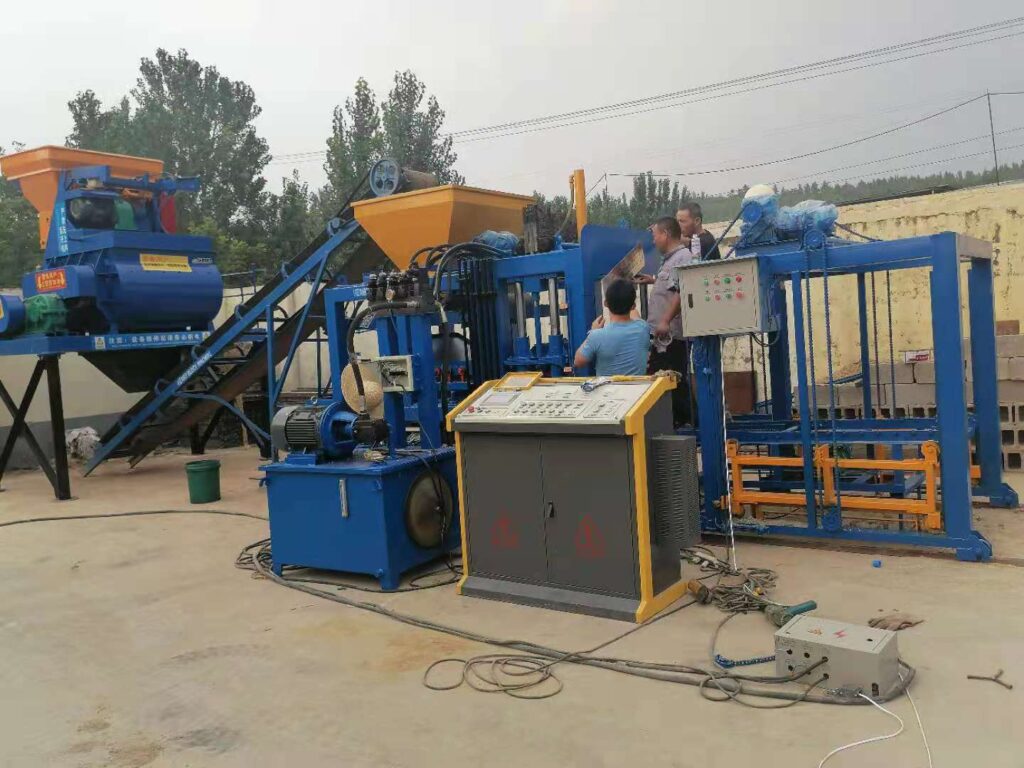
The Foundation: Material Consistency and Mix Design
The most frequent and preventable cause of jams originates not in the machine’s mechanics, but in the material fed into it. An inconsistent or improperly formulated mix is the primary culprit.
- 1.1. Optimal Moisture Content: The Critical Balance
Moisture is the most volatile variable. A mix that is too dry will not flow properly, causing it to bridge or “rat-hole” in the feed hopper and shoe, leading to incomplete fill and subsequent machine sequence errors. A mix that is too wet can stick aggressively to the mold liners, feed shoe, and pallet, preventing clean release and causing blocks to tear apart during the stripping cycle, with debris jamming moving parts.- Actionable Strategy: Implement rigorous moisture monitoring. Use calibrated sensors in the mixer and enforce manual checks (e.g., the “ball-in-hand” test) at regular intervals. Record moisture content alongside weather conditions, as aggregate moisture can vary significantly.
- 1.2. Aggregate Gradation and Cleanliness
The size and shape of aggregates directly impact mix flow and wear.- Oversized Aggregate: Stones larger than the gap between the feed shoe and mold, or larger than the block’s web thickness, can physically catch and cause immediate jams in the feed system or mold cavity.
- Fine Content and Contaminants: Excessive dust (fines) can alter water demand and cause packing. Foreign materials like wood, metal, or hardened cement lumps are guaranteed sources of obstruction.
- Actionable Strategy: Enforce strict aggregate sizing specifications and implement screening processes to remove oversize material and debris. Regularly audit aggregate stockpiles.
2. Machine-Centric Prevention: Wear Management and Alignment
Even with perfect mix, mechanical neglect will inevitably lead to jams. Precision and cleanliness are non-negotiable.
- 2.1. Maintaining Critical Wear Components
Worn parts create gaps where material can accumulate and harden, or fail to perform their sealing function.- Mold Liners and Cores: Worn, dented, or pitted liners increase friction, causing mix to stick. Damaged cores can create flash that breaks off and jams the pallet conveyor or stacker.
- Feed Shoe and Tamper Heads: Excessive wear on the bottom seal of the feed shoe allows mix to leak and compact underneath it, creating a hardened layer that interferes with movement and causes misfeeds.
- Палети: Warped, bent, or heavily coated pallets prevent the mold from closing uniformly. They can also fail to index correctly on the conveyor, leading to catastrophic collisions with the mold or stripper head.
- Actionable Strategy: Establish a scheduled inspection and replacement program for high-wear parts based on production hours, not just failure.
- 2.2. Ensuring Precision Alignment and Cleanliness
A misaligned machine is a jam waiting to happen.- Pallet System Alignment: The pallet conveyor, indexing mechanism, and mold station must be perfectly aligned. A misaligned pallet will strike the mold during indexing.
- Stripper Head Alignment: The head that lifts the mold off the block must descend perfectly square and vertical. An angled lift can drag the mold against the block, causing breakage and debris.
- The “Clean-as-You-Go” Doctrine: Hardened concrete buildup on the feed frame, vibration table, or inside the mold box changes clearances and interferes with movement. Daily and weekly cleaning schedules are essential preventative maintenance.
3. Procedural and Human Factor Controls
Technology and procedures are managed by people. Standardizing operations prevents erratic conditions that induce jams.
- 3.1. Standardized Start-Up and Shutdown Sequences
Improper procedures can leave material to set in critical areas.- Start-Up: Always begin with a dry cycle (no mix) to ensure all systems—hydraulics, conveyors, vibration—are functioning correctly before introducing material.
- Shutdown: The procedure must include running the mixer and feed system empty and then thoroughly cleaning the hopper, feed shoe, and mold cavity. Leaving mix in the system guarantees a hard-set jam at the next start-up.
- 3.2. Operator Training and Vigilance
The machine operator is the first line of defense.- Навчання: Operators must be trained to recognize the early signs of trouble: a change in machine sound, slight hesitation in movement, minor variations in block appearance. They must understand the “why” behind procedures like moisture checks and daily cleaning.
- Vigilance: Encouraging operators to stop and investigate a minor anomaly immediately can prevent it from escalating into a major jam that requires hours to clear.
Висновок
Preventing jams in a block-making machine is not a singular action but a holistic operational philosophy. It requires a closed-loop system that starts with disciplined control over raw material consistency, extends through a rigorous regime of mechanical inspection and wear-part management, and is cemented by standardized procedures and empowered, knowledgeable operators. For distributors and plant managers, investing in this preventative culture yields a direct return through maximized machine uptime, reduced spare part costs from catastrophic failures, and predictable production output. By shifting focus from fixing jams to systematically eliminating their causes, businesses secure a significant and sustainable competitive advantage in the market.
FAQ
Q1: What is the single most important daily task to prevent jams?
А: Without question, a thorough cleaning of the mold, feed shoe, and vibration table at the end of each production shift (or during scheduled breaks). Preventing the buildup of hardened concrete is the simplest, most effective way to avoid the majority of mechanical interference and feeding jams.
Q2: We have good mix control, but still get occasional jams in the feed hopper. Why?
А: This is often due to “bridging” caused by the hopper design or aggregate shape. Ensure the hopper interior surfaces are smooth and polished. Consider installing a mechanical vibrator or air cannon on the hopper to gently dislodge material if it begins to arch, but use these as aids, not substitutes for proper mix design.
Q3: How often should we check and replace wear parts like mold liners and feed shoe seals?
А: Do not wait for failure. Establish a schedule based on production volume (hours or cycles). Consult the machine manual for guidelines, but monitor condition weekly. Replace liners and seals when wear begins to affect part dimensions or surface smoothness, not when they are completely worn through.
Q4: Can weather or ambient temperature contribute to jamming?
А: Absolutely. High temperatures accelerate the setting of concrete in the machine. Low temperatures can affect the flow of hydraulic fluid and the behavior of the mix. Adjust cleaning frequency and mix hydration parameters (like using retarding admixtures in heat) seasonally to compensate.
Q5: What should be the immediate response protocol when a jam is detected?
А: 1. Stop the machine immediately using the emergency stop.
2. Lock out all power sources (LOTO procedure).
3. Diagnose the exact location and nature of the jam visually.
4. Clear debris manually using appropriate tools—never use hands or force the machine to cycle.
5. Before restarting, investigate and address the root cause (e.g., check moisture, inspect for worn parts) to prevent immediate recurrence.
