Багатогранні детермінанти міцності цегли
Міцність цегли є результатом інженерного проектування, а не випадковістю. На неї впливають на кожному етапі механізованого виробничого процесу, причому рішення на одному етапі фундаментально впливають на потенціал наступних етапів. Ми можемо класифікувати ці фактори на чотири основні стовпи: склад сировини, формування та ущільнення, режим сушіння та процес випалювання або твердіння.
1. Основний стовп: Склад і підготовка сировини
Властивості сировини визначають максимальну межу потенційної міцності.
1.1. Хімічний та мінералогічний склад глини або бетонної суміші
- Глиняна цегла:Тип глинистих мінералів (каолініт, іліт, монтморилоніт) та їх співвідношення визначають пластичність, температуру спікання та кінцеву міцність зв'язку. Важливим є збалансована суміш глини, мулу та непластичних матеріалів, таких як кремнезем. Надмірна кількість дрібної глини може призвести до високої усадки та розтріскування, що послаблює структуру, тоді як правильна пропорція кремнезему (пісок, шамот) виконує роль заповнювача, зменшуючи усадку та забезпечуючи стабільний каркас, який підвищує міцність після випалу.
- Бетонні цеглини:Якість та марка цементу, гранулометричний склад (розподіл за розміром частинок) піску та заповнювачів, а також водоцементне співвідношення мають вирішальне значення. Низьке водоцементне співвідношення забезпечує щільнішу та міцнішу структуру, але вимагає потужного ущільнення. Добре підібрані заповнювачі з мінімальною кількістю дрібних фракцій створюють міцну, взаємопов'язану внутрішню структуру.
1.2. Додатки та домішки
- Зміцнюючі добавки:У глиняній цеглі такі матеріали, як глинозем або спеціальні флюси, можуть сприяти міцнішому склоподібному зв'язуванню за оптимальних температур. У бетонній цеглі хімічні добавки, такі як пластифікатори, дозволяють знизити вміст води, тоді як добавки для контролю гідратації забезпечують послідовне та повне тверднення.
- Пороутворювальні агенти:Такі матеріали, як тирса або гранули полістиролу, вигорають під час випалу або твердіння, створюючи контрольовану пористість. Хоча це може покращити теплоізоляцію, надмірний або погано розподілений об'єм цих агентів діятиме як порожнечі та концентратори напружень.зниження міцності на стиск.
1.3. Обробка матеріалів та однорідність
- Зменшення розміру частинок та старіння:Для глини ретельне подрібнення, просіювання та витримка (вивітрювання) забезпечують однорідний дрібнозернистий склад. Це сприяє тісному контакту частинок під час формування та більш повній хімічній реакції під час випалу, що призводить до отримання однорідного, міцного виробу. Неоднорідний або грубий матеріал призводить до утворення слабких місць.
- Ефективність змішування:Як обговорювалося в попередніх аналізах, ідеально однорідна суміш — де кожен складник рівномірно розподілений — є обов'язковою умовою. Будь-яка локальна зона чистої глини, піску або надлишкової води стає площиною слабкості під навантаженням.
2. Формувальний стовп: Формувальний тиск та щільність
Цей етап перетворює потенціал підготовленого матеріалу на відчутний зелений продукт. Ключовий принцип:Вища щільність формування безпосередньо корелює з вищою міцністю після випалу або затвердіння.
2.1. Тип машини та сила ущільнення
- Екструзія (глини): While extruders create a continuous column, the pressure applied by the auger and the design of the extrusion head/die influence initial density. However, the de-airing process in a vacuum chamber is critical. Removing trapped air (up to 15-20% by volume) before extrusion eliminates microscopic voids, dramatically increasing the density and potential strength of the green brick.
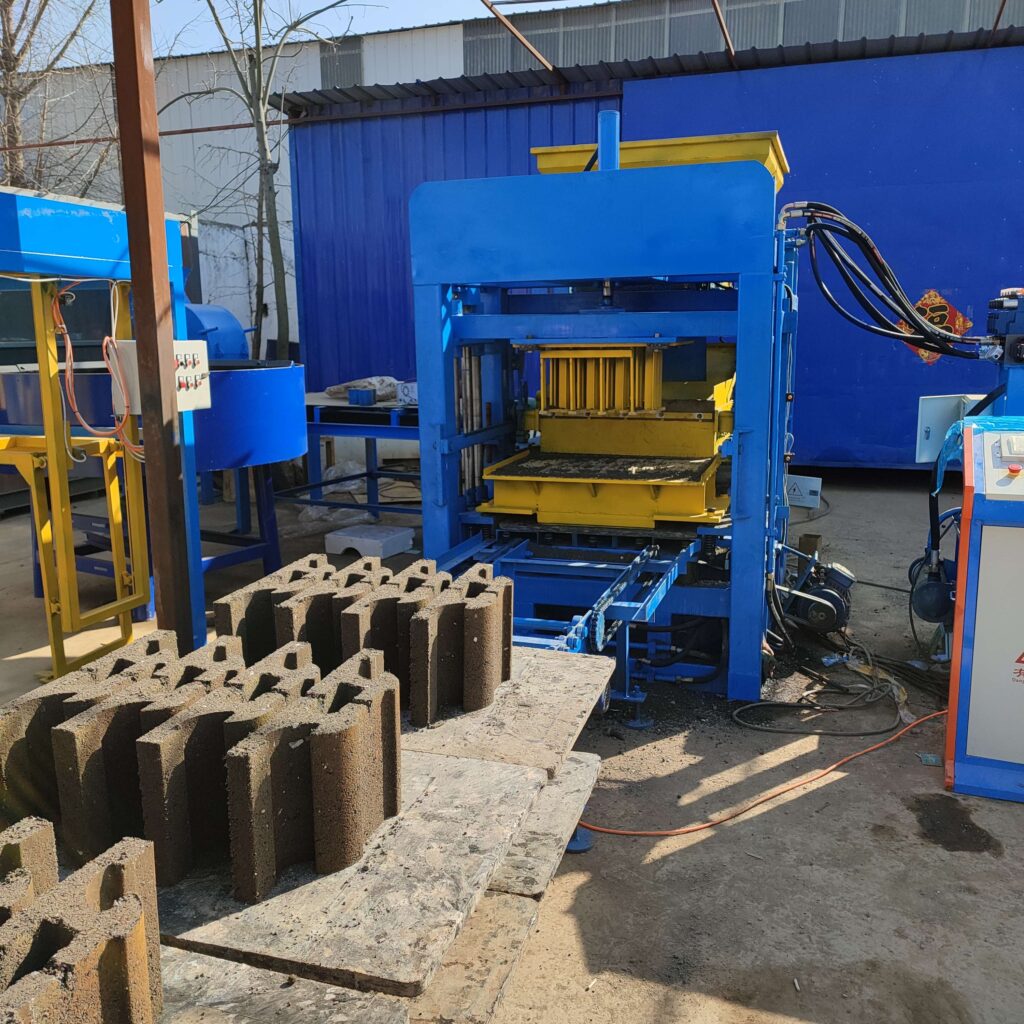
- Pressing (Clay and Concrete): This method offers direct control over density. The pressure applied by the hydraulic or mechanical press—often measured in hundreds of tons—compacts the material into the mold. A higher pressing force results in a denser, more tightly interlocked particle arrangement, yielding a significantly stronger final brick. This is why pressed bricks (e.g., engineering bricks, pavers) typically have higher minimum strength specifications than extruded facing bricks.
2.2. Moisture Content During Forming
- Optimum Moisture: There is a precise “sweet spot” for moisture content. For clay extrusion, it must be plastic enough to form without cracking but stiff enough to hold shape. For concrete pressing, it must be low (semi-dry) to allow for high compaction without water being forced out. Incorrect moisture is a primary cause of laminations, internal cracks, and reduced green strength, all of which propagate into the finished product.
3. The Conditioning Pillar: Drying and Curing
This phase removes water without inducing structural damage, preparing the brick for its final hardening.
3.1. Controlled Drying of Clay Bricks
- Rate of Drying: Rapid, uneven drying causes differential shrinkage, setting up internal stresses that manifest as cracks (sometimes microscopic). These cracks are fatal flaws that drastically reduce load-bearing capacity. A controlled, gradual drying cycle in humidity- and temperature-regulated chambers is essential to preserve the integrity of the green brick.
- Final Moisture Content: Bricks must enter the kiln with a uniformly low and consistent moisture content. High residual moisture turns to steam violently in the kiln, causing spalling or explosive cracking.
3.2. Scientific Curing of Concrete Bricks
- Curing Environment: Strength development in concrete bricks is a chemical process (hydration) requiring moisture and time. Curing in a controlled, high-humidity environment (steam rooms, fog tunnels) is not optional for high-strength products. It ensures the cement fully hydrates, developing a strong, continuous binding matrix. Ambient, uncontrolled curing leads to weak, dusty surfaces and inconsistent core strength.
- Curing Duration: The bricks must remain in the controlled environment long enough to achieve a significant percentage of their design strength before handling. Premature removal halts optimal strength development.
4. The Transformative Pillar: Firing or Curing
This is where permanent strength is locked in.
4.1. Firing of Clay Bricks: The Sintering Process
- Peak Temperature (Heat Work): Strength increases as the firing temperature rises towards the vitrification point, where clay particles begin to fuse. The temperature must be high enough and held long enough (soak time) to achieve the desired degree of sintering without causing deformation. Underfired bricks are weak and porous; overfired bricks may be brittle or distorted.
- Kiln Atmosphere and Uniformity: A modern tunnel kiln with precise temperature control throughout its length is essential. Hot spots or cold spots create batches of unevenly fired bricks with variable strength. Consistent heat work across all bricks in the kiln is a mark of a quality manufacturer.
4.2. Hardening of Concrete Bricks
- While primary curing gives early strength, the 28-day strength is the standard benchmark. This continued hardening relies on the internal moisture retained from the curing process or absorbed from the environment. Properly formulated and initially cured bricks will reliably achieve their specified strength over this period.
Conclusion: Strength as a Symphony of Controlled Variables
For the professional in the brick supply chain, compressive strength is the most reliable single indicator of overall quality. It is a symphony where every section—material science, mechanical engineering, and process control—must perform in harmony. A supplier focusing on just one aspect, such as high firing temperature, cannot compensate for poor raw material mix or inadequate compaction.
When auditing a potential supplier or investigating a strength-related issue, use the four-pillar framework:
- Композиція: Ask for mix designs and quality control logs for raw material testing.
- Формування: Inquire about machine pressures, the use of vacuum de-airing (for clay), and moisture control protocols.
- Conditioning: Tour the drying sheds or curing chambers. Look for control systems and consistency.
- Transformation: For clay, examine kiln firing curves and temperature uniformity data. For concrete, review steam curing schedules and 28-day test records.
A manufacturer that can articulate control strategies across all four pillars is a manufacturer that delivers predictable, high-performance products. This translates directly to your business as fewer call-backs, enhanced reputation for quality, and the ability to confidently supply projects with stringent structural requirements. In the end, specifying bricks with verifiable, well-engineered strength is not an added cost—it is the foundation of professional credibility and long-term success.
FAQ
Q1: Why do bricks from the same machine sometimes have variable strength?
A: True strength variation within a well-run batch should be minimal. Significant variability points to process inconsistency. Common causes include: uneven mixing leading to non-homogeneous material feed, fluctuations in forming moisture, temperature gradients in dryers or kilns, or uneven compaction pressure across a multi-cavity mold. This variability is a key quality red flag.
Q2: How does the brick’s finished texture (smooth, textured, frogged) affect its strength?
A: Surface texture has a negligible direct impact on the inherent compressive strength of the material itself. However, the process to create it can. For example, deep sand-facing or heavy wire-cutting after extrusion can create minor surface micro-cracks. A frog (indentation) reduces the cross-sectional area, so the load-bearing capacity of that individual brick is calculated on the net area. A deeply frogged brick will have a lower total load capacity than a solid brick of the same material, even if the material strength (psi or MPa) is identical.
Q3: We are sourcing bricks for a high-load application. Should we prioritize higher forming pressure or higher firing temperature?
A: For ultimate strength, forming pressure (density) is the primary driver, especially for clay bricks. A very dense green brick will achieve superior strength even at a slightly lower temperature than a less dense brick fired very high. The ideal, of course, is high density combined with optimal firing. For critical applications, specify pressed, high-density engineering bricks or concrete bricks with a proven high-strength mix design and curing regime.
Q4: Does a heavier brick always mean a stronger brick?
A: Not necessarily, but it is a strong correlate. Increased density (mass per unit volume) is a reliable indicator of higher strength, as it suggests better compaction and less porosity. However, weight can also be influenced by raw material type (e.g., iron-rich clay is heavier). Always verify with compressive strength test data rather than weight alone.
Q5: What is the single most telling question to ask a supplier about their strength quality control?
A: Ask: “What is your standard deviation for compressive strength test results across production batches, and how do you control the key variables (material mix, forming density, and firing/curing) to ensure it remains low?” This question reveals their depth of process control and statistical understanding, separating basic producers from true quality-focused manufacturers.