
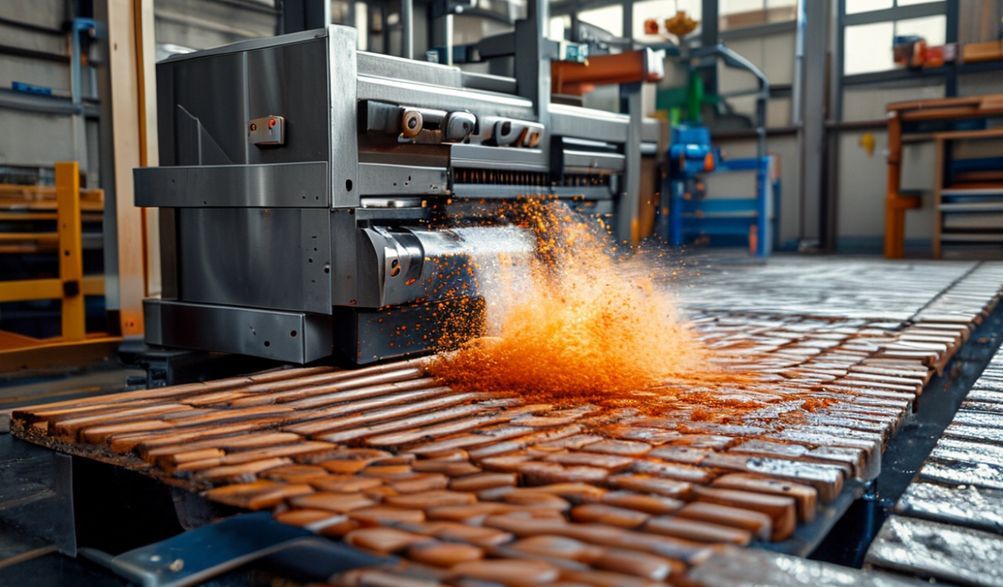
The Ultimate Guide to Brick Interlock Machines: Types, Benefits & How to Choose
Kirish
The global construction sector is projected to reach a staggering $15.2 trillion by 2030, driven by relentless urbanization and infrastructure development. In this landscape, the demand for efficient, durable, and aesthetically pleasing paving solutions has never been higher. Yet, for decades, contractors and builders have grappled with the limitations of traditional paving methods: labor-intensive processes, inconsistent product quality, and projects plagued by delays and budget overruns.
Enter the brick interlock machine—a technological leap that has revolutionized the production of interlocking concrete pavers. This isn’t just another piece of equipment; it’s the cornerstone of a modern, profitable, and quality-driven paving operation. This comprehensive guide, distilled from years of industry expertise and field experience, is designed to cut through the noise. Whether you’re a contractor looking to scale your business, a builder aiming for superior site results, or an entrepreneur entering the construction materials market, we will equip you with the knowledge to make a confident, informed decision. By the end of this guide, you will understand the core technology, the different types of machines available, their tangible benefits, and a step-by-step framework for selecting the perfect model for your specific needs.
What is a Brick Interlock Machine? The Core Technology Explained
At its heart, a brick interlock machine is a specialized piece of manufacturing equipment designed to produce interlocking concrete pavers (also known as interlocking bricks or blocks). Unlike standard bricks, these pavers have specially designed edges that “lock” together when installed, creating a stable, flexible, and load-bearing surface without the need for mortar.
Basic Working Principle: From Raw Material to Finished Paver
The process is a marvel of mechanical engineering, transforming a dry concrete mix into a precise, high-strength unit. While models vary, the core sequence remains consistent:
- Oziqlantirish: A pre-mixed concrete aggregate (stone, sand, cement, pigment) is loaded into the machine’s hopper.
- Oʻlchash va Qoliplash: The mix is fed into a mold box (or cavity) on a vibrating table. This mold defines the paver’s shape, thickness, and interlocking pattern.
- Siqish va Vibratsiya: This is the critical phase. The mold is subjected to intense hydraulic pressure (often measured in tons) and high-frequency vibration. This dual action forces out air pockets and compresses the material, ensuring maximum density and strength.
- Ejektsiya va quritish: The freshly formed, solid paver is ejected onto a wooden or steel pallet. These pallets are then moved to a curing area, where the pavers gain strength over several days before being ready for sale or installation.
Asosiy Komponentlar va Ularining Vazifalari
Understanding the machine’s anatomy is key to evaluating its quality and capability:
- Хоппер: Stores the raw material. Its size determines how often it needs refilling.
- Mold / Vibrating Table: The heart of customization. Interchangeable molds allow for different shapes (like herringbone, circle, or fan). The vibrating table ensures even distribution and compaction.
- Gidravlik Tizim: Provides the immense pressure needed for compaction. The system’s quality (pumps, cylinders) directly impacts machine reliability and paver density.
- Boshqaruv paneli: The operator’s interface. From basic manual levers to advanced PLC (Programmable Logic Controller) touchscreens for automating cycles and settings.
- Pallet System: The conveyor or feeder that supplies empty pallets to receive the ejected bricks, streamlining the production flow.
Types of Brick Interlock Machines: Finding Your Perfect Match
Selecting the right machine is not a one-size-fits-all decision. Your choice should be dictated by your production goals, budget, and operational context.
Qo'lda boshqariladigan vs. Yarim avtomatik vs. To'liq avtomatik mashinalar
- Qo'lda Boshqariladigan Mashinalar: Operated primarily by hand levers for feeding and compaction. They are the most affordable entry point but have low output (100-500 blocks per day) and require significant physical labor. Ideal for very small startups, community projects, or remote locations with limited power.
- Yarim avtomat mashinalar: Strike the best balance for most small to medium businesses. Key processes like vibration and compaction are powered (electric/hydraulic), but an operator is needed to feed material and remove finished pallets. Output ranges from 800 to 3000 blocks per 8-hour shift. They offer excellent quality with a manageable investment.
- To'liq avtomatik mashinalar: The pinnacle of efficiency. These systems integrate automatic material feeding, pallet circulation, and brick stacking. They require minimal human intervention, primarily for monitoring. Output can exceed 10,000 blocks per shift. The substantial investment is justified for large-scale factories or contractors with constant, high-volume demand.
Стационар ва мобил блок ишлаб чиқариш машиналари
- Statsionar mashinalar: These are heavy, industrial units installed in a fixed location, typically a factory or dedicated production yard. They are designed for maximum output, stability, and longevity. All raw materials must be transported to the machine.
- Mobil Mashinalar: Mounted on a trailer or wheels, these units can be driven directly to a construction site. This eliminates transport costs for finished bricks and allows for production exactly where the pavers are needed. While offering fantastic logistical advantages, they often have a slightly lower output than comparable stationary models.
By Output Capacity: Small, Medium, and High-Production Models
- Small-Scale (Up to 2,000 blocks/day): Perfect for landscaping businesses, small contractors, or entrepreneurs testing the market. Often semi-automatic or manual.
- Medium-Scale (2,000 – 8,000 blocks/day): The workhorse for growing paving companies and block manufacturers supplying local markets. Typically robust semi-automatic or entry-level automatic machines.
- High-Production (8,000+ blocks/day): The domain of fully automatic production lines. These supply large construction projects, municipalities, and distributors across regions.
Top 5 Benefits of Using a Professional Brick Interlock Machine
Investing in a professional-grade machine isn’t an expense; it’s a strategic move that delivers measurable returns across your operation.
Unmatched Efficiency & Increased Production Speed
A single semi-automatic machine can produce more high-quality pavers in one hour than a team of skilled laborers can create manually in a full day. This accelerated throughput allows you to take on more projects, meet tight deadlines, and improve cash flow.
Superior Consistency and Product Quality
Manual methods are vulnerable to human error, leading to variations in size, density, and color. A machine ensures every single paver is identical. This consistency is non-negotiable for professional installations, as it leads to a perfectly level surface, easier laying, and a flawless final appearance that builds your reputation.
Significant Reduction in Labor Costs and Physical Strain
By automating the most strenuous tasks—compaction and molding—you reduce your reliance on large, skilled labor crews. This translates directly to lower payroll costs and reduced exposure to workplace injuries associated with repetitive manual labor.
Design Versatility: Creating Various Patterns and Shapes
With a library of interchangeable molds, one machine can produce dozens of different paver styles. This allows you to offer clients a catalog of choices—from classic cobblestone to modern geometric designs—without investing in separate equipment for each type, making your business more agile and market-responsive.
Long-Term Cost-Effectiveness and ROI for Your Business
While the initial investment is higher than manual tools, the long-term economics are compelling. Consider the savings from reduced labor, waste, and rework, combined with the revenue from increased production capacity and the ability to command a premium for guaranteed quality. In practice, many businesses see a full return on investment within 12-24 months.
How to Choose the Right Brick Interlock Machine: A Buyer’s Checklist
Navigating the market requires a disciplined approach. Use this checklist to guide your evaluation.
Assess Your Project Requirements: Output, Paver Type, and Space
Start with the fundamentals. Be brutally honest about your:
* Daily/Weekly output needs (include a 20% growth buffer).
* Primary paver types (thickness, shape, complexity).
* Available space for the machine, raw materials, and curing area.
Key Technical Specifications to Scrutinize
Do not gloss over the technical sheet. Key metrics include:
* Bosim/Tonnaj: Higher tonnage (e.g., 150-ton vs. 80-ton) generally produces stronger, denser blocks suitable for vehicular traffic.
* Vibration Frequency & Amplitude: This affects compaction efficiency and surface finish. Look for a system with adjustable, balanced vibration.
* Motor quvvati: Indicates the machine’s overall capability and energy consumption.
* Sikl vaqti: How many seconds to produce one block? This directly calculates your maximum hourly output.
* Avtomatlashtirish Darajasi: Match this to your labor strategy and budget.
Quality of Construction: Materials, Brand Reputation, and Warranty
Inspect the build. Are critical frames and components made from reinforced steel? Research the manufacturer’s history and seek out third-party reviews or testimonials from existing users. A comprehensive warranty (at least 1 year on parts, longer on the frame) is a strong indicator of the manufacturer’s confidence in their product.
After-Sales Support: The Importance of Service and Parts Availability
Your relationship with the supplier begins after purchase. Ask directly:
* Is technical support available via phone or video?
* How quickly can replacement parts be shipped?
* Do they offer on-site installation or operator training?
* A machine is useless if a broken $50 component takes six weeks to arrive from overseas.
Budgeting: Understanding Total Cost of Ownership vs. Initial Price
The sticker price is just the beginning. Factor in:
* Shipping and installation costs.
* Costs for auxiliary equipment (mixer, pallets, forklift).
* Estimated costs of utilities (power) and routine maintenance.
* A slightly higher initial investment in a robust, supported machine often saves tens of thousands in downtime and repairs later.
Operational Best Practices and Maintenance Tips
A machine is a partner; treat it well, and it will serve you for years.
Essential Safety Protocols for Operators
- Always wear appropriate PPE: safety glasses, hearing protection, and steel-toe boots.
- Never bypass safety guards or interlocks.
- Ensure the machine is completely powered down and the hydraulic pressure is released before performing any cleaning or maintenance.
- Establish a clear lock-out/tag-out procedure.
Routine Daily and Weekly Maintenance Checklist
Daily:
* Clean the mold, hopper, and vibrating table of hardened concrete residue.
* Check hydraulic oil levels and look for leaks.
* Lubricate all moving parts as per the manual.
* Inspect pallets for damage.
Weekly/Monthly:
* Tighten all bolts and nuts (vibration can loosen them).
* Check the condition of vibration motors and hydraulic hoses.
* Clean or replace air filters on the hydraulic system.
Troubleshooting Common Issues
- Poor Compaction/Weak Bricks: Usually caused by an incorrect concrete mix (too dry or wrong ratios), insufficient vibration time, or low hydraulic pressure. Verify settings and mix design.
- Sticking in the Mold: Often due to a worn or damaged mold, insufficient mold release agent, or a mix that is too wet. Inspect the mold and adjust the mix.
- Uneven Color or Texture: Inconsistent raw material feeding or uneven vibration. Ensure the hopper is adequately filled and the vibrating table is level.
Optimizing Raw Material Mix for Best Results
The machine can only be as good as the material you feed it. A standard, high-quality mix for interlocking pavers includes:
* Sement: ASTM Type I or II.
* Agregatlar: A well-graded blend of coarse and fine aggregates (e.g., 1/4″ chip and concrete sand). They must be clean and dry.
* Water-Cement Ratio: Critical for strength. Aim for a low ratio (around 0.35-0.40) for a stiff, “no-slump” mix that holds its shape after compaction.
* Qo‘shimchalar: Consider pigments for color, and plasticizers or fly ash to improve workability and final strength without adding excess water.
Frequently Asked Questions (FAQ) About Brick Interlock Machines
Q: What is the average production capacity of a standard machine?
A: There is no true “standard,” as capacity varies wildly. A robust semi-automatic machine typically produces 1,000 to 1,500 blocks per 8-hour shift, depending on block size and operator speed. Always discuss your specific block dimensions with the manufacturer for accurate figures.
Q: Can one machine produce different sizes and shapes of interlocking bricks?
A: Absolutely. This is a key advantage. By purchasing and swapping out the mold (or mold inserts), a single machine can produce dozens of different paver designs, from standard rectangles to complex fan patterns.
Q: What is the typical lead time for setting up and starting production?
A: For a semi-automatic machine, a competent team can often have it unloaded, assembled, and producing test blocks within 2-3 days of arrival. Factor in additional time for site preparation, electrical hookup, and operator training.
Q: How much skilled labor is required to operate these machines?
A: For semi-automatic models, one or two general laborers can be trained to operate and manage production in a matter of days. Fully automatic lines require a technician with basic mechanical and electrical understanding for monitoring and troubleshooting.
Q: What are the most common mistakes first-time buyers make?
A: The top three are: 1) Underestimating their power and space requirements, 2) Choosing a machine based solely on lowest price, ignoring build quality and support, and 3) Not properly testing and optimizing their concrete mix design before full-scale production.
Q: How do I calculate the potential return on investment (ROI)?
A: A simplified formula: (Revenue from Pavers Sold – Cost of Materials, Labor, & Overhead) / Total Investment in Machine & Setup = ROI Timeframe. For example, if your net profit from the machine is $2,000 per week and your total investment was $40,000, your simple payback period would be 20 weeks. Most businesses also factor in intangible ROI like increased market share and reputation.
Xulosa
The decision to integrate a brick interlock machine into your operations is a decisive step toward modernizing your business, elevating your product quality, and securing a competitive edge. This technology directly addresses the core challenges of cost, consistency, and capacity that have long constrained the paving industry. As we’ve outlined, success hinges on moving beyond the initial price tag to consider the total value: the right machine type for your scale, built with quality components, and backed by a supplier who will be your partner for the long haul.
View this purchase not as a mere equipment buy, but as a foundational investment in the future growth and professionalism of your venture. The due diligence you perform today will pay dividends for years to come in the form of reliable production, satisfied clients, and a stronger bottom line.
Ready to discuss your specific project needs? Contact our team of experts for a personalized consultation and quote.
Want to dive deeper? Explore our video library to see our machines in action and download our free detailed specification sheet comparing top models.
<