
The Complete Guide to Cement Block Production: From Raw Materials to Finished Product
Kirish
Look around any city, town, or neighborhood. The foundations of our homes, the walls of our schools, and the structures of our commercial buildings are often built with a humble yet indispensable material: the cement block. Known technically as Concrete Masonry Units (CMUs), these blocks are the quiet workhorses of modern construction, prized for their strength, durability, and versatility.
This comprehensive guide is designed to demystify the process of cement block production. Whether you are a construction professional, a civil engineering student, an entrepreneur exploring a small-scale manufacturing business, or a dedicated DIY enthusiast, this resource aims to provide a clear, expert overview. We will bridge the gap between industrial-scale manufacturing principles and the practical considerations for smaller operations, all grounded in established engineering standards. By the end, you will have a firm understanding of the materials, machinery, processes, and quality controls that transform raw powder and stone into a foundational building block.
Understanding Cement Blocks: Types and Applications
To'g'ridan-to'g'ri kirishdan oldinqanday they are made, it’s crucial to understand nima they are and Nima uchun there are so many types.
What Are Cement Blocks (CMUs)?
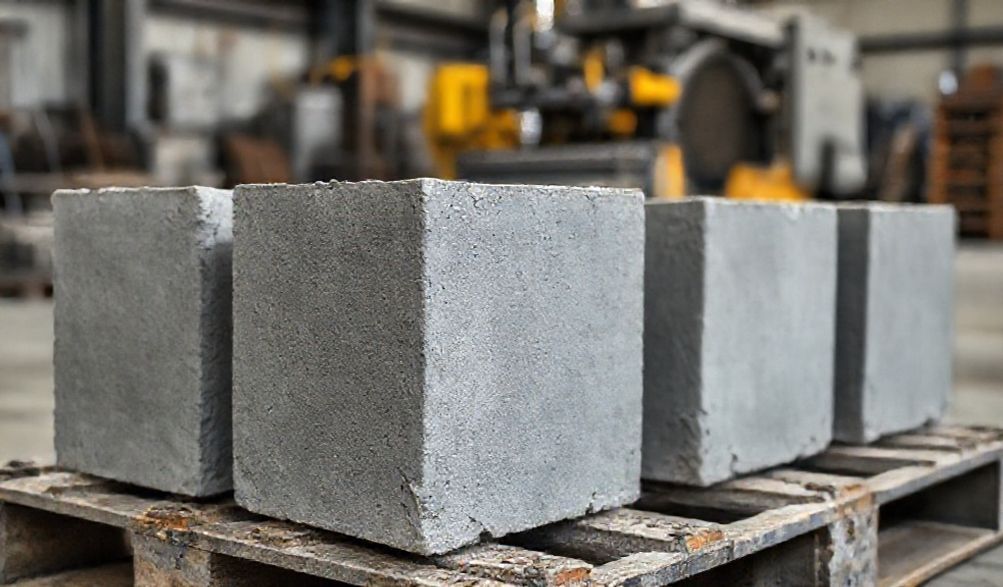
A Concrete Masonry Unit (CMU) is a precast building product made from a controlled mixture of Portland cement, aggregates (like sand and gravel), and water. It’s molded into standardized shapes and cured to gain strength.
- A Quick Clarification: The term “cinder block” is an outdated holdover from when industrial ashes (cinders) were used as aggregate. Modern “cement blocks” or “concrete blocks” do not contain cinders. Using the term CMU or concrete block is more accurate.
- Key Characteristics: Their popularity stems from inherent properties:
- Yuqori Siqilish Mustahkamligi: Ideal for load-bearing walls.
- Mustahkamlik va Uzoq Muddatli Xizmat Qilish: Resists weathering, rot, and pests.
- Yongʻin qarshiligi: Provides excellent fire ratings.
- Issiqlik Sig‘imi: Can absorb and slowly release heat, aiding in energy efficiency.
Common Types of Cement Blocks and Their Uses
Not all blocks are created equal. The mix design and molding process create blocks for specific applications.
- Standard Hollow Load-Bearing Blocks: The most common type. They have one or more hollow cores, which reduce weight, improve insulation, and allow for rebar and grout placement in structural walls. Used for foundations, exterior walls, and partition walls.
- Qattiq Bloklar: Dense, heavy blocks with no hollow cores. Used where maximum strength and sound insulation are needed, such as in security walls or heavy-duty paving.
- Yengil bloklar: Manufactured using lightweight aggregates like expanded clay, shale, or slate. They offer easier handling, better thermal insulation, and reduced dead load on structures, making them ideal for non-load-bearing partition walls and cladding.
- Aerated Autoclaved Concrete (AAC) Blocks: A different category made with a cement, lime, sand, and aluminum powder mixture that creates millions of tiny air bubbles. They are very light, easy to cut, and have superb insulation properties. Cured in a high-pressure steam autoclave.
- Paving Blocks & Interlocking Concrete Blocks: Dense, solid blocks designed for durability and aesthetics. Used for driveways, walkways, and retaining walls. Interlocking designs allow for installation without mortar.
Key Industry Standards and Specifications (ASTM, ISO)
To ensure safety and performance, block production adheres to strict standards. Referencing these builds authority and trust.
* ASTM C90: The standard specification for load-bearing concrete masonry units in the United States. It dictates minimum compressive strength, maximum water absorption, and dimensional tolerances.
* ASTM C129: Covers non-load-bearing concrete masonry units.
* ISO 9192: International standards for concrete masonry units.
* Compliance with these standards is non-negotiable for commercial production, guaranteeing builders receive a reliable, predictable product.
Raw Materials and Mix Design: The Foundation of Quality
The quality of a finished block is determined at the very beginning—with the selection and proportioning of raw materials.
Asosiy Komponentlar: Sement, Agregatlar va Suv
- Sement: The binding agent. Ordinary Portland Cement (OPC Type I) is most common. Portland Pozzolana Cement (PPC) is also used, offering improved workability and long-term strength.
- Agregatlar: Provide bulk, strength, and dimensional stability.
- Fine Aggregates: Typically clean, well-graded sand. Fills voids between larger particles.
- Coarse Aggregates: Crushed stone or gravel, usually between 1/4″ and 3/8″ in size. Provides the primary skeletal structure for strength.
- Suv: Must be clean and potable. Impurities can interfere with cement hydration and cause staining or weakening. The water-cement ratio is one of the most critical factors in the mix.
Additives and Admixtures: Enhancing Block Properties
These materials are added in small quantities to modify the fresh or hardened concrete’s properties.
* Color Pigments: Iron oxides for reds, browns, blacks; chromium oxide for greens. Added to the dry mix for integral coloring.
* Water Reducers/Plasticizers: Allow for a reduction in water content while maintaining workability, leading to a denser, stronger block.
* Accelerators/Retarders: Speed up or slow down the setting time, useful in extreme weather conditions.
* Air-Entraining Agents: Create microscopic air bubbles that provide resistance to freeze-thaw damage in cold climates.
Calculating the Perfect Mix Design
There is no single “perfect” mix; it’s a balance of requirements.
* The Critical Ratio: A typical starting mix by volume might be 1 part cement : 3-6 parts aggregate (combined fine and coarse), with just enough water to achieve a “semi-dry” or “no-slump” consistency. This low water content is key for the block to hold its shape immediately after molding.
* Factors Influencing the Design:
* Desired Strength: Higher cement content generally increases strength.
* Desired Density: More fine aggregate fills voids for denser blocks; lightweight aggregates reduce density.
* Sirt silliqligi: Mixes for smooth-faced blocks may have a higher proportion of fine sand.
* Izchillik Qirol: Precise, repeatable batching (by weight, not volume) is essential for producing uniform blocks with consistent performance.
The Cement Block Manufacturing Process: Step-by-Step
The transformation from raw mix to finished block is a fascinating sequence of precision and controlled force.
Stage 1: Batching and Mixing
This stage is about creating a uniform, homogeneous batch.
* Batching: In modern plants, computerized systems weigh each material component with high accuracy. Manual operations use calibrated weight batchers.
* Aralash: The dry aggregates and cement are blended first, then water is added. Common mixers include:
* Pan Mixers: Efficient for stiff, low-water mixes, ensuring all material passes through rotating stars or blades.
* Rotary Drum Mixers: Suitable for larger batches.
* The goal is a consistent color and texture where every particle of aggregate is coated with cement paste.
Stage 2: Molding and Compaction
This is where the block gets its shape and density.
* The Block Machine: A vibratory press is the heart of production. The semi-dry concrete mix is fed into a mold box on a steel pallet.
* Vibration and Pressure: The mold is subjected to intense high-frequency vibration (often over 10,000 RPM) simultaneously with hydraulic or mechanical pressure from above. This dual action forces air out, consolidates the mix, and packs the particles tightly together, creating a dense, strong block that can be immediately demolded.
* Mashina Turlari: Stationary plants produce blocks at a fixed location, where pallets are moved to curing. Mobile block machines (like egg-layers or traveling machines) move along a concrete slab, depositing blocks directly on the curing floor.
Stage 3: Curing – The Key to Strength Development
Curing is not just drying; it’s the controlled process of maintaining moisture and temperature to allow the cement to fully hydrate and gain strength.
* Why It’s Critical: Proper curing can more than double the block’s final strength compared to poorly cured blocks. It prevents cracking from premature moisture loss.
* Common Methods:
* Steam Curing (Kiln Curing): The most efficient for high-volume production. Fresh blocks on racks are rolled into a curing chamber where they are exposed to controlled steam heat (140-180°F) for 12-24 hours. This accelerates strength gain.
* Suv bilan davolash: Blocks are sprinkled with water or immersed in tanks for several days.
* Membrane Curing: Spraying with a liquid compound that forms a moisture-retaining film.
* Blocks are typically kept in a controlled environment for 3-7 days before being moved to storage, with full design strength reached at 28 days.
Stage 4: Cubing, Storage, and Palletizing
The final steps prepare blocks for shipment.
* Cubing: Automated equipment stacks blocks into stable cubes (e.g., 10 blocks high x 5 blocks wide x 2 blocks deep) on wooden pallets.
* Storage & Palletizing: Cubed blocks are moved with forklifts to a storage yard, where they continue to cure and await dispatch. Proper storage keeps blocks clean and protected from the elements.
Essential Machinery for Block Production
The right equipment defines capacity, quality, and operational efficiency.
Core Equipment: Block Making Machines
- Qo'lda Boshqariladigan Mashinalar: Simple lever-operated presses for very small-scale or DIY use. Output is low, and compaction is less effective.
- Yarim avtomat mashinalar: Operator feeds mix and initiates cycles, but molding, compaction, and ejection are machine-powered. Good balance of output and cost for small businesses.
- To'liq avtomatik mashinalar: Computer-controlled, with auto-feeding, molding, cubing, and palletizing. One operator can manage high output (thousands of blocks per shift). The industry standard for commercial plants.
Supporting Equipment for Efficiency
- Concrete Mixers: Sized appropriately for the block machine’s production rate.
- Konveyer tasmalari: Transport raw materials and fresh mix.
- Forklifts & Pallet Jacks: For material and finished product handling.
- Curing Racks/Chambers: Essential for implementing a proper steam or mist curing system.
Maintenance and Safety Protocols for Machinery
- Maintenance: Daily greasing of bearings, checking hydraulic fluid and vibrator mounts, and ensuring mold liners are clean and undamaged prevents downtime and ensures dimensional consistency.
- Safety: Operators must be trained on lockout/tagout procedures, wear hearing protection (vibration is loud), safety glasses, and steel-toed boots. Guards on all moving parts are mandatory.
Quality Control and Testing in Block Production
Robust QC is what separates a professional operation from an amateur one.
In-Process Quality Checks
- Xom ashyolar: Regular sieve analysis of aggregates, checking cement freshness.
- Mix Consistency: Monitoring the weight and moisture content of each batch.
- O'lchov aniqligi: Periodically checking freshly molded blocks with calipers against ASTM tolerances (typically ±1/8″ in dimension).
Standardized Tests for Finished Blocks
Samples from a production run are tested, often in an on-site lab.
* Compressive Strength Test (ASTM C140): Blocks are capped and crushed in a press. This is the primary performance indicator (e.g., 1900 psi net area compressive strength for ASTM C90).
* Water Absorption Test: Blocks are dried, weighed, immersed in water for 24 hours, and weighed again. Lower absorption indicates a denser, more durable block.
* Density Test: Determines the weight per cubic foot, classifying blocks as lightweight, medium, or normal weight.
* Dimensional Tolerance Check: Verifies blocks meet the specified length, height, and width.
Interpreting Test Results and Ensuring Compliance
Test results are logged against each batch. Consistent passing results build a reputation for reliability. Failure triggers an investigation into mix design, compaction, or curing processes. Meticulous record-keeping provides traceability and is a cornerstone of operational trustworthiness.
Starting a Small-Scale Cement Block Business
For the entrepreneur, block production can be a viable local business.
Feasibility and Market Analysis
- Demand: Assess local construction activity. Are there housing developments, commercial projects, or a culture of using blocks for fencing and outbuildings?
- Competition: Analyze existing block yards. Can you compete on quality, service, or location?
- Raw Material Sourcing: Secure reliable, cost-effective suppliers for cement, sand, and stone within a short hauling distance.
Basic Setup, Cost Estimation, and ROI
- Sozlamalar You’ll need a leased or owned plot of land (for storage and curing), a simple shed for the machine and mixer, and a level concrete casting yard.
- Costs (Varies Widely by Region):
- Machinery (Semi-auto machine & mixer): $15,000 – $50,000+
- Land & Shed Development: Variable.
- Raw Material Initial Stock: $5,000 – $10,000.
- Forklift/Pallet Jack: $5,000 – $15,000 (used).
- ROI: Calculate your cost per block (materials + labor + overhead) versus the local selling price. A semi-automatic plant producing 2000 blocks per day can often show a positive ROI within 12-18 months with consistent sales.
Common Challenges and Solutions for New Producers
- Low Strength Blocks: Likely due to incorrect water-cement ratio, insufficient compaction/vibration, or poor curing. Revisit and strictly control the fundamentals.
- Poor Surface Finish: Can be caused by worn mold liners, a mix that is too wet or too dry, or inadequate release agent.
- Marketing: Build relationships with local masons, contractors, and hardware stores. Offer sample blocks. A reputation for consistent quality and on-time delivery is your best advertisement.
Frequently Asked Questions (FAQ) About Cement Block Production
Q: What is the difference between cement blocks and concrete blocks?
A: Practically, the terms are used interchangeably. Technically, “cement” is just one ingredient. “Concrete block” is the more accurate term, as the block is made from concrete—a composite of cement, aggregates, and water.
Q: What is the ideal curing time for cement blocks before use?
A: While blocks gain enough “handling strength” to be moved in 24-48 hours, especially with steam curing, they should not be built into a load-bearing structure until they reach most of their design strength. For critical applications, the standard 28-day curing period is recommended before subjecting them to full design load.
Q: Can I produce cement blocks manually without expensive machinery?
A: Yes, for a very small project like a garden wall, you can use single-cavity plastic or steel manual molds. However, achieving consistent density and strength is extremely difficult without mechanical vibration. Output is also very slow compared to even a basic machine.
Q: How do I calculate the number of blocks needed for a project?
A: 1. Calculate the wall’s total square footage. 2. Find the square footage of one block face (including the mortar joint). For a standard 8″x16″ block with a 3/8″ mortar joint, the face area is about 0.89 sq ft. 3. Divide the wall area by the block area. 4. Add 5-10% for waste and cuts.
Q: What are the most common causes of cracks in fresh blocks?
A: The main culprits are: 1) Excess Water: Causes shrinkage cracks as the block dries. 2) Inadequate Compaction: Leaves a weak structure prone to cracking. 3) Improper Handling: Moving or stacking blocks before they have sufficient strength. 4) Rapid Drying: Failing to cure properly, which stops hydration.
Xulosa
The journey from raw, quarried materials to a precisely formed, high-strength cement block is a testament to applied material science and mechanical engineering. Each stage—from meticulous mix design and forceful compaction to controlled curing and rigorous testing—plays a non-negotiable role in determining the final product’s performance. Successful production is not an art but a science, relying on technical expertise, disciplined processes, and an unwavering commitment to quality control.
Well-manufactured cement blocks are more than just building components; they are the foundation for durable, safe, and sustainable structures that last for generations. If you are inspired to take the next step, whether for a personal project or a commercial venture, we strongly recommend consulting with local material suppliers and equipment manufacturers. They can provide specific guidance tailored to your region’s materials and market conditions.
Disclaimer: This guide is for informational and educational purposes. Specific mix designs, production processes, and product specifications must be developed in compliance with all local building codes, regulations, and under the guidance of qualified professional engineers.
<