
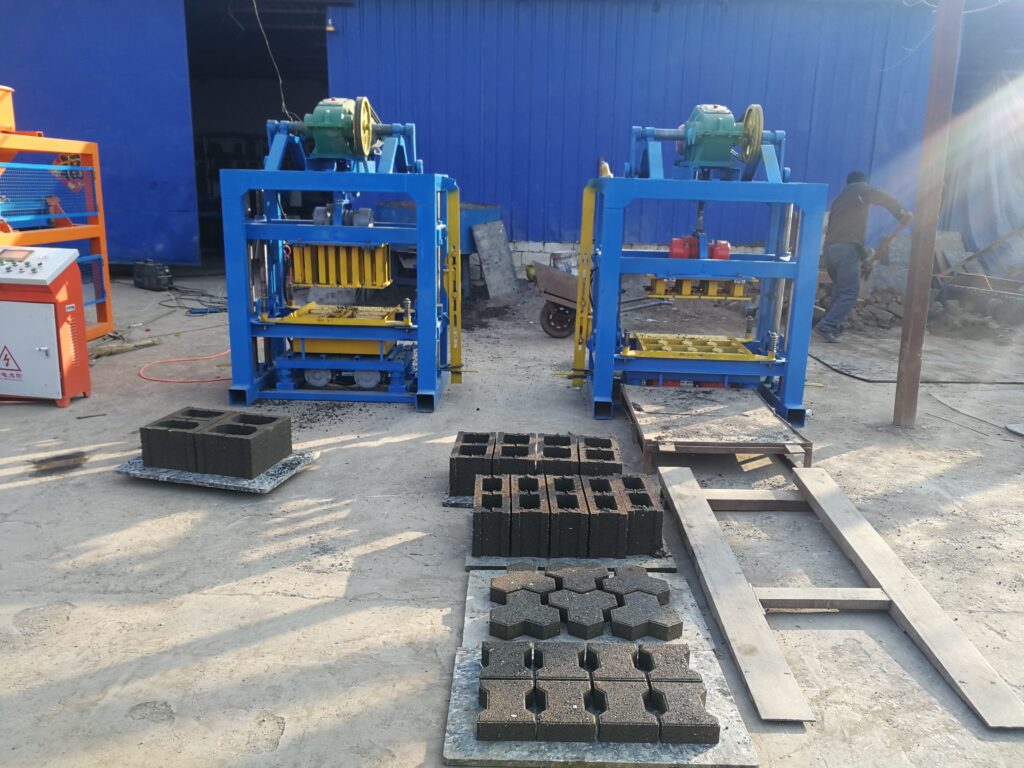
Phân tích tài chính so sánh về lợi nhuận đầu tư giữa máy gạch thủ công và máy gạch tự động
手动和自动砖机之间的投资回报率(ROI)对比,代表任何进入或扩展该行业的企业都面临的一个关键战略抉择。本分析超越简单的回收期,深入探讨资本密集度、运营可扩展性、劳动力经济学和市场定位之间微妙的相互作用。理解这些财务动态对于提供咨询指导至关重要,能帮助客户将其资本、产能和长期目标与合适的技术解决方案相匹配。
Định Nghĩa Các Mô Hình Đầu Tư và Lợi Nhuận
ROI trong bối cảnh này đo lường hiệu quả của vốn đầu tư vào máy móc bằng cách so sánh lợi nhuận ròng từ khoản đầu tư đó với chi phí ban đầu. Tuy nhiên, bản chất của 'lợi nhuận' khác biệt đáng kể giữa hai mô hình.
- Lợi ích đầu tư từ máy thủ công: Mô hình Sinh kế và Doanh nghiệp Siêu nhỏ
- Đầu tư:Chi phí vốn ban đầu rất thấp. Về cơ bản, chi phí chỉ là giá của chiếc máy ép vận hành bằng tay.
- Triết học Quy hồiROI được tính toán trên cơ sởbổ sung lao động thủ công bằng một công cụ đơn giảnLợi nhuận được đo lường bằng thu nhập tăng thêm so với phương pháp đúc thủ công truyền thống, phụ thuộc nhiều vào nỗ lực thể chất không ngừng nghỉ của người vận hành. Trọng tâm là tạo ra dòng tiền ngay lập tức, ít rủi ro với mức nợ tối thiểu.
- Tự động hóa ROI của Máy móc: Mô hình Tài sản Vốn Công nghiệp
- Đầu tư:大量资本支出,涵盖机器设备、通常的辅助设备(搅拌机、输送机)以及场地准备。
- Triết học Quy hồiROI được tính toán trên cơ sở用持续、高容量的自动化生产取代并倍增人力劳动。Lợi nhuận được thúc đẩy bởi lợi thế kinh tế nhờ quy mô, chi phí trên mỗi đơn vị thấp hơn và khả năng giành được các hợp đồng lớn hơn. Trọng tâm là xây dựng giá trị tài sản và vốn chủ sở hữu kinh doanh theo thời gian.
The Manual Machine ROI Calculation: Factors and Limitations
The financial profile of a manual operation is characterized by low barriers to entry but tightly constrained scalability.
- Key Investment (Cost) Factors:
- Machine Purchase Price: The primary and often sole capital cost.
- Minimal Tooling: Basic molds.
- Negligible Infrastructure: Can operate in a small, open shed or even outdoors.
- Key Return (Revenue) and Profit Factors:
- Extremely Low Output: Production is limited to a few hundred bricks per day per operator, heavily influenced by fatigue.
- High Variable Labor Cost Percentage: While absolute wages may be low, labor constitutes the overwhelming majority of the cost per brick.
- Inconsistent Quality and Low Product Value: Bricks often fail to meet formal engineering standards, limiting market options to informal, low-price segments.
- Vulnerability to Market Fluctuations: With no scale or cost advantage, the operation is a price-taker with thin, volatile margins.
- Sample ROI Scenario (Manual):
- Đầu tư: $1,500 (machine).
- Daily Net Profit (after material & labor): $15 (highly optimistic, assuming consistent labor).
- Annual Operating Days: 250.
- Annual Net Profit: $3,750.
- Simple Payback Period: ~5 months. ROI (Year 1): 250%.
- Analysis: The ROI percentage appears spectacularly high due to the tiny capital base. However, the absolute annual profit ceiling is low ($3,750), and it is entirely dependent on one operator’s continuous labor. There is no path to grow profits without linearly adding more manual machines and laborers.
The Automatic Machine ROI Calculation: A Systems-Based Approach
The financial profile of an automatic operation requires a business plan, with higher risk but a fundamentally higher profit ceiling.
- Key Investment (Cost) Factors:
- Machine System Price: From $50,000 to $200,000+ for a full line.
- Thiết bị phụ trợ: Mixer, conveyor, pallets, stacker – can be 30-50% of machine cost.
- Infrastructure: Cost of a proper shed, concrete foundation, three-phase power installation.
- Working Capital: Funds for raw material inventory, labor payroll before customer payment.
- Key Return (Revenue) and Profit Factors:
- High, Consistent Output: Thousands of bricks per shift, unaffected by operator fatigue.
- Low Variable Cost per Unit: Economies of scale in material purchasing and drastically reduced labor content per brick.
- High and Consistent Quality: Enables access to commercial, government, and contractor markets where specifications and volume are required, commanding higher prices.
- Business Value Appreciation: The operation evolves from a labor-centric activity to a saleable industrial asset with a customer base and reputation.
- Sample ROI Scenario (Automatic – Medium Scale):
- Total Capital Investment: $100,000 (machine & basic auxiliaries).
- Daily Production: 5,000 standard blocks.
- Net Profit per Block: $0.05 (lower margin per unit but massive volume).
- Annual Operating Days: 250.
- Annual Net Profit: $0.05 * 5,000 * 250 = $62,500.
- Simple Payback Period: ~1.6 years. ROI (Year 1): 62.5%.
- Analysis: The ROI percentage is lower than the manual example, but the absolute annual profit is over 16 times greater. After the payback period, the $62,500+ annual profit is largely liberated from direct labor constraints, representing a transformative return on the invested capital.
Strategic Comparative Analysis: Beyond the Numbers
The choice is not merely financial but strategic, reflecting the client’s vision and context.
- Labor Economics and Scalability
- Hướng dẫn sử dụng: Profits scale linearly with the number of laborers and machines. Growth means managing more people, not building a system.
- Tự động: Profits scale with machine utilization and market demand. Growth involves optimizing a system, potentially adding shifts or additional automated lines, leveraging the same core team.
- Market Access and Risk Profile
- Hướng dẫn sử dụng: Serves a limited, price-sensitive local market. High risk from labor unavailability or health issues of key individuals.
- Tự động: Can compete for institutional contracts, supply construction companies, and build a brand. Risk shifts from labor dependency to market demand, operational expertise, and maintenance of complex equipment.
- The “Sweat Equity” vs. “Financial Equity” Trade-off
- A manual machine requires the investor’s (or hired worker’s) continuous sweat equity to generate returns. The machine itself has little residual value.
- An automatic machine requires significant financial equity upfront but then builds business equity. The ongoing “sweat” is managerial and technical, not physical. The asset retains significant value.
The Bridging Role of Semi-Automatic Machines
Financially and operationally, semi-automatic machines occupy the middle ground. They offer a meaningful step up in output and labor productivity from manual machines, with an investment cost significantly below a full automatic line. Their ROI profile often presents the most attractive and manageable risk-reward balance for a small to medium enterprise (SME) seeking to professionalize and grow, serving as a critical stepping stone toward full automation.
Conclusion
The ROI comparison between manual and automatic brick machines is a tale of two fundamentally different business philosophies. The manual machine offers a path to self-employment and immediate, labor-bound cash flow with minimal capital risk. Its high ROI percentage is a function of its tiny capital base, not its potential for wealth creation. In contrast, the automatic machine represents a strategic capital investment in a scalable manufacturing business. Its lower initial ROI percentage belies its vastly higher absolute profit potential and its capacity to build enduring enterprise value.
For the distributor, the critical role is to guide the client through this strategic self-assessment. Key questions include: Is the goal a personal livelihood or building a company? What is the access to and cost of skilled versus unskilled labor? What is the scale and quality requirement of the target market? By moving the conversation from a simplistic “which pays back faster?” to a holistic analysis of “which builds the future you want?”, the distributor acts as a true business advisor. This ensures the chosen machinery becomes not just a purchased asset, but the correct engine for the client’s defined version of success, whether that is sustainable personal income or scalable industrial growth.
Các Câu Hỏi Thường Gặp (FAQ)
Q1: Can a manual machine ever generate a higher total profit than an automatic machine?
A: In theory, only through implausible scaling. To match the $62,500 annual net profit in our automatic example, a manual operation would need approximately 17 machines and 17 full-time, consistently productive operators (each generating $3,750 profit). The management complexity, space, and sheer operational chaos of this scenario make it economically and practically infeasible. The automatic machine achieves this profit in a controlled, system-based manner with 2-4 personnel.
Q2: How sensitive is automatic machine ROI to fluctuations in production volume?
A: It is highly sensitive due to high fixed costs (depreciation, loan interest, salaried staff). A 20% drop in production volume does not lead to a 20% drop in costs, so profits can fall disproportionately. This is the key financial risk. Manual operations, with their low fixed costs, have profit that falls more linearly with reduced output. Therefore, securing consistent market demand is the paramount requirement for achieving the projected ROI on an automatic system.
Q3: Does the higher ROI of a manual machine make it a “better” investment?
A: Not necessarily. “Better” is defined by the investor’s objectives. If the objective is to deploy a very small amount of capital to create a job, the manual machine can be an excellent tool. If the objective is to build a business with significant profit potential and asset value, the manual machine is a dead end. The high ROI percentage is a metric of capital efficiency on a small scale, not an indicator of superior wealth-building potential.
Q4: How do financing costs impact the ROI comparison?
A: They dramatically widen the strategic gap. A manual machine can often be purchased with cash. Financing a $100,000 automatic line adds substantial interest expense, extending the payback period and reducing net profit in the early years. This makes the initial ROI calculation for the automatic machine less attractive. However, if the financed automatic line enables the business to capture large, profitable contracts that would otherwise be impossible, the long-term value creation still justifies the cost of capital. The business case must be strong enough to service the debt and still generate attractive equity returns.
Q5: What is the single most important financial metric to watch after making an automatic machine investment?
A: Cost per Thousand Bricks (or Blocks). This metric synthesizes all operational efficiency: material waste, labor productivity, energy use, and machine uptime. Continuously driving this cost down while maintaining quality and volume is the direct operational lever that maximizes ROI. For a manual operation, the equivalent metric is essentially the daily wage divided by output, which is far more difficult to improve systematically.
