
Hướng Dẫn Toàn Diện Về Máy Ép Gạch Block: Các Loại, Công Dụng và Cách Lựa Chọn
Hãy tưởng tượng bạn là một nhà thầu, đang nhìn chằm chằm vào một lịch trình dự án đang trượt dốc từng ngày. Đội ngũ lao động đang làm việc hết tốc lực, nhưng việc lát gạch thủ công cho một khu thương mại rộng lớn là cuộc đua với thời gian và ngân sách. Hoặc có lẽ bạn là một nhà phát triển, đang tính toán chi phí hậu cần khủng khiếp của việc vận chuyển hàng nghìn viên gạch lát đến một địa điểm xa xôi. Có một cách tốt hơn. Giải pháp chuyển đổi biến những kịch bản căng thẳng này thành những hoạt động tinh gọn và có lợi nhuận chính làmáy lát gạch block.
Hướng dẫn toàn diện này được thiết kế để trở thành tài liệu tham khảo hàng đầu của bạn. Chúng tôi sẽ vượt ra ngoài những tài liệu quảng cáo bán hàng để cung cấp cái nhìn khách quan, chuyên sâu về máy ép gạch block, dựa trên các nguyên tắc kỹ thuật và ứng dụng thực tế. Dù bạn là chủ doanh nghiệp xây dựng đang mở rộng quy mô, kỹ sư xây dựng dân dụng yêu cầu thiết bị cụ thể, quản lý dự án tối ưu hóa chi phí, hay người đam mê tự làm đang thực hiện dự án quy mô lớn, hướng dẫn này sẽ giúp bạn tự tin hành động. Chúng tôi sẽ phân tích các loại máy, đi sâu vào các phương pháp vận hành tốt nhất và cung cấp khuôn khổ rõ ràng để đưa ra quyết định đầu tư sáng suốt và có lợi nhuận nhất.
Máy ép gạch block là gì? Chức năng cốt lõi và tác động ngành
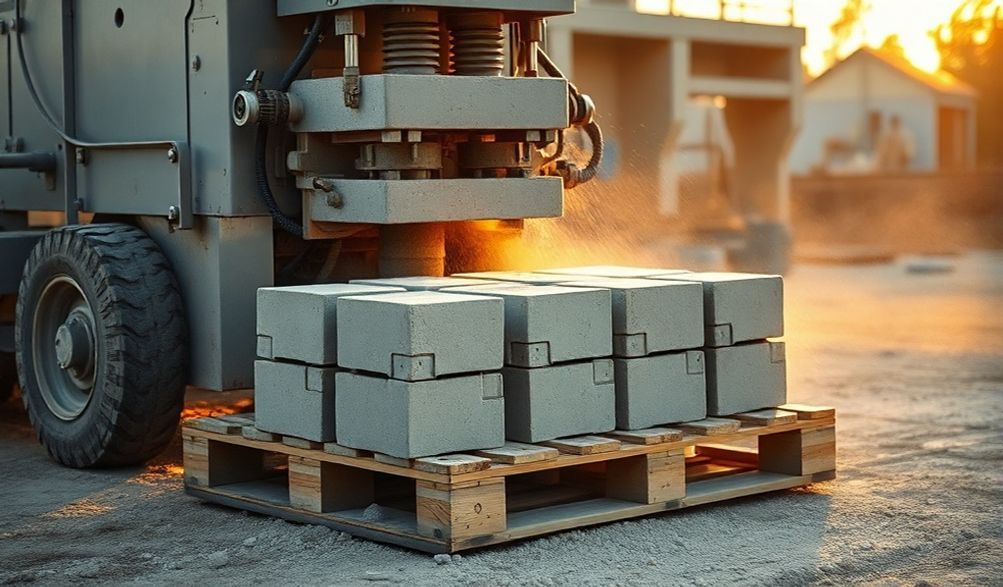
Về bản chất, máy gạch block là một kỳ quan của kỹ thuật công nghiệp, tự động hóa quá trình sản xuất các đơn vị xây dựng bằng bê tông. Nó biến hỗn hợp nguyên liệu thô gồm cát, cốt liệu, xi măng và nước thành các viên gạch lát, đá vỉa hè, tấm lát cảnh quan và các khối tường chắn đồng nhất, có cường độ cao thông qua quy trình nén và đúc khuôn có kiểm soát.
Định nghĩa máy móc: Từ nguyên liệu thô đến gạch lát hoàn thiện
Chiến dịch, dù được thực hiện tinh vi, vẫn tuân theo một trình tự logic:
1. Cho ăn:Hỗn hợp nguyên liệu thô đã chuẩn bị được nạp vào phễu của máy.
2. Nén chặt: This is the heart of the process. The mix is fed into a mold cavity (or multiple cavities on a pallet). A combination of high-frequency vibration and substantial hydraulic pressure forces out air pockets and compresses the material.
3. Đúc khuôn The compacted material takes the precise shape of the mold, which can be designed for countless patterns—interlocking, hexagonal, cobblestone, etc.
4. Đẩy ra: The freshly formed, semi-solid block is ejected onto a pallet or conveyor belt, ready for curing.
This mechanized cycle ensures every block has consistent dimensions, density, and structural integrity, which is nearly impossible to achieve with manual methods.
The Evolution of Paving: From Hand-Laying to Automated Production
The shift from manual, artisanal paving to mechanized production represents a fundamental leap in construction efficiency. Traditional methods were not only slow and labor-intensive but also prone to inconsistencies in size and strength. The modern máy lát gạch block has become the indispensable backbone of infrastructure and hardscape projects worldwide. It directly addresses the critical needs of our time: faster project completion, reduced reliance on volatile labor markets, superior product quality, and significant cost control over the long term.
Types of Block Paver Machines: Finding the Right Fit for Your Project
Choosing the wrong type of machine can shackle your productivity. Understanding these categories is the first critical step in aligning technology with your business goals and project demands.
Máy Sản Xuất Gạch Block Cố Định
- Mô tả: These are industrial powerhouses. Designed for fixed installation in a factory or dedicated production yard, they are built for maximum output and often integrate with automated conveyor systems, batching plants, and curing racks.
- Tốt Nhất Cho: Large-scale manufacturers supplying to distributors and retailers, major infrastructure projects with a dedicated on-site production plant, or businesses focusing on exporting blocks.
- Ưu điểm & Nhược điểm:
- Ưu điểm: Highest possible production capacity (often thousands of blocks per hour); highest degree of automation; superior consistency; designed for continuous, heavy-duty operation.
- Nhược điểm: Very high initial capital investment; requires significant, permanent space and infrastructure (like a strong concrete foundation and power supply); no mobility.
Máy Đúc Khối Di Động
- Mô tả: Also known as mobile block factories, these units are mounted on trailers or robust wheeled frames. They bring production directly to the job site.
- Tốt Nhất Cho: Remote housing developments, road construction projects in rural areas, or any situation where transporting finished blocks over long distances is cost-prohibitive. Ideal for medium-scale contractors who move between sites.
- Ưu điểm & Nhược điểm:
- Ưu điểm: Eliminates or drastically reduces transport costs for finished goods; provides incredible logistical flexibility; faster project startup.
- Nhược điểm: Generally has a lower output than comparable stationary models; requires on-site organization for raw materials and block curing; may have limitations on full automation.
Máy Thủ Công, Bán Tự Động và Tự Động Hoàn Toàn
This spectrum defines the level of human intervention required.
Máy Móc Thủ Công
The operator controls most steps: manually feeding material, activating the vibration, and removing the finished block. These are entry-level machines.
* Tốt Nhất Cho: Micro-enterprises, very small startups testing the market, or specific, low-volume specialty products.
* Yếu Tố Quan Trọng Cần Xem Xét: Output is directly tied to operator skill and stamina.
Máy Bán Tự Động
This is the sweet spot for many small-to-medium enterprises (SMEs). Key processes like compaction, vibration, and ejection are automated, but the machine may require manual feeding of raw material or manual removal of pallets.
* Tốt Nhất Cho: Growing businesses looking to scale production without the capital outlay for full automation. They offer an excellent balance of productivity, affordability, and flexibility.
* Yếu Tố Quan Trọng Cần Xem Xét: Significantly increases output over manual machines while keeping operational complexity and cost manageable.
Máy Móc Hoàn Toàn Tự Động
These are the pinnacle of automated production. Computer-controlled systems manage the entire cycle—from raw material feeding and precise mix distribution to compaction, pallet handling, and stacking. Robotic arms often place blocks on curing racks.
* Tốt Nhất Cho: Large-scale industrial production where labor costs must be minimized and output, consistency, and efficiency are paramount.
* Yếu Tố Quan Trọng Cần Xem Xét: Represents the highest investment and requires skilled technicians for maintenance and programming.
Key Features and Specifications to Analyze Before You Buy
Looking past the marketing requires a focus on these technical specifications. They determine your machine’s capability, output quality, and long-term viability.
Production Capacity: Blocks Per Hour (BPH) and Cycle Time
Don’t just look at the theoretical maximum BPH. Understand the thời gian chu kỳ—the time to produce one mold of blocks—and how many blocks per cycle the mold produces. A machine with a 15-second cycle time and a 10-block mold has a different output than one with a 10-second cycle and a 4-block mold. Match this to your thực tế daily production goals, not just peak dreams.
Pressure and Vibration System: The Heart of Block Strength
The durability of a paver block is a direct result of its density. This is achieved through:
* Áp suất thủy lực: Measured in tons or kilonewtons (kN), this static pressure compacts the mix. Higher pressure generally leads to denser, stronger blocks suitable for heavy traffic (e.g., industrial yards vs. pedestrian walkways).
* Vibration Frequency: Measured in Hertz (Hz) or RPMs, high-frequency vibration causes particles to settle and lock together tightly, eliminating voids. A balanced combination of ample pressure and optimal vibration is non-negotiable for quality.
Mold Versatility and Changeover Time
Your ability to adapt to market demands hinges on molds. Key questions to ask:
* What range of standard mold sizes and shapes does the supplier offer?
* Can they produce custom molds for unique designs?
* How long does it take to change molds? A machine that requires 4 hours for a changeover loses a half-day of production. Systems with quick-change mold frames offer a significant business advantage.
Power Source: Electric, Diesel, or Hybrid
- Điện: Cleaner, quieter, and lower operating cost per hour. Essential for indoor factories. Requires a reliable, high-capacity grid connection.
- Đi-ê-zen Offers complete independence from the power grid. Crucial for remote mobile operations. Higher fuel costs, requires ventilation, and has emissions.
- Lai tạo: Some mobile units offer the flexibility to run on either grid power or an onboard diesel generator, providing optimal site adaptability.
Operational Best Practices and Maintenance for Longevity
A common pitfall is investing in the machine but neglecting the process that feeds it and the maintenance that preserves it. Here’s the practical knowledge gained from the field.
Raw Material Preparation: The Foundation of Quality Blocks
The machine can only work with what you give it. A poor mix leads to weak blocks, machine wear, and constant headaches.
* Aggregate Gradation: Use a well-graded mix of fine and coarse sand/aggregate. Too much fine material can slow drainage and reduce strength; too much coarse material can lead to a rough finish and poor interlock.
* Cement Ratio: Follow a proven mix design (e.g., a standard 1:6 or 1:7 cement-to-aggregate ratio for pavers). Consistency is key.
* Độ Ẩm This is critical. The mix must be damp, not wet or dry. A simple “ball test”—where a handful of mix clumps together without dripping water—is a reliable field check. Incorrect moisture is the #1 cause of production issues for new operators.
Daily Operation and Safety Protocols
Startup: Check oil levels, inspect for loose parts, ensure the mold area is clear.
Running: Monitor the mix consistency and block formation. Never bypass safety guards or interlocks.
Shutdown: Run the machine empty to clear the hopper, clean all excess material, and perform a basic visual inspection.
Safety Gear is Mandatory: Hearing protection (vibration is loud), safety glasses, gloves, and steel-toe boots. Ensure all machine safety features are functional.
Essential Maintenance Schedule
Treat maintenance as non-negotiable production time.
* Hàng ngày: Thoroughly clean the machine, mold, and pallets. Check for any material buildup on vibrator tables or hydraulic rams.
* Hàng tuần: Tighten all bolts and nuts (vibration loosens them). Lubricate all moving parts as per the manual. Check hydraulic hoses for leaks.
* Monthly: Inspect the hydraulic oil level and condition. Check the mold for wear or damage. Inspect electrical connections. A small investment in preventative care prevents catastrophic, costly downtime.
How to Choose the Perfect Block Paver Machine: A 5-Step Decision Framework
Consolidate everything you’ve learned into this actionable, step-by-step process.
-
Assess Your Project Scope & Business Model. Be brutally honest. Are you supplying a single project or starting a manufacturing business? What is your required daily output? What product mix (pavers, kerbs, slabs) do you need? Is your production site fixed or mobile? Your answers will immediately point you to a machine category.
-
Define Your Budget (Total Cost of Ownership). Look beyond the sticker price. Calculate:
- Giá Máy
- Shipping and Installation
- Cost of initial molds and spare parts
- Foundation/Setup costs (for stationary)
- Operator Training
- Estimated maintenance costs for the first year.
-
Research and Shortlist Reputable Manufacturers. Look for companies with a long track record, not just a flashy website. Seek out genuine customer testimonials and case studies. A manufacturer’s reputation for after-sales service and spare parts availability is often more important than a 5% lower purchase price.
-
Request Demos and Raw Material Trials. This is the most critical step. Never buy based on paper specs alone. If possible, visit a working installation. Crucially, provide the supplier with samples of your local sand and aggregates. Ask them to run a production trial to see the actual block quality and machine performance with bạn materials.
-
Evaluate After-Sales Support. Your relationship with the supplier begins after payment. What does their support package include? Commissioning on-site? Comprehensive operator training? A clear warranty? Availability of technical support via phone or video? Prioritize suppliers who act as long-term partners.
Frequently Asked Questions (FAQ) About Block Paver Machines
Q1: What is the average cost range for a block paver machine?
A: Prices vary dramatically based on type and automation. A small manual or semi-automatic machine can start from around $15,000 – $30,000. A robust semi-automatic mobile unit might range from $40,000 – $80,000. High-output, fully automatic stationary production lines can easily range from $150,000 to over $500,000. The key is to specify your needs to get accurate quotes.
Q2: Can I use local sand and aggregates in these machines?
A: Absolutely. In fact, using local materials is a primary economic advantage. However, not all local materials are equal. The machine must be calibrated, and the mix design must be adjusted for your specific sand’s gradation and properties. This is why the material trial (Step 4 above) is so vital.
Q3: What is the typical payback period for investing in this equipment?
A: For a well-utilized machine in a decent market, the payback period can typically range from 1 to 3 years. This is calculated from the savings on purchased blocks or outsourced labor, combined with the revenue from increased production capacity and the ability to take on larger projects. A detailed business plan with local cost inputs is necessary for an accurate calculation.
Q4: How much space is required to install and operate a paver block machine?
A: You need space for more than just the machine. Consider:
* Dấu chân máy móc Varies from a few square meters for a mobile unit to a large shed for an automatic line.
* Raw Material Storage: Covered area for sand, aggregate, and cement.
* Curing Area: Blocks need to cure for 7-14 days in a shaded, moist area. This is often the largest space requirement.
* Finished Product Storage: Space for stockpiling cured blocks.
A small operation might need 500-1000 sq. meters, while a large factory will require significantly more.
Q5: What training is required to operate the machine safely and efficiently?
A: Comprehensive training from your supplier is non-negotiable and should be part of the purchase. Key areas include: safe startup/shutdown procedures, daily operation and monitoring, basic mix design principles, routine maintenance tasks, and simple troubleshooting for common issues. Never allow untrained personnel to operate the equipment.
Conclusion
Chọn đúngmáy lát gạch block is a strategic decision that impacts your productivity, product quality, and bottom line for years to come. We’ve explored the core types—from mobile units that conquer logistics to fully automatic factories that maximize output. We’ve highlighted the critical technical features that determine block strength and machine versatility, and we’ve outlined the operational and maintenance practices that protect your investment.
Armed with this knowledge and the 5-step decision framework, you are now equipped to move beyond speculation and make a confident, informed choice. This machine is more than equipment; it’s a tool for growth and competitive advantage.
Your next step is clear: Contact 3-4 shortlisted, reputable manufacturers. Request detailed catalogs, and most importantly, insist on scheduling a live demonstration. Prepare your local material samples and bring a list of pointed questions derived from this guide. See the machines in action, compare their performance with your mix, and evaluate the supplier’s expertise and support commitment firsthand.
Disclaimer: While this guide provides comprehensive information, final decisions, especially for large-scale or specialized applications, should be made in consultation with qualified engineers and equipment specialists who can assess your specific site conditions and requirements.
<