
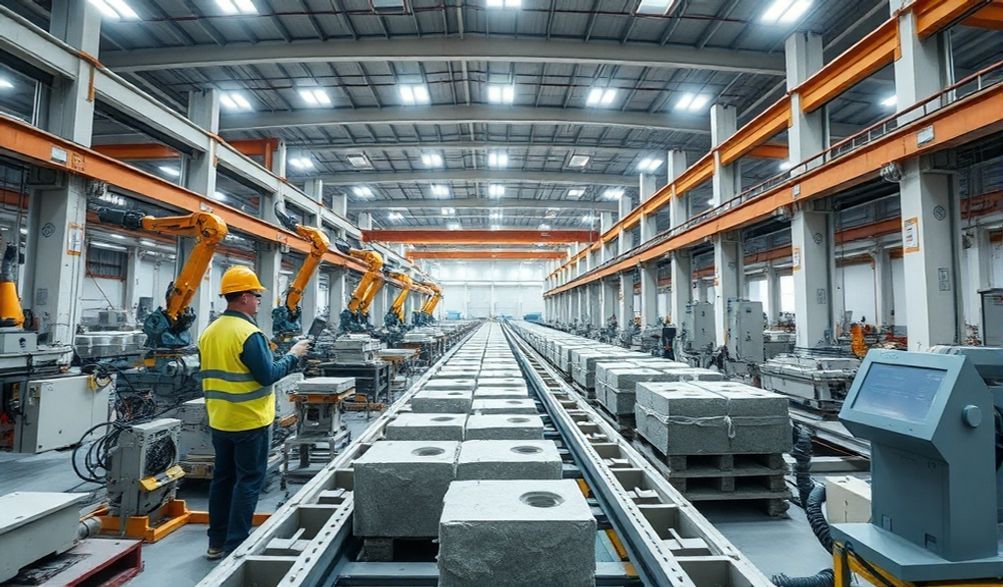
Hướng Dẫn Toàn Diện Để Tìm Nguồn Máy Gạch Block Từ Nhà Máy Trung Quốc
Ngành xây dựng toàn cầu là một động cơ tăng trưởng không ngừng, đòi hỏi những giải pháp hiệu quả, tiết kiệm chi phí và có khả năng mở rộng. Trọng tâm của các dự án xây dựng hiện đại—từ các khu phát triển nhà ở đô thị đến những siêu dự án hạ tầng—là một thiết bị then chốt: máy sản xuất gạch block. Những chiếc máy này biến nguyên liệu thô như bê tông, tro bay hoặc đất sét thành những viên gạch nền tảng xây dựng nên thế giới của chúng ta.
对于寻求投资这项技术的企业而言,中国无疑是全球的中心。无与伦比的制造规模、快速的技术应用以及具有竞争力的成本结构,共同将中国定位为工业机械的主要来源地。然而,要在这广阔的市场中找到可靠、高质量的合作伙伴,仍需审慎探索。中国砌块砖机工厂có thể là một nhiệm vụ khó khăn đầy rẫy những cạm bẫy tiềm ẩn.
Hướng dẫn này được xây dựng dựa trên chuyên môn ngành và hiểu biết sâu sắc về bối cảnh sản xuất và tìm nguồn cung ứng. Mục tiêu của chúng tôi là cung cấp cho bạn thông tin có thẩm quyền, đáng tin cậy và có thể áp dụng thực tế—thể hiện các nguyên tắc Kinh nghiệm, Chuyên môn, Tính thẩm quyền và Độ tin cậy (E-E-A-T). Chúng tôi sẽ đồng hành cùng bạn từ việc tìm hiểu các loại máy móc và tính năng chính, đến các bước quan trọng để thẩm định nhà máy, đảm bảo chất lượng và quản lý hậu cần. Hãy cùng bắt đầu hành trình hướng tới một sự hợp tác thành công.
Tìm Hiểu Các Loại Máy Sản Xuất Gạch Block và Ứng Dụng Của Chúng
Before you start contacting suppliers, you must understand the landscape of machinery available. The right machine depends entirely on your project scale, output requirements, budget, and product goals. A reputable 中国砌块砖机工厂 will offer a range of solutions, but knowing the categories demonstrates your seriousness and helps you ask the right questions.
Máy Làm Khối Tự Động Hoàn Toàn
These are the powerhouses of the industry, designed for high-volume, continuous production with minimal manual intervention.
- Mô tả: They integrate automated material batching, mixing, conveying, molding, curing, and pallet stacking into a single, synchronized production line.
- Output & Ideal Use: Capable of producing thousands of blocks per hour (e.g., 4,000-10,000+). They are the ideal choice for large-scale commercial block yards, major construction companies, and entrepreneurs aiming for maximum market supply with a small operational crew.
Máy Làm Khối Bán Tự Động
This category offers a strategic balance, providing significant automation for the core molding process while requiring manual handling for other stages.
- Mô tả: The machine itself automatically mixes, vibrates, and presses blocks. However, tasks like feeding raw materials, moving pallets of fresh blocks, and stacking cured blocks are done manually or with basic equipment.
- Output & Ideal Use: Production ranges from 500 to 3,000 blocks per hour. This is the most popular choice for medium-sized businesses, regional suppliers, and those making a strategic upgrade from manual operations without the capital outlay for a full line.
Manual or Mobile Brick Machines
These are the most accessible entry points into block manufacturing, prized for their simplicity and flexibility.
- Mô tả: Often small, portable, and operated by hand levers or small engines. They produce one or a few blocks at a time and are not part of a conveyor system.
- Output & Ideal Use: Production is low (e.g., 100-500 blocks per day) but perfect for on-site production for a specific project, small community-based enterprises, startups testing the market, or producing specialized, non-standard blocks.
Specialized Machines for Different Materials
Beyond automation level, machines are engineered for specific end products and raw materials.
- Concrete Hollow Block Machines: The most common type, producing standard hollow blocks for walls. They use vibration and pressure to compact a dry concrete mix.
- Máy Sản Xuất Gạch Đất Sét: Designed for extruding and cutting wet clay to form solid or perforated bricks, which are then fired in a kiln.
- Máy làm gạch lát: Create interlocking or standard paving stones, often with higher pressure for greater density and surface finish.
- Máy Sản Xuất Gạch Khóa Liên Kết: Produce bricks with designed ridges and grooves that lock together without mortar, popular for eco-friendly and rapid construction.
Key Factors When Choosing a China Block Machine Factory
Identifying a supplier that is both capable and reliable is the most critical step in your sourcing journey. Price should not be the sole deciding factor. Here’s a detailed checklist to evaluate potential partners.
Đánh giá Chuyên môn và Kinh nghiệm Sản xuất
A factory’s history and credentials are your first indicators of stability and quality.
- Company History: How long have they been in business? A factory with 10+ years of operation has likely navigated market cycles and refined its processes.
- Industry Certifications: Look for valid international certifications. ISO 9001 for quality management systems is crucial. Dấu CE indicates the machine meets EU health, safety, and environmental standards, a sign of robust engineering.
- R&D Capability: Do they have an in-house engineering team? Can they provide custom solutions or modify standard models? This shows technical depth.
- Portfolio & Client References: Ask for photos/videos of their workshop and past installations. Request contactable references from clients in your region, if possible.
Evaluating Machine Quality and Performance
Dig beneath the sales brochure to understand what makes a machine durable and efficient.
- Thành phần cốt lõi The quality of key parts dictates longevity.
- Hệ thống thủy lực: Are the pumps, valves, and cylinders from reputable brands (e.g., Rexroth, Yuken, Huade)?
- Động cơ rung: This is the heart of block density. High-power, reliable motors are essential.
- Frame & Mold Steel: The frame should be made from heavy-duty welded steel. Molds must be precision-machined from high-chromium alloy steel for long life and consistent block dimensions.
- Performance Specifications: Verify the claimed production capacity (blocks/hour), cycle time, and the range of block sizes the machine can produce.
- Hiệu suất Năng lượng: Modern machines should be designed to optimize power consumption, a major operational cost.
After-Sales Service and Technical Support
This is the ultimate test of a factory’s trustworthiness and your long-term operational peace of mind.
- Bảo hành: Standard warranties are typically 12 months for the machine and 3-6 months for wear parts like molds. Understand exactly what is covered.
- Support Structure: Do they provide clear English operation and maintenance manuals? What is their process for troubleshooting—email, WhatsApp, video call?
- Chính sách Linh kiện Thay thế: Is there a dedicated spare parts department? How quickly can they ship common wear parts (seals, springs, gaskets) and critical components (control panels, motors)? Ensure they provide a recommended spare parts list with your quotation.
The Step-by-Step Sourcing and Procurement Process
Follow this authoritative, step-by-step framework to navigate your procurement from research to delivery.
Initial Research and Factory Shortlisting
- B2B Platforms: Start on platforms like Alibaba and Made-in-China. Use filters for “Trade Assurance,” “Assessed Supplier,” or “Gold Supplier.” Read product descriptions and company profiles thoroughly.
- Beyond Platforms: Conduct a general web search for the factory name to find their independent website and any other online presence. Check for industry referrals in forums or from business contacts.
- Xác minh: Always verify the company’s business license (they should provide it) and cross-check their registered address.
Effective Communication and Quotation Request
A detailed RFQ (Request for Quotation) prevents misunderstandings.
* Key Specs to Include: Desired block type/size, target output (blocks per 8-hour shift), degree of automation, local voltage/frequency (e.g., 415V/50Hz), and preferred power source (electric, diesel).
* Essential Questions: Ask about customization options, installation drawings, foundation requirements, and the scope of their technical support.
* Commercial Terms: Discuss Payment Terms (e.g., 30% deposit, 70% before shipment), Điều khoản thương mại quốc tế (Incoterms) (FOB Shanghai is common; you control shipping), and the validity period of the quote.
Factory Audit and Quality Inspection (Critical Step)
Never skip due diligence on the physical product and producer.
* Pre-Shipment Inspection (PSI): This is non-negotiable. Hire a reputable third-party inspection company (like SGS, BV, or Intertek) to visit the factory before shipment. They will check materials, assembly, electrical safety, and perform a test run to verify performance against the contract.
* Virtual or In-Person Visit: If feasible, a video call factory tour is invaluable. For very large orders, a personal visit is highly recommended to assess the operation firsthand.
Logistics, Shipping, and Customs Clearance
- Shipping: For heavy machinery, sea freight (LCL or FCL) is standard. The factory should provide professional export wooden crate packaging to withstand ocean transit.
- Tài liệu: Ensure you receive a complete set of shipping documents: Commercial Invoice, Packing List, Bill of Lading, Certificate of Origin, and the equipment manual.
- Customs Clearance: Work with a reliable freight forwarder or customs broker in your country. They will use the provided documents to clear the machine, advising you on any applicable duties or taxes.
Avoiding Common Pitfalls and Red Flags
Learn from the experience of others to avoid costly mistakes.
Too-Good-to-Be-True Pricing
An extremely low price is the biggest red flag. It often means:
* Substandard materials (thin steel, low-grade hydraulics).
* Lack of proper testing and quality control.
* Hidden costs that appear later for “necessary” modifications or spare parts.
* Rule of Thumb: Collect 3-5 quotations. The suspiciously lowest and highest can often be discarded; focus on the middle range with the best detailed offer.
Lack of Transparency and Communication
Be wary of a supplier that is evasive.
* Unwillingness to provide a live video of their workshop or a machine in operation.
* Hesitation to share client references or detailed company documentation.
* Vague, non-technical answers to your specific questions about machine components or processes.
Inadequate or Vague Contracts
Your Proforma Invoice (PI) and final Sales Contract are your legal safeguards.
* The PI must detail: All technical specifications, packaging method, payment terms, Incoterms, delivery time, and warranty conditions.
* Never proceed with only a simple quote or an unclear agreement. A professional factory will provide a comprehensive PI for your review and approval before any payment.
Maximizing Your Investment: Installation and Operation
Your relationship with the factory shouldn’t end at delivery. Proper setup and maintenance are key to ROI.
Foundation Preparation and Machine Installation
- The factory should provide detailed foundation drawings with dimensions and load requirements.
- Use a qualified local engineer or contractor to pour a perfectly level and strong concrete foundation as specified. An unstable base will cause premature wear and poor block quality.
Raw Material Selection and Mix Design
- Block strength starts with the right mix. While the factory will give a basic recipe, you may need to adapt it to your local cement, aggregates (sand, gravel, crushed stone), and water quality.
- Conduct small test batches to find the optimal ratio for strength, surface finish, and curing time.
Routine Maintenance for Longevity
Preventative care is far cheaper than major repairs.
* Hàng ngày: Clean the machine thoroughly after each shift, check hydraulic oil levels, and inspect for loose bolts.
* Hàng tuần: Grease all lubrication points, check the tension of chains or belts, and inspect mold liners for wear.
* Monthly: Change hydraulic oil and filters as recommended, perform a detailed inspection of electrical connections, and calibrate sensors if applicable.
Các Câu Hỏi Thường Gặp (FAQ)
Q1: What is the average lead time for a block machine from China?
A: For standard models, expect 15-30 days for production after deposit confirmation. Customized production lines or large orders can take 45-90 days. Always get a written confirmation in the contract.
Q2: Can the factory provide operators training?
A: Reputable factories provide comprehensive operation and maintenance manuals and video guides. On-site training by a factory engineer can almost always be arranged for an additional fee, covering travel and accommodation.
Q3: How do I handle machine breakdowns or spare parts needs?
A: A trustworthy factory will have a dedicated spare parts department. Before ordering, agree on the warranty process for parts and the estimated shipping time for critical components. Keep a small inventory of common wear parts.
Q4: Are Chinese block machines compatible with my local voltage and standards?
A: Yes, this is a standard customization. You must clearly specify your local voltage (e.g., 220V, 380V, 415V, 50Hz/60Hz) in the contract. Factories can also adapt machines to meet specific regional safety standards upon request.
Q5: What is the minimum order quantity (MOQ) for these machines?
A: For standard block making machines, the MOQ is typically 1 unit. For complete automated production lines, the order is usually treated as a custom project with a single line as the minimum.
Conclusion
Sourcing a block brick making machine from China is a significant investment that, when done correctly, can yield tremendous returns for your business. Success hinges on moving beyond a simple price comparison to a thorough evaluation based on a factory’s demonstrated Kinh nghiệm, technical Chuyên môn, market Tính thẩm quyền, and operational Đáng tin cậy.
The most crucial phase of your journey is the due diligence you conduct before placing an order. Investing time in research, factory audits, and clear contract formulation is your best insurance against risk. Use this guide as your foundational checklist.
Begin your sourcing journey by requesting detailed proposals from multiple shortlisted factories that meet the criteria outlined here. Ask the hard questions, demand transparency, and partner with a supplier who acts as a long-term ally in your business growth.
<