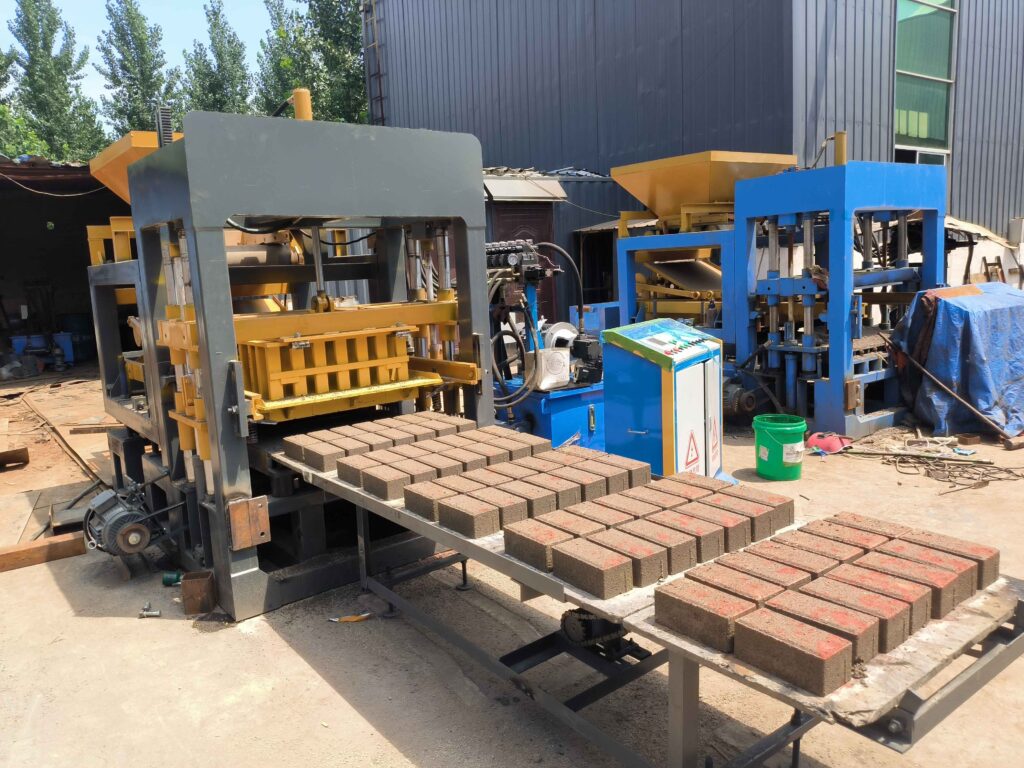
Khảo sát Kỹ thuật các Loại Máy Chủ Đạo
Bối cảnh sản xuất được định hình bởi nhiều công nghệ riêng biệt, mỗi loại phù hợp với nguyên liệu thô cụ thể, thông số kỹ thuật sản phẩm và quy mô kinh doanh. Việc lựa chọn công nghệ quyết định danh mục sản phẩm, hiệu quả sản xuất và vốn đầu tư ban đầu.
1. Máy Ép Tĩnh: Công Cụ Chủ Lực Trong Sản Xuất Số Lượng Lớn
Máy ép tĩnh đại diện cho công nghệ phổ biến và linh hoạt nhất để sản xuất các khối bê tông có mật độ cao, đá lát và gạch tự chèn.
- Nguyên lý hoạt động:Những máy này hoạt động dựa trên nguyên lý "nén rung". Hỗn hợp bê tông có độ sụt thấp đã được chuẩn bị sẵn được đưa vào hộp khuôn đặt trên bàn sản xuất bằng thép chắc chắn. Đầu ép thủy lực hạ xuống để nén hỗn hợp, đồng thời các bộ rung điện hoặc thủy lực công suất lớn giúp đầm chặt vật liệu. Áp lực và rung động đồng thời này đảm bảo đạt được độ đặc và cường độ tối ưu. Sau đó, hộp khuôn được nâng lên sẽ đẩy sản phẩm mới định hình ra ngoài, đặt lên pallet hoặc giá bảo dưỡng.
- Các Hệ Thống Phụ và Biến Thể Chính:
- Hệ thống cấp liệu:Có thể là định lượng thể tích (đơn giản) hoặc cấp liệu theo mẻ điện tử (chính xác) để đảm bảo chất lượng sản phẩm đồng nhất.
- Hệ thống khuônCác khuôn đúc có thể thay thế cho phép một máy duy nhất sản xuất ra nhiều kích thước và kiểu dáng sản phẩm khác nhau (đặc, rỗng, cách nhiệt).
- Hệ Thống Điều Khiển:Từ logic rơ-le cơ bản cho vận hành thủ công đến tự động hóa PLC (Bộ điều khiển logic khả trình) hoàn chỉnh, kiểm soát lực ép, thời gian rung và chỉ mục pallet.
- Sản lượng Sản phẩm và Tính Phù Hợp Ideal for standard construction blocks, lightweight blocks, and landscaping products. Output can range from 1,000 to over 5,000 standard blocks per 8-hour shift, depending on model automation.
2. Extrusion Machines: Masters of Continuous Clay Brick Production
Extrusion is the dominant technology for manufacturing fired clay bricks and certain types of hollow clay blocks, prized for their durability and aesthetic qualities.
- Nguyên lý hoạt động: This process involves forcing a prepared, plastic clay body through a shaped die under high pressure using an auger system. As the continuous column of clay exits the die, it is cut into individual units by wires or blades. This “column” can be solid for bricks or complex for hollow blocks. The green (unfired) products are then dried and fired in a kiln.
- Các Hệ Thống Phụ và Biến Thể Chính:
- Pugmill (Clay Preparation): A critical component that mixes, homogenizes, and de-airs the clay to ensure plasticity and eliminate defects.
- Extrusion Auger and Die: The heart of the machine. Hardened steel dies define the product’s cross-sectional shape. Vacuum chambers within the extruder remove air pockets, increasing green strength.
- Cutter and Handling System: Automated systems cut the column to precise length and gently transfer green products to drying racks.
- Sản lượng Sản phẩm và Tính Phù Hợp The definitive solution for high-volume clay brick and tile production. Suited for large-scale plants supplying regional markets with facing bricks, pavers, and structural clay products.
3. Mobile Block Making Machines: Flexibility for On-Site and Small-Scale Production
These self-contained, often trailer-mounted units bring production directly to the construction site or to small, localized markets.
- Nguyên lý hoạt động: Typically smaller static presses or egg-layer-type machines. “Egg-layers” work by molding a block and then depositing (laying) it directly onto a level ground surface or a concrete slab before the machine indexes forward to make the next block. They require minimal foundation and can be operated with a small crew.
- Các Hệ Thống Phụ và Biến Thể Chính:
- Mobility Frame: Built on a trailer or skid frame for easy transport.
- Nguồn điện: Often equipped with a diesel engine for complete site independence.
- Sự đơn giản: Designed for robustness and ease of operation over high automation.
- Sản lượng Sản phẩm và Tính Phù Hợp Perfect for remote projects, producing blocks for local housing directly where they are needed, reducing transport costs. Output is lower, typically from 500 to 2,000 blocks per day, but offers unparalleled logistical advantages.
Market Dynamics and Strategic Investment Considerations
The selection of manufacturing technology is a strategic decision influenced by target market, raw material availability, and financial capacity.
Analyzing the Target Product and Market
- Geographic Material Preferences: Concrete block machines dominate in regions where aggregate is plentiful. Extrusion machines are key in areas with rich clay deposits. Understanding local building codes and aesthetic preferences (e.g., demand for clay facades) is crucial.
- Scale of Operation: A large-scale stationary plant supplying a city requires a high-automation static press line with palletizers and curing systems. A entrepreneur serving a rural community may start with a single mobile egg-layer machine.
- Đa dạng hóa sản phẩm: Static presses offer the easiest route to a diverse catalog. A single machine with multiple molds can produce everything from standard blocks to decorative pavers and garden edging, allowing a manufacturer to respond to various market demands.
Comprehensive Cost Structure and Pricing Tiers
The price of machinery is a direct reflection of its automation level, build quality, and output capacity. Investment must be viewed as a Total Cost of Ownership (TCO).
- Capital Expenditure (CapEx) Breakdown:
- Cấp độ Nhập môn (Thủ công/Bán tự động): Includes basic mobile machines and small static presses with manual feed and product handling. Price Point: Comparable to a mid-range heavy truck or van. Focus is on affordability and low-volume production.
- Mid-Range (Fully Automatic Standalone): Encompasses fully automatic static presses with automatic feeders, mixers, and pallet dispensers. These are turnkey stations for serious SMEs. Price Point: A significant industrial investment, often requiring financing. Offers the best balance of output and cost for growing businesses.
- High-End (Fully Integrated Production Lines): Includes complete plants with robotic handling, automated curing systems, and sophisticated extrusion lines with dryers and kilns. Price Point: Represents a major capital project, akin to establishing a full-scale factory. Justified by massive, continuous output.
- Operational Expenditure (OpEx) and Hidden Costs:
- Raw Material Processing: Costs for crushers, screens, and mixers for concrete, or pugmills and dryers for clay.
- Tiêu thụ điện năng: Hydraulic systems and vibrators are energy-intensive. High-efficiency drives are a selling point.
- Labor and Training: Higher automation reduces direct labor but requires more skilled technicians for maintenance.
- Mold and Wear Parts: Mold boxes, extrusion dies, and wear parts for the auger are recurring costs that vary by material abrasiveness.
- Curing and Handling: Costs for pallets, racking, and forklifts for concrete, or kiln fuel and maintenance for clay.
Conclusion: Building a Profitable Supply Chain Partnership
For distributors and dealers, success in the brick and block machinery market hinges on moving beyond transactional sales to become consultative partners. This requires a deep understanding of a client’s business model, local market conditions, and growth aspirations. The right machine is not the most expensive one, but the one that perfectly aligns with the client’s production goals, raw material access, and financial roadmap.
The future of this sector is tied to sustainable construction. Machinery that can efficiently utilize fly ash, slag, recycled aggregates, or produce highly insulating blocks is increasingly valuable. Furthermore, offering comprehensive packages—including machine installation, operator training, mold supply, and reliable after-sales service—creates indispensable, long-term client relationships. By providing the correct technology and support, you empower your clients to build the literal foundations of their communities, securing your position as a cornerstone of the construction supply chain.
Frequently Asked Questions (FAQ)
Q1: What is the main difference between a machine for concrete blocks and one for clay bricks?
A: The core difference lies in the process and raw material. Concrete block machines use a vibro-compaction process with a semi-dry concrete mix in a static mold. Clay brick machines typically use an extrusion process, forcing wet, plastic clay through a die to form a continuous column which is then cut. The technologies are not interchangeable.
Q2: What level of technical expertise is required to operate and maintain these machines?
A: It varies by type. Basic mobile or semi-automatic presses require practical mechanical skill for routine maintenance. Fully automated lines and extrusion systems demand knowledge of hydraulics, electronics, PLC controls, and, for clay, thermodynamics (kilns). Quality distributor support includes thorough training and clear technical documentation.
Q3: How do we determine the right production capacity (blocks per day) for a client?
A: Conduct a detailed market analysis with the client. Key factors include: local annual construction volume, the client’s target market share, availability of raw materials, and investment budget. It is often wiser to start with a machine that can be run for two shifts to meet growing demand, rather than an oversized, underutilized machine.
Q4: Beyond the machine itself, what other equipment is needed for a complete setup?
A: A full production line requires supporting equipment. For concrete: a mixer (pan or planetary), conveyor belts, a cement silo, pallet handling equipment (forklift, stacker), and a curing area. For clay: a clay crusher, pugmill, dryer, and a tunnel or chamber kiln for firing. The “balance of plant” costs can be substantial.
Q5: What are the key factors affecting the final quality and strength of the produced blocks?
A: Machine performance is only one factor. Quality depends on: Raw Material Consistency (gradation of aggregates, clay composition), Mix Design (correct cement/water ratio, additives), Proper Compaction (achieved by the machine’s vibration and pressure), and Adequate Curing (controlled moisture and temperature for concrete; precise drying and firing cycles for clay).
Q6: What is the typical payback period for an investment in a medium-capacity automatic block making machine?
A: The payback period is highly sensitive to local block pricing, production costs, and machine utilization. A well-managed operation with a good market can often see a return on investment within 18 to 36 months. This is calculated by comparing the profit margin per block against the daily output and the total capital and operating costs. A detailed financial projection is essential before purchase.