
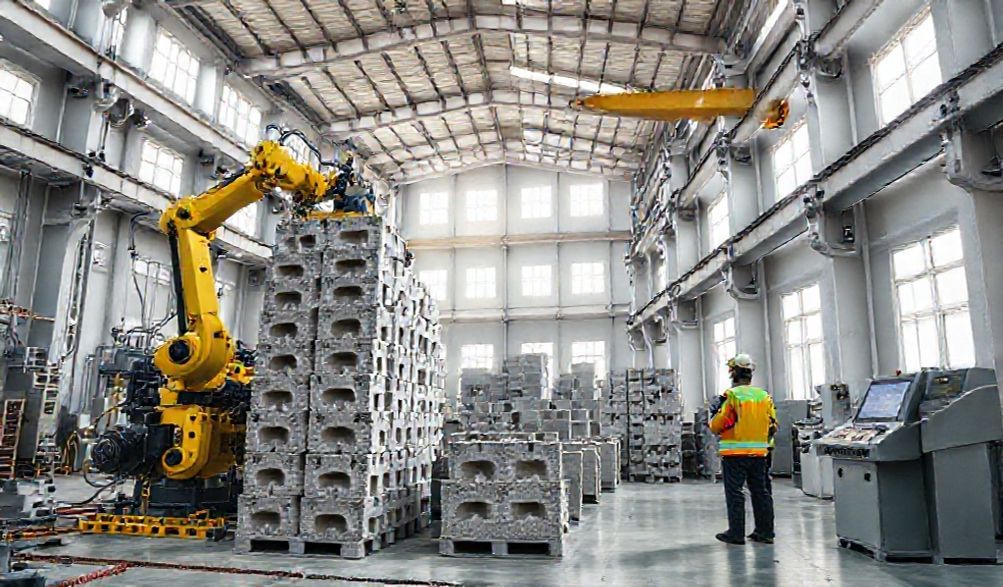
Your Ultimate Guide to Choosing a China Hollow Block Making Machine Manufacturer
Giới thiệu
The global construction industry runs on a foundation of efficiency and affordability. From ambitious infrastructure projects to essential housing developments, the demand for reliable, cost-effective building materials is ceaseless. At the heart of producing these materials—specifically hollow blocks, paving stones, and interlocking bricks—lies a critical piece of equipment: the hollow block making machine. For decades, China has solidified its position as the world’s workshop, becoming the undisputed global hub for manufacturing this essential machinery.
However, navigating this vast and complex marketplace can feel like a daunting task. With thousands of companies claiming to be top manufacturers, how do you separate genuine industry leaders from unreliable middlemen? Common concerns about hidden costs, inconsistent quality, unclear communication, and virtually non-existent after-sales support have, unfortunately, become a familiar story for some unprepared buyers.
This guide is your strategic compass. Built not on speculation but on the consolidated insights of industry veterans, procurement specialists, and engineers with decades of direct experience in the Sino-global machinery trade, this resource is designed to empower you. We will move beyond simple price comparison and equip you with the framework to identify, evaluate, and build a successful, long-term partnership with a credible China hollow block making machine manufacturer.
Why China is the Global Hub for Hollow Block Machine Manufacturing
Hiểu biếtTại sao China dominates this sector is the first step in making an informed sourcing decision. It’s a dominance built on more than just low prices; it’s a result of a perfected industrial ecosystem.
Scale and Industrial Ecosystem
Imagine an entire city dedicated to manufacturing machinery components. In regions like Fujian, Shandong, and Henan, this is essentially the reality. China’s concentrated industrial clusters create an unparalleled ecosystem. A block machine manufacturer has immediate, cost-effective access to:
* Steel Foundries & Fabricators: For frames, moulds, and structural components.
* Hydraulic System Suppliers: For pumps, cylinders, and valves.
* Electrical & PLC Control Panel Producers: For automation and control systems.
* Motor and Vibration Equipment Makers.
This vertical integration drastically reduces production lead times and costs. A manufacturer can source high-quality components within hours, allowing them to offer a wider range of machines at scales and prices that are difficult for manufacturers in other countries to match.
Tiến bộ và Đổi mới Công nghệ
The outdated stereotype of Chinese manufacturers as mere copiers is just that—outdated. Today’s leading manufacturers are innovators. Significant investment in R&D has led to machines that rival, and in some aspects surpass, European counterparts in sophistication. Key advancements include:
* Advanced PLC Control Systems: Touch-screen interfaces allow for precise control over vibration time, pressure, and cycle times, ensuring consistent block density and quality.
* Thiết kế Tiết kiệm Năng lượng: Variable frequency drives (VFDs) on motors and optimized hydraulic systems reduce power consumption by up to 30%.
* IoT and Remote Diagnostics: Progressive manufacturers now offer machines with IoT capabilities, enabling remote monitoring of production data and predictive maintenance alerts.
Cost-Competitiveness Without Sacrificing Range
The efficiency of the supply chain translates directly to competitive pricing. This doesn’t mean you are limited to basic models. Instead, it means you can access a full spectrum of technology within your budget:
* From simple, manually-operated machines for entrepreneurial startups.
* To semi-automatic workhorses for small to medium businesses.
* All the way up to fully automatic production lines and mobile block-making plants capable of outputting thousands of blocks per hour.
This range ensures that whether your project is in rural Africa, the Middle East, or South America, there is a cost-optimized Chinese machine suitable for your local market conditions.
Key Factors to Evaluate a Manufacturer’s Credibility (Beyond Price)
The initial quoted price is just one data point. True value and lower total cost of ownership come from partnering with a credible manufacturer. Here are the critical factors to scrutinize.
Manufacturing Experience and Track Record
Longevity and focus matter. A company with 15+ years specializing in block machinery has likely iterated and improved its designs through real-world feedback.
* Ask For: A detailed project portfolio or case studies. Do they have experience supplying machines for projects in your region or with your desired block types?
* Look For: Specialization. A factory that only makes block machines is generally a safer bet than a general machinery maker that produces a hundred different products.
In-House Production Capability vs. Trading Companies
This is perhaps the most crucial distinction. Trading companies act as middlemen, adding a markup and often diluting control over quality and after-sales support.
* How to Verify a Real Factory:
1. Request a Live Video Tour: Ask for a real-time walkthrough of the workshop via WhatsApp or Zoom. A genuine manufacturer will readily show you their welding bays, assembly lines, and testing areas.
2. Ask for Process Videos: Request specific videos of core processes like mould machining or hydraulic assembly.
3. Check Consistency: Does their Alibaba store, website, and brochure show the same factory, machines, and team? Inconsistencies are a red flag.
Quality Certifications and Standards Compliance
Certifications are independent validations of a manufacturer’s processes. They are not just pieces of paper.
* ISO 9001: Indicates a certified quality management system.
* Dấu CE: For machines sold to Europe, it signifies compliance with EU safety, health, and environmental requirements.
* Báo cáo Kiểm định SGS: While not a certification of the factory itself, a history of providing SGS pre-shipment inspection reports for clients shows a commitment to verified quality.
R&D and Engineering Support
A manufacturer with a dedicated R&D and engineering team is a partner, not just a vendor. This is vital for:
* Tùy chỉnh: Adapting machine dimensions, pressure, or vibration for unique block designs or local raw materials.
* Hỗ trợ Kỹ thuật: Providing deep, expert troubleshooting that goes beyond reading a manual.
* Parts Innovation: Continuously improving wear parts like moulds and mixer blades for longer life.
Deep Dive: Types of Hollow Block Machines from Chinese Manufacturers
Chinese manufacturers offer a solution for every production need. Understanding these categories will help you align the machine with your business model.
Máy Thủ Công và Bán Tự Động
- Lý Tưởng Cho: Startups, small-scale projects, entrepreneurs, and markets with lower labor costs.
- Đầu ra: Typically 1,000 – 4,000 blocks per 8-hour shift.
- Hoạt động: Manual feeding of raw material and block removal. Semi-automatic models use a hydraulic press and vibration but may require manual mould filling or pallet cycling.
- Lợi Thế Chủ Chốt: Lowest capital investment and simplicity of operation and maintenance.
Fully Automatic Stationary Plants
- Lý Tưởng Cho: Medium to large-scale commercial block yards supplying construction projects or retailers.
- Đầu ra: Ranges from 8,000 to over 30,000 blocks per shift.
- Tính năng: These are integrated systems. They include automatic batching and mixing, conveyor belt feeding, fully automatic pressing and vibration cycles, and robotic block stacking/curing.
- Lợi Thế Chủ Chốt: High output with minimal manual labor, ensuring consistent product quality and lower per-unit cost.
Mobile Block Making Machines (QGM, Zenith-type)
- Lý Tưởng Cho: On-site production for large infrastructure projects (dams, roads, housing estates) to eliminate transport costs of finished blocks.
- Hoạt động: The entire plant is mounted on a trailer. It can be moved to different locations on a project site.
- Điểm Khác Biệt Chủ Chốt: They are designed to produce blocks directly on the ground (using a concrete slab or plastic sheet) or on wooden pallets, without the need for a massive, fixed factory floor.
Specialized Machines for Diverse Products
Beyond standard hollow blocks, manufacturers offer machines engineered for specific products:
* Paving Block Machines: For interlocking pavers, with high-pressure capabilities for superior strength and surface finish.
* Máy Sản Xuất Gạch Khóa Liên Kết: For dry-stack, mortar-less construction systems.
* Curb Stone Machines: For producing large, heavy landscape and road curbs.
* Insulated Block Machines: For producing dual-layer blocks with an insulation cavity.
The Procurement Process: From Inquiry to After-Sales
A structured procurement process minimizes risk and sets the stage for a successful partnership.
How to Initiate a Professional Inquiry
A detailed inquiry (RFQ – Request for Quotation) gets you a more accurate and comparable quote. Include:
* Desired block type, size, and required compressive strength.
* Target output (blocks per hour or 8-hour shift).
* Level of automation (manual, semi, full).
* Local power supply (voltage and frequency, e.g., 380V/50Hz or 440V/60Hz).
* Available raw materials (type of sand, aggregate size, cement grade).
Understanding Quotations and Negotiation Points
A professional quote should be clear. Understand the trade terms:
* EXW (Giao tại xưởng): Price at the factory gate. You handle all shipping, insurance, and customs.
* FOB (Giao hàng lên tàu): Price includes delivery to the Chinese port and loaded onto the ship. You handle sea freight and destination costs.
* CIF (Cost, Insurance, Freight): Price includes delivery to your nearest port.
* Negotiate On: Spare parts packages (a standard 2-year set of wear parts is common), tool kits, and the scope of free technical support.
Factory Audit and Quality Inspection (Pre-Shipment)
Never skip this step. Before final payment, hire a third-party inspection company like SGS, BV, or Intertek to:
* Verify the machine is built to the agreed specifications.
* Perform a test run with raw materials (if possible).
* Check the quality of welding, painting, and electrical work.
* Confirm packaging for export is adequate.
After-Sales Service: The True Test of a Partner
The relationship begins when the machine arrives. Your manufacturer must provide:
* Tài liệu Toàn diện: Clear manuals, electrical diagrams, and parts lists.
* Installation Support: Detailed video guides, 24/7 WhatsApp/WeChat support for remote commissioning via video call, or the option for an engineer to visit (at an additional cost).
* Training Materials: Videos showing operation, daily maintenance, and basic troubleshooting.
* Spare Parts Guarantee: A commitment to supply wear parts (moulds, mixer blades, hydraulic seals) for 10+ years, with a clear and responsive ordering process.
Mitigating Risks and Building a Successful Partnership
Clear Communication and Contractual Safeguards
- The Contract: Ensure it details every specification, delivery timeline, payment terms (e.g., 30% deposit, 70% against copy of Bill of Lading), and liability clauses.
- Use Secure Payment Channels: Platforms like Alibaba Trade Assurance offer a layer of protection by holding payment until you confirm satisfactory delivery.
Navigating Cultural and Business Practices
- Build Guanxi (Relationship): Chinese business is relational. Be respectful, patient, and invest time in building trust with your contact.
- Be Specific and Clear: Avoid ambiguity. Confirm all details in writing (email) after verbal discussions.
- Understand Timelines: Account for Chinese national holidays (e.g., Chinese New Year, Golden Week) which can shut down production for 2-3 weeks.
Common Pitfalls to Avoid
- The “Too Good to Be True” Price: It almost always is. It may indicate inferior materials, hidden costs, or a trading company with no control over production.
- Lack of Verifiable Information: No physical address, only a mobile number, or refusal to provide a video call factory tour.
- Vague or Rushed Contracts: A manufacturer unwilling to detail terms is a major risk.
- No Client References: A credible manufacturer will have a list of past international clients (with country) that you can potentially contact.
Frequently Asked Questions (FAQ)
Q1: What is the typical lead time for a machine order from China?
A: Lead times vary significantly. Standard models may ship in 15-30 days after deposit. For large, fully automatic lines or heavily customized machines, expect 45-90 days for production, testing, and packing.
Q2: How do I handle machine installation if I can’t get an engineer from China?
A: Reputable manufacturers have adapted. They provide exhaustive installation manuals, HD step-by-step video tutorials, and offer 24/7 remote support via video call (e.g., Zoom, WhatsApp) to guide your local technician through assembly, wiring, and commissioning in real-time.
Q3: Are Chinese machines compatible with our local power standards and raw materials?
A: Yes, reliable manufacturers will customize the electrical system (motors, control panel) to your local voltage and frequency (e.g., 110V/60Hz, 415V/50Hz). Their engineering team can also advise on optimal mix designs (cement-sand-aggregate ratios) for the materials available in your region.
Q4: What is the minimum order quantity (MOQ) for hollow block machines?
A: The MOQ is typically 1 set for complete machinery. However, if you are ordering multiple machines or a large quantity of spare parts, discuss consolidating them into a full container (FCL) to significantly reduce per-unit shipping costs.
Q5: How do I verify if a company is a real factory and not just a trader?
A: Use a multi-step verification: 1) Insist on a live video tour of their production floor, not a pre-recorded promo. 2) Request a copy of their official business license. 3) Ask to see specific workshop areas like the mould processing CNC center. 4) Check for consistency across all their online profiles and marketing materials.
Conclusion
Selecting the right China hollow block making machine manufacturer is a strategic investment that extends far beyond the initial purchase price. It is a decision that impacts your production capacity, product quality, and operational costs for years to come. The vast Chinese market holds both exceptional partners and potential pitfalls.
By prioritizing proven expertise, transparent manufacturing capability, and a robust after-sales framework over the allure of the absolute lowest bid, you dramatically increase your chances of long-term success. Conduct thorough due diligence, ask the detailed questions outlined in this guide, and trust the verification process.
Ready to move forward with confidence? Download our comprehensive Manufacturer Evaluation Checklist to systematically compare potential suppliers, or contact our independent industry consultants for a personalized shortlist of pre-vetted manufacturers known for their reliability and global support. This guide, grounded in decades of practical trade experience and technical expertise, aims to be your definitive, trustworthy resource for building a prosperous future in the construction materials industry.
<