
The Ultimate Guide to Sourcing a Cement Block Making Machine in China (2024)
Inleiding
The global construction industry runs on efficiency and affordability. From ambitious infrastructure projects to essential housing developments, the demand for reliable, cost-effective building materials is insatiable. At the heart of this supply chain for concrete blocks, pavers, and kerbstones is a critical piece of equipment: the cement block making machine. And when it comes to sourcing this machinery, one nation stands as the undisputed global workshop—China.
For international buyers, navigating the vast Chinese manufacturing landscape can feel overwhelming. The challenges are real: sifting through thousands of online suppliers, distinguishing genuine manufacturers from middlemen, verifying unsubstantiated quality claims, managing complex international logistics, and ultimately ensuring you receive true value for your investment. A misstep can lead to costly delays, subpar equipment, and operational headaches.
This guide is your comprehensive roadmap. Drawing from over a decade of experience in the construction machinery sector, including direct factory audits in key industrial hubs like Shandong, Fujian, and Henan, we’ve compiled the insights you need. Our goal is to transform a daunting procurement process into a strategic, informed decision, empowering you to source a machine that perfectly aligns with your production goals and budget.
Why China is the Global Leader in Cement Block Machinery
China’s dominance in manufacturing block making machines isn’t accidental. It’s the result of a powerful convergence of scale, innovation, and market-driven flexibility that is difficult for any other region to match.
Skaal en Vervaardiging Ekosisteem
China’s strength lies in its concentrated industrial clusters. Regions like Linyi in ShandongenQuanzhou in Fujian are epicenters for construction machinery, hosting hundreds of specialized foundries, component suppliers, and assembly plants within a small geographic radius.
- Koste-doeltreffendheid: This clustering creates immense economies of scale. Raw materials like steel plate, hydraulic cylinders, and electrical components are sourced locally and at volume, driving down unit costs.
- Vaardige Arbeidsmagpoel: Decades of specialization have cultivated a deep pool of skilled welders, technicians, and engineers familiar with the nuances of block machine design and assembly.
- Supply Chain Resilience: Need a replacement mold or a specific vibration motor? Within these clusters, parts are readily available, minimizing downtime for manufacturers and, by extension, for you.
Tegnologiese Vooruitgang en Innovasie
Gone are the days when “Made in China” implied basic, manual technology. Chinese manufacturers have aggressively embraced innovation.
- Automation is Standard: The market has decisively shifted. While manual machines exist, the focus is on PLC (Programmable Logic Controller) systems that manage the entire production cycle—mixing feeding, molding, curing, and stacking—with minimal human intervention.
- Smart Manufacturing: Leading factories now integrate IoT (Internet of Things) sensors into their high-end models. This allows for remote monitoring of production data, machine health diagnostics, and predictive maintenance alerts, maximizing uptime and efficiency.
- Material & Design R&D: Continuous improvement in hydraulic systems for higher pressure, better vibration technology for denser blocks, and the use of wear-resistant alloys for molds are all areas of active development.
Cost-Competitiveness Without Sacrificing Range
This is China’s core value proposition. The market caters to every tier of buyer.
- You can find robust, simple manual machines for a village-level startup.
- You can invest in a semi-automatic system for a growing block yard.
- You can commission a fully automated, computer-controlled production line for an industrial plant.
This spectrum means you pay for exactly the capability you need. The competitive market ensures that at each level, you are likely to find a more feature-rich or cost-effective option than from manufacturers in other countries.
Key Types of Cement Block Making Machines in China
Understanding the fundamental categories of machines is the first step to defining your needs. Here’s a breakdown of the primary types available.
Handmatige & Semi-outomatiese Masjiene
These are the entry-point workhorses of the industry.
- Ideale Gebruiksgevalle: Small-scale projects (e.g., building a single home), entrepreneurial startups with very limited capital, regions with unreliable electricity, or for producing specialty blocks in low volume.
- Voordele:
- Lae Aanvangsbelegging:Die mees bekostigbare opsie op die mark.
- Eenvoudige Bediening en Instandhouding: Easier to fix with local mechanical knowledge.
- Low Power Consumption: Often can run on a standard generator.
- Nadele:
- Hoë Arbeidsintensiteit: Requires several operators for material handling, feeding, and block removal.
- Laer Uitset: Production is limited by human speed and stamina.
- Inkonsekwentheid: Block density and quality can vary more than with automated systems.
Fully Automatic Stationary Block Machines
This is the most popular category for serious commercial block production.
- Ideale Gebruiksgevalle: Medium to large-scale block manufacturing yards supplying local construction markets, businesses with steady, predictable demand.
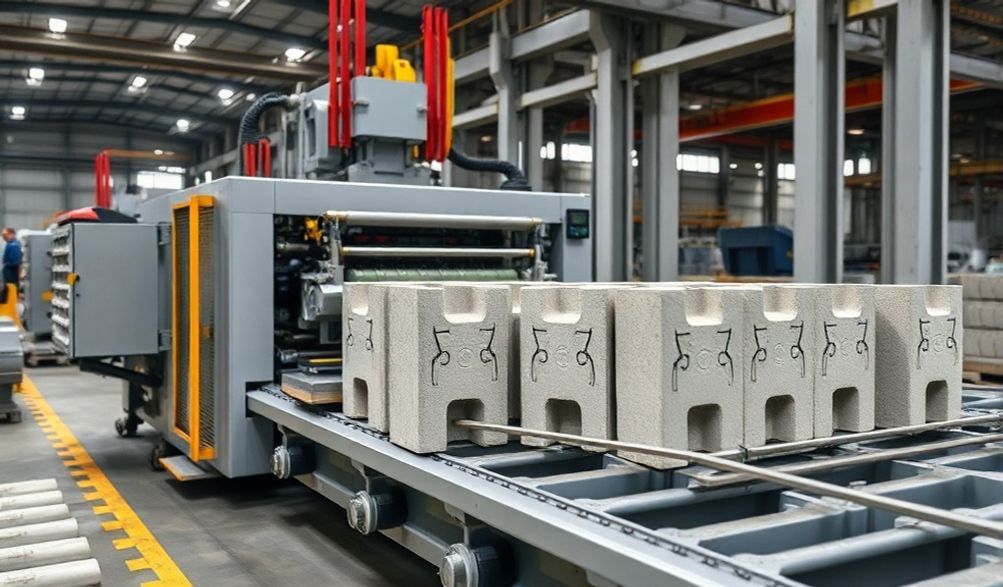
- Hoe Hulle Werk: The machine is fixed to a solid concrete foundation. Pallets cycle through on a conveyor system. The machine automatically feeds concrete, compacts it via vibration and pressure, ejects the finished block onto the pallet, and sends it to a curing area.
- Voordele:
- High & Consistent Output: Can produce between 4,000 to over 15,000 standard blocks in an 8-hour shift.
- Excellent Quality Consistency: PLC control ensures every block has identical dimensions, density, and strength.
- Verminderde Arbeid: Often requires only 2-3 personnel for oversight and pallet management.
- Nadele:
- Higher Capital Cost.
- Requires a Solid Foundation: Installation is more complex and permanent.
- Dependent on Steady Power Supply.
Mobile Block Making Machines (Egg-Laying Type)
A unique and highly versatile solution for on-site production.
- Ideale Gebruiksgevalle: Construction projects where transporting blocks is costly (e.g., remote sites), producing blocks directly where they will be used, businesses with limited space for a stationary plant.
- Hoe Hulle Werk: The machine is mounted on wheels or tracks. It moves forward on a prepared slab, lays down a layer of concrete, molds the blocks in situ, and then moves forward to repeat the process. Blocks cure right on the ground.
- Voordele:
- Eliminates Pallets & Curing Racks: A major cost and logistics saving.
- Ware Portabiliteit: Can be towed between job sites.
- Lower Operational Complexity: No pallet circulation system.
- Nadele:
- Weather Dependent: Production can be halted by rain or extreme temperatures.
- Laer Uitset: Generally slower than stationary automatic lines.
- Surface Preparation Required: Needs a level, stable ground slab to operate on.
Specialized Block Machine Plants
These are the pinnacle of production, designed for maximum output with minimal labor.
- Ideale Gebruiksgevalle: Large-scale industrial plants, government infrastructure projects, producers supplying major cities or export markets.
- Beskrywing:Dit is 'nturnkey system. It integrates an automatic batching plant, mixer, conveyor, the block making machine itself, an automatic curing system (like a curing chamber), and a robotic palletizer/stacker.
- Fokus: The value here is in system integration and total automation, driving down the cost per block through sheer scale and efficiency.
Critical Factors for Choosing the Right Supplier
Finding a machine is easy; finding a betroubare vennoot is the challenge. Here’s how to vet Chinese suppliers.
Verifying Manufacturer Credentials & Expertise
- Business Licenses: Don’t just take their word for it. Use their Chinese business license number (营业执照) to check on official local Administration for Market Regulation websites or through verified third-party platforms.
- R&D and Patents: A supplier that invests in research has a longer-term vision. Ask about their engineering team and if they hold any design or utility model patents for their machines. This indicates innovation capability.
- Fabriek teenoor Handelaar: Always aim for the actual manufacturer. Trading companies can be useful but add a layer of cost and potential communication issues. Request videos of the production floor, specifically showing welding, assembly, and painting stations. Look for their company name on equipment and worker uniforms.
Assessering van Produksiekapasiteit en Kwaliteitsbeheer
- Sleutelvrae om te vra:
- “What is your QC process at each stage of assembly?”
- “Do you source your steel frames and hydraulic components, or do you fabricate/cast them in-house?” (In-house is typically better for quality control).
- “Can you provide a test report for the vibration motor and hydraulic system pressure?”
- “Do you perform a full no-load and load test before shipment?”
- Factory Audits: For large orders, a pre-purchase factory audit is invaluable. If you can’t travel, hire a local third-party inspection agent or insist on a comprehensive, live video tour guided by a senior engineer, not a salesperson.
Analyzing After-Sales Service and Support
This is where the best suppliers separate themselves from the pack.
- Documentation: A professional supplier will provide a comprehensive English manual, clear electrical and hydraulic schematic diagrams, and a detailed parts catalog with item numbers. This is non-negotiable.
- Warranty & Support: Scrutinize the warranty terms. What is covered (parts? labor? shipping?) and for how long? Understand their technical support structure: Is it 24/7 remote support via WhatsApp/TeamViewer? Will they send an engineer for commissioning (often at the buyer’s cost)?
- Onderdele Beleid: Ask for their spare parts price list. How long does it take to ship common wear parts? Do they use standard, off-the-shelf components, or are they proprietary?
The Smart Buyer’s Checklist: From Inquiry to Delivery
Follow this systematic process to navigate your purchase confidently.
Step 1: Defining Your Specifications
Create a clear internal brief before contacting suppliers:
* Block Types/Size: Hollow blocks, solid blocks, pavers, interlocking stones? Provide precise dimensions.
* Target Daily Output: Be realistic about your current and 2-year future needs.
* Available Power: Voltage (220V/380V/415V?) and phase (3-phase).
* Outomatiseringsvlak: Manual, semi-auto, full-auto?
* Rou Materiaal: What type of aggregate (crushed stone, fly ash) will you use?
* Budget Range: Include a buffer for shipping and incidentals.
Step 2: Supplier Shortlisting and Communication
- Effective RFQ: Send your detailed spec brief to 3-5 shortlisted manufacturers. Ask for a technical specification sheet, a detailed quotation (Proforma Invoice), and videos of similar machines working.
- Red Flags: Vague answers, refusal to provide a video call with the factory, prices significantly lower than the market average, pressure for immediate payment.
- Request References: Ask for contact information for 2-3 previous international customers in a region similar to yours. Follow up with them.
Step 3: Technical & Commercial Negotiation
- Proforma Invoice (PI): Ensure it lists every detail: model, specs, packaging (usually wooden case), payment terms, delivery time, and most importantly, Incoterms.
- Payment Terms: Standard is 30% T/T deposit, 70% before shipment. For larger orders, consider using a Letter of Credit (L/C) for security.
- Incoterms: FOB (Vry aan Boord) is most common. You own the goods once they’re loaded on the ship, and you control the main shipping and insurance. EXW (Ex Works) means you handle everything from their factory door; only use this if you have a reliable freight forwarder in China.
Step 4: Pre-Shipment Inspection and Logistics
- Inspection is Critical: Before making the final payment, hire a reputable third-party inspection company like SGS, Bureau Veritas (BV), of TÜV to visit the factory. They will check construction quality, electrical safety, perform a test run, and verify packaging. This fee is a small price for peace of mind.
- Logistics: Work with a freight forwarder experienced in heavy machinery. They will handle booking sea/air freight, customs documentation (Bill of Lading, Commercial Invoice, Packing List), and clearance at your destination port.
Maximizing Your Investment: Operation and Maintenance Tips
Your relationship with the supplier shouldn’t end at delivery. Proper setup and care are crucial.
Proper Installation and Commissioning
- Foundation is Key: For stationary machines, follow the supplier’s foundation drawing exactly. An uneven base will cause premature wear and machine failure.
- Commissioning: Ideally, have the supplier send a technician to install and train your team. If this is too costly, ensure you have exhaustive video guides and remote support scheduled for your first production run.
Routine Maintenance Schedule for Longevity
A simple, disciplined routine prevents major breakdowns.
- Daily: Check hydraulic oil levels, clean the machine, inspect for loose bolts or leaks.
- Weekly: Lubricate all moving parts (bearings, guide rods), check belt tensions, clean the mold thoroughly.
- Monthly: Inspect hydraulic hoses for wear, check the electrical connections for tightness, test safety devices.
Sourcing and Managing Spare Parts
- Initial Inventory: With your machine, purchase a starter spare parts kit from the OEM, including common wear items: mold liners, springs, seal kits for the hydraulic cylinders, and a set of filters.
- Long-Term Sourcing: For common items like standard bearings or hydraulic hoses, you can often source them locally. For specialized parts like the mold core or controller board, you will likely need to return to the OEM. Keep your parts catalog accessible.
FAQ Section
Q1: What is the average price range for a cement block making machine from China?
A: Prices vary dramatically based on specifications. A basic manual machine can start around $3 000 – $8 000. A semi-automatic model may range from $15,000 – $35,000. Fully automatic stationary lines typically fall between $40,000 – $120,000+, and complete turnkey plants can exceed $200,000. Always get itemized quotes based on your specific needs.
Q2: How do I ensure the machine meets international safety and quality standards?
A: While many suppliers offer CE certification (a self-declared conformity for the European market), the document alone is not a guarantee. The most reliable method is to mandate a pre-shipment inspection by an accredited third-party agency. They will physically test the machine’s construction, electrical systems, grounding, and guarding against recognized international standards.
Q3: Can Chinese suppliers provide training and English manuals?
A: Yes, reputable manufacturers absolutely can and should. This must be a clearly stipulated requirement in your sales contract. Specify that you require full operation and maintenance manuals, electrical schematics, and parts lists in English. Many also offer on-site or video training sessions.
Q4: What are the hidden costs I should budget for?
A: Beyond the machine price, budget for:
* International shipping, marine insurance, and port fees.
* Import duties and taxes in your country (consult a local customs broker).
* Cost of auxiliary equipment (concrete mixer, conveyor, pallets).
* Foundation construction and electrical hookup by local contractors.
* Initial spare parts inventory.
* Costs for an inspection agency or commissioning engineer.
Q5: How long is the typical lead time and warranty period?
A:
* Lead Time: 15-30 days for standard models from stock. 30-60 days for customized configurations or large plants.
* Waarborg:Tipies12 months for the main machine frame and systems, excluding wear parts. Wear parts like mold liners may have a 3-6 month warranty. These terms are negotiable; always seek to extend them.
Conclusion
Sourcing a cement block making machine from China presents a unparalleled opportunity: access to cutting-edge technology, a vast range of options, and competitive pricing that can significantly boost your business’s profitability and capacity. However, this opportunity is best seized with diligent research, careful vetting, and a systematic approach.
By applying the framework and checklist provided in this guide—rooted in practical industry experience and direct supplier engagement—you move beyond being just a buyer to becoming an informed partner in your own supply chain. You can transform a complex international procurement journey into a confident, strategic investment.
Call to Action: Use this guide as a living document throughout your sourcing process. Cross-reference advice, ask the tough questions, and when in doubt, consult with an independent technical expert in your region before finalizing a major purchase. Your due diligence today is the foundation for years of reliable, profitable production tomorrow.
<