
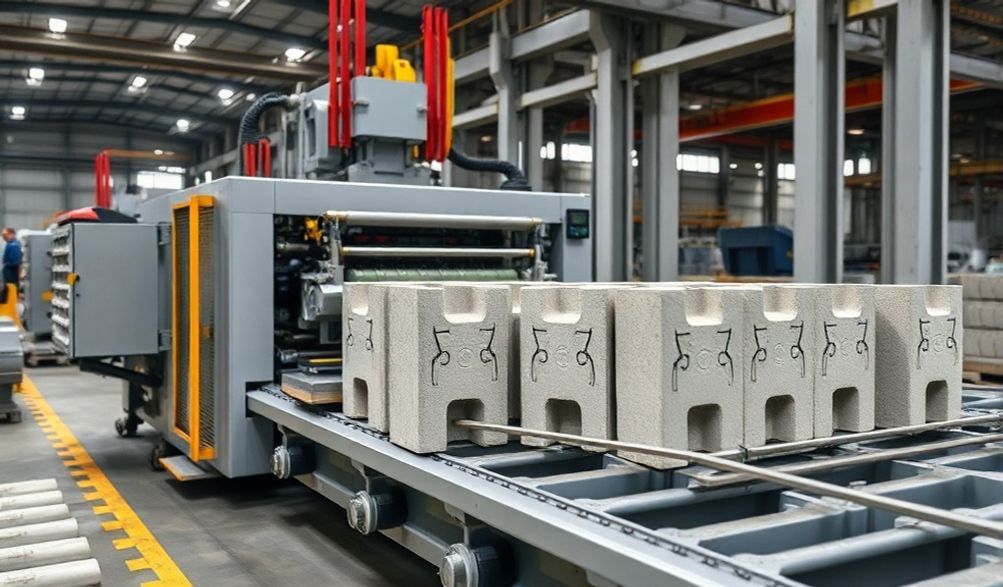
Guia Definitivo para Comprar Máquinas de Blocos de Concreto na China (2024)
Introdução
A indústria global da construção funciona com base em eficiência e custo-benefício. Desde projetos de infraestrutura ambiciosos até empreendimentos habitacionais essenciais, a demanda por materiais de construção confiáveis e econômicos é insaciável. No centro dessa cadeia de suprimentos para blocos de concreto, pavimentadoras e meio-fios está um equipamento crítico: a máquina de fazer blocos de cimento. E quando se trata de adquirir essa maquinaria, uma nação se destaca como a oficina global incontestável: a China.
Para compradores internacionais, navegar pelo vasto cenário de manufatura chinesa pode parecer avassalador. Os desafios são reais: peneirar milhares de fornecedores online, distinguir fabricantes genuínos de intermediários, verificar alegações de qualidade não fundamentadas, gerenciar logísticas internacionais complexas e, por fim, garantir que você receba um verdadeiro valor pelo seu investimento. Um erro pode levar a atrasos custosos, equipamentos de baixa qualidade e dores de cabeça operacionais.
Este guia é seu roteiro abrangente. Com base em mais de uma década de experiência no setor de máquinas de construção, incluindo auditorias diretas em fábricas em polos industriais importantes como Shandong, Fujian e Henan, compilamos os insights que você precisa. Nosso objetivo é transformar um processo de aquisição intimidador em uma decisão estratégica e informada, capacitando você a adquirir uma máquina que se alinha perfeitamente com seus objetivos de produção e orçamento.
Por que a China é a Líder Global em Maquinário para Blocos de Cimento
A dominância da China na fabricação de máquinas de produção de blocos não é acidental. É o resultado de uma poderosa convergência de escala, inovação e flexibilidade orientada pelo mercado, difícil de ser igualada por qualquer outra região.
Escala e Ecossistema de Manufatura
A força da China está em seus clusters industriais concentrados. Regiões como临沂在山东eQuanzhou, em Fujiansão epicentros para maquinário de construção, abrigando centenas de fundições especializadas, fornecedores de componentes e plantas de montagem dentro de um pequeno raio geográfico.
- Eficiência de Custos:Este agrupamento cria imensas economias de escala. Matérias-primas como chapas de aço, cilindros hidráulicos e componentes elétricos são adquiridos localmente e em grande volume, reduzindo os custos unitários.
- Mão de Obra Qualificada:Décadas de especialização cultivaram um amplo conjunto de soldadores qualificados, técnicos e engenheiros familiarizados com as nuances do projeto e montagem de máquinas de blocos.
- Resiliência da Cadeia de Suprimentos:Precisa de um molde de reposição ou de um motor de vibração específico? Dentro desses agrupamentos, as peças estão prontamente disponíveis, minimizando o tempo de inatividade para os fabricantes e, por extensão, para você.
Avanço Tecnológico e Inovação
Os dias em que "Made in China" implicava tecnologia manual e básica já se foram. Os fabricantes chineses adotaram a inovação de forma agressiva.
- Automação é Padrão:O mercado mudou de forma decisiva. Embora existam máquinas manuais, o foco está emSistemas PLC (Controlador Lógico Programável)que gerenciam todo o ciclo de produção — mistura, alimentação, moldagem, cura e empilhamento — com intervenção humana mínima.
- Manufatura Inteligente:As principais fábricas agora integramIoT (Internet das Coisas)sensores em seus modelos de alta linha. Isso permite o monitoramento remoto de dados de produção, diagnósticos da saúde das máquinas e alertas de manutenção preditiva, maximizando o tempo de atividade e a eficiência.
- Pesquisa e Desenvolvimento de Materiais e Design:Melhoria contínua em sistemas hidráulicos para maior pressão, melhor tecnologia de vibração para blocos mais densos e o uso de ligas resistentes ao desgaste para moldes são todas áreas de desenvolvimento ativo.
Competitividade de Custos Sem Sacrificar a Autonomia
Esta é a proposta de valor central da China. O mercado atende a todos os níveis de compradores.
- Você pode encontrar máquinas manuais robustas e simples para uma startup em nível de vila.
- Você pode investir em um sistema semiautomático para um pátio de blocos em expansão.
- Você pode encomendar uma linha de produção totalmente automatizada e controlada por computador para uma planta industrial.
Este espectro significa que você paga exatamente pela capacidade de que precisa. O mercado competitivo garante que, em cada nível, é provável que você encontre uma opção mais rica em recursos ou mais custo-efetiva do que a oferecida por fabricantes de outros países.
Principais Tipos de Máquinas para Fabricação de Blocos de Cimento na China
Compreender as categorias fundamentais de máquinas é o primeiro passo para definir suas necessidades. Aqui está uma análise dos principais tipos disponíveis.
Máquinas Manuais e Semiautomáticas
Estas são as máquinas de trabalho fundamentais da indústria.
- Casos de Uso Ideais:Projetos de pequena escala (por exemplo, construção de uma única casa), startups empreendedoras com capital muito limitado, regiões com eletricidade pouco confiável, ou para produzir blocos especiais em baixo volume.
- Prós:
- Baixo Investimento Inicial:A opção mais acessível do mercado.
- Operação e Manutenção Simples:Mais fácil de consertar com conhecimento mecânico local.
- Baixo Consumo de Energia:Frequentemente pode funcionar em um gerador padrão.
- Contras:
- Alta Intensidade de Mão de Obra: Requires several operators for material handling, feeding, and block removal.
- Saída Inferior: Production is limited by human speed and stamina.
- Inconsistência: Block density and quality can vary more than with automated systems.
Fully Automatic Stationary Block Machines
This is the most popular category for serious commercial block production.
- Casos de Uso Ideais: Medium to large-scale block manufacturing yards supplying local construction markets, businesses with steady, predictable demand.
- Como Funcionam: The machine is fixed to a solid concrete foundation. Pallets cycle through on a conveyor system. The machine automatically feeds concrete, compacts it via vibration and pressure, ejects the finished block onto the pallet, and sends it to a curing area.
- Prós:
- High & Consistent Output: Can produce between 4,000 to over 15,000 standard blocks in an 8-hour shift.
- Excellent Quality Consistency: PLC control ensures every block has identical dimensions, density, and strength.
- Mão de Obra Reduzida: Often requires only 2-3 personnel for oversight and pallet management.
- Contras:
- Higher Capital Cost.
- Requires a Solid Foundation: Installation is more complex and permanent.
- Dependent on Steady Power Supply.
Mobile Block Making Machines (Egg-Laying Type)
A unique and highly versatile solution for on-site production.
- Casos de Uso Ideais: Construction projects where transporting blocks is costly (e.g., remote sites), producing blocks directly where they will be used, businesses with limited space for a stationary plant.
- Como Funcionam: The machine is mounted on wheels or tracks. It moves forward on a prepared slab, lays down a layer of concrete, molds the blocks no local, and then moves forward to repeat the process. Blocks cure right on the ground.
- Prós:
- Eliminates Pallets & Curing Racks: A major cost and logistics saving.
- Verdadeira Portabilidade: Can be towed between job sites.
- Lower Operational Complexity: No pallet circulation system.
- Contras:
- Weather Dependent: Production can be halted by rain or extreme temperatures.
- Saída Inferior: Generally slower than stationary automatic lines.
- Surface Preparation Required: Needs a level, stable ground slab to operate on.
Specialized Block Machine Plants
These are the pinnacle of production, designed for maximum output with minimal labor.
- Casos de Uso Ideais: Large-scale industrial plants, government infrastructure projects, producers supplying major cities or export markets.
- Descrição:Isto é umturnkey system. It integrates an automatic batching plant, mixer, conveyor, the block making machine itself, an automatic curing system (like a curing chamber), and a robotic palletizer/stacker.
- Foco: The value here is in system integration and total automation, driving down the cost per block through sheer scale and efficiency.
Critical Factors for Choosing the Right Supplier
Finding a machine is easy; finding a parceiro confiável is the challenge. Here’s how to vet Chinese suppliers.
Verifying Manufacturer Credentials & Expertise
- Business Licenses: Don’t just take their word for it. Use their Chinese business license number (营业执照) to check on official local Administration for Market Regulation websites or through verified third-party platforms.
- R&D and Patents: A supplier that invests in research has a longer-term vision. Ask about their engineering team and if they hold any design or utility model patents for their machines. This indicates innovation capability.
- Fábrica vs. Comerciante: Always aim for the actual manufacturer. Trading companies can be useful but add a layer of cost and potential communication issues. Request videos of the production floor, specifically showing welding, assembly, and painting stations. Look for their company name on equipment and worker uniforms.
Avaliação da Capacidade de Produção e Controle de Qualidade
- Perguntas-chave a serem feitas:
- “What is your QC process at each stage of assembly?”
- “Do you source your steel frames and hydraulic components, or do you fabricate/cast them in-house?” (In-house is typically better for quality control).
- “Can you provide a test report for the vibration motor and hydraulic system pressure?”
- “Do you perform a full no-load and load test before shipment?”
- Factory Audits: For large orders, a pre-purchase factory audit is invaluable. If you can’t travel, hire a local third-party inspection agent or insist on a comprehensive, live video tour guided by a senior engineer, not a salesperson.
Analyzing After-Sales Service and Support
This is where the best suppliers separate themselves from the pack.
- Documentação: A professional supplier will provide a comprehensive English manual, clear electrical and hydraulic schematic diagrams, and a detailed parts catalog with item numbers. This is non-negotiable.
- Warranty & Support: Scrutinize the warranty terms. What is covered (parts? labor? shipping?) and for how long? Understand their technical support structure: Is it 24/7 remote support via WhatsApp/TeamViewer? Will they send an engineer for commissioning (often at the buyer’s cost)?
- Spare Parts Policy: Ask for their spare parts price list. How long does it take to ship common wear parts? Do they use standard, off-the-shelf components, or are they proprietary?
The Smart Buyer’s Checklist: From Inquiry to Delivery
Follow this systematic process to navigate your purchase confidently.
Step 1: Defining Your Specifications
Create a clear internal brief before contacting suppliers:
* Block Types/Size: Hollow blocks, solid blocks, pavers, interlocking stones? Provide precise dimensions.
* Target Daily Output: Be realistic about your current and 2-year future needs.
* Available Power: Voltage (220V/380V/415V?) and phase (3-phase).
* Nível de Automação: Manual, semi-auto, full-auto?
* Matérias-primas: What type of aggregate (crushed stone, fly ash) will you use?
* Budget Range: Include a buffer for shipping and incidentals.
Step 2: Supplier Shortlisting and Communication
- Effective RFQ: Send your detailed spec brief to 3-5 shortlisted manufacturers. Ask for a technical specification sheet, a detailed quotation (Proforma Invoice), and videos of similar machines working.
- Red Flags: Vague answers, refusal to provide a video call with the factory, prices significantly lower than the market average, pressure for immediate payment.
- Request References: Ask for contact information for 2-3 previous international customers in a region similar to yours. Follow up with them.
Step 3: Technical & Commercial Negotiation
- Proforma Invoice (PI): Ensure it lists every detail: model, specs, packaging (usually wooden case), payment terms, delivery time, and most importantly, Incoterms.
- Payment Terms: Standard is 30% T/T deposit, 70% before shipment. For larger orders, consider using a Carta de Crédito (C/C) for security.
- Incoterms: FOB (Livre a Bordo) is most common. You own the goods once they’re loaded on the ship, and you control the main shipping and insurance. EXW (Ex Works) means you handle everything from their factory door; only use this if you have a reliable freight forwarder in China.
Step 4: Pre-Shipment Inspection and Logistics
- Inspection is Critical: Before making the final payment, hire a reputable third-party inspection company like SGS, Bureau Veritas (BV) ou TÜV to visit the factory. They will check construction quality, electrical safety, perform a test run, and verify packaging. This fee is a small price for peace of mind.
- Logística: Work with a freight forwarder experienced in heavy machinery. They will handle booking sea/air freight, customs documentation (Bill of Lading, Commercial Invoice, Packing List), and clearance at your destination port.
Maximizing Your Investment: Operation and Maintenance Tips
Your relationship with the supplier shouldn’t end at delivery. Proper setup and care are crucial.
Proper Installation and Commissioning
- Foundation is Key: For stationary machines, follow the supplier’s foundation drawing exactly. An uneven base will cause premature wear and machine failure.
- Commissioning: Ideally, have the supplier send a technician to install and train your team. If this is too costly, ensure you have exhaustive video guides and remote support scheduled for your first production run.
Routine Maintenance Schedule for Longevity
A simple, disciplined routine prevents major breakdowns.
- Diário: Check hydraulic oil levels, clean the machine, inspect for loose bolts or leaks.
- Semanal: Lubricate all moving parts (bearings, guide rods), check belt tensions, clean the mold thoroughly.
- Mensalmente: Inspect hydraulic hoses for wear, check the electrical connections for tightness, test safety devices.
Sourcing and Managing Spare Parts
- Initial Inventory: With your machine, purchase a starter spare parts kit from the OEM, including common wear items: mold liners, springs, seal kits for the hydraulic cylinders, and a set of filters.
- Long-Term Sourcing: For common items like standard bearings or hydraulic hoses, you can often source them locally. For specialized parts like the mold core or controller board, you will likely need to return to the OEM. Keep your parts catalog accessible.
FAQ Section
Q1: What is the average price range for a cement block making machine from China?
A: Prices vary dramatically based on specifications. A basic manual machine can start around $3.000 – $8.000. A semi-automatic model may range from $15,000 – $35,000. Fully automatic stationary lines typically fall between $40,000 – $120,000+, and complete turnkey plants can exceed $200,000. Always get itemized quotes based on your specific needs.
Q2: How do I ensure the machine meets international safety and quality standards?
A: While many suppliers offer Certificação CE (a self-declared conformity for the European market), the document alone is not a guarantee. The most reliable method is to mandate a pre-shipment inspection by an accredited third-party agency. They will physically test the machine’s construction, electrical systems, grounding, and guarding against recognized international standards.
Q3: Can Chinese suppliers provide training and English manuals?
A: Yes, reputable manufacturers absolutely can and should. This must be a clearly stipulated requirement in your sales contract. Specify that you require full operation and maintenance manuals, electrical schematics, and parts lists in English. Many also offer on-site or video training sessions.
Q4: What are the hidden costs I should budget for?
A: Beyond the machine price, budget for:
* International shipping, marine insurance, and port fees.
* Import duties and taxes in your country (consult a local customs broker).
* Cost of auxiliary equipment (concrete mixer, conveyor, pallets).
* Foundation construction and electrical hookup by local contractors.
* Initial spare parts inventory.
* Costs for an inspection agency or commissioning engineer.
Q5: How long is the typical lead time and warranty period?
A:
* Lead Time: 15-30 days for standard models from stock. 30-60 days for customized configurations or large plants.
* Garantia: Typically 12 months for the main machine frame and systems, excluding wear parts. Wear parts like mold liners may have a 3-6 month warranty. These terms are negotiable; always seek to extend them.
Conclusão
Sourcing a cement block making machine from China presents a unparalleled opportunity: access to cutting-edge technology, a vast range of options, and competitive pricing that can significantly boost your business’s profitability and capacity. However, this opportunity is best seized with diligent research, careful vetting, and a systematic approach.
By applying the framework and checklist provided in this guide—rooted in practical industry experience and direct supplier engagement—you move beyond being just a buyer to becoming an informed partner in your own supply chain. You can transform a complex international procurement journey into a confident, strategic investment.
Call to Action: Use this guide as a living document throughout your sourcing process. Cross-reference advice, ask the tough questions, and when in doubt, consult with an independent technical expert in your region before finalizing a major purchase. Your due diligence today is the foundation for years of reliable, profitable production tomorrow.
<