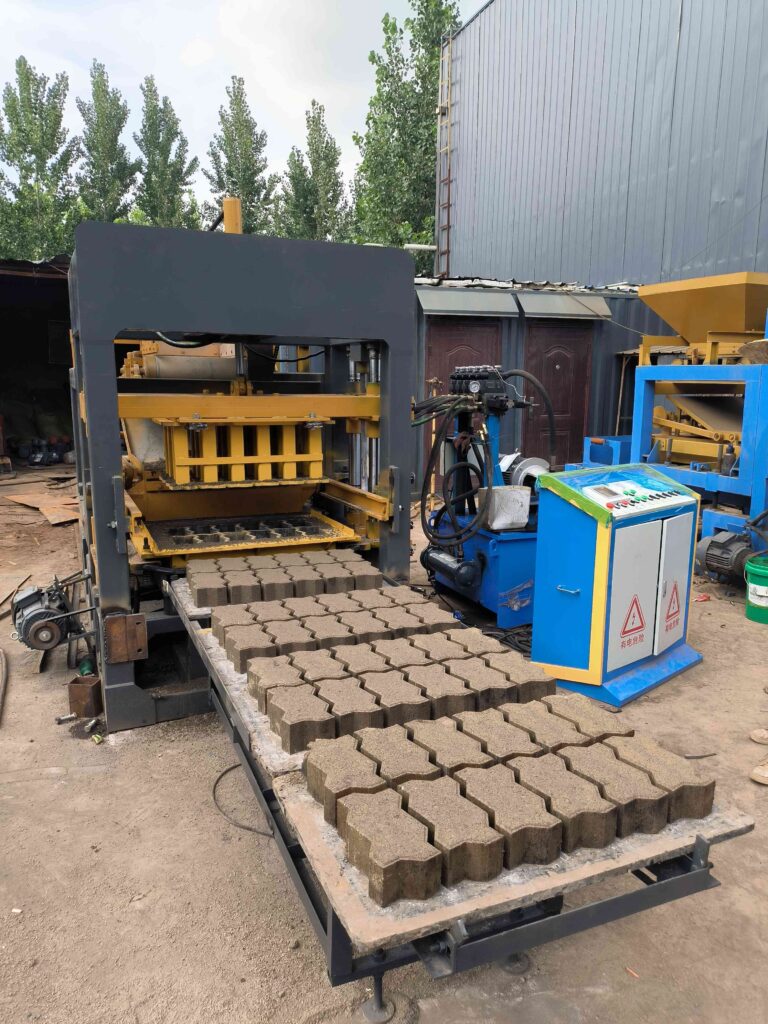
الفجوة الآلية: تحليل شامل للآلات اليدوية مقابل الآلات الأوتوماتيكية لصناعة البلوك
التعريفات الأساسية وآليات التشغيل
يكمن التمييز الأساسي في مستوى التدخل البشري المطلوب لإكمال دورة إنتاج واحدة—من تغذية المواد الخام إلى تفريغ البلوك النهائي.
آلة الكتل اليدوية: دقة تعمل بالطاقة البشرية
آلة صنع الطوب اليدوية هي جهاز يعمل بمساعدة ميكانيكية أو هيدروليكية حيث يكون المشغل هو المحرك الرئيسي لكل خطوة إنتاجية.
- انهيار الدورةيقوم العامل يدوياً بتحميل كمية محددة من خليط الخرسانة في صندوق القالب، الذي يكون غالباً مفتوحاً من الأعلى. ثم يقوم بتشغيل رافعة أو عجلة قيادة يدوية أو مضخة هيدروليكية بسيطة لخفض رأس الضغط، مما يطبق ضغطاً. يتم تفعيل الاهتزاز، إذا كان موجوداً، عن طريق مفتاح منفصل. بعد الضغط، يقوم العامل يدوياً بفتح ورفع صندوق القالب أو فتح الألواح الجانبية، ثم يزيل البلوكة الطرية "الخضراء"، عادةً بوضعها على منصة أو على الأرض للمعالجة. كل إجراء - من القياس، والضغط، والإزالة، والتعامل - يتم تنفيذه بواسطة العامل.
- مستوى التكنولوجيا:تتميز هذه الآلات بآلياتها البسيطة، حيث تستخدم غالبًا وصلات من نوع الدبوس والجلبة، وصمامات يدوية، ومفاتيح كهربائية أساسية. يعتمد التحكم فيها بالكامل على اللمس والبصر، ويعتمد على إيقاع المشغل وحكمه.
آلة البلوك الأوتوماتيكية: الإنتاج القابل للبرمجة
آلة البلوك الأوتوماتيكية هي نظام كهروهيدروميكانيكي متكامل حيث يقوم جهاز التحكم المنطقي المبرمج (PLC) بتسلسل دورة الإنتاج بأكملها بعد التشغيل.
- انهيار الدورةتبدأ الدورة بأمر واحد (مثل الضغط على زر أو إشارة استشعار تلقائية). ثم تقوم الآلة بتنفيذ ما يلي بشكل ذاتي: درج التغذية أو الناقل ينقل الخليط من قادوس مدمج إلى القالب؛ يتحرك القالب إلى محطة الضغط؛ يتم تفعيل محركات الاهتزاز؛ تطبق أسطوانة الضغط الهيدروليكي ضغطًا مُعدًا مسبقًا لفترة "توقف زمني" محددة؛ يتم فك القالب؛ وينقل نظام الإخراج البلوك النهائي على منصة التحميل خارج الآلة. يتحول دور المشغل من مشارك فعلي إلى مشرف ومراقب.
- مستوى التكنولوجيا:تتميز هذه الأنظمة بهيدروليكيات معقدة تتضمن صمامات نسبية، تحكمات سيرفو، اهتزازات عالية التردد، مصفوفات حساسات (للكشف عن الموقع، الضغط، والمنصات) وجهاز تحكم منطقي قابل للبرمجة مركزي. إن معايير الإنتاج تُدخل رقمياً، مما يضمن قابلية التكرار.
تحليل مقارن: تقييم متعدد الأبعاد
الاختيار بين هذه الأنظمة يمتد عبر عدة أبعاد تجارية حاسمة.
1. القدرة الإنتاجية وثبات المخرجات
- آلة يدوية
- الإخراج: Heavily dependent on operator skill, stamina, and pace. Maximum output rarely exceeds 300-500 blocks per 8-hour shift per machine, with significant variability.
- الاتساق Product weight, density, and dimensions fluctuate based on the operator’s consistency in filling the mold and applying pressure. Quality is intrinsically variable.
- Automatic Machine:
- الإخراج: Dictated by machine cycle time, which is fixed and repeatable. Output can range from 1,000 to over 5,000 blocks per shift consistently, irrespective of time of day or operator fatigue.
- الاتساق Every cycle is an exact digital replica of the last. This guarantees uniform block quality, weight, and strength, which is critical for meeting standardized specifications and building codes.
2. Labor Requirements and Human Resource Strategy
- آلة يدوية
- Role: Requires physically strong laborers for constant, repetitive tasks. The work is arduous and can lead to high turnover.
- مستوى المهارة Basic training is sufficient, but a skilled, motivated operator can significantly improve output and quality.
- Staffing Model: Business scaling is linear: to double output, you essentially need to double machines and operators.
- Automatic Machine:
- Role: Requires a technically minded operator for monitoring, basic troubleshooting, and data input. Physical labor is minimal.
- مستوى المهارة Requires higher technical literacy to understand machine interfaces, basic mechanics, and hydraulics. Training is more intensive.
- Staffing Model: One operator can often supervise multiple automatic machines or an entire production line, leading to exponential gains in labor productivity.
3. Financial Investment and Economic Model
- Capital Expenditure (CAPEX):
- آلة يدوية Very low initial investment. This low barrier to entry is its primary advantage, allowing micro-enterprises to start production.
- Automatic Machine: High initial investment, often 5 to 20 times the cost of a manual machine. This represents a significant commitment.
- Operational Expenditure (OPEX) & Total Cost of Ownership (TCO):
- آلة يدوية Low direct energy costs but very high and variable labor costs per block. Maintenance is simple and cheap, but wear parts may fail more frequently due to inconsistent operation. The true cost is hidden in low, inconsistent output and high per-unit labor expense.
- Automatic Machine: Higher energy costs but dramatically lower labor cost per block. Predictive maintenance is crucial but leads to higher planned spare parts costs. The per-unit production cost plummets at scale, offering superior margins.
4. Product Range and Flexibility
- آلة يدوية Limited flexibility. Mold changes are slow and cumbersome, discouraging short runs of specialty products. Best suited for one or two standard block types produced in long runs.
- Automatic Machine: High flexibility, especially with Quick Mold Change (QMC) systems. Switching between different block, paver, or kerbstone profiles can be done in under 30 minutes, enabling a “batch-on-demand” model that serves diverse market segments from a single machine.
5. Quality Control and Market Positioning
- آلة يدوية Inherently produces a commodity product with acceptable but variable quality. Suitable for low-cost, informal, or self-build markets where absolute precision is not critical. Difficult to supply large contractors or government tenders requiring certified, consistent specifications.
- Automatic Machine: Capable of producing a premium, specification-grade product. Enables a supplier to meet the stringent demands of large-scale commercial projects, architectural specifications, and export markets. Builds brand reputation based on reliability and quality.
Strategic Alignment: Matching Technology to Business Vision
The decision is not about which machine is “better,” but which is appropriate for a specific stage and vision.
The Manual Machine: Foundational and Niche Utility
- مثالي لـ: The true micro-entrepreneur with severely limited capital; on-site production for a specific, limited-scope project; markets with very low labor costs and minimal quality expectations; production in regions with unreliable electricity.
- Strategic Path: Can serve as a low-risk proof-of-concept to validate a local market. However, it typically represents a business ceiling rather than a growth platform.
The Automatic Machine: The Engine of Growth
- مثالي لـ: Any serious entrepreneur aiming to build a commercial manufacturing business; supplying the formal construction sector; businesses planning to scale; markets where labor costs are rising or skilled masons are scarce.
- Strategic Path: Represents a commitment to industrial-scale manufacturing. It is a vehicle for capturing market share, building a brand, and achieving economies of scale. The higher CAPEX is an investment in lower long-term OPEX and higher revenue potential.
The Evolving Landscape: The Semi-Automatic Middle Ground
A critical third category, the semi-automatic machine, often serves as a strategic compromise. It automates the core pressing cycle (feed and press are automated) but requires manual pallet feeding and block removal. This offers a meaningful step up in consistency and output from a manual machine without the full capital outlay of a fully automatic system. It is a viable “stepping-stone” technology for businesses in transition.
خاتمة
The difference between manual and automatic block machines is a chasm that separates artisanal production from industrial manufacturing. It is a choice between a tool that extends human labor and a system that replaces and amplifies it through programmed precision. For the distributor or advisor, the most critical service is to guide the client beyond the immediate allure of low capital cost towards a clear-eyed analysis of their total operational economics and strategic ambition.
Selling a manual machine is often a transactional sale based on affordability. Selling an automatic machine is a consultative partnership, where you help the client build a business case based on unit economics, market demand, and growth modeling. In an increasingly competitive and quality-conscious global construction market, automation is not merely an option; it is the definitive pathway to scalability, profitability, and longevity. Understanding this divide in all its dimensions allows you to become an architect of your clients’ success, helping them lay the right foundation—not just for a block, but for an enduring enterprise.
FAQ
Q1: Can a business profitably start with a manual machine and then upgrade to an automatic one?
A: Yes, this is a common and often prudent pathway. The manual machine allows for market validation, initial cash flow generation, and learning the fundamentals of production and sales with minimal risk. The key is to plan for this transition from the outset. Entrepreneurs should reinvest profits deliberately, choose a manual machine from a manufacturer that also produces automatic systems (for potential trade-in), and use the initial phase to build customer relationships that will demand the higher, consistent output of an automatic machine.
Q2: How significant is the electricity requirement for an automatic machine, and can it operate in areas with poor grid power?
A: The requirement is significant. A medium-sized automatic machine may require a stable three-phase power supply of 30-75 kW. In areas with poor grid power, operation is challenging but not impossible. Solutions include investing in a powerful diesel generator set (which adds to CAPEX and OPEX for fuel) or utilizing hybrid systems with power stabilizers and battery buffers. This infrastructure cost must be factored into the business plan. Manual machines, in contrast, often run on single-phase power or minimal three-phase, making them more adaptable to weak grids.
Q3: Is the maintenance for an automatic machine too complex for a small business owner?
A: While more complex, it is manageable with proper training and discipline. Modern automatic machines are designed for serviceability. The complexity is offset by predictability—maintenance is scheduled and planned. The risk with a manual machine is that its simple components, while easy to fix, are subject to more erratic wear and catastrophic failure due to operator inconsistency, leading to unplanned downtime, which is more damaging to a business than planned maintenance.
Q4: For a given product, will the block from an automatic machine be structurally stronger than one from a manual machine?
A: Almost invariably, yes. The automatic machine applies a precise, repeatable, and typically higher compaction pressure for an exact duration, coupled with controlled vibration. This results in optimal and consistent density. A manual machine’s pressure is variable (based on the operator’s force and technique), leading to lower and inconsistent density, which directly correlates to lower and variable compressive strength. For any structural application, the certified consistency of the automatic machine’s output is a major advantage.
Q5: How does the choice impact a business’s ability to secure loans or investment?
A: This is a crucial but often overlooked differentiator. A business plan centered on automatic machinery is typically viewed more favorably by banks and investors. It demonstrates a commitment to scale, presents a clearer projection of costs and output (lower risk), and is based on asset-backed financing (the machine itself is collateral). A manual machine-based model is often seen as a subsistence or informal sector activity, with higher perceived risk due to its dependency on variable human labor and unproven scalability, making it harder to secure formal financing.