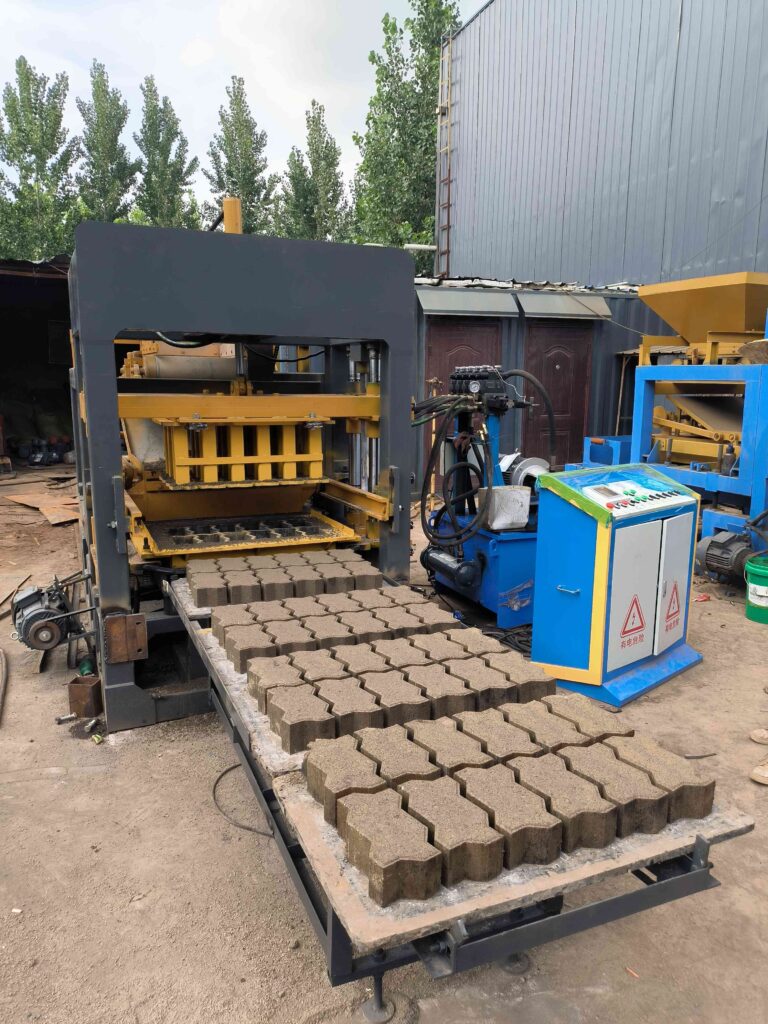
Divisão da Automação: Uma Análise Abrangente de Máquinas de Bloco Manuais vs. Automáticas
Definições Fundamentais e Mecânica Operacional
A principal diferença está no nível de intervenção humana necessária para completar um ciclo de produção - desde a alimentação de matéria-prima até a descarga de um bloco acabado.
Máquina de Blocos Manual: Precisão Movida a Força Humana
A máquina de blocos manual é um dispositivo assistido mecanicamente ou hidraulicamente, onde o operador é o principal condutor de cada etapa da produção.
- Quebra de Ciclo:O operador carrega manualmente uma quantidade específica de mistura de concreto na caixa de molde, que geralmente é aberta na parte superior. Em seguida, aciona uma alavanca, volante ou bomba hidráulica simples para abaixar um cabeçote de compactação, aplicando pressão. A vibração, se presente, é ativada por um interruptor separado. Após a compactação, o operador destrava manualmente e levanta a caixa de molde ou abre os painéis laterais, removendo o bloco "verde" fresco, geralmente colocando-o em um palete ou no chão para curar. Cada ação—medição, prensagem, desmoldagem e manuseio—é executada pelo trabalhador.
- Nível de Tecnologia:Essas máquinas são caracterizadas por mecânica simples, geralmente utilizando articulações de pino e bucha, válvulas manuais e interruptores elétricos básicos. O controle é totalmente tátil e visual, dependendo do ritmo e do julgamento do operador.
Máquina de Bloco Automática: Produção Programável
Uma máquina de blocos automática é um sistema eletro-hidromecânico integrado no qual um controlador lógico programável (CLP) sequencia todo o ciclo de produção após a iniciação.
- Quebra de Ciclo:O ciclo é iniciado por um único comando (ex.: pressionar um botão ou sinal automático de sensor). A máquina então executa autonomamente: um alimentador ou esteira dosa a mistura de um funil integrado para o molde; o molde se move para a estação de prensagem; motores de vibração são ativados; o cilindro hidráulico de compactação aplica pressão pré-definida por um "tempo de permanência" estabelecido; o molde se desmolda; e um sistema de ejeção transporta o bloco acabado sobre seu palete para fora da máquina. O papel do operador muda de participante físico para supervisor e monitor.
- Nível de Tecnologia:Esses sistemas possuem hidráulica complexa com válvulas proporcionais, controles servo, vibradores de alta frequência, conjuntos de sensores (para detecção de posição, pressão e paletes) e um CLP central. Os parâmetros de produção são entradas digitais, garantindo repetibilidade.
Análise Comparativa: Uma Avaliação Multidimensional
The choice between these systems unfolds across several critical business dimensions.
1. Production Capacity and Output Consistency
- Manual Machine:
- Saída: Heavily dependent on operator skill, stamina, and pace. Maximum output rarely exceeds 300-500 blocks per 8-hour shift per machine, with significant variability.
- Consistência: Product weight, density, and dimensions fluctuate based on the operator’s consistency in filling the mold and applying pressure. Quality is intrinsically variable.
- Automatic Machine:
- Saída: Dictated by machine cycle time, which is fixed and repeatable. Output can range from 1,000 to over 5,000 blocks per shift consistently, irrespective of time of day or operator fatigue.
- Consistência: Every cycle is an exact digital replica of the last. This guarantees uniform block quality, weight, and strength, which is critical for meeting standardized specifications and building codes.
2. Labor Requirements and Human Resource Strategy
- Manual Machine:
- Role: Requires physically strong laborers for constant, repetitive tasks. The work is arduous and can lead to high turnover.
- Nível de Habilidade: Basic training is sufficient, but a skilled, motivated operator can significantly improve output and quality.
- Staffing Model: Business scaling is linear: to double output, you essentially need to double machines and operators.
- Automatic Machine:
- Role: Requires a technically minded operator for monitoring, basic troubleshooting, and data input. Physical labor is minimal.
- Nível de Habilidade: Requires higher technical literacy to understand machine interfaces, basic mechanics, and hydraulics. Training is more intensive.
- Staffing Model: One operator can often supervise multiple automatic machines or an entire production line, leading to exponential gains in labor productivity.
3. Financial Investment and Economic Model
- Capital Expenditure (CAPEX):
- Manual Machine: Very low initial investment. This low barrier to entry is its primary advantage, allowing micro-enterprises to start production.
- Automatic Machine: High initial investment, often 5 to 20 times the cost of a manual machine. This represents a significant commitment.
- Operational Expenditure (OPEX) & Total Cost of Ownership (TCO):
- Manual Machine: Low direct energy costs but very high and variable labor costs per block. Maintenance is simple and cheap, but wear parts may fail more frequently due to inconsistent operation. The true cost is hidden in low, inconsistent output and high per-unit labor expense.
- Automatic Machine: Higher energy costs but dramatically lower labor cost per block. Predictive maintenance is crucial but leads to higher planned spare parts costs. The per-unit production cost plummets at scale, offering superior margins.
4. Product Range and Flexibility
- Manual Machine: Limited flexibility. Mold changes are slow and cumbersome, discouraging short runs of specialty products. Best suited for one or two standard block types produced in long runs.
- Automatic Machine: High flexibility, especially with Quick Mold Change (QMC) systems. Switching between different block, paver, or kerbstone profiles can be done in under 30 minutes, enabling a “batch-on-demand” model that serves diverse market segments from a single machine.
5. Quality Control and Market Positioning
- Manual Machine: Inherently produces a commodity product with acceptable but variable quality. Suitable for low-cost, informal, or self-build markets where absolute precision is not critical. Difficult to supply large contractors or government tenders requiring certified, consistent specifications.
- Automatic Machine: Capable of producing a premium, specification-grade product. Enables a supplier to meet the stringent demands of large-scale commercial projects, architectural specifications, and export markets. Builds brand reputation based on reliability and quality.
Strategic Alignment: Matching Technology to Business Vision
The decision is not about which machine is “better,” but which is appropriate for a specific stage and vision.
The Manual Machine: Foundational and Niche Utility
- Ideal Para: The true micro-entrepreneur with severely limited capital; on-site production for a specific, limited-scope project; markets with very low labor costs and minimal quality expectations; production in regions with unreliable electricity.
- Strategic Path: Can serve as a low-risk proof-of-concept to validate a local market. However, it typically represents a business ceiling rather than a growth platform.
The Automatic Machine: The Engine of Growth
- Ideal Para: Any serious entrepreneur aiming to build a commercial manufacturing business; supplying the formal construction sector; businesses planning to scale; markets where labor costs are rising or skilled masons are scarce.
- Strategic Path: Represents a commitment to industrial-scale manufacturing. It is a vehicle for capturing market share, building a brand, and achieving economies of scale. The higher CAPEX is an investment in lower long-term OPEX and higher revenue potential.
The Evolving Landscape: The Semi-Automatic Middle Ground
A critical third category, the semi-automatic machine, often serves as a strategic compromise. It automates the core pressing cycle (feed and press are automated) but requires manual pallet feeding and block removal. This offers a meaningful step up in consistency and output from a manual machine without the full capital outlay of a fully automatic system. It is a viable “stepping-stone” technology for businesses in transition.
Conclusão
The difference between manual and automatic block machines is a chasm that separates artisanal production from industrial manufacturing. It is a choice between a tool that extends human labor and a system that replaces and amplifies it through programmed precision. For the distributor or advisor, the most critical service is to guide the client beyond the immediate allure of low capital cost towards a clear-eyed analysis of their total operational economics and strategic ambition.
Selling a manual machine is often a transactional sale based on affordability. Selling an automatic machine is a consultative partnership, where you help the client build a business case based on unit economics, market demand, and growth modeling. In an increasingly competitive and quality-conscious global construction market, automation is not merely an option; it is the definitive pathway to scalability, profitability, and longevity. Understanding this divide in all its dimensions allows you to become an architect of your clients’ success, helping them lay the right foundation—not just for a block, but for an enduring enterprise.
FAQ
Q1: Can a business profitably start with a manual machine and then upgrade to an automatic one?
A: Yes, this is a common and often prudent pathway. The manual machine allows for market validation, initial cash flow generation, and learning the fundamentals of production and sales with minimal risk. The key is to plan for this transition from the outset. Entrepreneurs should reinvest profits deliberately, choose a manual machine from a manufacturer that also produces automatic systems (for potential trade-in), and use the initial phase to build customer relationships that will demand the higher, consistent output of an automatic machine.
Q2: How significant is the electricity requirement for an automatic machine, and can it operate in areas with poor grid power?
A: The requirement is significant. A medium-sized automatic machine may require a stable three-phase power supply of 30-75 kW. In areas with poor grid power, operation is challenging but not impossible. Solutions include investing in a powerful diesel generator set (which adds to CAPEX and OPEX for fuel) or utilizing hybrid systems with power stabilizers and battery buffers. This infrastructure cost must be factored into the business plan. Manual machines, in contrast, often run on single-phase power or minimal three-phase, making them more adaptable to weak grids.
Q3: Is the maintenance for an automatic machine too complex for a small business owner?
A: While more complex, it is manageable with proper training and discipline. Modern automatic machines are designed for serviceability. The complexity is offset by predictability—maintenance is scheduled and planned. The risk with a manual machine is that its simple components, while easy to fix, are subject to more erratic wear and catastrophic failure due to operator inconsistency, leading to unplanned downtime, which is more damaging to a business than planned maintenance.
Q4: For a given product, will the block from an automatic machine be structurally stronger than one from a manual machine?
A: Almost invariably, yes. The automatic machine applies a precise, repeatable, and typically higher compaction pressure for an exact duration, coupled with controlled vibration. This results in optimal and consistent density. A manual machine’s pressure is variable (based on the operator’s force and technique), leading to lower and inconsistent density, which directly correlates to lower and variable compressive strength. For any structural application, the certified consistency of the automatic machine’s output is a major advantage.
Q5: How does the choice impact a business’s ability to secure loans or investment?
A: This is a crucial but often overlooked differentiator. A business plan centered on automatic machinery is typically viewed more favorably by banks and investors. It demonstrates a commitment to scale, presents a clearer projection of costs and output (lower risk), and is based on asset-backed financing (the machine itself is collateral). A manual machine-based model is often seen as a subsistence or informal sector activity, with higher perceived risk due to its dependency on variable human labor and unproven scalability, making it harder to secure formal financing.