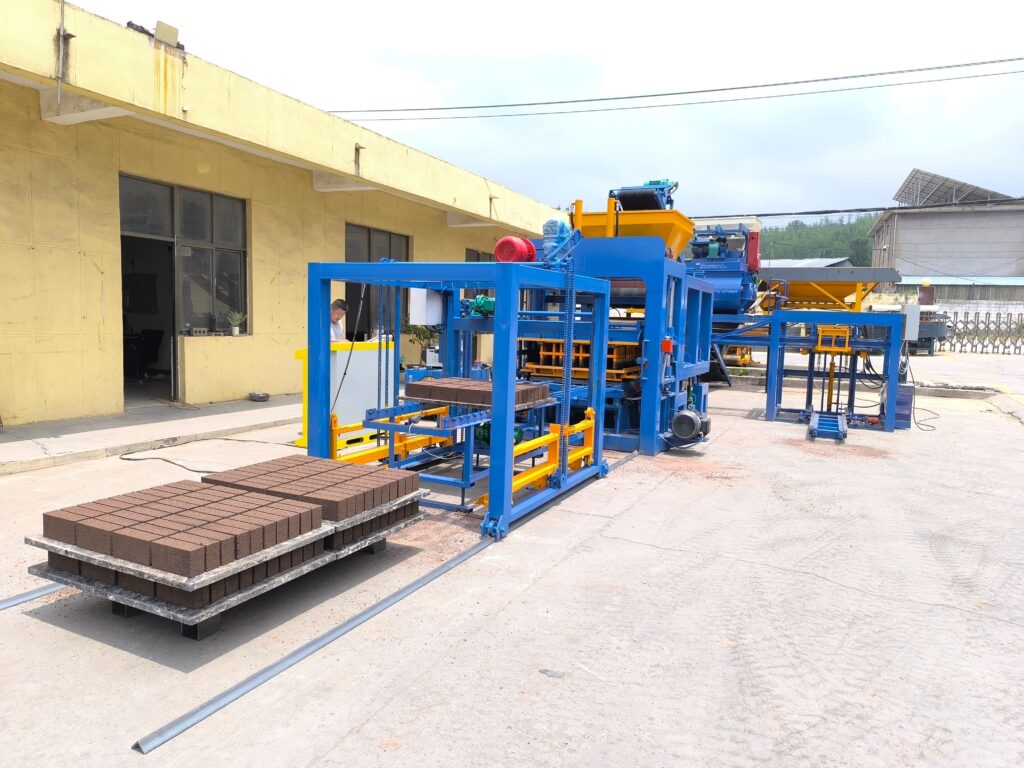
1. Defining Capacity: Key Metrics and Their Interdependence
The capacity of a block machine is not a single figure but a spectrum defined by several interconnected metrics.
1.1. Cycle Time: The Heartbeat of Production
The most fundamental unit of measurement is the machine cycle—the complete sequence from filling the mold to ejecting a finished pallet of blocks. Cycle times for modern stationary machines typically range from 10 to 25 seconds. This single number is the primary driver of all other output calculations. A machine with a 15-second cycle completes 240 cycles per hour under continuous operation.
1.2. Mold Configuration: The Multiplier Effect
Capacity is directly multiplied by the number of cavities in the machine’s mold. A standard mold configuration is expressed as, for example, “4-wide x 2-high,” meaning it produces 8 standard (8″x8″x16″) blocks per cycle.
- Common Configurations: Machines can be configured from small (e.g., 3×2 = 6 blocks/cycle) to very large (e.g., 6×3 = 18 blocks/cycle or more for smaller units like bricks or pavers).
- Product-Specific Molds: The capacity for producing solid blocks, partition blocks, or pavers will differ even on the same machine, as mold cavities for smaller, denser units can be packed more densely.
1.3. Theoretical Maximum Output
This is the headline figure often advertised. It is calculated as:
(Seconds per hour / Cycle time in seconds) x Number of cavities per mold.
- Ejemplo: A machine with an 18-second cycle and a 4×2 (8-cavity) mold.
- Cycles per hour: 3600 seconds / 18 seconds = 200 cycles.
- Theoretical Output: 200 cycles x 8 blocks = 1,600 blocks per hour.
It is crucial to understand that this is an ideal, unattainable figure in sustained practice, as it assumes zero stoppages, perfect material flow, and instantaneous changeovers.
2. Factors That Determine Real-World, Sustainable Capacity
The gap between theoretical maximum and real-world sustainable output is where operational expertise and machine quality are proven. Sustainable capacity is the reliable output a plant can maintain over an 8-hour shift or a 5-day week.
2.1. Machine Design and Reliability
- Hydraulic System Robustness: A high-quality, thermally stable hydraulic system maintains consistent cycle times without overheating and minimizes unplanned downtime.
- Eficiencia del Sistema de Vibración: Powerful, well-balanced vibration tables ensure optimal compaction on the first cycle, preventing the need for re-compaction attempts that lengthen cycle time.
- Automation and Control Systems: Advanced Programmable Logic Controllers (PLCs) with precise sensor feedback ensure repeatable movements, reduce jams, and facilitate quicker product changeovers.
2.2. The “Ecosystem” of Production: Upstream and Downstream Integration
A machine is only as fast as its slowest supporting system. Real capacity is bottlenecked by:
- Raw Material Supply: Can the batching plant mix and deliver enough consistent, quality concrete to keep the machine’s feed hopper full at all times?
- Circulación de Tarimas: The system for feeding empty pallets into the machine and transporting loaded pallets to the curing chamber must be flawless. Any delay here stops the entire machine.
- Curing and Cubing Capacity: The curing kilns must have sufficient volume and turnover rate to accept the machine’s output. Similarly, the depalleting and cubing stations must keep pace. Production halts if the curing area is full.
2.3. Human and Operational Factors
- Changeover Time: Switching from producing standard blocks to partition blocks or pavers requires changing the mold and adjusting machine settings. Efficient designs and trained crews minimize this non-productive time.
- Mantenimiento Preventivo: Scheduled pauses for lubrication, inspection, and part replacement are non-negotiable for long-term reliability. A machine run without maintenance will see catastrophic drops in capacity due to major breakdowns.
- Habilidad del Operador: Technicians must be able to troubleshoot minor issues quickly, adjust mixes for daily conditions (e.g., aggregate moisture), and optimize machine parameters for the specific product being run.
3. Capacity in Context: Machine Types and Product Mix
Capacity must always be evaluated in relation to the intended product portfolio.
3.1. Stationary Plant vs. Mobile Machine
- High-Capacity Stationary Plants: These are the systems discussed above, designed for outputs ranging from 800 to over 3,000 standard blocks per hour in sustainable production. They supply regional distribution networks and major projects.
- Mobile On-Site Machines: Capacity is measured differently, often in square meters of wall produced per day. Their output is lower (e.g., equivalent to 500-1,500 blocks per day) but their value lies in eliminating transport costs for large, localized projects. Their capacity is limited by on-site mix preparation and block handling.
3.2. The Impact of Product Complexity
A machine’s capacity is fluid based on what it is making.
- Bloques Huecos Estándar: Maximum output, as the mix and mold design are optimized for the core process.
- Specialty Units (e.g., Interlocking Pavers, Retaining Wall Blocks): Output can drop by 20-40%. These products often require longer vibration times for intricate shapes, finer concrete mixes that may flow differently, and more delicate handling upon ejection.
- Insulated Concrete Forms (ICFs) or Architectural Screen Blocks: These complex shapes have the most significant impact, potentially reducing cycle count by 50% or more due to extended compaction needs and slower, more careful demolding.
4. Strategic Implications for Distribution and Procurement
For the supply chain, understanding true capacity translates into risk management and strategic planning.
4.1. Assessing Supplier Reliability and Scalability
When evaluating a manufacturing partner, ask not for their machine’s brochure capacity, but for their historical sustainable output data over a quarterly period. Inquire about their plant’s bottleneck, their maintenance schedule, and their buffer curing capacity. This reveals their true ability to fulfill a large, time-sensitive order without disrupting your other supply lines.
4.2. Inventory Forecasting and Lead Time Management
Knowing that a supplier’s effective weekly capacity is, for instance, 200,000 blocks allows for accurate forecasting. You can plan inventory builds for the construction season and provide realistic lead times to your clients, especially for custom products or colors that require production line changeovers.
4.3. Guiding Client Specifications and Project Planning
Armed with this knowledge, you can professionally guide contractors and developers. If a project requires 50,000 specialty pavers, you can counsel them that this may represent a week of dedicated production for a plant, influencing the project timeline. This advisory role builds trust and positions you as a strategic partner, not just an order-taker.
4.4. The “Hidden” Capacity: Flexibility and Responsiveness
A plant with two machines of different sizes may have a lower total headline capacity than a plant with one massive machine. However, the dual-plant setup has higher effective capacity for the market, as it can run standard blocks on one line and specialty products on the other simultaneously, offering greater flexibility and responsiveness to diverse client needs—a crucial consideration for distributors serving varied market segments.
Conclusión
The capacity of a block machine is a dynamic and revealing metric that serves as a proxy for a manufacturer’s overall capability, efficiency, and strategic sophistication. It is a symphony of mechanical speed, systemic integration, and operational discipline, not merely a function of motor power. For distributors and procurement professionals, delving into the nuances of sustainable output, product-mix impacts, and ecosystem bottlenecks is an essential due diligence exercise. It enables the identification of truly reliable partners, the mitigation of supply chain risk, and the delivery of credible, expert guidance to the end client. In a market where timely delivery is as critical as product quality, understanding the true meaning of capacity is what separates a reactive vendor from a proactive, value-driving partner in the construction ecosystem.
FAQ (Frequently Asked Questions)
Q1: What is a realistic “efficiency factor” to apply to a theoretical capacity to estimate sustainable output?
A: A well-run, modern plant with integrated material handling and a disciplined maintenance program can typically achieve a 75-85% efficiency factor over an 8-hour shift. This accounts for scheduled pauses, minor jams, and mix adjustments. For weekly or monthly calculations, factoring in planned maintenance downtime, the efficiency may be 70-80%. Always use the more conservative figure for supply planning.
Q2: How does raw material quality specifically impact machine capacity?
A: Poor quality materials are a primary cause of reduced output. Oversized or poorly graded aggregate can cause blockage in the feed system or mold. Inconsistent moisture in the sand leads to variable mix workability, causing the machine to auto-adjust or even stop to prevent making off-spec product. A low-quality mix will result in more broken blocks upon ejection, creating waste and forcing the machine to run longer to meet the net output target.
Q3: Can capacity be increased on an existing machine?
A: There are limited pathways, each with trade-offs:
- Cycle Time Optimization: Fine-tuning vibration and pressure parameters can sometimes shave 1-2 seconds off a cycle.
- Mold Cavity Increase: Upgrading from a 4×2 to a 5×2 mold increases output per cycle but requires verifying the machine’s hydraulic system and frame can handle the increased load.
- Ecosystem Upgrades: The most effective upgrade is often downstream, such as adding a faster pallet return system or expanding curing space, which allows the machine to run at its designed cycle time more consistently.
Q4: For a distributor, is it better to source from one high-capacity plant or several smaller ones?
A: This is a core strategic decision. A single high-capacity plant offers simplicity, consistent product quality, and volume pricing but creates a single point of failure. Multiple smaller suppliers diversify risk and may offer greater flexibility and local service but can lead to inconsistencies in product and require more complex logistics management. A hybrid approach, with a primary high-capacity partner and a secondary regional supplier, is often optimal.
Q5: How should capacity be factored into pricing negotiations?
A: Understand that a plant running at near its sustainable capacity is operating most efficiently, lowering its per-unit fixed cost. Your largest, most predictable orders that allow for optimized production runs should command the best pricing. Conversely, small, rush, or custom orders that force changeovers and interrupt high-volume production will carry a premium. Negotiate based on your ability to provide forecasted, volume-stable business.