
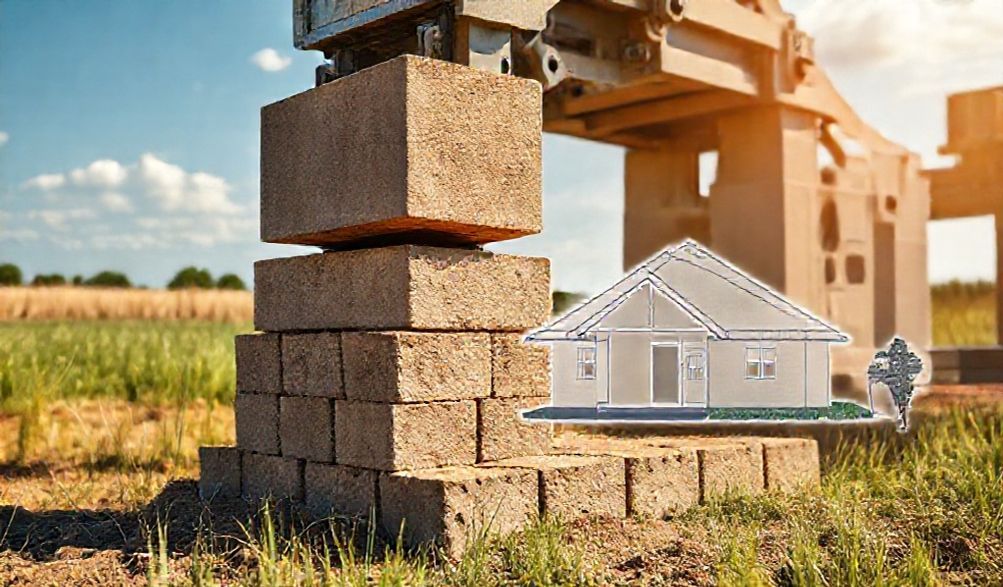
La Guía Definitiva sobre Máquinas para Bloques de Tierra: Construyendo un Futuro Sostenible
Las crisis gemelas de la vivienda asequible y el cambio climático a nivel global exigen una reinvención radical de cómo construimos. La industria de la construcción es un contribuyente importante a las emisiones de carbono y al agotamiento de recursos, mientras que miles de millones carecen de acceso a un refugio seguro y digno. ¿Y si la solución para construir estructuras más fuertes, saludables y resistentes estuviera literalmente bajo nuestros pies? ¿Y si pudiéramos transformar el material local más abundante—el suelo—en bloques de construcción precisos y duraderos con una fracción del impacto ambiental?
Ingresa elMáquina para hacer bloques de tierra, también conocida como prensa de bloques de tierra comprimida (CEB) o máquina de bloques de suelo. Esta tecnología transformadora no es una fantasía futurista, sino una herramienta práctica y comprobada que mecaniza uno de los métodos de construcción más antiguos de la humanidad. Empodera a individuos, comunidades y desarrolladores para crear sus propios materiales de construcción, reduciendo costos y construyendo un futuro verdaderamente sostenible desde cero.
Esta guía completa está diseñada para constructores, arquitectos, entusiastas del bricolaje con visión de futuro y ecoemprendedores. Iremos más allá del ruido superficial, basándonos en principios de ingeniería, experiencia real en construcción y las mejores prácticas de la industria para brindar información confiable y práctica. No solo aprenderás¿qué?unaMáquina para hacer bloques de tierraes, pero¿cómo?para integrarlo exitosamente en un proyecto, desde seleccionar el equipo adecuado y analizar tu suelo, hasta diseñar estructuras duraderas y comprender los beneficios a largo plazo. Descubramos juntos el potencial de la tierra.
¿Qué es una máquina de bloques de tierra? La ciencia de la estabilización del suelo.
En esencia, una máquina de bloques de tierra es un dispositivo que comprime suelo húmedo e ingenierizado en un bloque denso y de forma regular. Es el puente entre la tierra cruda y la construcción moderna, ofreciendo consistencia y resistencia que el adobe hecho a mano no puede igualar.
Desde el adobe antiguo hasta la ingeniería moderna
Durante milenios, la humanidad ha construido con tierra—desde la Gran Muralla China hasta las imponentes mezquitas de África Occidental. El adobe tradicional (ladrillos de barro secados al sol) nos sirvió bien, pero su producción requiere mucha mano de obra y la calidad puede variar. En los siglos XIX y XX surgieron las prensas mecánicas para estandarizar este proceso. Hoy en díamáquinas de bloques de tierrason la evolución de ese ingenio, aplicando una fuerza mecánica precisa y medible para crear un producto que cumple con los estándares contemporáneos de construcción en cuanto a resistencia, durabilidad y uniformidad dimensional.
¿Cómo funciona una máquina de bloques de tierra comprimida (BTC)?
El proceso es elegantemente simple, pero depende de una ejecución precisa.
- Preparación:El suelo se tamiza, se mezcla con una pequeña cantidad de agua (y a menudo un estabilizador como cal o cemento), y se carga en la tolva de la máquina.
- Compresión:Un mecanismo—una palanca manual, un volante mecánico o un pistón hidráulico—fuerza el suelo dentro de un molde de acero sólido (troquel) bajo una presión extrema, típicamente entre 500 y 1,500 PSI. Esta presión alinea las plaquetas de arcilla y elimina los espacios vacíos.
- Eyección: The newly formed, highly dense block is ejected from the mold, stable enough to be handled immediately and stacked for curing.
Machines generally fall into three categories:
* Prensas Manuales: Lever-operated, human-powered. Ideal for small-scale, low-budget projects or community workshops. Production is slower but costs are minimal.
* Prensas Hidráulicas: Use a hydraulic pump (often diesel or electric) to generate immense, consistent pressure. They are the workhorses for medium to large projects, offering high output and excellent block uniformity.
* Mechanical Presses: Utilize a flywheel and cam system to generate compression. Known for high-speed production in industrial settings.
Componentes Clave y Sus Funciones
Understanding the machine’s anatomy helps in selection and operation:
* Hopper: The loading bay for the soil mix. A well-designed hopper ensures consistent feed and prevents bridging or clogging.
* Molde/Matriz: The heart of the machine. This hardened steel chamber defines the block’s shape (rectangular, interlocking) and size. Its quality directly impacts block finish and durability.
* Mecanismo de Compresión: The source of pressure. Its force (measured in tons or PSI) and consistency determine the final block strength.
* Marco: The structural skeleton. A robust, welded steel frame is non-negotiable to withstand constant stress and ensure alignment over thousands of cycles.
Why Choose an Earth Block Machine? Tangible Benefits and Impact
Investing in this technology is an investment in a different paradigm of construction. The benefits are environmental, economic, and social.
Unmatched Sustainability and Environmental Credentials
- Energía Incorporada Ultra-Baja: Manufacturing cement and fired bricks is incredibly energy-intensive. CEBs use the sun’s energy for curing and require only the mechanical energy of compression.
- Huella de Carbono Mínima. They drastically reduce CO2 emissions associated with material transport (using on-site or local soil) and production.
- Use of Subsoil: Productive topsoil is preserved for agriculture. Machines often use subsurface “resource soil.”
- 100% Recyclable: At end of life, an earth block can be crushed, re-moistened, and repressed into a new block or simply returned to the earth.
Significant Cost Reduction in Construction
- Material Cost: The primary material—soil—is often free or very low cost.
- Transportation: Eliminating the need to ship heavy materials like bricks or concrete blocks over long distances saves massively on fuel and logistics.
- Owner-Builder Potential: Empowers self-build projects, reducing labor costs. It turns building materials from a capital expense into a manageable operational one.
Superior Building Performance and Comfort
- Masa Térmica: Earth blocks absorb heat during the day and release it at night, naturally regulating indoor temperatures and slashing heating/cooling costs.
- Humidity Control: The material is hygroscopic, passively absorbing and releasing moisture to maintain ideal indoor humidity (40-60%).
- Resistencia al Fuego: They are inherently non-combustible, providing excellent fire safety.
- Acoustic Insulation: The mass and density of earth walls provide superb sound insulation.
Empowerment and Local Economic Development
This technology decentralizes production. It enables:
* Self-Reliance: Communities can build their own schools, clinics, and homes.
* Local Enterprise: Small businesses can spring up to produce blocks for their region.
* Desarrollo de Habilidades Creates valuable local jobs in machine operation, soil testing, and earth-based construction.
Choosing the Right Earth Block Machine: A Buyer’s Expert Checklist
Selecting a machine is a critical decision. The right choice depends on your project’s specific needs, not just the machine’s price tag.
Assessing Your Project Scale and Output Needs
- Small Home/DIY Project (e.g., < 2,000 blocks): A manual press may be sufficient and cost-effective.
- Multiple Homes/Community Project (e.g., 2,000 – 50,000 blocks): A motorized hydraulic press is likely necessary for efficiency and labor savings.
- Commercial Enterprise/Development: High-output mechanical or hydraulic machines with automation (e.g., auto-feed) are required.
Critical Technical Specifications to Scrutinize
- Fuerza de Compresión Measured in tons, PSI, or MPa. Higher force generally means stronger blocks, but must be matched to your soil type.
- Block Dimensions & Shapes: Standard rectangular or interlocking “LEGO-style” blocks that reduce mortar use. Ensure the size fits your design.
- Production Rate: Blocks per hour. Manufacturer rates are often ideal; factor in real-world workflow for a realistic estimate.
- Fuente de Energía: Electric, diesel, or PTO (tractor-powered). Consider your site’s energy access.
Soil Compatibility: The Most Important Factor
This is the cornerstone of success. Not all soil is suitable. The ideal mix is a “rammed earth” blend:
* ~70% Sand and Gravel: Provides the skeletal structure and compressive strength.
* ~30% Silt and Clay: Acts as the natural binder, holding the block together.
Perspectiva de Expertos: You debo conduct a soil test. Simple field tests (ribbon test, jar test) give a rough idea, but professional lab analysis (proctor test, particle size distribution) is a wise investment for any serious project. Based on results, you will determine if and what type of stabilizer is needed:
* Limón: Best for clay-rich soils, reacts chemically for a strong, water-resistant bond.
* Cement (3-10%): A common stabilizer for a wide range of soils, providing reliable strength quickly.
* Bitumen or Polymers: For specific applications requiring high water resistance.
Durability, Support, and Total Cost of Ownership
- Calidad de Construcción: Inspect welds, steel thickness, and component quality. It must endure abrasive soil and constant pressure.
- Spare Parts & Support: Ensure wear parts (molds, rams, seals) are available and the manufacturer offers technical support.
- Warranty & Reputation: Research the manufacturer’s track record. A longer warranty on the frame and compression system is a good sign.
- Total Cost: Factor in shipping, import duties (if applicable), and the cost of any necessary ancillary equipment (e.g., a soil sieve or mixer).
Operating Your Machine: A Step-by-Step Protocol for Success
Owning the machine is just the start. Proper operation is key to producing high-quality blocks.
Phase 1: Comprehensive Soil Testing and Preparation
- Sample: Take soil samples from several spots on your site, from a consistent depth below topsoil.
- Analyze: Perform or commission tests to determine composition.
- Diseño de Mezcla: Based on results, create a mix recipe: X parts soil, Y% stabilizer, Z% water.
- Prepare: Sieve soil to remove stones and organic matter. Use a mechanical mixer for consistency. Moisture content is critical—aim for “optimum moisture” where the mix holds its shape when squeezed but leaves no excess water on your hand.
Phase 2: Machine Setup and Calibration
- Safety First: Clear the area. Wear gloves and safety glasses. Ensure all guards are in place.
- Assembly & Leveling: Assemble per manual. The machine must be on a solid, level base.
- Test Runs: Run several test blocks with your mix. Adjust moisture up or down in small increments until the ejected block has sharp edges, a smooth surface, and doesn’t crumble.
Phase 3: Efficient Production and Quality Control
- Workflow: Establish a rhythm: loading, compressing, ejecting, stacking. A team of 3-4 people is often ideal.
- Control de Calidad: Regularly check block dimensions and weight. Drop a finished block from waist height onto a hard surface; a good block should not break.
- Curado: Stack blocks under a breathable cover (plastic sheeting) for at least 14-28 days. Keep them moist (by misting) for the first week if using cement stabilization to ensure proper curing strength.
Phase 4: Maintenance for Longevity
- Diariamente Clean all soil residue from the hopper, mold, and ram. Lubricate all moving points as per the manual.
- Semanal Check for loose bolts, hydraulic leaks, or wear on the mold faces.
Beyond the Machine: Designing and Building with Earth Blocks
The machine makes the block, but knowledge builds the wall.
Architectural Design Principles for Earth Block Walls
- Foundations: A raised, moisture-proof foundation (stone, stabilized earth, or concrete) is essential to protect blocks from ground moisture and splash-back.
- Bond Beams: A reinforced concrete or wooden bond beam at the top of walls is crucial to tie the structure together and support the roof, especially in seismic zones.
- Lintels: Use reinforced concrete, stone, or wood over doors and windows.
- Design for Climate: Wide roof overhangs (60cm+) are critical in rainy climates to shield walls. In all climates, the thermal mass works best when walls are exposed internally.
Mortar, Plastering, and Finishing Techniques
- Mortero Use a slurry made from the same soil mix as your blocks, or a weak cement-lime-sand mortar. The goal is a bond that is slightly weaker than the block to allow for movement.
- Plaster: Earth blocks are best finished with breathable, earth-based plasters (clay or lime). They allow moisture vapor to pass through, protecting the wall. Cement-based stucco can trap moisture and cause spalling.
Real-World Case Studies and Project Galleries
- The “Miami Earth House,” USA: A modern, code-compliant residence in Florida demonstrating CEB’s viability in a humid climate, featuring passive cooling and dramatically lower energy bills.
- The Auroville Earth Institute, India: A global leader in research and training, their campus features stunning arches, domes, and vaults built with interlocking CEBs, showcasing architectural versatility.
- School Complex in Rwanda: A humanitarian project using locally produced CEBs to build durable, cool, and quiet classrooms at a fraction of the cost of conventional materials, empowering the local community.
Frequently Asked Questions (FAQ)
Q: What is the typical compressive strength of blocks made with an earth block machine?
A: Unstabilized blocks can achieve 2-4 MPa (approx. 300-600 PSI). With proper soil mix and cement stabilization (5-10%), strengths of 7-10+ MPa (1000-1500+ PSI) are common—surpassing many conventional fired bricks and matching some concrete masonry units.
Q: Can I use any soil from my property with a CEB machine?
A: Not necessarily. While many soils are suitable, some require amendment or stabilization. Simple field tests (like the jar test) can give you an initial idea, but for a building project, professional analysis is strongly recommended to determine the exact mix design.
Q: How does the cost of an earth block structure compare to conventional brick or concrete block?
A: Material costs are often 50-80% lower. The overall project cost depends on labor. For owner-builder projects, total savings can be 30-50%. For contracted projects, savings are still significant, primarily in material costs, though labor for laying earth blocks is comparable.
Q: Are earth block homes suitable for all climates?
A: Yes, with appropriate design. In wet climates, this means large roof overhangs, raised foundations, and breathable, water-shedding plasters. In cold climates, their high thermal mass stores passive solar heat. They excel in hot, arid climates.
Q: Where can I get training or see building codes for earth block construction?
A: Seek training from established institutions like the Auroville Earth Institute (India) or the CalEarth Institute (USA). For codes, refer to ASTM E2392 / E2392M (Standard Guide for Design of Earthen Wall Building Systems) and resources from the International Code Council (ICC) or your local building authority, which may have adopted appendices for earth construction.
Conclusión
ElMáquina para hacer bloques de tierra is far more than a piece of equipment; it is a key that unlocks a more resilient, affordable, and ecologically sane approach to building. This guide has walked you through the science, the economics, the practical selection criteria, and the operational protocols that transform raw earth into a modern building material.
The technology is proven, the expertise is available, and the authority of earth-based construction is growing within the architectural and engineering communities. Choosing this path is an investment not just in a machine, but in a skill set and a philosophy that places sustainability, self-reliance, and human comfort at the center of the built environment.
Your informed journey begins now. Take the next step: conduct a simple soil test on your land, connect with the global community of earth builders online, or reach out to reputable manufacturers to discuss your specific project vision. The future of building is, quite literally, foundational.
<