
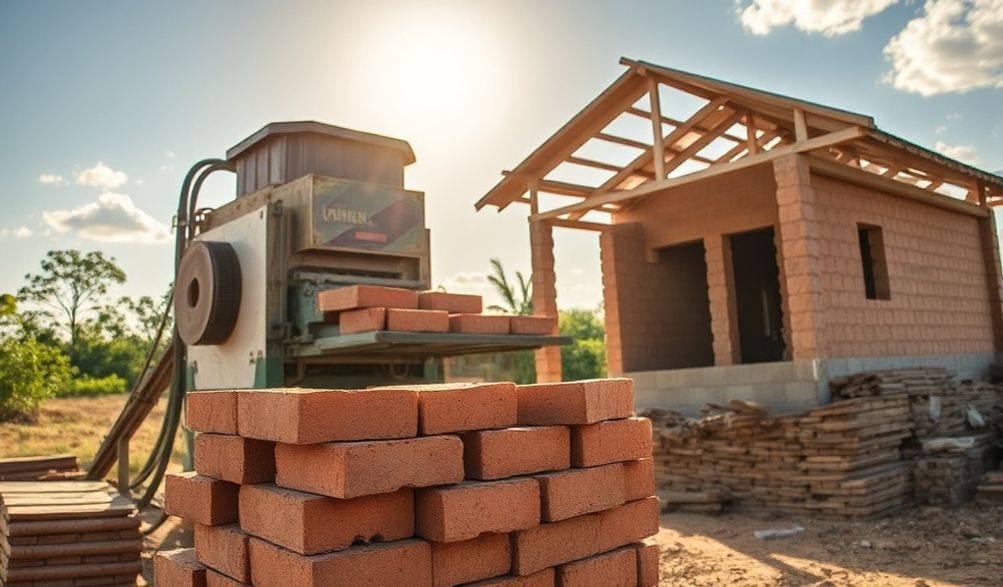
La Guía Definitiva sobre Máquinas para Ladrillos de Tierra en Camerún: Construyendo de Manera Sostenible y Económica
Introducción
Camerún enfrenta un desafío habitacional profundo. Con una población urbana en rápido crecimiento y un déficit habitacional rural significativo, la demanda de viviendas asequibles y duraderas nunca ha sido mayor. Agravando esta necesidad está el costo disparado de materiales de construcción convencionales como el cemento y el acero importado, lo que impone una pesada carga financiera a familias, emprendedores y proyectos comunitarios. Para muchos cameruneses, el sueño de construir un hogar seguro o iniciar un negocio de construcción parece cada vez más inalcanzable.
¿Pero qué tal si la solución estuviera literalmente bajo nuestros pies? A lo largo de Camerún—desde los suelos ricos en arcilla de la Región del Oeste hasta la tierra laterítica alrededor de Yaundé—se encuentra la clave para una revolución constructiva. Las máquinas de Ladrillos de Tierra Comprimida (LTC) están transformando este material abundante y local en bloques de construcción de alta resistencia y bajo costo. Esta tecnología no es un paso atrás; es un salto hacia una construcción más inteligente, sostenible y autosuficiente.
Esta guía integral está diseñada para constructores cameruneses, emprendedores en ciernes, líderes comunitarios y desarrolladores con visión de futuro. Sintetizamos conocimiento práctico de la industria, perspectivas de proyectos locales en Douala, Bamenda y más allá, así como consejos claros y accionables adaptados a nuestro clima y mercado específicos. Aprenderás cómo funcionan las máquinas para fabricar ladrillos de tierra, por qué son una opción superior para nuestro contexto, cómo seleccionar y operar una, y cómo esta tecnología ya está construyendo un futuro mejor en todo Camerún. Exploremos cómo convertir la tierra en refugio.
¿Qué es una Máquina de Ladrillos de Tierra Comprimida (CEB)?
La Tecnología Central Explicada
En esencia, una máquina para fabricar Ladrillos de Tierra Comprimida (CEB, por sus siglas en inglés) es una prensa mecánica diseñada para compactar tierra húmeda y estabilizada en ladrillos densos y de forma regular. A diferencia de los ladrillos de adobe secados al sol tradicionales, la máquina aplica una presión inmensa—típicamente mediante una palanca, un tornillo mecánico o un pistón hidráulico—para crear un producto con una resistencia estructural y durabilidad significativamente mayores. El proceso imita la formación geológica, creando una arenisca artificial en minutos.
La clave del rendimiento del ladrillo esestabilizaciónMientras que la tierra (aproximadamente 90-95% de la mezcla) proporciona el volumen, se añade un pequeño porcentaje (usualmente del 3 al 10%) de un estabilizador como cemento Portland o cal hidratada. Este aglutinante aumenta drásticamente la resistencia a la compresión del ladrillo y, lo que es más importante para el clima tropical de Camerún, su resistencia a la erosión por agua. La máquina en sí es una pieza de ingeniería sencilla: la mezcla de tierra se introduce en una tolva, se dirige a una cámara de compresión donde un molde le da forma bajo alta presión, y luego se expulsa un ladrillo sólido y terminado, listo para curarse.
Del Suelo al Ladrillo Sólido: El Proceso Sencillo
La transformación de la tierra cruda a bloque de construcción sigue una secuencia lógica y manejable.
- Abastecimiento y Pruebas de Suelo:Se retira la capa superior de tierra vegetal orgánica. Luego se prueba la subsuelo para determinar su idoneidad (más sobre este paso crítico más adelante).
- Mezcla:La tierra se cierne para eliminar piedras grandes y escombros. Luego se mezcla a fondo con la cantidad precisa de estabilizador (cemento/cal) y agua. Lograr el contenido de humedad correcto—"humedad óptima"—es crucial para una compactación adecuada.
- Comprimiendo:La mezcla homogénea se introduce en la cámara de la máquina. Luego, el operador activa la prensa, aplicando toneladas de presión para formar un ladrillo firmemente entrelazado.
- Curado:Los ladrillos recién prensados se apilan cuidadosamente en un área sombreada y bien ventilada, manteniéndolos ligeramente húmedos (a menudo cubriéndolos con láminas de plástico) durante 14 a 28 días. Esto permite que el estabilizador de cemento se hidrate completamente, alcanzando su máxima resistencia.
¿Por qué elegir una máquina de ladrillos de tierra para construir en Camerún?
Reducción Dramática de Costos
El argumento económico para los bloques de tierra comprimida (BTC) en Camerún es convincente. Los costos de construcción están dominados por los materiales, y la tecnología de BTC ataca esto directamente:
* Materiales Locales:El 90-95% de tu material es tierra, a menudo disponible directamente en el sitio o obtenida de manera muy local, eliminando los enormes costos de transporte de arena, grava y una gran parte del cemento.
* Reduced Cement Use: A CEB wall uses significantly less cement than an equivalent concrete block wall. You are replacing expensive, energy-intensive cement with free, local earth.
* Comparative Analysis: While prices fluctuate, evidence from projects in Sub-Saharan Africa indicates that CEB walls can reduce material costs by 30% to 50% compared to conventional fired clay bricks or concrete blocks. For a family building a home or an entrepreneur supplying bricks, this is a transformative saving.
Superior Sustainability & Environmental Benefits
CEB construction aligns perfectly with global and local sustainability goals, offering profound environmental advantages:
* Baja Huella de Carbono: There is no high-temperature firing process. The bricks cure at ambient temperature, saving the firewood or fossil fuels used in kilns and avoiding associated CO2 and particulate emissions.
* Minimal Waste: Production creates almost no waste. Unused soil mix can be re-mixed, and damaged bricks can be crushed and reintroduced into the process.
* Natural Thermal Regulation: CEBs have high thermal mass. They absorb heat during the day and release it slowly at night, naturally regulating indoor temperatures. This can dramatically improve comfort and reduce the need for energy-intensive air conditioning in Cameroon’s hot regions—a direct long-term cost saving.
* Biodegradable & Non-Toxic: At the end of a building’s very long life, the bricks can simply return to the earth or be crushed for reuse, creating a truly circular material flow.
Proven Durability & Strength
A common misconception is that earth bricks are weak or temporary. Properly made CEBs are exceptionally durable.
* Resistencia a la Compresión: A well-produced, stabilized CEB can achieve compressive strengths between 2 and 7 MPa (Megapascals), easily meeting and often exceeding the requirements for single and two-story residential construction as outlined in many building codes.
* Resilience: They are inherently fireproof, rodent-proof, and, when properly stabilized and rendered, highly resistant to weathering. The longevity of ancient earth structures worldwide is a testament to the material’s inherent durability.
* Expert Endorsement: Organizations like UN-Habitat have extensively promoted earth construction for affordable housing in Africa. Research from institutions like the University of Yaoundé I’s Faculty of Science has contributed to the body of knowledge on local soil suitability and stabilization techniques, validating the technology for our specific context.
Key Considerations Before Buying a Machine in Cameroon
Assessing Your Soil Suitability
Not all soil is perfect. Conducting simple field tests before investing is non-negotiable.
- The Jar Test (Sedimentation Test): Fill a clear jar one-third with soil, add water, shake vigorously, and let it settle for 24 hours. The layers will reveal the approximate proportions of gravel (bottom), sand, silt, and clay (top). Ideal CEB soil is roughly 70% sand and 30% combination of silt and clay.
- The Ribbon Test: Take a moist handful of soil and roll it into a ribbon between your thumb and forefinger. If it forms a long, flexible ribbon, it has high clay content. If it crumbles quickly, it is sandy. A moderate ribbon length indicates a good balance.
- For Major Projects: Consider a formal lab test. Institutions like the National Advanced School of Public Works (ENSTP) in Yaoundé or private geotechnical labs can provide a precise particle size analysis and recommend optimal stabilization percentages.
Types of Machines: Manual vs. Hydraulic
Your choice depends on budget, scale, and site conditions.
| Feature | Manual Press (e.g., Makiga, TerraBrick) | Hydraulic/Electric Press |
| :— | :— | :— |
| Precio | Low initial investment (CFA 500,000 – 2,000,000+) | High initial investment (CFA 3,000,000+) |
| Output/Day | Lower (150 – 500 bricks) | High (1,000 – 3,000+ bricks) |
| Power Needed | Human power only | Requires electricity or a generator |
| Mejor Para | Owner-builders, small homes, community projects, NGOs. | Commercial brick-making enterprises, large housing projects, developers. |
| Key Advantage | Portability, independence from grid power, low cost. | Production speed, consistency, less operator fatigue. |
Sourcing Machines & Parts in Cameroon
Navigating the supply chain is a critical step.
- Local Dealers/Agents: The market is growing. Inquire with construction equipment suppliers in Douala and Yaoundé. Some international manufacturers have local representatives. Always ask for a live demonstration using local soil.
- Direct Importation: You can import a machine yourself. Be prepared to handle shipping, customs clearance (through agencies like the Cameroon Customs Directorate), and import duties. The major risk here is the lack of local after-sales support and spare parts.
- Critical Advice: Prioritize access to spare parts and technical support. Ask the supplier about the availability of replacement molds, wear plates, and hydraulic seals within Cameroon. A machine that breaks down and cannot be repaired for months is a financial loss.
Operating Your Earth Brick Machine: A Practical Guide
Setting Up Your Production Yard
Efficiency starts with organization. You will need:
* A Flat, Drained Area: For machine operation and curing.
* Shelter: A simple roofed structure is essential to protect curing bricks from direct sun and heavy rain.
* Organized Zones: Designate clear areas for raw soil stockpile, sieving, mixing, brick production, and stacked curing bricks.
* Water Access: A reliable water source for mixing and curing.
Daily Operation & Maintenance Checklist
Consistency ensures quality and machine longevity.
- Safety First: Wear gloves, safety glasses, and closed-toe shoes. Keep hands clear of compression chambers.
- Pre-Operation: Clean the machine of old soil residue. Check all bolts and fittings for tightness. Lubricate moving parts as per the manual.
- Troubleshooting:
- Bricks sticking in mold: Ensure the mold is clean and lightly lubricated (with oil or water). Check moisture content—too wet can cause sticking.
- Bricks crumbling or lack strength: Likely incorrect moisture (too dry) or insufficient stabilizer. Re-test your mix.
- Post-Operation: Thoroughly clean the machine. Store under cover.
Mastering the Mix & Curing for Best Results
This is where science meets craftsmanship.
- The “Optimum Moisture” Sweet Spot: The soil mix should be damp enough to hold together when squeezed in your fist, but leave no free water on your palm. It should crumble when poked. This requires practice and adjustment based on soil type and weather.
- Curing is Not Drying: Curing is a chemical process. Stack bricks off the ground on pallets, cover them with plastic sheeting or damp burlap sacks to retain moisture, and leave them for a minimum of two weeks. Spray with water lightly in very dry, hot weather.
- Control de Calidad: After 28 days, test a brick. It should be hard, have a clear “ring” when struck, and resist scratching. For formal projects, compressive strength tests can be done at local engineering labs.
Success Stories: Earth Brick Construction in Cameroon
Case Study: A Community School Project in the West Region
A local NGO, facing limited funds to build a much-needed primary school, turned to CEB technology. Sourcing soil directly from the site, they used a manual press operated by trained community members. The project faced challenges—initial skepticism and the need to train local masons in a new laying technique. However, the outcomes were transformative:
* Ahorro de Costos: Wall material costs were reduced by an estimated 40% compared to quoted prices for concrete blocks.
* Velocidad: Community involvement accelerated production and construction.
* Comfort: Teachers and students now report the classrooms remain noticeably cooler throughout the day than neighboring concrete buildings.
* Legacy: The project left the community with not just a school, but also the skills and equipment to build more structures.
Entrepreneur Spotlight: The Model for a Successful CEB Business
Imagine a young entrepreneur in the outskirts of Douala. Seeing the constant demand for affordable building materials, they invest in a medium-capacity hydraulic press. Their business model is clear:
1. Land & Soil: Secure a lease on land with suitable soil or arrange for low-cost delivery from a nearby source.
2. Producción: Manufacture standardized, high-quality bricks.
3. Market: Sell directly to individual home-builders, small contractors, and real estate developers marketing “eco-friendly” homes.
4. Value-Added Services: Offer soil testing, on-site training for masons, and even small-scale contracting.
The lessons from such a venture are universal: start with a solid business plan, build a reputation for quality (brick strength and consistency), and educate your market on the benefits of CEBs. This model creates local jobs, reduces construction costs in the community, and promotes sustainable development.
Frequently Asked Questions (FAQ)
Q1: Are earth brick houses strong enough for Cameroon’s heavy rainfall?
A: Absolutely. The combination of cement stabilization, a properly rendered or plastered exterior, and fundamental good construction practices—like a strong foundation above grade and wide roof overhangs (at least 45-60cm)—makes CEB walls highly resistant to rain. The key is to prevent sustained direct water impact.
Q2: Can I use any soil from my plot in Yaoundé, Douala, or Bamenda?
A: Not directly. You must remove the organic topsoil. The underlying subsoil in many urban and peri-urban areas of Cameroon is often suitable, but you debo perform the simple jar test first. Soils in the volcanic regions (e.g., parts of the West) may be particularly well-suited.
Q3: What is the typical production cost per brick compared to a concrete block?
A: Exact figures vary, but the cost advantage is clear. A concrete block’s cost is driven by purchased sand, gravel, and cement. A CEB’s cost is primarily the stabilizer (less cement), labor, and machine depreciation. If soil is free on-site, raw material cost for a CEB can be less than half that of a concrete block. A simplified calculation for a commercial operation might show a production cost of CFA 80-120 per CEBversusCFA 150-250+ for a concrete block.
Q4: Do I need special skills or training to operate the machine?
A: Basic training is essential for safety, efficiency, and quality. Reputable suppliers should provide this. The mechanical operation is simple to learn. The greater skill is in mastering soil mix preparation and curing—knowledge that any dedicated builder or entrepreneur can acquire.
Q5: Where can I see examples of these buildings in Cameroon?
A: Seek out NGOs working in sustainable development and housing, such as Codev Cameroon or the MAGHA Group. Inquire with the Ministry of Housing and Urban Development (MINHDU) or the Cameroon Society of Architects (SARC) about any demonstration projects. Visiting a supplier who has a showroom or project site is also an excellent way to see the technology in action.
Conclusión
The path to addressing Cameroon’s housing deficit and soaring construction costs is not solely through imported solutions or increasingly expensive conventional materials. It lies in harnessing innovative, appropriate technology that leverages our greatest local resource: the earth itself. Compressed Earth Brick machines offer a proven trifecta of benefits: profound affordability, exceptional environmental sustainability, and proven structural durability.
This guide, rooted in practical expertise and the specific realities of the Cameroonian market, climate, and soil, demonstrates that CEB technology is more than an alternative—it’s a smart, modern choice. It represents a future where communities are empowered to build their own homes, where entrepreneurs can build thriving businesses, and where development happens in harmony with the environment.
The next step is yours. Begin by testing the soil on your site. Connect with local experts, user groups, or training centers. Request a live demonstration from a supplier. By embracing earth brick technology, you are not just building a wall; you are building a more sustainable, self-reliant, and prosperous future for Cameroon.
<