
Hướng Dẫn Toàn Diện Về Máy Làm Gạch Đất Tại Cameroon: Xây Dựng Bền Vững & Tiết Kiệm Chi Phí
Giới thiệu
Cameroon đang đối mặt với một thách thức nhà ở sâu sắc. Với dân số đô thị tăng nhanh và tình trạng thiếu hụt nhà ở nông thôn đáng kể, nhu cầu về chỗ ở bền vững, giá cả phải chăng chưa bao giờ lớn hơn thế. Điều làm trầm trọng thêm nhu cầu này là chi phí vật liệu xây dựng truyền thống như xi măng và thép nhập khẩu tăng cao, gây gánh nặng tài chính nặng nề lên các gia đình, doanh nhân và dự án cộng đồng. Đối với nhiều người Cameroon, giấc mơ xây dựng một ngôi nhà kiên cố hay khởi nghiệp trong lĩnh vực xây dựng dường như ngày càng trở nên xa vời.
Nhưng sẽ thế nào nếu giải pháp lại nằm ngay dưới chân chúng ta? Trên khắp Cameroon - từ những vùng đất giàu sét ở Khu vực Miền Tây đến lớp đất đỏ laterit quanh Yaoundé - ẩn chứa chìa khóa cho một cuộc cách mạng xây dựng. Những máy ép gạch đất nén (CEB) đang biến nguồn nguyên liệu địa phương dồi dào này thành những viên gạch xây dựng bền chắc, chi phí thấp. Công nghệ này không phải là bước thụt lùi; mà là bước nhảy vọt hướng tới một nền xây dựng thông minh hơn, bền vững hơn và tự chủ hơn.
Hướng dẫn toàn diện này được thiết kế dành cho các nhà xây dựng Cameroon, các doanh nhân khởi nghiệp, lãnh đạo cộng đồng và các nhà phát triển có tầm nhìn. Chúng tôi tổng hợp kiến thức thực tiễn về ngành, những hiểu biết sâu sắc từ các dự án địa phương ở Douala, Bamenda và các khu vực khác, cùng những lời khuyên rõ ràng, có thể áp dụng được, phù hợp với điều kiện khí hậu và thị trường đặc thù của chúng ta. Bạn sẽ tìm hiểu về cách máy ép gạch đất hoạt động, tại sao chúng là lựa chọn vượt trội trong bối cảnh của chúng ta, cách lựa chọn và vận hành một chiếc máy, và cách công nghệ này đang và sẽ xây dựng một tương lai tốt đẹp hơn trên khắp Cameroon. Hãy cùng khám phá cách biến đất thành mái ấm.
Máy làm gạch đất nén (CEB) là gì?
Công Nghệ Cốt Lõi Được Giải Thích
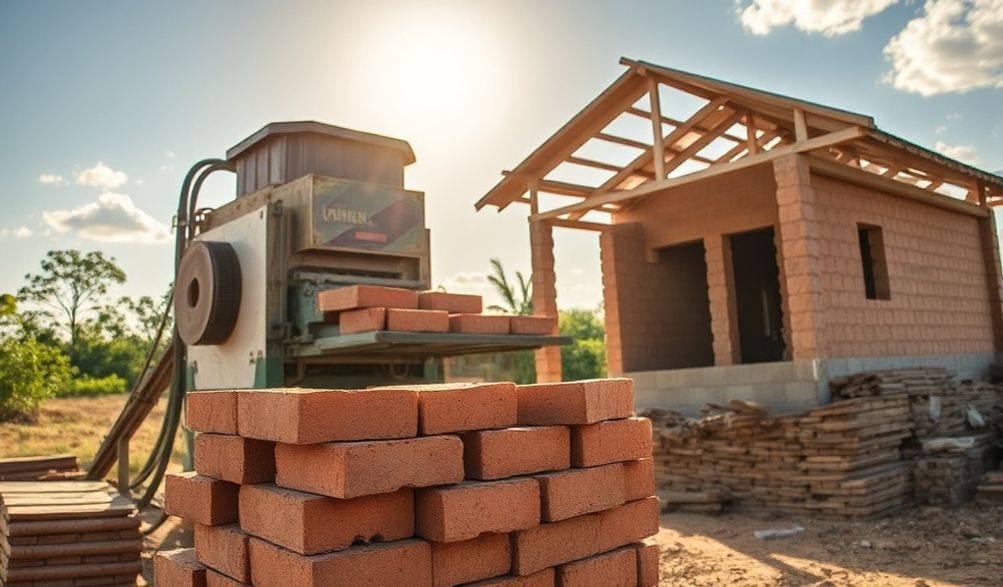
Về cốt lõi, máy ép gạch đất nén (CEB) là một thiết bị ép cơ học được thiết kế để nén đất ẩm đã qua xử lý ổn định thành những viên gạch đặc, có hình dạng đồng đều. Khác với gạch bùn phơi nắng truyền thống, máy này tạo ra áp lực cực lớn—thường thông qua một đòn bẩy, trục vít cơ học, hoặc pít-tông thủy lực—để tạo ra sản phẩm có độ bền kết cấu và độ bền vượt trội. Quy trình này mô phỏng quá trình hình thành địa chất, tạo ra một loại đá sa thạch nhân tạo chỉ trong vài phút.
The key to the brick’s performance is stabilization. While the soil (approximately 90-95% of the mix) provides the bulk, a small percentage (usually 3-10%) of a stabilizer like Portland cement or hydrated lime is added. This binder dramatically increases the brick’s compressive strength and, most importantly for Cameroon’s tropical climate, its resistance to erosion from water. The machine itself is a straightforward piece of engineering: soil mix is fed into a hopper, directed into a compression chamber where a mold gives it shape under high pressure, and then a finished, solid brick is ejected, ready for curing.
From Soil to Solid Brick: The Simple Process
The transformation from raw earth to building block follows a logical, manageable sequence:
- Sourcing & Testing Soil: The top layer of organic topsoil is removed. The subsoil is then tested for suitability (more on this critical step later).
- Pha trộn: The soil is sieved to remove large stones and debris. It is then thoroughly mixed with the precise amount of stabilizer (cement/lime) and water. Achieving the correct moisture content—”optimum moisture”—is crucial for proper compaction.
- Nén: The homogeneous mix is fed into the machine’s chamber. The operator then activates the press, applying tonnes of pressure to form a tightly interlocked brick.
- Chữa bệnh: The freshly pressed bricks are carefully stacked in a shaded, well-ventilated area and kept slightly damp (often by covering with plastic sheeting) for 14 to 28 days. This allows the cement stabilizer to hydrate fully, reaching its maximum strength.
Why Choose an Earth Brick Machine for Building in Cameroon?
Dramatic Cost Reduction
The economic argument for CEBs in Cameroon is compelling. Construction costs are dominated by materials, and CEB technology attacks this directly:
* Local Materials: 90-95% of your material is soil, often available directly on-site or sourced very locally, eliminating massive transport costs for sand, gravel, and a large portion of cement.
* Reduced Cement Use: A CEB wall uses significantly less cement than an equivalent concrete block wall. You are replacing expensive, energy-intensive cement with free, local earth.
* Comparative Analysis: While prices fluctuate, evidence from projects in Sub-Saharan Africa indicates that CEB walls can reduce material costs by 30% to 50% compared to conventional fired clay bricks or concrete blocks. For a family building a home or an entrepreneur supplying bricks, this is a transformative saving.
Superior Sustainability & Environmental Benefits
CEB construction aligns perfectly with global and local sustainability goals, offering profound environmental advantages:
* Low Carbon Footprint: There is no high-temperature firing process. The bricks cure at ambient temperature, saving the firewood or fossil fuels used in kilns and avoiding associated CO2 and particulate emissions.
* Minimal Waste: Production creates almost no waste. Unused soil mix can be re-mixed, and damaged bricks can be crushed and reintroduced into the process.
* Natural Thermal Regulation: CEBs have high thermal mass. They absorb heat during the day and release it slowly at night, naturally regulating indoor temperatures. This can dramatically improve comfort and reduce the need for energy-intensive air conditioning in Cameroon’s hot regions—a direct long-term cost saving.
* Biodegradable & Non-Toxic: At the end of a building’s very long life, the bricks can simply return to the earth or be crushed for reuse, creating a truly circular material flow.
Proven Durability & Strength
A common misconception is that earth bricks are weak or temporary. Properly made CEBs are exceptionally durable.
* Cường độ nén: A well-produced, stabilized CEB can achieve compressive strengths between 2 and 7 MPa (Megapascals), easily meeting and often exceeding the requirements for single and two-story residential construction as outlined in many building codes.
* Resilience: They are inherently fireproof, rodent-proof, and, when properly stabilized and rendered, highly resistant to weathering. The longevity of ancient earth structures worldwide is a testament to the material’s inherent durability.
* Expert Endorsement: Organizations like UN-Habitat have extensively promoted earth construction for affordable housing in Africa. Research from institutions like the University of Yaoundé I’s Faculty of Science has contributed to the body of knowledge on local soil suitability and stabilization techniques, validating the technology for our specific context.
Key Considerations Before Buying a Machine in Cameroon
Assessing Your Soil Suitability
Not all soil is perfect. Conducting simple field tests before investing is non-negotiable.
- The Jar Test (Sedimentation Test): Fill a clear jar one-third with soil, add water, shake vigorously, and let it settle for 24 hours. The layers will reveal the approximate proportions of gravel (bottom), sand, silt, and clay (top). Ideal CEB soil is roughly 70% sand and 30% combination of silt and clay.
- The Ribbon Test: Take a moist handful of soil and roll it into a ribbon between your thumb and forefinger. If it forms a long, flexible ribbon, it has high clay content. If it crumbles quickly, it is sandy. A moderate ribbon length indicates a good balance.
- For Major Projects: Consider a formal lab test. Institutions like the National Advanced School of Public Works (ENSTP) in Yaoundé or private geotechnical labs can provide a precise particle size analysis and recommend optimal stabilization percentages.
Types of Machines: Manual vs. Hydraulic
Your choice depends on budget, scale, and site conditions.
| Feature | Manual Press (e.g., Makiga, TerraBrick) | Hydraulic/Electric Press |
| :— | :— | :— |
| Giá | Low initial investment (CFA 500,000 – 2,000,000+) | High initial investment (CFA 3,000,000+) |
| Output/Day | Lower (150 – 500 bricks) | High (1,000 – 3,000+ bricks) |
| Power Needed | Human power only | Requires electricity or a generator |
| Tốt Nhất Cho | Owner-builders, small homes, community projects, NGOs. | Commercial brick-making enterprises, large housing projects, developers. |
| Key Advantage | Portability, independence from grid power, low cost. | Production speed, consistency, less operator fatigue. |
Sourcing Machines & Parts in Cameroon
Navigating the supply chain is a critical step.
- Local Dealers/Agents: The market is growing. Inquire with construction equipment suppliers in Douala and Yaoundé. Some international manufacturers have local representatives. Always ask for a live demonstration using local soil.
- Direct Importation: You can import a machine yourself. Be prepared to handle shipping, customs clearance (through agencies like the Cameroon Customs Directorate), and import duties. The major risk here is the lack of local after-sales support and spare parts.
- Critical Advice: Prioritize access to spare parts and technical support. Ask the supplier about the availability of replacement molds, wear plates, and hydraulic seals within Cameroon. A machine that breaks down and cannot be repaired for months is a financial loss.
Operating Your Earth Brick Machine: A Practical Guide
Setting Up Your Production Yard
Efficiency starts with organization. You will need:
* A Flat, Drained Area: For machine operation and curing.
* Shelter: A simple roofed structure is essential to protect curing bricks from direct sun and heavy rain.
* Organized Zones: Designate clear areas for raw soil stockpile, sieving, mixing, brick production, and stacked curing bricks.
* Water Access: A reliable water source for mixing and curing.
Daily Operation & Maintenance Checklist
Consistency ensures quality and machine longevity.
- Safety First: Wear gloves, safety glasses, and closed-toe shoes. Keep hands clear of compression chambers.
- Pre-Operation: Clean the machine of old soil residue. Check all bolts and fittings for tightness. Lubricate moving parts as per the manual.
- Troubleshooting:
- Bricks sticking in mold: Ensure the mold is clean and lightly lubricated (with oil or water). Check moisture content—too wet can cause sticking.
- Bricks crumbling or lack strength: Likely incorrect moisture (too dry) or insufficient stabilizer. Re-test your mix.
- Post-Operation: Thoroughly clean the machine. Store under cover.
Mastering the Mix & Curing for Best Results
This is where science meets craftsmanship.
- The “Optimum Moisture” Sweet Spot: The soil mix should be damp enough to hold together when squeezed in your fist, but leave no free water on your palm. It should crumble when poked. This requires practice and adjustment based on soil type and weather.
- Curing is Not Drying: Curing is a chemical process. Stack bricks off the ground on pallets, cover them with plastic sheeting or damp burlap sacks to retain moisture, and leave them for a minimum of two weeks. Spray with water lightly in very dry, hot weather.
- Kiểm soát chất lượng: After 28 days, test a brick. It should be hard, have a clear “ring” when struck, and resist scratching. For formal projects, compressive strength tests can be done at local engineering labs.
Success Stories: Earth Brick Construction in Cameroon
Case Study: A Community School Project in the West Region
A local NGO, facing limited funds to build a much-needed primary school, turned to CEB technology. Sourcing soil directly from the site, they used a manual press operated by trained community members. The project faced challenges—initial skepticism and the need to train local masons in a new laying technique. However, the outcomes were transformative:
* Tiết kiệm Chi phí: Wall material costs were reduced by an estimated 40% compared to quoted prices for concrete blocks.
* Tốc độ: Community involvement accelerated production and construction.
* Comfort: Teachers and students now report the classrooms remain noticeably cooler throughout the day than neighboring concrete buildings.
* Legacy: The project left the community with not just a school, but also the skills and equipment to build more structures.
Entrepreneur Spotlight: The Model for a Successful CEB Business
Imagine a young entrepreneur in the outskirts of Douala. Seeing the constant demand for affordable building materials, they invest in a medium-capacity hydraulic press. Their business model is clear:
1. Land & Soil: Secure a lease on land with suitable soil or arrange for low-cost delivery from a nearby source.
2. Sản xuất: Manufacture standardized, high-quality bricks.
3. Market: Sell directly to individual home-builders, small contractors, and real estate developers marketing “eco-friendly” homes.
4. Value-Added Services: Offer soil testing, on-site training for masons, and even small-scale contracting.
The lessons from such a venture are universal: start with a solid business plan, build a reputation for quality (brick strength and consistency), and educate your market on the benefits of CEBs. This model creates local jobs, reduces construction costs in the community, and promotes sustainable development.
Các Câu Hỏi Thường Gặp (FAQ)
Q1: Are earth brick houses strong enough for Cameroon’s heavy rainfall?
A: Absolutely. The combination of cement stabilization, a properly rendered or plastered exterior, and fundamental good construction practices—like a strong foundation above grade and wide roof overhangs (at least 45-60cm)—makes CEB walls highly resistant to rain. The key is to prevent sustained direct water impact.
Q2: Can I use any soil from my plot in Yaoundé, Douala, or Bamenda?
A: Not directly. You must remove the organic topsoil. The underlying subsoil in many urban and peri-urban areas of Cameroon is often suitable, but you must perform the simple jar test first. Soils in the volcanic regions (e.g., parts of the West) may be particularly well-suited.
Q3: What is the typical production cost per brick compared to a concrete block?
A: Exact figures vary, but the cost advantage is clear. A concrete block’s cost is driven by purchased sand, gravel, and cement. A CEB’s cost is primarily the stabilizer (less cement), labor, and machine depreciation. If soil is free on-site, raw material cost for a CEB can be less than half that of a concrete block. A simplified calculation for a commercial operation might show a production cost of CFA 80-120 per CEBso vớiCFA 150-250+ for a concrete block.
Q4: Do I need special skills or training to operate the machine?
A: Basic training is essential for safety, efficiency, and quality. Reputable suppliers should provide this. The mechanical operation is simple to learn. The greater skill is in mastering soil mix preparation and curing—knowledge that any dedicated builder or entrepreneur can acquire.
Q5: Where can I see examples of these buildings in Cameroon?
A: Seek out NGOs working in sustainable development and housing, such as Codev Cameroon or the MAGHA Group. Inquire with the Ministry of Housing and Urban Development (MINHDU) or the Cameroon Society of Architects (SARC) about any demonstration projects. Visiting a supplier who has a showroom or project site is also an excellent way to see the technology in action.
Conclusion
The path to addressing Cameroon’s housing deficit and soaring construction costs is not solely through imported solutions or increasingly expensive conventional materials. It lies in harnessing innovative, appropriate technology that leverages our greatest local resource: the earth itself. Compressed Earth Brick machines offer a proven trifecta of benefits: profound affordability, exceptional environmental sustainability, and proven structural durability.
This guide, rooted in practical expertise and the specific realities of the Cameroonian market, climate, and soil, demonstrates that CEB technology is more than an alternative—it’s a smart, modern choice. It represents a future where communities are empowered to build their own homes, where entrepreneurs can build thriving businesses, and where development happens in harmony with the environment.
The next step is yours. Begin by testing the soil on your site. Connect with local experts, user groups, or training centers. Request a live demonstration from a supplier. By embracing earth brick technology, you are not just building a wall; you are building a more sustainable, self-reliant, and prosperous future for Cameroon.
<