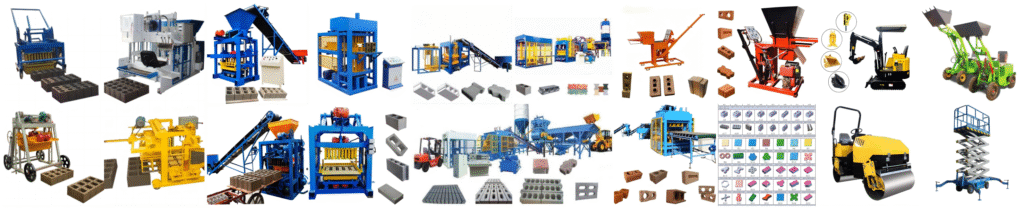
Analyse détaillée des types de machines et des technologies opérationnelles
Le marché propose un écosystème gradué de machines, chacune conçue pour répondre à des volumes de production spécifiques, des niveaux d'automatisation et une préparation au capital définis.
1. Machines manuelles et semi-automatiques : la base de la production de niveau d'entrée
Ces machines constituent le point d'entrée accessible dans la fabrication de blocs, mettant l'accent sur un faible investissement en capital et une simplicité opérationnelle.
- Principe opérationnel fondamental :Ce sont typiquement des machines monostations de type presse. Un mélange de béton préparé, semi-sec, est introduit manuellement dans un moule. L'opérateur actionne ensuite un levier ou un mécanisme de presse mécanique/hydraulique pour compacter le mélange. La vibration, souvent assurée par une table vibrante externe ou des moteurs montés, est cruciale pour atteindre une densité adéquate et éliminer les poches d'air.
- Caractéristiques clés et gamme de produits :
- Flux de Travail Centré sur l'HumainToutes les opérations de manutention—mélange, alimentation, retrait des blocs verts et durcissement—sont effectuées manuellement. La production est directement liée à la taille de l’équipe et à son endurance.
- Polyvalence grâce aux moulesUn avantage important est la capacité de produire une grande variété de produits—blocs solides, blocs creux, dalles de pavage, bordures—en changeant simplement la boîte à moules. Cela les rend idéaux pour les petites commandes personnalisées.
- Capacité de sortie :La production réaliste varie de 300 à 1 000 blocs par quart de travail de 8 heures, selon l'efficacité de l'équipe et la taille des blocs.
- Application stratégique :Idéal pour les micro-entreprises, les projets de logements communautaires et la production sur place pour des chantiers de construction spécifiques où les coûts de transport des blocs finis sont prohibitifs.
2. Machines fixes entièrement automatiques : Le moteur de l'industrie de moyenne échelle
Cette catégorie représente le segment le plus important pour les entreprises sérieuses de fabrication de blocs, offrant l'équilibre optimal entre automatisation, production et investissement.
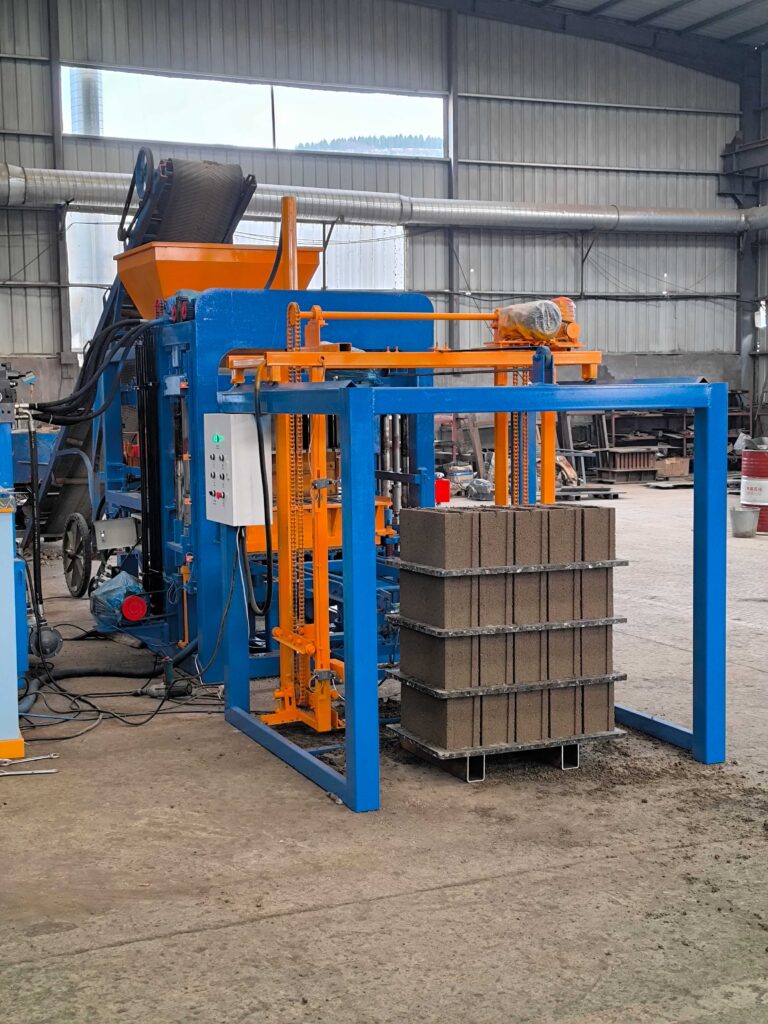
- Principe opérationnel fondamental :Ces systèmes intégrés sont centrés autour d'une presse à vibro-compaction haute pression et multi-directionnelle. Le processus est cyclique et automatisé : une palette est positionnée, le béton est dosé avec précision dans le moule, la tête de presse descend avec vibration simultanée, le bloc est éjecté sur la palette, et la palette est transférée vers une zone de cure. L'ensemble du cycle est contrôlé par un automate programmable industriel (API).
- Sous-systèmes clés et caractéristiques technologiques :
- Manutention automatisée des matériaux :Comprend des convoyeurs d'alimentation, des trémies de pesage électroniques et des mélangeurs, garantissant une qualité de mélange uniforme.
- Compression à haute pression :Les systèmes hydrauliques exercent des pressions de 50 à 150 tonnes et plus, produisant des blocs de haute densité et haute résistance avec une excellente finition de surface.
- Système de circulation de palettes:Un élément clé de différenciation. Les palettes sont automatiquement alimentées, nettoyées, huilées et recyclées au sein du système, permettant une production continue.
- Diversité des produitsLes modèles avancés utilisent une technologie « multicouche » ou « pressage fractionné » pour produire, en un seul cycle, des pavés à face colorée ou des blocs isolants liés chimiquement.
- Application stratégique : The standard for profitable block yards supplying regional construction markets, ready-mix concrete plants diversifying into products, and dedicated block manufacturers targeting municipal and commercial contracts.
3. Fully Automatic Mobile Plants and Egg-Layer Machines: Flexibility for Evolving Sites
These units sacrifice some degree of output speed for unparalleled logistical flexibility and lower infrastructure requirements.
- Principe opérationnel fondamental : Unlike stationary plants, these machines produce blocks directly on a concrete floor or a prepared slab. After compacting a block, the machine moves forward (or the mold indexes) to lay the “green” block in place on the curing strip. This “lay-and-go” method eliminates the need for pallets and complex transfer systems.
- Caractéristiques clés :
- Low Infrastructure Needs: No heavy foundation or complex pallet return conveyor is required. Curing happens in situ.
- Mobilité : Many are mounted on trailers or wheels, allowing a single machine to serve multiple sites or be easily relocated as a project progresses.
- Opération simplifiée : Generally have fewer moving parts than high-speed stationary plants, which can simplify maintenance.
- Application stratégique : Ideal for large, linear projects (road construction with kerb production), remote area development, and businesses that prioritize the ability to move their production facility to the market.
Investment Framework: Understanding Price Determinants and Total Cost of Ownership (TCO)
For procurement agents and their clients, the purchase price is merely the entry point of the financial analysis. A sophisticated evaluation considers the complete TCO and return on investment (ROI).
Capital Expenditure (CapEx) Pricing Tiers and Drivers
Machine prices are dictated by automation, robustness, and output.
- Tier 1: Manual & Semi-Automatic Machines
- Gamme de prix : Typically from a few thousand to low tens of thousands of USD.
- Facteurs de coûts Simplicity of design, material (steel) costs, and inclusion of a basic motor/vibrator. Price variations are often based on the number of blocks produced per cycle (e.g., single vs. tri-block machines).
- Tier 2: Fully Automatic Stationary Machines
- Gamme de prix : This is a broad range, from approximately mid-five figures to several hundred thousand USD.
- Facteurs de coûts
- Degré d'automatisation : A machine with automatic pallet feed and product stacker commands a premium.
- Production Speed (Cycles/Hour): Higher speed requires more robust hydraulics, controls, and steel frames.
- Capacité de pression : Higher tonnage presses produce stronger blocks and justify higher costs.
- Sophistication du système de contrôle A full-color touchscreen HMI with diagnostic capabilities and recipe storage adds value.
- Tier 3: Large-Scale Turnkey Production Lines
- Gamme de prix : Investments can reach millions of USD.
- Facteurs de coûts This price encompasses not just the block-making machine, but the entire ecosystem: automated batching plants, robotic pallet handling and curing systems, climate-controlled curing chambers, and packaging lines. It is a complete factory solution.
The Critical Analysis of Operational Expenditure (OpEx) and ROI
A discerning buyer looks beyond the invoice.
- Coûts opérationnels : These include energy consumption (significant for hydraulic systems and vibrators), labor for operation and maintenance, mold and wear-part replacement, and consumables like pallet oil and release agents.
- Efficacité de la production : A higher-priced automatic machine with a 20% faster cycle time and 5% lower reject rate will often outperform a cheaper alternative within months.
- Cohérence de la qualité Machines producing blocks with precise dimensions and high, uniform strength reduce waste for the end-user (the mason) and build a superior brand reputation for the manufacturer, allowing for premium pricing.
- Sample ROI Calculation: A distributor should be prepared to model this. For instance: A $100,000 automatic machine producing 5,000 blocks/day at a net profit of $0.10/block can generate $500/day. Factoring in operating costs and downtime, the payback period could be under 12 months with sufficient market demand.
Conclusion: Positioning as a Strategic Partner in Production
For the distribution and procurement channel, success in the block machinery market requires a paradigm shift from selling equipment to enabling production businesses. This demands:
- Technical Consultancy: The ability to assess a client’s local market (demand for hollow vs. solid blocks, paving trends), raw material availability, and financial capacity to recommend the correct machine type.
- Financial Acumen: Building persuasive, transparent TCO and ROI models that justify the investment and help clients secure financing.
- Lifecycle Support: The machinery sale is the beginning. Competitive advantage is secured by offering reliable spare parts, expert technical service, and operator training programs. Dowtime is the primary enemy of your client’s profitability and your reputation.
By providing holistic solutions that encompass the right technology, clear financial planning, and unwavering support, you transition from a supplier to an indispensable partner in your clients’ growth, cementing your role in building the very fabric of infrastructure.
Foire aux questions (FAQ)
Q1: What is the single most important factor in determining the final strength of the block?
A : While machine pressure is vital, the consistency and quality of the raw material mix is paramount. The correct ratio of cement, aggregates (sand and gravel), and water, along with proper mixing, is fundamental. A high-quality machine cannot compensate for a poor mix design. Distributors should consider offering basic mix design consultancy or partnerships with batching plant suppliers.
Q2: How significant is after-sales service, and what should we look for in a manufacturer’s support package?
A : It is absolutely critical. Look for manufacturers that offer: Comprehensive On-Site Training for operators and maintenance staff, Clear Documentation (parts manuals, electrical diagrams), Availability of a Local Parts Inventory or guaranteed short shipping times for critical wear parts, and Remote Technical Support capabilities. The service commitment is often more important than a marginal difference in initial price.
Q3: Can one machine produce different types and sizes of blocks?
A : Yes, versatility is a key feature. This is achieved through interchangeable mold boxes. A reputable manufacturer will offer a catalog of molds for hundreds of different products. The changeover process time—from minutes to a few hours—is a specification to compare. The machine’s control system should also allow for easy adjustment of vibration time and pressure for different products.
Q4: What are the power requirements for a fully automatic stationary machine?
A : Requirements vary significantly. A mid-range machine might require a 3-phase electrical connection with a total installed power of 30-75 kW. It is crucial to verify the specific voltage (e.g., 380V/50Hz or 460V/60Hz) and amperage requirements with the manufacturer to ensure the client’s site can be properly equipped. Mobile egg-layer machines often use diesel engines for complete independence.
Q5: How do we guide a client in choosing between a stationary plant and a mobile egg-layer machine?
A : This decision hinges on business model and logistics. A stationary plant is for a fixed-site factory supplying a regional market. It offers higher output and lower per-unit cost at scale. An egg-layer is for a project-based business, remote operations, or a start-up wanting to minimize initial site preparation costs. It offers flexibility but typically at a lower hourly output.
Q6: What is a realistic expected lifespan of a well-maintained automatic block making machine?
A : The structural frame and core components of a quality machine can last 15-20 years or more with proper maintenance. Hydraulic seals, electrical components, and vibrator bearings are wear items that require periodic replacement. The longevity is directly tied to the preventative maintenance program initiated from day one, a program a good distributor should help establish.