
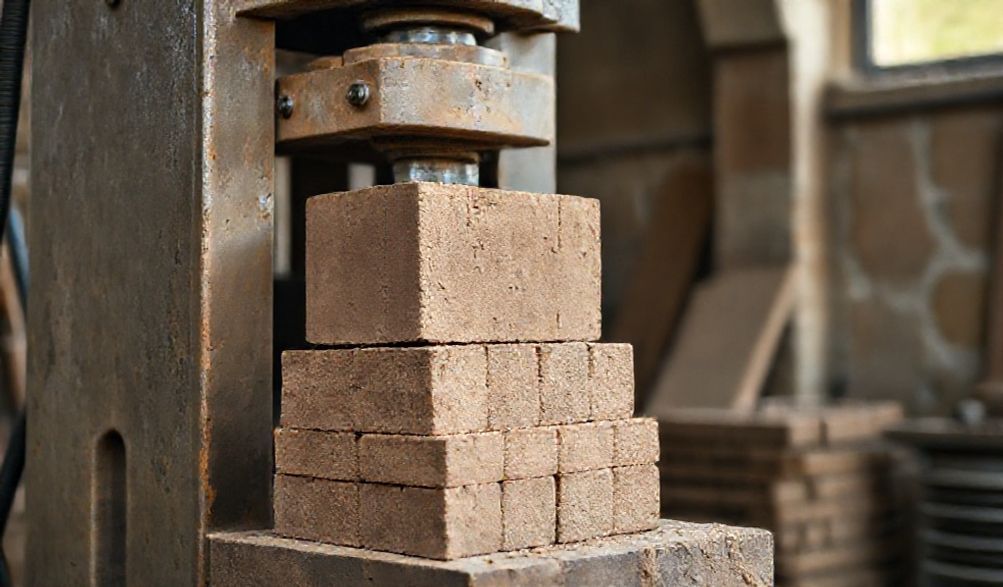
Le Guide Ultime pour Choisir la Meilleure Petite Machine à Fabriquer des Briques en Argile
À une époque où les coûts de construction augmentent et où le désir de vivre de manière durable et autonome s'accroît, une révolution silencieuse prend forme — littéralement, une brique à la fois. Des propriétaires soucieux de l'environnement aux entrepreneurs en herbe, en passant par les projets de développement communautaires, de plus en plus de personnes se tournent vers la production locale et à petite échelle de matériaux de construction. Au cœur de ce mouvement se trouve un outil puissant : lepetite machine pour brique d'argilefaire.
Bien que la vision de fabriquer vos propres briques durables et esthétiques soit séduisante, la réalité des méthodes manuelles avec boue et moule est souvent d’une lenteur éreintante et inconstante. À l’autre extrême, les usines de briques industrielles représentent un investissement bien au-delà des moyens d’une petite entreprise. Cet écart entre l’effort artisanal et l’échelle industrielle est précisément là où la petite machine à briques en argile excelle. Elle offre une voie médiane réalisable et efficace.
Ce guide définitif est élaboré à partir d'une synthèse des spécifications techniques, des expériences utilisateurs réelles et des pratiques établies dans l'industrie. Notre objectif est de vous offrir une ressource fiable et complète pour éclairer votre décision. Nous démystifierons les types de machines disponibles, détaillerons les caractéristiques essentielles à examiner, vous guiderons à travers l'ensemble du processus de production et vous fournirons les connaissances pratiques nécessaires pour démarrer votre propre opération à petite échelle. Posons ensemble des bases solides pour votre projet.
Comprendre les machines à briques en argile de petite taille : types et applications
Toutes les machines à briques de petite taille ne sont pas créées égales. Votre choix affectera fondamentalement votre capacité de production, vos besoins en main-d'œuvre et votre investissement initial. Comprendre ces trois catégories principales est la première étape vers un achat judicieux.
Machines à presser manuelles (Le choix d'entrée de gamme)
Description :Ce sont les types les plus simples et les plus abordables de petites machines à briques. Elles reposent entièrement sur la force humaine, utilisant un levier ou un mécanisme à vis pour appliquer une force de compression à l'argile placée dans un moule.
Idéal pour :
* Les particuliers ou les familles qui entreprennent un projet de construction de bricolage (par exemple, un mur de jardin, un abri ou une petite maison).
* Centres de formation professionnelle et programmes éducatifs.
* Projets communautaires dans des régions hors réseau sans accès à l'électricité.
* Tester les eaux de la production de briques avec un risque financier minimal.
Avantages et inconvénients :
* Avantages :Coût extrêmement bas ; zéro coût d'énergie de fonctionnement ; portable et simple à entretenir ; parfait pour apprendre les bases de la composition et de la compression du sol.
* Inconvénients :Exigeant en main-d'œuvre et lent ; la production dépend fortement de l'endurance de l'opérateur ; la densité et la qualité des briques peuvent varier ; ne convient pas à une production à l'échelle commerciale.
Machines semi-automatiques (L'interprète équilibré)
Description :Cette catégorie offre un équilibre optimal pour de nombreuses petites entreprises. Ces machines impliquent généralement l'alimentation manuelle du mélange d'argile préparé dans une trémie ou une chambre, mais la compression est réalisée via un volant mécanique ou un système hydraulique alimenté par un moteur électrique ou diesel. Certaines peuvent inclure un convoyeur pour l'éjection des briques.
Idéal pour :
* Petites et moyennes entreprises (PME) visant une production commerciale constante.
* Entreprises de construction cherchant à produire des briques pour des projets spécifiques.
* Entreprises sociales et coopératives communautaires.
* Toute personne ayant besoin d’un débit plus élevé et plus fiable que ce qu’une presse manuelle peut offrir.
Avantages et inconvénients :
* Avantages :Production nettement supérieure et plus régulière que les presses manuelles; produit des briques uniformes et de haute densité; réduit la contrainte physique du travail; bon retour sur investissement pour les projets sérieux.
* Inconvénients : Higher upfront cost; requires a power source (electricity or fuel); more complex than a manual press; requires basic operational training.
Fully Automatic Small Machines (The Efficiency Expert)
Description : These are the pinnacle of small-scale efficiency. They integrate automated systems for feeding the raw material, compressing it, and ejecting the finished brick—often onto a pallet or conveyor. Operation may only require one or two persons to monitor the process and handle raw materials/pallets.
Idéal pour :
* Established small-to-medium enterprises (SMEs) with strong market demand.
* Businesses focused on maximizing daily output with a minimal workforce.
* Operations where brick quality and dimensional consistency are paramount.
Avantages et inconvénients :
* Avantages : Highest output potential for the “small machine” category; exceptional consistency and quality; maximizes labor efficiency; often includes advanced features like programmable logic controllers (PLCs).
* Inconvénients : Substantial capital investment; requires a reliable and powerful energy source; more complex maintenance requiring potential specialist knowledge; less flexibility for remote, off-grid sites.
| Machine Type | Meilleur pour | Key Advantage | Primary Limitation |
| :— | :— | :— | :— |
| Manual Press | DIY, Training, Ultra-Low Budget | Low Cost & No Power Needed | Low, Labor-Intensive Output |
| Semi-Automatique | Small Businesses, Consistent Production | Balance of Output, Cost & Quality | Requires Power & Higher Investment |
| Entièrement Automatique | High-Output SMEs, Efficiency Focus | Maximum Output & Labor Savings | High Cost & Complex Operation |
Key Features to Evaluate When Buying Your Machine
Once you’ve identified the suitable machine type, drilling down into these specific features will ensure you select a model that delivers long-term value and meets your precise needs.
Capacité de production (production par heure/jour)
Don’t just look at the “maximum” theoretical output in promotional material. Consider sustainable, real-world output.
* Match to Your Goals: Are you supplying bricks for a single 6-month home build, or do you aim to serve a local market? Calculate your weekly brick requirement and choose a machine that can meet 70-80% of that with one shift, allowing room for maintenance and material preparation.
* Understand the Metrics: Capacity is usually given in “bricks per hour” or “cycles per hour.” Remember, a cycle might produce 2, 4, or even 6 bricks at once (depending on the mold). A machine rated for 500 cycles/hour with a 4-brick mold has a potential output of 2000 bricks/hour.
Brick Size and Mold Versatility
The mold defines your product. This is where your machine’s flexibility pays off.
* Moules interchangeables : Ensure the supplier offers a range of standard mold sizes (e.g., standard rectangular, hollow blocks for insulation, interlocking bricks for mortar-less construction). The ability to swap molds allows you to diversify your product line to meet different customer needs.
* Moules sur mesure : Some manufacturers will create custom molds for unique brick designs or special projects, though this adds to the cost. Discuss this possibility upfront if you have a specific architectural vision.
Power Source and Requirements
Your location and utility access will heavily influence this decision.
* Moteurs électriques : Common for semi- and fully-automatic machines in areas with stable grid power. They are cleaner, quieter, and have lower per-hour operating costs. Check the voltage (e.g., 220V/380V) and phase (single or three-phase) requirements carefully.
* Moteurs Diesel : Provide independence from the electrical grid, making them ideal for remote sites. They are more rugged but are noisier, produce emissions, and have higher fuel and maintenance costs.
* Manuel : As discussed, for entry-level, off-grid applications only.
Build Quality and Durability: The Trust Factor
This is where the true cost of a machine is revealed over time. Prioritizing build quality is a non-negotiable aspect of a trustworthy investment.
* Materials Matter: The frame and critical components should be made from high-grade steel. Ask about the thickness of the steel plates and the quality of the hydraulic cylinder (if applicable). A machine made from mild steel will not withstand the constant stress of compression.
* Construction : Look for clean, robust welding. Poor welds are a primary point of failure under constant vibration and pressure.
* Brand Reputation: Research the manufacturer’s history. How long have they been in business? Do they specialize in brick machinery? A company with a long track record is more likely to be producing reliable equipment and will likely still be around if you need support later.
After-Sales Support: The Deal-Breaker
A machine is a long-term asset. The supplier’s support is part of the product you’re buying.
* Disponibilité des pièces de rechange : Inquire about the availability and cost of common wear-and-tear parts: mold liners, compression plates, seals, and hydraulic hoses. If parts must be shipped from overseas with a 3-month lead time, a single broken seal can halt your entire operation.
* Documentation and Training: A clear, illustrated operation and maintenance manual in your language is essential. Many reputable suppliers offer installation guidance videos or even video call support for initial setup.
* Support technique : Can you call or email someone with questions? The responsiveness of a supplier before you buy is often a good indicator of their support after the sale.
The Clay Brick Making Process: From Soil to Solid Brick
Owning the machine is only one part of the equation. Success hinges on your mastery of the entire process. Here is the end-to-end workflow you’ll need to manage.
Step 1: Clay Preparation and Soil Testing
Expertise Display: Not all dirt is suitable. The ideal soil is a blend of approximately:
* Clay (20-30%): Provides plasticity and binding strength.
* Silt (10-20%): Fills voids.
* Sand (50-70%): Reduces shrinkage and cracking during drying.
Simple Field Tests:
* Ribbon Test: Moisten a handful of soil and roll it into a ribbon. If it forms a ribbon 1-2 inches long before breaking, it has sufficient clay.
* Shrink Test: Make a small ball of wet soil, let it dry completely. If it cracks significantly, it has too much clay; if it crumbles easily, it has too much sand/silt.
Step 2: Mixing and Tempering
This step ensures uniformity. The clay soil is mixed with the correct amount of water (typically 10-15% by weight) to reach an optimal, malleable consistency—like stiff dough. This can be done with a simple hoe and pit, a paddle mixer, or a pan mixer for larger volumes. At this stage, stabilizers like 5-10% cement or lime can be added to improve strength and water resistance, especially for soils with less-than-ideal composition.
Step 3: Molding and Compression
The tempered clay is fed into the machine’s mold chamber. The machine’s core function—applying high pressure (measured in PSI or MPa)—compacts the clay, forcing out air pockets and creating a dense, coherent brick (known as a “green brick”). The pressure is what gives the brick its structural integrity.
Step 4: Curing and Drying
The most critical phase for final strength. The green bricks are carefully stacked in a well-ventilated, shaded area (direct sun causes uneven drying and cracking). They must air-dry for a minimum of 7-14 days. For cement-stabilized bricks, keeping them moist (by sprinkling water) for the first week actually increases final strength through a process called hydration. Full strength is achieved after 4-6 weeks.
mermaid

graph TD

    A[Test & Source Clay Soil] --> B[Mix with Water <br> (Optional: Add Stabilizer)];

    B --> C[Load into Machine & Compress];

    C --> D[Eject & Handle Green Bricks];

    D --> E[Cure & Dry for 2-6 Weeks];

    E --> F[Solid, Ready-to-Use Brick];
Practical Considerations for Your Small Brick-Making Venture
Turning machine operation into a viable project or business requires planning beyond the equipment itself.
Cost Analysis: Machine Investment vs. Return
Create a basic framework:
* Capital Costs: Machine price, delivery, customs duties, mold extras, basic tools (shovels, mixer), and site preparation.
* Coûts opérationnels : Raw materials (clay, stabilizer), labor, utilities (power/fuel), maintenance, and transportation.
* Revenue Potential: Research the local price per brick. Even a small semi-automatic machine producing 1,500 bricks per day can generate significant volume. Your profit margin will be the difference between your cost-per-brick and your selling price.
Space and Workspace Setup
You need a logical workflow area:
1. Raw Material Storage: For your clay pile and stabilizers.
2. Station de mixage : Where soil and water are combined.
3. Production Shed: To house the machine and protect operations from rain.
4. Drying Yard: A large, level, well-drained area for stacking and curing bricks. This is often the largest space requirement.
Sourcing Raw Materials Locally
The “sustainable” advantage is key. Test soils from local construction sites, farms (with permission), or natural deposits. Using on-site or locally sourced clay drastically reduces material costs and the environmental footprint of your bricks, a strong selling point.
Market and Applications for Your Bricks
Identify your customers:
* Eco-Homes & Owner-Builders: Individuals seeking sustainable, natural building materials.
* Landscaping & Garden Design: For paths, retaining walls, patios, and outdoor kitchens.
* Local Contractors: Small builders working on residential extensions, boundary walls, or rural structures.
* Community Projects: Schools, clinics, or community centers often prioritize locally made materials.
Foire aux questions (FAQ)
Q1: What is the approximate price range for a good small clay brick machine?
A : Prices vary dramatically based on type and automation. A basic manual press can start from $500 to $1,500. A quality semi-automatic machine typically ranges from $3,000 to $12,000. Small, fully automatic systems can begin around $15,000 and go upwards of $40,000+. Always get detailed quotes from multiple suppliers, ensuring they include shipping, duties, and standard molds.
Q2: Can I use any type of soil with these machines?
A : No. Using pure sand or silt will result in bricks that crumble. The soil must have sufficient clay content (20-30%) to bind the material together under pressure. As outlined in the process section, simple field tests can determine suitability, and soils can often be modified by blending or adding stabilizers like cement.
Q3: How many bricks can a small machine produce in a day?
A : This depends entirely on the machine type and operational efficiency. Here are realistic 8-hour shift estimates:
* Presse manuelle : 200 – 500 bricks
* Semi-Automatique : 800 – 2,500 bricks
* Fully Automatic (Small): 3,000 – 6,000+ bricks
Remember, these figures assume a steady workflow with prepared materials and do not include curing/drying time.
Q4: Is a small brick-making business profitable?
A : It can be a profitable venture, but it is not a “get-rich-quick” scheme. Success hinges on key factors: proven local demand for your brick type, tight control of your production costs (especially raw materials and labor), consistent product qualityeteffective local marketing to builders and homeowners.
Q5: Where can I find reliable suppliers or manufacturers?
A : Start by researching online on B2B platforms like Alibaba, Made-in-China, or industry-specific directories. Attend construction or manufacturing trade fairs if possible. The most critical stepestdue diligence: always request customer references, search for independent reviews or videos of their machines in operation, and verify their company history. A trustworthy supplier will be transparent and encourage this.
Conclusion
Choisir le bonpetite machine pour brique d'argile production is a journey that blends practical needs with entrepreneurial vision. We’ve explored the spectrum from simple manual presses to efficient automatic systems, highlighting that the “best” machine is the one that aligns with your output goals, budget, and context. We’ve underscored the non-negotiable importance of build quality and after-sales support—factors that ensure your investment pays off for years to come.
Remember, the machine is a tool. Your success will equally depend on your understanding of the complete process, from soil testing to patient curing, and on the sound planning of your workspace and business model. This guide serves as your foundational checklist.
Your next steps: Clearly define your project scope or business goals. Use the criteria here to shortlist 3-4 potential machine models and suppliers. Reach out to them with informed, specific questions. If feasible, request to see a machine operating—either in person or via a live video call. By prioritizing research and quality, you’re not just buying a piece of equipment; you’re investing in the foundation of your sustainable building dream.
<