
Le Guide Ultime des Machines à Fabriquer des Blocs d'Interverrouillage : De la Sélection à l'Exploitation
Introduction
Le paysage mondial de la construction est en pleine révolution silencieuse. Alors que la demande pour des solutions de construction abordables, résilientes et durables monte en flèche, l'industrie s'éloigne des méthodes gourmandes en ressources. Au cœur de ce changement se trouve une innovation simple mais profonde : le bloc à emboîtement. Ces unités de construction sans mortier, semblables à des Lego, promettent une construction plus rapide, plus solide et plus écologique. Mais ce qui alimente véritablement cette révolution, c'est la machine qui les crée.
Cet article est votre guide définitif et expert sur la machine à fabriquer des blocs de construction à emboîtement. Que vous soyez un constructeur cherchant à rationaliser ses opérations, un entrepreneur envisageant une entreprise rentable, ou un chef de projet chargé de fournir des logements économiques, comprendre cette technologie est crucial. Nous irons au-delà des brochures commerciales pour fournir un manuel complet qui vous permettra de prendre des décisions éclairées, rentables et axées sur la qualité—depuis la première idée d'achat jusqu'au ronronnement quotidien de la production.
Notre guide est construit sur une base deExpérience, Expertise, Autorité et Fiabilité (E-E-A-T)Nous synthétisons les principes du génie mécanique, les normes établies de l'industrie et les connaissances pratiques acquises sur le terrain. Notre objectif n'est pas de vous vendre une machine, mais de vous outiller avec les connaissances nécessaires pour prioriser la sécurité, maximiser l'efficacité et garantir la valeur à long terme de votre investissement. Commençons.
Qu'est-ce qu'une machine à fabriquer des blocs de verrouillage?
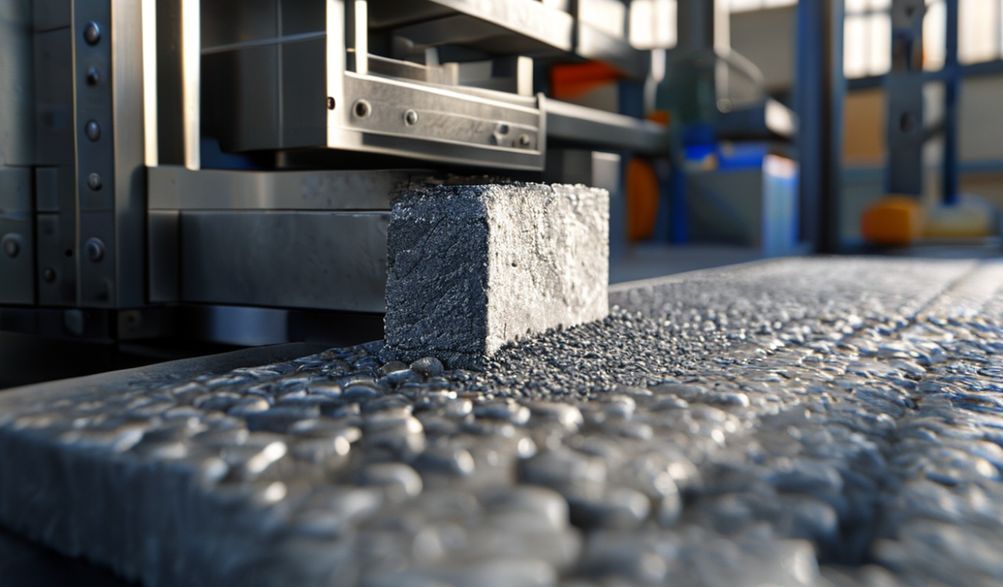
Une machine à fabriquer des blocs à emboîtement est un équipement spécialisé conçu pour produire des blocs en béton ou en terre stabilisée dotés de rainures et de nervures intégrées. Ces caractéristiques géométriques précises permettent aux blocs de s'emboîter verticalement et horizontalement sans nécessiter de mortier humide, créant ainsi un système de murs stable et empilé à sec.
Fonction principale et principe de fonctionnement
At its core, the machine is a high-pressure compaction system. The process, whether hydraulic or mechanical, follows a consistent sequence:
- Batching & Mixing: Raw materials (typically a damp mix of sand, aggregate, cement, and water, or soil stabilized with a binder) are prepared separately.
- Alimentation :Ce mélange est introduit dans la trémie de la machine.
- Mesurage et Moulage : A measured amount of material is delivered into a precision-engineered mold (or die) on a vibration table.
- Compactage : The key stage. A hydraulic ram or mechanical lever applies immense pressure—often measured in tons—to the material while simultaneous vibration removes air pockets. This dual action creates a dense, high-strength block.
- Éjection : The freshly formed block is pushed out of the mold onto a pallet or curing area.
- Guérison : Blocks are stacked and kept moist for a period (usually 7-28 days) to gain full strength through hydration.
Composants clés et leurs rôles
Understanding the machine’s anatomy is key to evaluating quality:
* Hopper : The entry point for the raw material mix. A well-designed hopper ensures consistent flow without bridging or clogging.
* Moule/Matrice: The heart of the machine. This hardened steel component defines the block’s shape, size, and interlocking design. Its precision and durability directly affect block quality and machine longevity.
* Système de compression : The muscle. In hydraulic systems, this consists of a power pack, cylinders, and valves. In mechanical systems, it’s a lever and cam assembly. It provides the force needed for compaction.
* Table de vibration : Powered by robust eccentric motors, it subjects the mold to high-frequency vibrations during filling and compression, ensuring a uniform, void-free block.
* Panneau de configuration : The brain. In semi and fully automatic models, this houses the PLC or simple controls to manage the cycle sequence, vibration time, and pressure.
The Finished Product: Types of Interlocking Blocks
The versatility lies in the mold. By changing it, a single machine can produce a system of blocks for entire structures:
* Standard Stretcher Blocks: The workhorse for straight wall runs.
* Corner Blocks: Designed for 90-degree turns at wall corners.
* Half Blocks: Used for closing gaps and maintaining the bond pattern.
* Header Blocks: For bonding wall intersections or capping.
* Pavés autobloquants : Thinner blocks with interlocking patterns for driveways, walkways, and patios.
Key Benefits of Using an Interlocking Block Machine
Adopting this technology isn’t just about buying equipment; it’s about upgrading your entire construction methodology.
Avantages économiques
- Drastically Reduced Mortar Use: Eliminating up to 80% of mortar from wall construction saves significantly on material and labor costs.
- Lower Skilled Labor Requirement: The simple dry-stacking process can be quickly taught, reducing dependence on highly skilled masons.
- Faster Construction Speed: Walls rise 3-5 times faster than conventional brick-and-mortar methods, shortening project timelines.
- On-Site Production Potential: Producing blocks directly at the project site slashes transportation costs and logistics headaches.
Construction and Performance Benefits
- High Structural Strength: Properly made interlocking blocks often exceed the compressive strength of standard hollow blocks, suitable for load-bearing walls.
- Inherent Durability: The high compaction creates a dense, weather-resistant block with excellent thermal mass.
- Superior Drainage & Flexibility: The dry-stacked joints allow for water drainage and slight movement, making structures more resilient in seismic zones.
- Flexibilité de conception : Curved walls and complex architectural features are easier to achieve with the modular block system.
Environmental and Sustainability Impact
- Use of Local Materials: Machines can utilize on-site or locally sourced soil (when stabilized), reducing the carbon footprint of transportation.
- Reduced Cement Consumption: Soil-cement blocks or optimized concrete mixes can lower the high-emission cement content.
- Minimal Waste: Precise production and dry-stacking generate almost zero construction waste compared to cut bricks and mortar droppings.
How to Choose the Right Machine: A Buyer’s Checklist
Selecting a machine is a critical investment. This checklist, born from field experience, will guide you past marketing claims to practical reality.
Évaluation de vos besoins de production
Start with your business plan or project scope. Ask:
* What is my required daily output? (e.g., 500 blocks/day for a housing project vs. 5,000 for a commercial venture).
* What block types do I need? Ensure the supplier offers the complete mold system you require.
* What is my power source? A remote site might need a diesel-powered machine, while a factory setting favors electric.
Critical Machine Specifications to Compare
Do not make a decision without clarifying these:
* Capacité de production et temps de cycle A “2,000 blocks per day” claim is meaningless without knowing the cycle time (e.g., 15 seconds per block) and accounting for operator breaks.
* Source d'alimentation : Electric (clean, consistent), Diesel (portable, powerful), or Manual (low-capacity, no power needed).
* Force de pression (Tonnage) : This is critical for block strength. For soil-cement blocks, 15-20 tons may suffice. For high-strength concrete blocks, 30+ tons is common. Higher tonnage generally correlates with higher block density and strength.
* Niveau d'automatisation :
* Manuel : Operator-dependent for all steps. Lowest cost, lowest output.
* Semi-Automatique : Operator feeds material, but compression and ejection are automated via a button. Best balance of cost, control, and output.
* Entièrement Automatique : Batching, feeding, compression, and stacking are automated. High output, requires more skill and investment.
Quality and Durability Factors
Look beyond the paint. Inspect:
* Qualité d'acier : The mold and main frame should be made from high-quality, hardened steel. A poor-quality mold will wear quickly, ruining block precision.
* Composants hydrauliques : Reputable brand names (e.g., Bosch Rexroth, Parker) for pumps and valves indicate reliability and easier service.
* Moteurs de vibration : They should be resilient and securely mounted. The difference between a smooth, consistent hum and a jarring rattle often lies here.
* Warranty & Support: A clear warranty (at least 1 year on major parts) and a commitment to providing spare parts are non-negotiable.
Supplier Evaluation for Trustworthiness
The machine is only as good as the company behind it.
* Verify Reputation: Search for independent reviews, not just testimonials on their site.
* Demand References: A trustworthy supplier will gladly connect you with past clients. Call them. Ask about machine performance, block quality, and after-sales support.
* Assess After-Sales Service: Do they offer installation supervision, operator training, and have a technical support hotline? Is there a local agent or distributor for spare parts?
Operational Best Practices and Safety Protocols
Owning the machine is step one. Operating it correctly and safely is where success is secured.
Site Preparation and Machine Setup
- Foundation: Install the machine on a perfectly level, reinforced concrete pad. This is crucial for alignment and to absorb vibration.
- Pouvoir & Espace : Ensure stable, correctly rated power supply. Allow ample space for material storage, mixing, block curing, and safe movement around the machine.
The Production Process: Step-by-Step
- Conception du mélange: Establish a consistent recipe. The mix should be damp, not wet or dry—it should hold its shape when squeezed.
- Alimentation des matériaux : Keep the hopper consistently fed to avoid air pockets in blocks.
- Initiation du cycle : Engage the machine. Listen for the steady rhythm of vibration and compression. A well-tuned machine has a predictable, solid sound.
- Block Handling: Carefully transfer green (fresh) blocks onto curing pallets. They are fragile until cured.
- Guérison : Keep blocks under plastic sheeting or regularly spray them with water for at least 7 days to ensure proper strength development.
Essential Maintenance for Longevity
A simple schedule prevents catastrophic downtime:
* Daily: Clean the machine thoroughly after use. Remove all concrete buildup from the mold, hopper, and table.
* Weekly: Check and tighten all bolts and nuts, especially on the vibration table and mold assembly. Inspect hydraulic hoses for wear.
* Monthly: Check hydraulic fluid levels and condition. Inspect the mold liners for wear—rounded edges on the block’s interlocking features are a telltale sign it’s time for replacement.
Non-Negotiable Safety Guidelines
- Équipement de protection individuelle (EPI) : Safety glasses, hearing protection, gloves, and steel-toe boots are mandatory.
- Lock-Out/Tag-Out: Always disconnect and lock the power source before performing any maintenance or clearing a jam.
- Safe Material Handling: Use proper lifting techniques for bags of cement and blocks. Keep the work area tidy to prevent trips and falls.
Financial Insights: Cost Analysis and ROI
A clear financial picture separates a thriving business from a costly mistake.
Breaking Down the Investment
The machine price is just the start. Budget for:
* Machine Cost & Shipping
* Installation & Foundation
* Initial Raw Material Inventory (cement, aggregate)
* Labor (operators, mixers)
* Utilities (power, water)
* A contingency fund for maintenance and spare parts (5-10% of machine cost annually).
Calculating Your Potential Return on Investment (ROI)
Use a simplified framework:
1. Calculate Cost Per Block: (Material Cost + Labor + Machine Depreciation + Overhead) / Number of Blocks.
2. Determine Local Selling Price: Research the market for finished interlocking blocks or the installed wall price per square meter.
3. Project Volume: Based on your machine’s realistic output and market demand.
4. Run the Numbers: (Selling Price – Cost Per Block) x Projected Volume = Gross Profit. Determine how long it takes for gross profit to cover the total initial investment.
Navigating Common Financial Pitfalls
- Underestimating Operating Costs: Maintenance, power, and labor are ongoing. Factor them in.
- Overestimating Demand & Output: Be conservative. Market saturation and machine downtime are real.
- Choosing on Price Alone: The cheapest machine often has the highest long-term cost in repairs, poor block quality, and low output.
FAQ Section
Q1: Can I use local soil in an interlocking block machine?
A : Yes, many machines are designed for stabilized earth blocks (SEBs). However, the soil must be tested (simple sieve and jar tests) and typically requires stabilization with 5-10% cement or lime to achieve structural strength. Not all soils are suitable.
Q2: What is the typical strength of blocks produced, and are they suitable for load-bearing walls?
A : With a proper mix (e.g., 1:8 cement-soil ratio) and adequate compaction, blocks can consistently achieve compressive strengths of 7 MPa (1000 psi) and above. This is more than sufficient for single-story and, with engineering, multi-story load-bearing walls in many international building codes. Always have your blocks tested and consult a structural engineer for specific projects.
Q3: How much technical skill is required to operate the machine?
A : For semi-automatic machines, a careful, trainable individual can become proficient in a few days. The skills focus on mix consistency, machine operation sequence, and basic troubleshooting. Fully automatic lines require more technical understanding of electronics and mechanics. A reputable supplier must provide hands-on training.
Q4: What are the most common maintenance issues?
A : The most frequent issues are wear on mold liners (a consumable part), leaks from hydraulic hose fittings or seals, and bolts loosening due to constant vibration. A disciplined preventive maintenance schedule, as outlined above, will mitigate 95% of major breakdowns.
Q5: How does the cost compare to traditional fired clay bricks or concrete blocks?
A : While the raw material cost per unit may be similar, the installed cost of an interlocking block wall is typically 20-40% lower. This is due to the dramatic reductions in mortar use, skilled labor, and construction time. The speed of construction itself has a significant financial value.
Conclusion
The interlocking blocks making machine is more than a piece of factory equipment; it’s a catalyst for change. It represents a tangible path toward more affordable, durable, and sustainable construction. However, its transformative potential is only unlocked through informed selection, meticulous operation, and sound business acumen.
Success hinges not on the purchase order, but on the due diligence that precedes it and the disciplined practices that follow. Use this guide as your foundational blueprint. Visit multiple suppliers, inspect their machines in person, speak to their existing clients, and start with a clear, modest project plan. By prioritizing knowledge, quality, and safety, you invest in more than a machine—you invest in a future of building smarter, stronger, and more sustainably for your community. The foundation for that future starts with the block you choose to make today.
<