
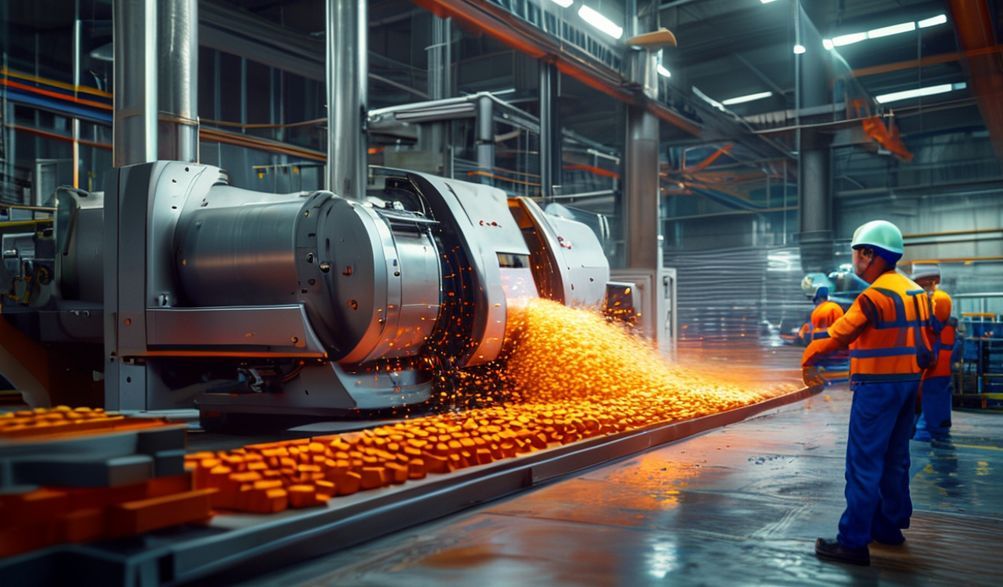
Le Guide Ultime des Machines à Blocs Entièrement Automatiques en Inde : À l'Intérieur de l'Usine de Fabrication de Briques FUDA
Le secteur de la construction en Inde ne fait pas que croître ; il explose. Avec la poussée incessante du gouvernement pour les infrastructures, le logement pour tous et les villes intelligentes, la demande en matériaux de construction a atteint des niveaux sans précédent. Les rapports du secteur indiquent un besoin annuel de milliards de briques et de blocs pour suivre le rythme. Pourtant, au cœur de cet essor se trouve un goulot d'étranglement critique : les méthodes traditionnelles et manuelles de production de ces éléments de construction fondamentaux sont de plus en plus insoutenables. Elles sont intensives en main-d'œuvre, entachées d'incohérence, génèrent des déchets considérables et ont un lourd impact environnemental.
Entrez dans l'ère de la machine de fabrication de blocs entièrement automatique—une merveille technologique qui révolutionne la façon dont l'Inde construit. Il ne s'agit pas seulement d'une amélioration ; c'est une transformation industrielle complète. Et à l'avant-garde de cette révolution dans la fabrication indienne se trouve l'Usine de Fabrication de Briques FUDA. Ce guide est construit sur une base d'expertise sectorielle approfondie, d'analyse technique et de connaissances des processus d'un fabricant leader. Notre objectif est de fournir aux propriétaires d'entreprises, aux sociétés de construction et aux investisseurs une ressource complète et fiable pour comprendre cette technologie, ses avantages profonds, et comment un partenariat avec un fabricant comme FUDA peut être un tournant décisif pour la rentabilité et la croissance à long terme.
À la fin de cet article, vous aurez une compréhension claire de :
* Les forces du marché qui poussent à l'automatisation en Inde.
* La technologie de base derrière ces machines avancées.
* Ce qui distingue une usine axée sur la qualité comme FUDA.
* Les avantages tangibles d'investir dans un système entièrement automatique.
* Une liste de contrôle pratique pour prendre votre propre décision d'achat éclairée.
Pourquoi l'Inde adopte la technologie de fabrication de blocs entièrement automatique
Le virage vers l'automatisation dans la fabrication de blocs n'est pas une simple tendance ; c'est une réponse stratégique aux exigences uniques et puissantes du paysage de la construction moderne en Inde.
L'Exigence de Rapidité et d'Échelle dans l'Industrie de la Construction
Du projet d'autoroute Bharatmala au développement de nombreuses villes intelligentes et au PM Awas Yojana (urbain), l'ampleur des projets est monumentale. Ces initiatives nécessitent un approvisionnement constant et massif en matériaux de construction de haute qualité, dans des délais serrés. Les usines entièrement automatiques, capables de produire des milliers de blocs précis par heure, sont la seule solution viable pour répondre à cette demande de rapidité et d'échelle sans compromettre la qualité.
Surmonter les pénuries de main-d'œuvre et les écarts de compétences
La dépendance à la main-d'œuvre pour la fabrication de briques est semée d'embûches : migration saisonnière, augmentation des coûts salariaux et manque de compétences standardisées. L'automatisation dissocie la production de ces aléas liés aux ressources humaines. Une machine entièrement automatique garantit une production constante, prévisible et efficace, 24 heures sur 24 et 7 jours sur 7 si nécessaire, indépendamment de la disponibilité ou des compétences de la main-d'œuvre.
L'Impulsion Cruciale pour la Standardisation et la Qualité
L'accent accru de l'Inde sur la sécurité et la durabilité des constructions, souligné par des normes strictes comme celles du Bureau of Indian Standards (BIS), exige des matériaux de résistance certifiée et de dimensions précises. Les briques artisanales sont intrinsèquement variables. En revanche, une machine entièrement automatique produit des blocs avec une précision dimensionnelle exceptionnelle et une résistance à la compression constante, garantissant l'intégrité structurelle, une construction plus rapide (grâce à l'uniformité des dimensions) et une utilisation réduite de mortier.
Durabilité et Réglementations Environnementales
La conformité environnementale n'est plus une option. Le gouvernement encourage activement l'utilisation de déchets industriels comme les cendres volantes dans la construction. Les machines modernes de fabrication de blocs entièrement automatiques sont conçues pour utiliser de manière optimale ces matériaux (cendres volantes, laitier, etc.), transformant ainsi les déchets en ressources précieuses. De plus, elles éliminent la pollution causée par les fours traditionnels à charbon, optimisent l'utilisation des matières premières pour minimiser les déchets et réduisent considérablement l'empreinte carbone globale de la production de blocs.
Comprendre les machines de fabrication de blocs entièrement automatiques : composants principaux et fonctionnement
Pour apprécier la valeur, il faut comprendre l'excellence technique de ces systèmes. Une machine à fabriquer des blocs entièrement automatique est un orchestre synchronisé de composants robustes.
Le Cœur du Système : L'Unité Hydraulique
Voici le cœur de la machine. Les systèmes hydrauliques haute pression fournissent la force immense nécessaire pour compacter le mélange de béton en un bloc dense et résistant. La qualité du système hydraulique—ses pompes, ses vannes et ses cylindres—détermine directement la fiabilité de la machine, la constance de la pression (mesurée en tonnes) et l'efficacité énergétique. Une unité hydraulique robuste garantit une longue durée de vie et des performances stables en fonctionnement continu.
Le Panneau de Contrôle : Cerveau de l'Opération
Gone are the days of manual levers and guesswork. The modern nerve center is a Programmable Logic Controller (PLC) with a user-friendly touch-screen interface. This “brain” allows for:
* Précision : Exact control over vibration time, pressure, and cycle times.
* Programmability: Store recipes for different block types (solid, hollow, pavers) and switch between them with a tap.
* Facilité d'utilisation : Simplifies complex processes, requiring minimal training for operators.
* Diagnostics: Monitors machine health and can alert operators to potential issues.
Key Production Stations: From Raw Material to Finished Block
The process is a seamless, automated flow:
1. Alimentation & Mélange : Automated conveyors and weighing systems batch raw materials (cement, fly ash, aggregate) with precision, feeding them into a mixer for a homogenous blend. Consistency here is key to quality later.
2. Moulage & Compactage : The mixed concrete is fed into the mold box. Here, simultaneous high-frequency vibration and immense hydraulic pressure work together to remove air voids and compact the material, defining the block’s final density and strength.
3. Curage et Palettisation : The freshly formed block is automatically ejected onto a pallet, neatly stacked by a robotic stacker, and then transferred to a curing chamber (often a controlled steam or water spray environment) to gain its full strength. The empty pallet is automatically returned to the start of the cycle.
Spotlight on FUDA Brick Making Factory: A Benchmark in Indian Manufacturing
In a market filled with options, the manufacturer’s credibility is as important as the machine’s specifications. FUDA Brick Making Factory has established itself as a benchmark for quality and reliability.
FUDA’s Legacy and Commitment to the Indian Market
With years of specialized experience in industrial machinery manufacturing, FUDA has built a reputation grounded in technical prowess and customer success. Their deep understanding of the Indian context is crucial. Their machines are not just imported designs; they are engineered considering local raw material characteristics (like the specific properties of Indian fly ash), power supply conditions, and the demanding operational environments of Indian production sites.
Inside the FUDA Factory: Quality as a Process
Quality at FUDA is not an afterthought; it’s integrated into every step. Visiting their factory reveals a commitment to precision:
* Certified Materials: Use of high-grade steel, internationally branded hydraulic components, and quality electricals.
* Usinage CNC : Critical parts are fabricated using Computer Numerical Control (CNC) machines, ensuring millimeter-perfect accuracy for perfect alignment and smooth operation.
* Rigorous Assembly & QC: Each workstation follows strict assembly protocols. Quality control checks are conducted at multiple stages—from welding integrity and hydraulic line assembly to final paint and function testing.
FUDA’s Machine Range: Solutions for Every Scale
FUDA offers a portfolio designed to cater to diverse business ambitions:
* High-Capacity Stationary Plants: For large-scale block producers and construction companies supplying major projects. Capable of producing thousands of blocks per shift.
* Gamme de Produits Polyvalente : Their machines can be configured to produce a wide array of products, including:
* Blocs de béton pleins et creux
* Pavers and Interlocking Tiles
* Kerbstones and Decorative Blocks
This flexibility allows a business to adapt to market demands.
Key Benefits of Investing in a FUDA Fully Automatic Machine
The investment transcends the machinery; it’s an investment in transforming your business model.
Unmatched Productivity and Profitability
The numbers speak for themselves. A single fully automatic line can outperform dozens of manual laborers. This massive leap in output (often 10x or more compared to semi-automatic systems) directly translates to higher sales volume and faster return on investment (ROI). Reduced direct labor costs further amplify profitability.
Consistent, Superior Quality Blocks
Every block that comes off a FUDA line is a carbon copy of the last. This exceptional consistency means:
* Haute résistance à la compression : Meets and exceeds IS standards for load-bearing applications.
* Perfect Dimensions: Ensures straight walls, reduces mortar consumption, and speeds up construction.
* Excellent Surface Finish: Enhances the aesthetic appeal of the final structure.
Remarkable Operational Efficiency and Savings
Automation drives efficiency across the board:
* Optimisation de la main-d'œuvre : Requires only 3-5 personnel for oversight, feeding, and pallet management.
* Raw Material Savings: Precise batching and efficient compaction minimize waste.
* Efficacité énergétique : Modern designs incorporate energy-saving features in hydraulics and motors, reducing per-block power costs.
Durabilité et Fiabilité à Long Terme
FUDA machines are built for the long haul. The robust construction, use of premium components, and thoughtful engineering result in:
* Minimal Downtime: Reliable performance for continuous production cycles.
* Faible entretien : Easy access for servicing and durable parts reduce maintenance frequency and cost.
* Lower Total Cost of Ownership: While the initial investment is significant, the extended service life and reduced operational costs make it a more economical choice over a decade or more.
Choosing the Right Fully Automatic Machine: A Buyer’s Checklist
Making the right choice requires careful evaluation. Use this checklist to guide your decision.
Assessing Your Production Needs and Business Goals
- What is your target daily/monthly output?
- Which block types and sizes are in highest demand in your market?
- What is the available space for the plant and curing area?
- What is your growth projection for the next 5 years?
Critical Technical Specifications to Scrutinize
- Hydraulic Pressure (Tonnage): Determines block density and strength.
- Temps de cycle : Seconds per cycle; defines maximum hourly output.
- Motor Power & Electrical Requirements: Impacts your power infrastructure needs.
- Niveau d'automatisation : From automatic material feeding to robotic palletizing.
- Pallet Size and Standard: Compatibility with existing or planned curing systems.
Beyond the Machine: Evaluating the Manufacturer
The machine is only part of the equation. The manufacturer’s support is critical.
* Service après-vente : Is there a dedicated, trained service team locally available?
* Spare Parts Inventory: Are critical spares readily available in India to minimize downtime?
* Installation et Mise en Service : Do they provide supervised installation and training for your staff?
* Factory Visit: Always insist on visiting the manufacturing facility. Seeing the build quality, like at FUDA’s factory, is the best testament to their claims.
Total Cost Analysis: Investment vs. Lifetime Value
Look beyond the sticker price. Consider:
* Installation and foundation costs.
* Training for operators.
* Estimated energy and maintenance costs per year.
* Potential cost of downtime without proper service support.
A slightly higher initial investment in a reliable machine from a reputable factory like FUDA often results in a much lower total cost over its lifespan.
Foire aux Questions (FAQ)
Q1: What is the approximate price range for a fully automatic block making machine in India from a manufacturer like FUDA?
A: Prices vary significantly based on capacity, automation level, and configuration. A small-scale model will cost differently than a large, fully-integrated plant. For an accurate quotation tailored to your specific production goals, it is best to contact FUDA directly with your requirements.
Q2: What kind of after-sales service and warranty does FUDA offer?
A: Reputable manufacturers like FUDA typically offer a comprehensive warranty on the machine and core components. More importantly, they back it with a strong service network, including trained engineers, availability of critical spare parts, and remote technical support to ensure minimal operational disruption.
Q3: Can these machines use local raw materials like Indian fly ash?
A: Absolutely. In fact, leading manufacturers design their machines specifically for regional material mixes. FUDA’s machines are expertly engineered to optimally utilize Indian fly ash and other locally available aggregates, ensuring high-quality block production from indigenous resources.
Q4: How much manpower is required to operate a fully automatic plant?
A: This is a key advantage. While a traditional brick yard may require 20-30 laborers, a fully automatic plant typically needs only 3-5 personnel to manage the control panel, oversee raw material feeding, and handle the palletized blocks for curing, representing massive labor savings and consistency.
Q5: What is the typical lead time for delivery and installation?
A: Lead time depends on the machine model and complexity. Generally, after order confirmation, delivery can take several weeks. Reputable manufacturers work closely with clients on site preparation guidance to ensure a smooth and timely installation and commissioning process.
Conclusion
The adoption of fully automatic block making technology is a defining shift for India’s construction material sector. It directly addresses the nation’s need for speed, scale, quality, and sustainability. This isn’t just about buying a machine; it’s about future-proofing your business.
Choosing to partner with FUDA Brick Making Factory means aligning with a manufacturer whose process is rooted in precision engineering, deep market understanding, and an unwavering commitment to quality. It is a strategic decision for long-term, profitable growth.
Ready to transform your block production capabilities? Take the next step with confidence.
* Request a Detailed Brochure to explore FUDA’s technical specifications.
* Schedule a Factory Visit to witness their manufacturing excellence firsthand.
* Consult with a FUDA Technical Expert for a custom solution tailored to your business goals.
Invest in a partnership built on quality, supported by expertise, and dedicated to building a stronger India, one perfect block at a time.
<