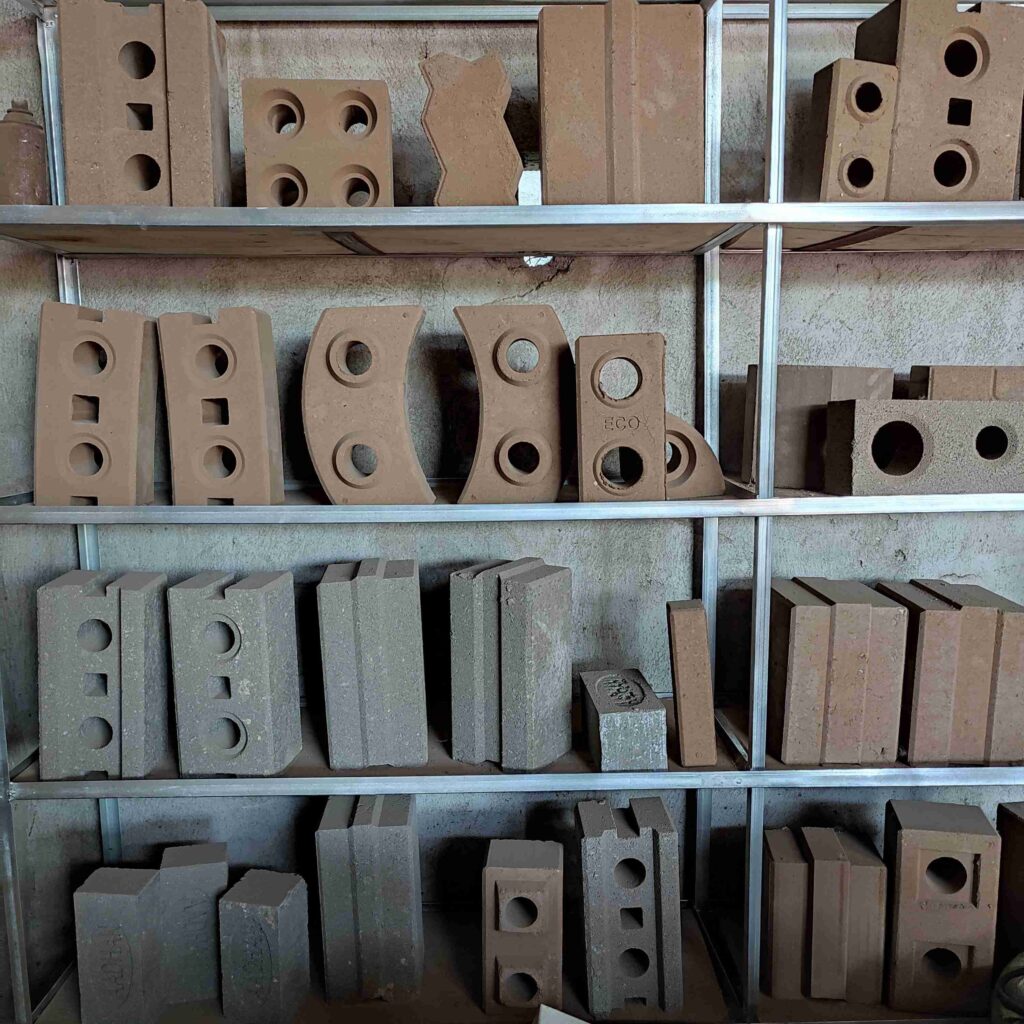
I. Définition de la technologie : Principes fondamentaux et flux de processusDe la machine à fabriquer des blocs d'argile
Une machine à fabriquer des briques en argile est un système industriel conçu pour façonner de l'argile plastique en formes précises (briques, tuiles, blocs), qui sont ensuite séchées et cuites dans un four pour acquérir leurs propriétés céramiques finales. Ce processus est fondamentalement différent de la cure à l'air libre du béton ou de la stabilisation des sols.
A. Le Procédé d'Extrusion Fondamental
La technologie dominante pour la production de briques en terre cuite moderne est l'extrusion, un procédé de mise en forme continu.
- Chambre à vide et tarière :Au cœur se trouve une chambre d'extrusion sous vide. L'argile préparée est introduite dans cette chambre où une puissante vis sans fin rotative la transporte vers l'avant. Une pompe à vide cruciale élimine l'air emprisonné dans la masse d'argile. Cette étape de débullage est non négociable, car elle évite les délaminages, réduit les fissures lors du séchage/de la cuisson, et augmente considérablement la densité et la résistance du produit final.
- La filière et l'extrusion :L'argile compactée et désaérée est forcée sous haute pression à travers une filière en acier méticuleusement conçue. Le profil interne de la filière façonne l'argile en une colonne continue et solide avec les dimensions extérieures précises et, le cas échéant, le motif de perforation interne de la brique finale.
- Découpage au filLa colonne d’argile lisse et continue (ou « boudin ») sort de la filière. Un système de coupe, utilisant généralement des fils tendus sur un cadre à mouvement alternatif, tranche la colonne en unités de brique individuelles à intervalles précis. Cette étape détermine la longueur de la brique.
B. Les étapes essentielles post-formage : séchage et cuisson
La machine de formage n'est que le premier acte d'une pièce industrielle en trois parties. Sa production est une « brique verte », fragile et saturée d'eau.
- Séchage :Les briques vertes contiennent une quantité importante d'eau mécanique (généralement 15-25 %). Elles doivent être séchées lentement et uniformément dans des chambres contrôlées ou des bâtiments de séchage pour réduire la teneur en humidité à moins de 3 %. Un séchage rapide ou inégal provoque des fissures et des déformations. Les usines modernes utilisent des séchoirs à tunnel automatisés pour un séchage continu et efficace.
- Cuisson (Le Processus de Vitrification) This is the transformative step. Dried bricks are fired in kilns at temperatures between 900°C and 1200°C. The heat triggers complex physicochemical reactions:
- Sintering: Clay particles begin to fuse at their boundaries.
- Vitrification: Fluxing materials melt, forming a glassy phase that fills pores and bonds particles.
- This process creates the permanent hardness, strength, weather resistance, and fixed color of the ceramic product. Common kiln types include energy-efficient tunnel kilns (continuous) and periodic kilns like Hoffman kilns.
II. Key Machine Types and Configurations
Clay brick machinery varies in scale, automation, and specific forming methods beyond standard extrusion.
A. Stiff-Mud Extruders (The Industry Standard)
This is the most common type, using clay with a moisture content of 12-18%, giving it a “stiff” but plastic consistency.
- Caractéristiques : Produces dense, sharp-edged bricks with high dimensional accuracy. Excellent for producing perforated and hollow bricks due to the stability of the extruded column. Essential for high-volume, modern brick plants.
- Commercial Application: The core equipment for suppliers targeting large-scale construction projects, architectural brick supply, and industrial markets requiring consistent, high-specification products.
B. Soft-Mud Machines (For Traditional or Specialized Textures)
These handle clay with higher moisture content (up to 30%), making it “soft.”
- Forming Process: The clay is often molded rather than extruded under high pressure. In some systems, the soft clay is pressed into individual sand-coated molds to produce bricks with a characteristic “sand-struck” or “water-struck” textured surface.
- Caractéristiques : Can produce bricks with a more irregular, hand-made aesthetic prized in restoration and high-end architectural projects. Generally has a lower production rate than stiff-mud extrusion.
- Commercial Application: Serves a niche but high-value market. Important for distributors in regions with demand for historic or artisanal-style brick facades.
C. Complete Plant vs. Standalone Extruder
A critical distinction for investment planning.
- Standalone Extrusion Machine: Includes the extruder, cutter, and perhaps a simple conveyor. Assumes the client already has or will separately procure drying and firing infrastructure (kilns). This is a modular approach for upgrading existing facilities.
- Turnkey Plant Project: A comprehensive supply that includes the entire production line: clay preparation equipment (crushers, screens, mixers), the extruder and cutter, automated setting systems for dryers and kilns, the dryer(s) themselves, the kiln(s), and cooling/handling/packaging systems. This is a major capital project.
III. Strategic Commercial Considerations for B2B Stakeholders
Dealing in clay brick machinery requires a distinct set of commercial and technical evaluations compared to other brick-making technologies.
A. Market Analysis and Client Profiling
Success depends on accurate market alignment.
- Raw Material Dependency: The business is geographically tethered to viable clay deposits. A feasibility study including clay testing (composition, plasticity, firing characteristics) is often a prerequisite. Distributors must be aware of local geology.
- Energy-Intensive Process: The firing process requires significant and reliable energy input (natural gas, coal, biomass, electricity). The cost and availability of energy are primary determinants of a client’s long-term operational viability.
- End-Product Market: Is the demand for common engineering bricks, facing bricks in various colors and textures, or specialized refractory bricks? Each has implications for the required machine precision and kiln temperature capabilities.
B. Investment Scale and Complexity
Clay brick production is a heavy industrial undertaking.
- High Capital Expenditure (CAPEX): A complete plant represents one of the largest investments in the construction materials machinery sector, often orders of magnitude greater than an equivalent-output concrete block plant.
- Technical Complexity and Support: The integration of mechanical extrusion with thermal process engineering (drying and firing) demands sophisticated technical knowledge. After-sales support must cover not just the extruder, but also kiln atmosphere control, combustion systems, and thermodynamics.
- Longer Return on Investment (ROI) Horizon: Due to the high CAPEX and significant operating energy costs, the ROI period is typically longer. Business models must be based on high-volume output, premium product pricing, or both.
C. Value Proposition and Competitive Advantages
Understanding the unique selling points of clay brick is crucial.
- Product Superiority: Clay bricks offer exceptional durability, fire resistance, thermal mass, and low maintenance. They do not fade, spall easily, or degrade in UV light. This provides a powerful technical narrative.
- Versatilité esthétique : Through the use of different clays, surface treatments (sanding, glazing), and firing techniques, an immense variety of colors and textures can be achieved, meeting specific architectural design needs.
- Sustainability Narratives: Modern clay brick plants can utilize methane from landfills as fuel and are increasingly energy-efficient. The product itself is 100% natural, recyclable, and has a long lifespan, contributing to sustainable building credentials.
Conclusion
The clay brick making machine is the engine of a sophisticated, capital-intensive, and highly specialized industrial sector. For the B2B professional, it represents a high-value, high-complexity product line that demands deep technical understanding and strategic market positioning. Success in this arena requires moving beyond equipment sales to becoming a consultant on the entire ceramic production ecosystem—from clay pit analysis to kiln thermodynamics.
Distributors and dealers who cultivate expertise in this field position themselves to serve a premium market segment where product quality, consistency, and performance are paramount. The client profile is typically an established industrialist or a significant investor, making the sales cycle consultative and relationship-based. By comprehensively understanding the extrusion process, the critical importance of drying and firing, and the substantial commercial dynamics at play, you can provide indispensable guidance. This enables your clients to make informed investments in a technology that produces one of humanity’s oldest, yet most enduringly reliable, building materials: the fired clay brick.
Foire aux Questions (FAQ)
Q1: What are the main advantages of clay bricks produced by this machinery over concrete blocks?
A: The advantages are rooted in material science. Clay bricks offer superior long-term durability and weathering resistance, excellent fire rating (non-combustible), high résistance à la compression, and natural thermal mass for energy efficiency. They also provide unparalleled aesthetic variety in color and texture that is permanent, as the color is fired in, not painted on. Concrete blocks can be more susceptible to efflorescence and moisture penetration over time in certain environments.
Q2: Is the clay extrusion process suitable for making interlocking bricks?
A: Yes, but with important caveats. Extrusion can produce interlocking clay bricks, but the die design for the interlocking profile is complex and the green (unfired) interlocking brick is very fragile. Handling, drying, and firing these delicate shapes require extreme care to prevent breakage. The process is more challenging and has a higher potential waste rate than producing standard rectangular bricks.
Q3: What is the single most critical factor for a client’s success with a clay brick plant?
A: Consistent access to suitable clay and affordable energy. Without a reliable, homogeneous clay supply that fires to the desired color and strength, the business cannot produce a consistent product. Without cost-effective energy for the high-temperature kiln, the operational costs will be unsustainable. These two factors must be secured before any machinery investment is considered.
Q4: How does the level of automation differ in a clay brick plant compared to a concrete block plant?
A: Automation is highly advanced but focused on different stages. In a modern clay plant, automation is critical in material handling and setting. Robots or automated setting machines precisely place fragile green bricks onto kiln cars or dryer cars. The firing process itself in a tunnel kiln is fully automated with computerized temperature and atmosphere control. The extrusion process is also automated, but the complexity lies in integrating these mechanical and thermal automation systems seamlessly.
Q5: Can a small or medium enterprise (SME) realistically enter the clay brick manufacturing business?
A: It is challenging but possible in specific contexts. A full-scale tunnel kiln plant is often prohibitive. However, SMEs can focus on niche markets using smaller, periodic kilns (like shuttle kilns) and simpler extrusion equipment to produce specialty or artisanal bricks. The business model would be based on lower volume but higher value-per-unit, targeting architectural restoration, custom home builds, or local heritage projects. The investment and technical knowledge required are still significant but on a different scale than an industrial plant.