Deconstructing the Drying and Curing Timeline
The process following the molding of a concrete brick is accurately described as a two-stage journey: initial setting and demolding, followed by the critical curing period. The term “drying” is somewhat misleading, as the goal is not to remove all moisture but to manage its presence to facilitate the chemical hydration of cement.
1. The Science of Curing: From Plastic to Product
Concrete brick strength develops through the chemical reaction between Portland cement and water, known as hydration. This reaction forms crystalline structures that bind the aggregate (sand, stone) into a solid mass.
- The Role of Water: Sufficient moisture must remain within the brick for hydration to continue to completion. Premature or excessive drying halts this reaction, resulting in a permanently weak, dusty, and permeable product.
- The Concept of “Green Strength”: This refers to the initial hardness that allows the brick to be demolded from the machine without deformation. It is achieved rapidly, often within minutes to hours, due to initial set.
- Maturation: The full development of design strength is a prolonged process, continuing for weeks, though bricks are typically handled and sold after reaching a specified minimum handling strength.
2. Primary Factors Governing the Curing Timeline
The duration is not arbitrary but is dictated by several controllable and environmental variables.
2.1. Mix Design and Constituent Materials
- Cement Type and Content: The use of rapid-hardening (Type III) cement can accelerate early strength gain, potentially reducing initial curing time before handling. The cement-to-aggregate ratio also plays a role; a richer mix may set faster.
- Chemical Admixtures: The strategic use of admixtures is a primary lever for controlling production speed.
- Accelerators: These admixtures drastically speed up the hydration reaction, allowing for demolding in as little as 15-30 minutes in some high-speed systems and enabling early palletizing.
- Water Reducers/Plasticizers: By reducing the water content needed for workability, they result in a denser matrix that gains strength faster and has lower shrinkage.
- Curing Compounds: Internal curing agents can be added to the mix to provide a reservoir of moisture, supporting hydration even in lower-humidity environments.
2.2. Production Methodology and Machine Technology
- Machine Type – Static vs. Mobile: This is the most significant differentiator in curing logistics.
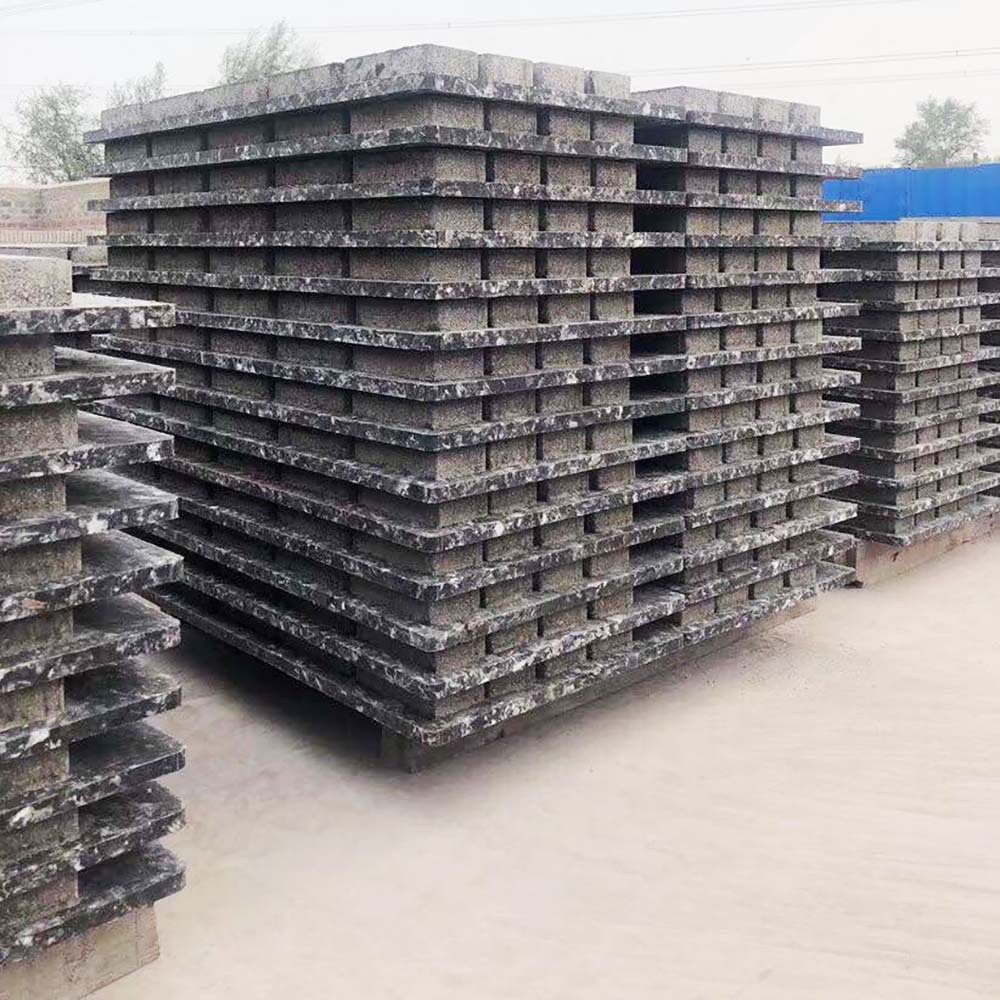
- Static Pallet Systems: Bricks are molded on large, heavy steel pallets (e.g., 12-15 per pallet). The entire pallet, weighing several tons, is moved by forklift to a curing chamber or yard. The bricks cure sur place on the pallet for 18 to 36 hours minimum before they can be depalletized (stripped). This is a batch process with a longer initial cycle.
- Mobile Pallet Systems (Egg-Layers): The machine itself moves along a concrete slab, depositing (“laying”) a batch of bricks directly onto the curing floor. It then moves forward to produce the next batch. Bricks cure where they are laid for a period typically ranging from 24 to 48 hours before they are gathered (“picked”) by a separate machine for stacking. This method requires significant floor space but allows continuous production.
- High-Speed Cubing Systems: The most advanced lines integrate accelerators and specialized molds to achieve demolding strengths in minutes. Bricks are automatically stacked into cubes on wooden pallets within 1-2 hours of casting and moved to a controlled curing environment. This represents the fastest initial cycle time.
2.3. Curing Environment and Controlled Conditions
- Ambient Curing: Bricks are left in the production shed or yard. Time is heavily dependent on weather: high temperatures and wind accelerate moisture loss, risking poor curing; low temperatures slow hydration dramatically. In ideal conditions (70°F/21°C, high humidity), ambient curing to handling strength may take 3-7 days.
- Controlled Curing: This is the hallmark of a quality-focused, consistent producer.
- Steam Curing (Low-Pressure): Pallets or cubes of bricks are housed in a insulated chamber and exposed to low-pressure steam (typically 120°F – 160°F / 50°C – 70°C) and high humidity for 12 to 24 hours. This process accelerates hydration, allowing bricks to reach 70-80% of their 28-day strength in one day. It ensures consistency regardless of outside weather.
- Fog Rooms & Curing Tunnels: Enclosed spaces with automated misting and temperature control maintain a near-100% relative humidity environment, optimizing the curing process without heat.
2.4. The Target Strength and Final Moisture Content
- Handling & Shipping Strength: The minimum compressive strength required for safe depalletizing, cubing, wrapping, and transport. For distributors, this is the most critical milestone, as it dictates when the product can enter the supply chain. With accelerators and steam curing, this can be achieved in 18-24 hours.
- Final Specified Strength: The guaranteed strength, typically measured at 28 days under standard conditions. While most strength gain occurs in the first week, the product continues to cure slowly during storage and transit.
- Drying for Packaging: Before shrink-wrapping, bricks may require additional time to allow surface moisture to evaporate, preventing mold growth under the film.
3. A Comparative Timeline Framework for Business Planning
To translate this into practical logistics, consider these generalized production pathways:
Path A: Standard Static Plant with Ambient Curing
- Demolding/Stripping Time: 24 – 48 hours.
- Time to Handling Strength: 3 – 7 days.
- Time to Ready for Shipment: 5 – 10 days.
- Key Business Implication: Higher inventory holding costs on-site, weather-dependent variability, longer lead times.
Path B: Advanced Plant with Steam Curing & Accelerators
- Demolding/Stripping Time: 18 – 24 hours (for static pallets); 1-2 hours (for cubing systems).
- Time to Handling Strength: 18 – 24 hours.
- Time to Ready for Shipment: 2 – 3 days.
- Key Business Implication: Faster turnaround, consistent quality year-round, reduced footprint, ability to respond quickly to large orders.
Conclusion: Curing Time as a Metric of Operational Sophistication
For the construction materials distributor, the curing timeline of a concrete brick supplier is a powerful indicator of their operational efficiency, quality commitment, and reliability. A supplier who relies solely on ambient curing is subject to the whims of climate, leading to seasonal bottlenecks and potential inconsistency. In contrast, a supplier investing in controlled steam curing chambers and modern admixture technology is not just speeding up production; they are engineering a predictable, high-quality product and a reliable supply chain.
When evaluating suppliers or negotiating contracts, move beyond asking “how long does it take?” Instead, ask specific questions:
- “Do you use controlled steam curing or ambient yard curing?”
- “What is your standard lead time from production to load-out for a full truckload?”
- “How do you adjust your mix and process in winter versus summer to maintain consistency?”
The answers will reveal the sophistication of the operation. A shorter, controlled curing time directly translates to your competitive advantage: the ability to guarantee supply, fulfill urgent orders, and provide your customers with a product of verified and uniform quality. In the business of concrete bricks, time is not just money—it is strength, consistency, and market trust.
FAQ
Q1: Why do some suppliers quote a 28-day lead time for concrete bricks if they are hard in a few days?
A: The 28-day period is the standard testing age for specified compressive strength. A conservative supplier may quote this to ensure the product has fully matured before shipment, especially if using ambient curing. However, with modern curing methods, bricks reach shipping strength much sooner. The quoted lead time often includes production scheduling, curing to handling strength, quality control testing, and logistics, not just the chemical cure.
Q2: How does curing time impact the brick’s long-term durability and performance?
A: Proper curing is absolutely critical for durability. Inadequately cured bricks have higher permeability, allowing water and de-icing salts to penetrate more easily. This leads to reduced freeze-thaw resistance, potential efflorescence, and lower overall longevity. A faster cure through controlled conditions (steam) is superior to a slow, uneven ambient cure that risks premature drying.
Q3: We receive bricks that are sometimes damp or have a whitish powder (efflorescence). Is this related to curing?
A: Directly. Damp bricks indicate they were wrapped and shipped before excess surface moisture evaporated, a sign of rushed curing or improper scheduling. Efflorescence is caused by soluble salts migrating to the surface with water. Inadequate curing (too dry too fast) can leave unreacted cement particles near the surface that later react, while improper water drainage during curing can also concentrate salts. Consistent, controlled curing minimizes both issues.
Q4: Can bricks be used immediately upon delivery, or do they need further curing on-site?
A: Bricks shipped after reaching their handling strength (typically >70% of 28-day strength) are ready for immediate installation in most applications. The 28-day strength is a guarantee that will be achieved over time in the wall. It is crucial, however, to store them on-site on dry, flat ground and protect them from contamination and excessive wetting before use.
Q5: What is the single most important question I can ask a potential supplier about their curing process?
A: Ask: “Do you use a controlled, accelerated curing system (like steam), and what is your standard process time from molding to the brick being stable enough for palletizing and wrapping?” This question cuts to the heart of their technology, consistency, and understanding of their own production cycle, giving you a clear picture of their capability and reliability.