
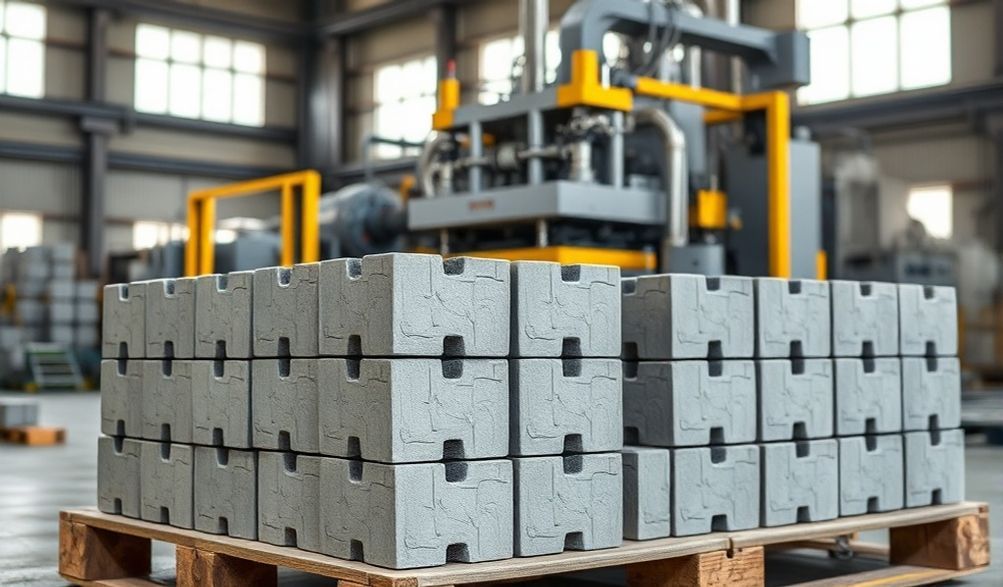
Votre Guide Ultime pour l'Achat d'une Machine à Fabriquer des Blocs de Béton en Vente (2024)
Introduction
Vous cherchez à bâtir une entreprise de construction rentable ou à développer vos capacités de production ? La machine à fabriquer des blocs de béton adaptée est votre investissement le plus crucial. Elle est le moteur de votre exploitation, déterminant votre rendement, la qualité de vos produits et, en fin de compte, votre rentabilité. Pourtant, s'orienter dans le vaste marché des machines en vente peut s'avérer une tâche ardue, remplie de jargon technique et d'enjeux financiers considérables.
Ce guide complet de 2024, s'appuyant sur des décennies d'expérience dans le secteur, vous servira de feuille de route fiable. Nous allons démêler la complexité pour vous aider à comprendre précisément ce qu'il faut rechercher dans unmachine à fabriquer des blocs de béton à vendreVous apprendrez à choisir les types de machines adaptés à vos objectifs spécifiques, à décrypter les facteurs de prix, à évaluer les fabricants avec un regard critique et à éviter les pièges courants coûteux. À la fin, vous serez en mesure de prendre une décision d'achat éclairée et confiante, qui soutiendra votre croissance pour les années à venir.
Comprendre les machines de fabrication de blocs de béton : types et applications
Avant de plonger dans les spécifications et les prix, il est crucial de comprendre les catégories fondamentales de machines disponibles. Le bon choix dépend de votre échelle de production, de votre budget et de votre stratégie en matière de main-d'œuvre.
Manuel vs Semi-Automatique vs Entièrement Automatique : Machines à Blocs
Le niveau d'automatisation est le principal facteur de différenciation dans les machines à blocs, influençant directement la production, les coûts de main-d'œuvre et l'investissement initial.
-
Machines à blocs manuelles :
- Opération :Entièrement actionnée par l'homme. Les opérateurs remplissent manuellement le moule, compriment le béton (souvent à l'aide d'un levier) et démoulent le bloc.
- Travail & Production :Intensité de main-d'œuvre élevée, production très faible (généralement 100 à 500 blocs par jour). Convient pour 1 à 2 opérateurs.
- Recommandation d'Expert :Idéal pour les startups de très petite envergure, les projets communautaires ou dans les zones reculées avec une faible disponibilité d'énergie et des capitaux limités. Ils constituent un point d'entrée à faible risque, mais ne conviennent pas à une production à volume commercial.
-
Machines semi-automatiques de fabrication de blocs :
- Opération :Mécanise le processus de compactage central (par vibration et pression hydraulique) mais nécessite un chargement manuel de la matière première et un retrait/palettisation manuels des blocs finis.
- Travail & Production :Main-d'œuvre modérée requise (2 à 4 personnes), bonne production (1 000 à 6 000+ blocs par équipe de 8 heures, selon le modèle).
- Recommandation d'Expert :Le point idéal pour la plupart des petites et moyennes entreprises (PME). Elles offrent un excellent équilibre entre abordabilité, taux de production amélioré et constance de la qualité des blocs. Parfait pour les entreprises cherchant à passer d'opérations manuelles à une production à plus grande échelle.
-
Machines à fabriquer des blocs entièrement automatiques :
- Opération :Entièrement automatisées via des systèmes de PLC (Automate Programmable Industriel). Elles disposent d'une alimentation automatique des matériaux, du moulage, du compactage, de la cure et de l'empilage. Faisant souvent partie d'une ligne de production complète.
- Travail & Production :Travail minimal (pour la supervision et la maintenance), production très élevée (8 000 à 20 000+ blocs par équipe).
- Recommandation d'Expert :Réservé aux installations commerciales de grande envergure et aux contrats à volume élevé. L'investissement en capital important se justifie par une efficacité inégalée, un coût unitaire inférieur et une cohérence supérieure. Nécessite une alimentation électrique fiable et une maintenance plus sophistiquée.
Machines à blocs stationnaires contre machines à blocs mobiles
Cette distinction concerne la mobilité de la machine et son empreinte d'installation.
-
Machines à fabriquer des blocs stationnaires :
- Ce sont des installations fixes, généralement montées sur une fondation en béton solide dans une usine ou une cour dédiée.
- Ils sont généralement plus robustes, plus puissants et capables de volumes de production plus élevés.
- Application : The standard choice for permanent block manufacturing plants supplying a regional market.
-
Mobile Block Making Machines (or “Egg-Layers”):
- These units are mounted on wheels or a trailer. They produce blocks directly on the ground or on a concrete slab, then move forward to lay the next batch.
- They are simpler, often require less foundation work, and are highly portable.
- Application : Excellent for on-site production for large construction projects (e.g., building a housing complex) where transporting blocks is costly. They eliminate transport damage and costs.
Key Products: What Can You Manufacture?
Your business potential isn’t limited to standard blocks. Machine versatility, determined by its mold system, defines your product catalog.
- Blocs creux : The most common product for construction, offering excellent strength-to-weight ratio and insulation.
- Blocs Pleins : Used for heavier load-bearing applications and paving.
- Dalles de pavage et pavés autobloquants : For driveways, walkways, and patios. A high-demand market in landscaping and municipal work.
- Curb Stones & Kerbs: Essential for road construction and landscaping projects.
- Formes Spécialisées : Interlocking blocks for retaining walls, chimney blocks, and decorative landscaping units.
Avis d'Expert : When evaluating a machine à fabriquer des blocs de béton à vendre, inquire about the mold compatibility and cost. A machine that allows for quick mold changes with a wide range of available mold designs enables you to pivot with market demands and capture diverse revenue streams.
Facteurs Critiques à Considérer Avant d'Acheter
Armed with an understanding of machine types, you must now drill down into the specifics that separate a wise investment from a costly mistake.
Capacité de Production et Exigences de Rendement
Don’t just look at the “maximum” output in a brochure. Think practically.
- Cycles per Hour & Blocks per Cycle: Multiply these figures to get the theoretical hourly output. A machine with a 10-second cycle time producing 4 blocks per cycle can theoretically make 1,440 blocks per hour.
- Real-World Calculation: Deduct time for mold changes, maintenance breaks, material loading delays, and operator shifts. A realistic daily output is often 70-80% of the theoretical maximum.
- Correspondance aux objectifs : Align the machine’s realistic output with your current orders and projected growth for the next 3-5 years. Buying slightly more capacity than you need today is often smarter than outgrowing a machine too quickly.
Machine Specifications & Technical Details
These are the nuts and bolts that determine performance and longevity.
- Pression (Tonnage) : Higher compaction pressure (measured in tons) generally produces denser, stronger blocks. For standard hollow blocks, machines range from 50 to 400+ tons.
- Exigences en matière d'alimentation électrique : Manuals may need no power, while semi-automatics often use a standard 3-phase motor (e.g., 380V/50Hz or 440V/60Hz). Verify your local power supply.
- Système de Vibration : This is critical for compacting the concrete and releasing air bubbles. Look for durable, high-frequency vibrators mounted effectively within the mold table.
- Système de Contrôle : From simple relay logic to touch-screen PLCs. More advanced controls offer precision, diagnostic tools, and easier operation.
- Trust Factor: Always ask about the availability of technical manuals, wiring diagrams, and spare parts lists. A supplier’s reluctance to provide these is a major red flag.
Quality of Construction & Key Components
This is where “you get what you pay for” becomes starkly real.
- Cadre et Structure : The frame should be made from heavy-duty, reinforced steel plate to withstand constant vibration and pressure without warping.
- Système Hydraulique : The heart of an automatic machine. Look for reputable component brands (e.g., Bosch Rexroth, Parker, Yuken) and a well-designed, accessible system with proper filtration and cooling.
- Moississures : These are high-wear items. They should be made from hardened, high-chrome steel for longevity and precise block dimensions.
- Authoritative Benchmark: Reputable manufacturers will often build to recognized standards (like ISO) and can provide material certificates for critical components. Don’t hesitate to ask for them.
Space, Logistics, and Foundation Needs
A machine isn’t just the machine itself.
- Factory Space: You need space for the machine, raw material storage (aggregates, cement), a mixing area, a curing area, and finished product storage. Include space for forklift movement.
- Foundation: Most stationary machines require a solid, level concrete foundation of specified thickness to absorb vibrations. The supplier should provide detailed foundation drawings.
- Logistique : Consider the machine’s shipping dimensions and weight. Do you have access for a delivery truck? Do you need a crane or heavy forklift for unloading and placement?
Navigating the Market: Cost, Suppliers, and Selection
This is the phase where due diligence separates successful buyers from regretful ones.
Concrete Block Making Machine Price Ranges
Prices vary astronomically based on the factors we’ve discussed. Here’s a transparent 2024 overview:
- Machines manuelles : $1,000 – $5,000 USD.
- Machines semi-automatiques : $8,000 – $50,000+ USD. A robust, mid-capacity model for SME production typically starts around $15,000-$25,000.
- Fully Automatic Machines / Production Lines: $50,000 – $300,000+ USD. Single-pallet fully automatic machines start around $50k-$80k, while large multi-pallet lines with full automation can reach several hundred thousand.
Critical Expertise Note: The initial purchase price is just one part of the Total Cost of Ownership (TCO). A cheaper, poorly supported machine can cost far more in downtime, repair costs, and lost production than a higher-quality, well-supported alternative.
How to Choose a Reputable Manufacturer or Supplier
Your relationship with the supplier is as important as the machine itself. Use this checklist:
- Company History & Reputation: How long have they been in business? Search for their brand name online alongside keywords like “review,” “problem,” or “service.” A 10+ year track record is a good sign.
- Quality Evidence: Do they have quality management certifications (ISO)? Can they provide test reports or videos of the machine in operation? Will they share material certificates for key parts?
- Structure de Support Après-Vente : This is non-negotiable. Do they have technical support staff? What is the warranty period and what does it cover? Is there a stock of commonly needed spare parts? Do they offer installation supervision and operator training?
- Transparency & References: A trustworthy supplier will be proud to connect you with previous customers in your region or a similar industry. They should also be open to a factory visit or a live video tour of their production facility.
- Red Flags: Extremely low prices, pressure to pay via insecure methods, vague company addresses, inability to communicate clearly in your language, and no physical contact details.
New vs. Used Concrete Block Making Machines
A used machine can be a great value—or a money pit.
- New Machine Pros: Full warranty, latest technology, customized to your needs, reliable performance from day one.
- Used Machine Pros: Lower upfront cost, potential for faster delivery, depreciation already absorbed.
- Used Machine Inspection Checklist:
- Hours/Cycles: Check the machine’s service hour meter or get an estimate of total production cycles.
- Physical Inspection: Look for cracks in the frame, signs of weld repairs, hydraulic oil leaks, and excessive wear on molds and vibrators.
- Test Run: Toujours insist on seeing the machine under power, producing blocks. Listen for unusual noises in the hydraulics or vibrations.
- Documentation: Request the original manuals, part lists, and maintenance history.
Maximizing Your Investment: Operation and Beyond
Your new machine is the centerpiece, but its success depends on the ecosystem around it.
Essential Auxiliary Equipment
Rarely does a machine work in isolation. Consider these for an efficient line:
- Bétonnière : A pan mixer or planetary mixer ensures a consistent, homogenous mix, which is vital for block quality.
- Système de convoyeur : Transports mixed concrete to the machine hopper, saving labor and time.
- Système d'alimentation/de circulation de palettes. Automatic systems move pallets in and out of the machine, crucial for high-output automation.
- Block Curing System: This can be a simple rack system in a sheltered yard or a sophisticated steam curing chamber for faster strength gain.
- Forklift or Block Clamp: Essential for handling raw materials and moving stacks of finished blocks.
Raw Material Considerations for Optimal Blocks
The machine can only form what you feed it.
- Conception du Mélange : A proper ratio of cement, sand, aggregate (gravel or crushed stone), and water is critical. The water-cement ratio directly affects strength.
- Aggregate Size: Must be compatible with your mold dimensions—typically between 5mm and 10mm for standard blocks.
- Consistency is Key: Variations in raw material quality or moisture content will lead to inconsistent block density and strength, causing production issues and customer complaints.
The Importance of After-Sales Support
The sale is the beginning of the relationship, not the end.
- Installation et Mise en Service : Professional setup ensures the machine is level, calibrated, and operating safely from the start.
- Formation Complète : Operators must be trained not just on how to run the machine, but on basic troubleshooting, daily maintenance, and safety protocols.
- Warranty & Long-Term Support: Understand the response time for technical queries. How quickly can they ship a critical spare part? A supplier with a strong support network is investing in your long-term success.
Frequently Asked Questions (FAQ)
Q: What is the average cost of a concrete block making machine for sale?
A: As detailed above, there’s no single “average.” Prices range from around $1,000 for a basic manual model to well over $200,000 for a high-capacity, fully automatic production line. Your final cost depends on automation level, capacity, brand, and included support.
Q: How many blocks can a standard machine produce per day?
A: Output varies dramatically. A machine semi-automatique might produce 2,000 to 6,000 standard hollow blocks in an 8-hour shift. A fully automatic single-pallet machine can produce 8,000 to 15,000, while large multi-pallet lines can exceed 20,000 blocks per day.
Q: Can one machine produce different block types and sizes?
A: Yes, absolutely. This is achieved through interchangeable molds. However, factor in the cost of additional molds and the time required for mold changeover, which can temporarily halt production.
Q: What kind of power supply is needed?
A: It depends entirely on the machine. Small manuals may need none. Semi-automatic and automatic machines almost always require a three-phase industrial power supply (commonly 380V/50Hz or 440V/60Hz). Always confirm the exact voltage and power (kW) requirements with the supplier before purchase.
Q: How do I ensure I’m choosing a trustworthy supplier?
A: Follow the checklist in the guide: verify their business history, ask for quality certifications, demand details on after-sales service and spare parts, and always request customer references or a factory visit. A reputable company will be transparent and eager to prove its credibility.
Conclusion
Purchasing a machine à fabriquer des blocs de béton à vendre is a pivotal decision that hinges on careful planning and informed selection. We’ve walked through the essential pillars: defining your production needs and scale, understanding the core differences between manual, semi-automatic, and automatic systems, and prioritizing durable construction and robust after-sales support over price alone.
Remember, this machine is a long-term partner in your business growth. The most cost-effective choice isn’t the cheapest sticker price, but the machine—backed by a reputable supplier—that delivers reliable, efficient production for years with minimal downtime. Thorough research and partnering with experienced, trustworthy experts are the true foundations of your success in the block manufacturing industry.
Ready to take the next step? Browse our curated selection of verified, high-performance concrete block making machines for sale, or contact our team of technical experts today for a free, no-obligation consultation tailored to your project goals.
<