
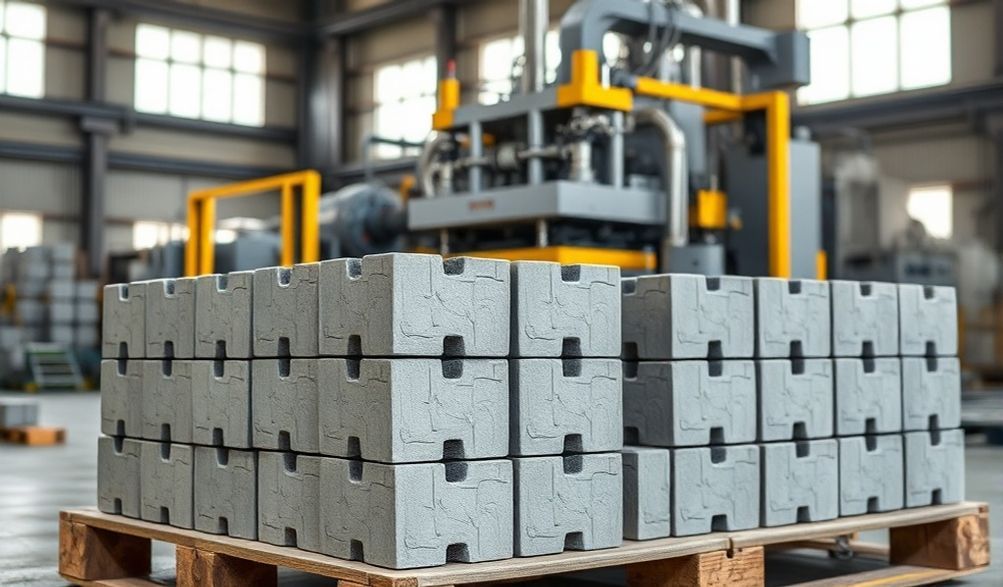
Дастури ниҳоии шумо барои харидани мошини сохтани блокҳои бетонӣ барои фурӯш (2024)
Муқаддима
Сохтмони тиҷорати фоидаовари сохтмон ё васеъ кардани имконияти истеҳсолӣ? Дастгоҳи дурусти сохтани блокҳои бетонӣ муҳимтарин сармоягузории шумост. Ин мошини амалиёти шумост, ки маҳсул, сифати маҳсулот ва дар ниҳоят, натиҷаи ниҳоии шуморо муайян мекунад. Аммо, раҳнамоӣ дар бозори васеъи дастгоҳҳои фурӯшӣ метавонад вазифаи душворе бошад, ки пур аз истилоҳоти техникӣ ва хатарҳои молиявии аҳамиятнок аст.
Ин дастури муфассали соли 2024, ки аз даҳҳо сол таҷрибаи саноатӣ истифода мебарад, ҳамчун роҳнамои боэътимоди шумо хидмат хоҳад кард. Мо мураккабиҳоро коҳиш дода, ба шумо мефаҳмем, ки дар як...мошини сохтани блокҳои бетонӣ барои фурӯшШумо меомӯзед, ки чӣ гуна навъҳои дастгоҳҳоро ба мақсадҳои мушаххаси худ мувофиқ кунед, омилҳои нархгузорӣро шифр кушоед, истеҳсолкунандагонро бо диди интиқодӣ арзёбӣ намоед ва аз хатоҳои густаридаи пулакӣ худдорӣ кунед. То поёни ин курс, шумо барои қабули қарори хариди огоҳона ва боварӣ таҷҳиз карда мешавед, ки барои солҳои оянда рушди шуморо таъмин мекунад.
Фаҳмидани дастгоҳҳои сохтани блокҳои бетонӣ: Намудҳо ва Истифодабарӣҳо
Пеш аз он ки ба тафсилоти техникӣ ва нархҳо бипардозед, муҳим аст ки навъҳои асосии дастгоҳҳои дастрасро фаҳмед. Интихоби дуруст ба андозаи истеҳсолот, буҷа ва стратегияи кори шумо вобаста аст.
Дастӣ барои Ним-Автоматӣ барои Пурра-Автоматӣ Блок Машинаҳо
Сатҳи автоматсозӣ дар мошинаҳои блоксозӣ асосий фарқкунанда мебошад, ки бевосита ба истеҳсолот, хароҷоти меҳнат ва сармоягузории ибтидоӣ таъсир мерасонад.
-
Дастгоҳҳои дастӣ барои сохтани блокҳо
- Амалиёт:Тамоми раванд бо дасти одам амалӣ мешавад. Операторҳо қолибро дастӣ пур мекунанд, бетонро фишор медиҳанд (аксар вақт бо ёрии дӯстона) ва блокро аз қолиб берун меоваранд.
- Меҳнат ва Маҳсулот:Меҳнати зиёд, истеҳсоли хеле паст (оддӣ 100-500 блок дар як рӯз). Барои 1-2 оператор мувофиқ аст.
- Тавсияи мутахассис:Идеалӣ барои стартапҳои хеле хурд, лоиҳаҳои ҷамъиятӣ ё дар минтақаҳои дурдаст бо дастрасии кам ба барқ ва сармоя. Онҳо нуқти даромади камхатариро ташкил медиҳанд, аммо барои истеҳсоли ҳаҷми тиҷорӣ мувофиқ нестанд.
-
Машинаҳои ним худкор барои сохтани блокҳо:
- Амалиёт: Mechanizes the core compaction process (via vibration and hydraulic pressure) but requires manual feeding of raw material and removal/palletizing of finished blocks.
- Меҳнат ва Маҳсулот: Moderate labor requirement (2-4 persons), good output (1,000 to 6,000+ blocks per 8-hour shift, depending on model).
- Тавсияи мутахассис: The sweet spot for most small to medium-sized enterprises (SMEs). They offer an excellent balance between affordability, improved production rate, and block quality consistency. Perfect for businesses looking to scale from manual operations.
-
Машинаҳои пурра худкор барои сохтани блокҳо:
- Амалиёт: Entirely automated via PLC (Programmable Logic Controller) systems. They feature automatic material feeding, molding, compaction, curing, and stacking. Often part of a complete production line.
- Меҳнат ва Маҳсулот: Minimal labor (for supervision and maintenance), very high output (8,000 to 20,000+ blocks per shift).
- Тавсияи мутахассис: Reserved for large-scale commercial plants and high-volume contracts. The significant capital investment is justified by unmatched efficiency, lower per-unit cost, and superior consistency. Requires reliable power and more sophisticated maintenance.
Машинаҳои истеҳсоли блокҳои стационарӣ ва машинаҳои истеҳсоли блокҳои мобилӣ
This distinction relates to the machine’s mobility and installation footprint.
-
Машинаҳои истеҳсоли блокҳои сабит:
- These are fixed installations, typically mounted on a solid concrete foundation in a factory or dedicated yard.
- They are generally more robust, powerful, and capable of higher production volumes.
- Application: The standard choice for permanent block manufacturing plants supplying a regional market.
-
Mobile Block Making Machines (or “Egg-Layers”):
- These units are mounted on wheels or a trailer. They produce blocks directly on the ground or on a concrete slab, then move forward to lay the next batch.
- They are simpler, often require less foundation work, and are highly portable.
- Application: Excellent for on-site production for large construction projects (e.g., building a housing complex) where transporting blocks is costly. They eliminate transport damage and costs.
Key Products: What Can You Manufacture?
Your business potential isn’t limited to standard blocks. Machine versatility, determined by its mold system, defines your product catalog.
- Блокҳои ҳолӣ: The most common product for construction, offering excellent strength-to-weight ratio and insulation.
- Блокҳои сахт: Used for heavier load-bearing applications and paving.
- Сангҳои фарш ва пайвандҳои мутақобила: For driveways, walkways, and patios. A high-demand market in landscaping and municipal work.
- Curb Stones & Kerbs: Essential for road construction and landscaping projects.
- Шаклҳои махсус: Interlocking blocks for retaining walls, chimney blocks, and decorative landscaping units.
Expert Insight: When evaluating a мошини сохтани блокҳои бетонӣ барои фурӯш, inquire about the mold compatibility and cost. A machine that allows for quick mold changes with a wide range of available mold designs enables you to pivot with market demands and capture diverse revenue streams.
Омилҳои муҳим барои баррасӣ пеш аз харид
Armed with an understanding of machine types, you must now drill down into the specifics that separate a wise investment from a costly mistake.
Production Capacity & Output Requirements
Don’t just look at the “maximum” output in a brochure. Think practically.
- Cycles per Hour & Blocks per Cycle: Multiply these figures to get the theoretical hourly output. A machine with a 10-second cycle time producing 4 blocks per cycle can theoretically make 1,440 blocks per hour.
- Real-World Calculation: Deduct time for mold changes, maintenance breaks, material loading delays, and operator shifts. A realistic daily output is often 70-80% of the theoretical maximum.
- Matching to Goals: Align the machine’s realistic output with your current orders and projected growth for the next 3-5 years. Buying slightly more capacity than you need today is often smarter than outgrowing a machine too quickly.
Machine Specifications & Technical Details
These are the nuts and bolts that determine performance and longevity.
- Фишори (Тоннаж): Higher compaction pressure (measured in tons) generally produces denser, stronger blocks. For standard hollow blocks, machines range from 50 to 400+ tons.
- Талабҳои барқ: Manuals may need no power, while semi-automatics often use a standard 3-phase motor (e.g., 380V/50Hz or 440V/60Hz). Verify your local power supply.
- Системаи Ларзишӣ: This is critical for compacting the concrete and releasing air bubbles. Look for durable, high-frequency vibrators mounted effectively within the mold table.
- Системи идоракунӣ From simple relay logic to touch-screen PLCs. More advanced controls offer precision, diagnostic tools, and easier operation.
- Trust Factor: Always ask about the availability of technical manuals, wiring diagrams, and spare parts lists. A supplier’s reluctance to provide these is a major red flag.
Quality of Construction & Key Components
This is where “you get what you pay for” becomes starkly real.
- Фрейм ва сохтор The frame should be made from heavy-duty, reinforced steel plate to withstand constant vibration and pressure without warping.
- Системаи гидравликӣ: The heart of an automatic machine. Look for reputable component brands (e.g., Bosch Rexroth, Parker, Yuken) and a well-designed, accessible system with proper filtration and cooling.
- Муқаррарҳо: These are high-wear items. They should be made from hardened, high-chrome steel for longevity and precise block dimensions.
- Authoritative Benchmark: Reputable manufacturers will often build to recognized standards (like ISO) and can provide material certificates for critical components. Don’t hesitate to ask for them.
Space, Logistics, and Foundation Needs
A machine isn’t just the machine itself.
- Factory Space: You need space for the machine, raw material storage (aggregates, cement), a mixing area, a curing area, and finished product storage. Include space for forklift movement.
- Foundation: Most stationary machines require a solid, level concrete foundation of specified thickness to absorb vibrations. The supplier should provide detailed foundation drawings.
- Logistics: Consider the machine’s shipping dimensions and weight. Do you have access for a delivery truck? Do you need a crane or heavy forklift for unloading and placement?
Navigating the Market: Cost, Suppliers, and Selection
This is the phase where due diligence separates successful buyers from regretful ones.
Concrete Block Making Machine Price Ranges
Prices vary astronomically based on the factors we’ve discussed. Here’s a transparent 2024 overview:
- Дастгоҳҳои дастӣ: $1,000 – $5,000 USD.
- Машинаҳои ним-автоматӣ: $8,000 – $50,000+ USD. A robust, mid-capacity model for SME production typically starts around $15,000-$25,000.
- Fully Automatic Machines / Production Lines: $50,000 – $300,000+ USD. Single-pallet fully automatic machines start around $50k-$80k, while large multi-pallet lines with full automation can reach several hundred thousand.
Critical Expertise Note: The initial purchase price is just one part of the Total Cost of Ownership (TCO). A cheaper, poorly supported machine can cost far more in downtime, repair costs, and lost production than a higher-quality, well-supported alternative.
How to Choose a Reputable Manufacturer or Supplier
Your relationship with the supplier is as important as the machine itself. Use this checklist:
- Company History & Reputation: How long have they been in business? Search for their brand name online alongside keywords like “review,” “problem,” or “service.” A 10+ year track record is a good sign.
- Quality Evidence: Do they have quality management certifications (ISO)? Can they provide test reports or videos of the machine in operation? Will they share material certificates for key parts?
- After-Sales Support Structure: This is non-negotiable. Do they have technical support staff? What is the warranty period and what does it cover? Is there a stock of commonly needed spare parts? Do they offer installation supervision and operator training?
- Transparency & References: A trustworthy supplier will be proud to connect you with previous customers in your region or a similar industry. They should also be open to a factory visit or a live video tour of their production facility.
- Red Flags: Extremely low prices, pressure to pay via insecure methods, vague company addresses, inability to communicate clearly in your language, and no physical contact details.
New vs. Used Concrete Block Making Machines
A used machine can be a great value—or a money pit.
- New Machine Pros: Full warranty, latest technology, customized to your needs, reliable performance from day one.
- Used Machine Pros: Lower upfront cost, potential for faster delivery, depreciation already absorbed.
- Used Machine Inspection Checklist:
- Hours/Cycles: Check the machine’s service hour meter or get an estimate of total production cycles.
- Physical Inspection: Look for cracks in the frame, signs of weld repairs, hydraulic oil leaks, and excessive wear on molds and vibrators.
- Test Run: Ҳамеша insist on seeing the machine under power, producing blocks. Listen for unusual noises in the hydraulics or vibrations.
- Documentation: Request the original manuals, part lists, and maintenance history.
Maximizing Your Investment: Operation and Beyond
Your new machine is the centerpiece, but its success depends on the ecosystem around it.
Essential Auxiliary Equipment
Rarely does a machine work in isolation. Consider these for an efficient line:
- Миксер барои омехтани бетон: A pan mixer or planetary mixer ensures a consistent, homogenous mix, which is vital for block quality.
- Системаи конвейерӣ: Transports mixed concrete to the machine hopper, saving labor and time.
- Pallet Feeder/Circulation System: Automatic systems move pallets in and out of the machine, crucial for high-output automation.
- Block Curing System: This can be a simple rack system in a sheltered yard or a sophisticated steam curing chamber for faster strength gain.
- Forklift or Block Clamp: Essential for handling raw materials and moving stacks of finished blocks.
Raw Material Considerations for Optimal Blocks
The machine can only form what you feed it.
- Mix Design: A proper ratio of cement, sand, aggregate (gravel or crushed stone), and water is critical. The water-cement ratio directly affects strength.
- Aggregate Size: Must be compatible with your mold dimensions—typically between 5mm and 10mm for standard blocks.
- Consistency is Key: Variations in raw material quality or moisture content will lead to inconsistent block density and strength, causing production issues and customer complaints.
The Importance of After-Sales Support
The sale is the beginning of the relationship, not the end.
- Насб ва ба кор даровардан: Professional setup ensures the machine is level, calibrated, and operating safely from the start.
- Таълими ҳамаҷониба Operators must be trained not just on how to run the machine, but on basic troubleshooting, daily maintenance, and safety protocols.
- Warranty & Long-Term Support: Understand the response time for technical queries. How quickly can they ship a critical spare part? A supplier with a strong support network is investing in your long-term success.
Frequently Asked Questions (FAQ)
Q: What is the average cost of a concrete block making machine for sale?
A: As detailed above, there’s no single “average.” Prices range from around $1,000 for a basic manual model to well over $200,000 for a high-capacity, fully automatic production line. Your final cost depends on automation level, capacity, brand, and included support.
Q: How many blocks can a standard machine produce per day?
A: Output varies dramatically. A дастгоҳи ним худкор might produce 2,000 to 6,000 standard hollow blocks in an 8-hour shift. A fully automatic single-pallet machine can produce 8,000 to 15,000, while large multi-pallet lines can exceed 20,000 blocks per day.
Q: Can one machine produce different block types and sizes?
A: Yes, absolutely. This is achieved through interchangeable molds. However, factor in the cost of additional molds and the time required for mold changeover, which can temporarily halt production.
Q: What kind of power supply is needed?
A: It depends entirely on the machine. Small manuals may need none. Semi-automatic and automatic machines almost always require a three-phase industrial power supply (commonly 380V/50Hz or 440V/60Hz). Always confirm the exact voltage and power (kW) requirements with the supplier before purchase.
Q: How do I ensure I’m choosing a trustworthy supplier?
A: Follow the checklist in the guide: verify their business history, ask for quality certifications, demand details on after-sales service and spare parts, and always request customer references or a factory visit. A reputable company will be transparent and eager to prove its credibility.
Conclusion
Purchasing a мошини сохтани блокҳои бетонӣ барои фурӯш is a pivotal decision that hinges on careful planning and informed selection. We’ve walked through the essential pillars: defining your production needs and scale, understanding the core differences between manual, semi-automatic, and automatic systems, and prioritizing durable construction and robust after-sales support over price alone.
Remember, this machine is a long-term partner in your business growth. The most cost-effective choice isn’t the cheapest sticker price, but the machine—backed by a reputable supplier—that delivers reliable, efficient production for years with minimal downtime. Thorough research and partnering with experienced, trustworthy experts are the true foundations of your success in the block manufacturing industry.
Ready to take the next step? Browse our curated selection of verified, high-performance concrete block making machines for sale, or contact our team of technical experts today for a free, no-obligation consultation tailored to your project goals.
<