
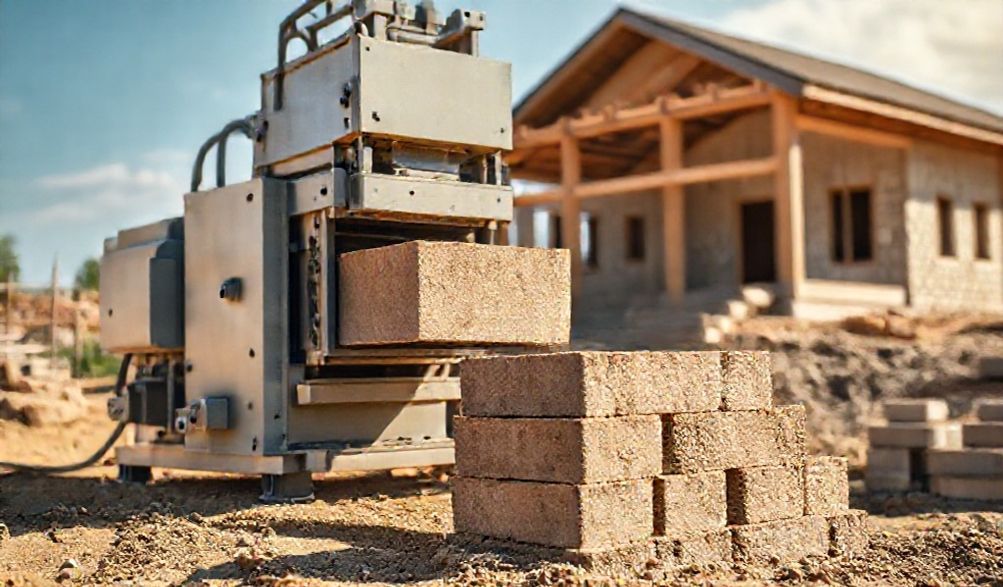
The Ultimate Guide to Compressed Earth Block Machines: Building Sustainably
परिचय
Imagine a world where the very ground beneath our feet provides the solution to two of modern construction’s greatest challenges: soaring material costs and significant environmental impact. For billions seeking affordable, dignified shelter and for architects and builders striving for true sustainability, this vision is not a distant utopia. It’s being built today, one block at a time, using an ancient material re-engineered for the modern age: compressed earth.
At the heart of this quiet revolution is a powerful yet often overlooked tool: the Compressed Earth Block (CEB) machine. This guide, crafted from industry knowledge, mechanical engineering principles, and field-tested insights, is your comprehensive resource. Whether you’re a self-builder, a professional architect, or an eco-entrepreneur, we will demystify this technology. We’ll explore what a CEB machine is, how it transforms simple soil into a formidable building block, the profound benefits it unlocks, and the critical steps to successfully integrate it into your next project. This is more than a building method; it’s a pathway to resilient, affordable, and ecological construction.
What is a Compressed Earth Block Machine?
मुख्य कार्य और परिभाषा
A compressed earth block machine is a mechanical or hydraulic press designed to compact damp, subsoil into high-density, geometrically precise building blocks. It’s crucial to understand its primary function: compression. Unlike equipment for other earth techniques, a CEB machine does not mix (though material prep is separate) or fire its output. It applies immense, focused pressure to consolidate soil particles, creating a strong, cohesive unit through mechanical force alone. This distinction from energy-intensive kiln firing is what makes the technology so sustainable.
A Brief History: From Ancient Technique to Modern Engineering
Humanity’s relationship with earth construction is millennia old, seen in cob, rammed earth, and adobe structures that have stood for centuries. The leap to mechanically compressed blocks began in the mid-20th century. A pivotal invention was the Cinva Ram, a manually operated press developed in the 1950s. This simple lever device proved that controlled, high-pressure compaction could produce blocks with superior strength and consistency compared to sun-dried adobe.
From that foundational design, CEB machines have evolved dramatically. Today, they range from improved manual presses to sophisticated mobile units with diesel or electric engines, offering unparalleled efficiency and scale. This evolution represents a perfect marriage of ancient material wisdom and contemporary engineering.
The Output: Understanding Compressed Earth Blocks (CEBs)
The product of this process is a Compressed Earth Block: a dense, rectangular block with sharp edges. Its properties are distinct from its earthen cousins:
* vs. Adobe: Adobe is sun-dried, not mechanically pressed. CEBs are typically denser, stronger, and more dimensionally uniform due to the high-pressure compaction.
* vs. Fired Bricks: Fired bricks are hardened in a kiln at extreme temperatures (over 1000°C), a process with high embodied energy and carbon emissions. CEBs gain their strength from compression and curing, not firing, resulting in a fraction of the energy footprint.
How Does a Compressed Earth Block Machine Work?
मूल परिचालन सिद्धांत
The core science is elegantly simple: Soil + Optimal Moisture + High Pressure = A Durable Block. The pressure forces soil particles into intimate contact, creating friction and cohesion that yield structural strength. A small amount of moisture (the “lubricant”) allows particles to slide and pack together efficiently during compression.
Step-by-Step Process Breakdown
- सामग्री तैयारी: It all starts with the soil. Suitable soil is sourced, often from the build site itself, and then screened to remove large rocks, roots, and organic matter. The goal is a consistent, homogenous mix.
- Moisture Conditioning: Water is added to achieve the Optimum Moisture Content (often identified by a standard or modified Proctor test). This is critical—too little water and the block won’t bind; too much and it becomes weak and prone to shrinkage cracks.
- Loading & Compression: The prepared mix is fed into a steel mold chamber. A hydraulic ram or mechanical piston then applies immense pressure—often ranging from 500 to over 2,000 PSI. This compresses the loose soil to about half its original volume.
- निष्कासन और उपचार: The newly formed block is ejected from the mold onto a pallet. It is then carefully stacked and allowed to air-cure for several weeks. Curing is not drying; it’s a gradual process where the block gains strength through continued hydration and particle bonding. Stabilized blocks (with cement or lime) require moist-curing for maximum strength development.
Types of Machines: Manual, Mechanical, and Hydraulic
- मैन्युअल/लीवर प्रेस: Operated by human power, these are low-cost, low-output machines (e.g., 50-100 blocks per day). Ideal for small-scale, community-led, or DIY projects where capital is limited and labor is available. They offer a profound hands-on understanding of the process.
- Mechanical (Mobile) Presses: These are the workhorses of commercial CEB production. Powered by diesel or electric engines, they use mechanical linkages to generate high pressure. They are often mounted on trailers for on-site mobility and can produce hundreds to thousands of blocks per day. This is the most common type for building single homes or larger developments.
- हाइड्रोलिक प्रेस: These industrial-grade machines use hydraulic systems to deliver the highest and most consistent pressure. They are typically stationary, designed for maximum output and block uniformity in a centralized production yard setting.
Key Benefits of Using a CEB Machine
Environmental & Sustainability Advantages
- अति-निम्न अंतर्निहित ऊर्जा: The most celebrated benefit. With no firing process, the energy input is primarily the compression force and material transport, resulting in a carbon footprint far lower than fired bricks or concrete blocks.
- Local & Abundant Material: It leverages the most local material possible—often the soil excavated for the building’s foundation. This drastically cuts transportation emissions, costs, and supply chain complexity.
- Fully Recyclable: At end of life, CEBs can be crushed and returned to the earth or re-moistened and re-pressed, creating a truly circular material loop.
- उत्कृष्ट थर्मल मास: Dense earth has a high capacity to absorb, store, and slowly release heat. This naturally regulates indoor temperatures, reducing reliance on mechanical heating and cooling systems and delivering long-term energy savings.
Economic & Practical Benefits
- लागत-प्रभावी: By valorizing on-site soil, material costs can be reduced by 50% or more compared to conventional masonry. The major investment shifts to the machine and skilled labor.
- टिकाऊपन और मजबूती: When properly formulated and stabilized, CEBs can achieve compressive strengths that meet or exceed those of standard concrete masonry units (CMUs), as per ASTM D1633 standards. They are highly durable against weathering.
- Fire, Pest, and Sound Resistance: Being mineral-based, they are non-combustible (fire-resistant). They are also immune to termites and rodents and provide exceptional acoustic insulation due to their mass.
- Empowerment & Skill Development: CEB technology is scalable and teachable. It enables communities to build for themselves, fostering local skill development and reducing dependency on imported materials and specialized labor.
Critical Considerations Before You Buy or Rent
Soil Suitability: The Most Important Factor
Not all dirt is building material. The ideal soil is a “rammed earth mix” containing:
* मिट्टी (15-30%): Acts as the binder.
* Silt (10-20%): Fills voids.
* Sand & Gravel (50-75%): Provides the skeletal structure and strength.
Action: Before any machine purchase, invest in professional lab testing. Supplement this with simple field tests like the jar test (to see soil stratification) and the ribbon test (to gauge clay plasticity).
Production Capacity & Project Scale
Match the machine to your project’s scope. A small manual press might be perfect for a garden wall or shed. Building a 2,000 sq. ft. home, however, could require 10,000+ blocks, making a mechanical press a necessity to complete production in a reasonable timeframe. Calculate your total block need and research machine output in blocks per hour.
Stabilization: When and Why It’s Needed
Stabilization involves adding a small percentage (typically 3-10%) of a binder like Portland cement or hydrated lime to the soil mix.
* Purpose: It significantly increases compressive strength, reduces erosion from driving rain, and minimizes water absorption and expansion. It is often considered essential in climates with significant freeze-thaw cycles or heavy rainfall.
* विनिमय: Stabilization increases cost, embodied energy, and can reduce the block’s vapor permeability (its ability to “breathe”).
Machine Specifications to Compare
When evaluating machines, scrutinize these key specs:
* दबाव रेटिंग: Measured in PSI or MPa. Higher pressure generally yields denser, stronger blocks.
* Block Size & Shape Options: Can it produce different thicknesses or interlocking shapes?
* Power Source & Fuel Efficiency: Diesel, electric, or manual? What is the operating cost?
* Portability & Set-Up: Is it trailer-mounted? How many people are needed to operate it?
* Build Quality & Support: Is it made of durable steel? What is the warranty? Is training and technical support available? Reliable after-sales service is a critical, often overlooked factor.
Getting Started with Your CEB Project
Step 1: Education and Feasibility Study
Begin with knowledge. Research local building codes—some regions have specific standards for earth construction (like New Mexico’s Earth Building Code). Study climate-appropriate designs (e.g., wide eaves for wet climates). Analyze case studies from similar environments to understand best practices and potential pitfalls.
Step 2: Soil Testing and Mix Design
This step is non-negotiable. Send soil samples to a geotechnical lab for a full analysis. Based on the results, develop a mix design—the precise recipe of soil, stabilizer (if any), and water. Make hundreds of test blocks with this mix, vary the parameters, and then have the best ones tested for compressive strength. This upfront work prevents costly failures later.
Step 3: Selecting the Right Machine Partner
Choosing a supplier is as important as choosing the machine. Look for:
* A proven track record and verifiable project portfolio.
* Transparency about machine capabilities and limitations.
* Comprehensive operator training offerings.
* Availability of spare parts and responsive technical support.
* Willingness to connect you with previous customers for references.
Step 4: Training, Prototyping, and Production
Never start full production on day one. Use the first week for intensive crew training and prototyping. Fine-tune the mix, master the machine’s operation, and establish efficient workflow patterns for material handling, block stacking, and curing. This period of practice ensures quality and efficiency for the entire production run.
अक्सर पूछे जाने वाले प्रश्न (एफएक्यू)
Q1: How strong are compressed earth blocks?
A: With proper soil grading and stabilization (e.g., 5-8% cement), CEBs can routinely achieve compressive strengths of 600 to 1,200+ PSI, which meets or exceeds the minimum requirement for many load-bearing concrete block applications (ASTM C90). Unstabilized blocks are weaker but can still be suitable for non-structural infill or in arid climates.
Q2: Are CEB buildings suitable for wet or cold climates?
A: Yes, but they require good boots and a good hat. This means:
* A raised, moisture-proof foundation.
* High-quality stabilization for erosion resistance.
* Wide roof overhangs to protect walls from driving rain.
* A vapor-permeable yet protective exterior plaster.
Their high thermal mass is actually a major asset in cold climates, storing passive solar heat.
Q3: How much does a CEB machine cost?
A: Costs vary enormously by type and capacity:
* Manual Presses: $1,500 – $5,000
* Mid-Range Mechanical Presses: $15,000 – $40,000
* High-Capacity Hydraulic Presses: $50,000 – $100,000+
Consider this an investment offset by massive material savings. Renting is also a viable option for single projects.
Q4: Can I make the blocks myself without a machine?
A: For true compressed earth blocks, a machine is essential to achieve the consistent density and strength that define the material. You can create adobe blocks (sun-dried, molded) without a press, but they have different structural properties, dry slower, and are less dimensionally uniform.
Q5: Where can I see examples of CEB buildings?
A: Renowned examples include many structures at the Auroville Earth Institute in India and various Earthship homes globally. Excellent online resources are the “Earth Architecture” website and the project galleries of major machine manufacturers like Vermeer or Advanced Earthen Construction Technologies (AECT).
निष्कर्ष
The compressed earth block machine is far more than a piece of construction equipment. It is a catalyst for change, transforming one of our planet’s most abundant resources into safe, affordable, and beautiful shelter. Its value proposition—blending environmental stewardship with economic pragmatism—is powerful and increasingly relevant.
Success, however, hinges on a triad: the right technology (a reliable machine), applied expertise (soil science and structural understanding), and trustworthy execution (meticulous curing and detailing). This guide provides the foundation. The next step is yours. Begin with a soil test. Connect with the global community of earth builders. Consult with reputable engineers and machine suppliers. By embracing this method, you’re not just planning a building; you’re investing in a more resilient, sustainable, and empowered future, built from the ground up.
<