
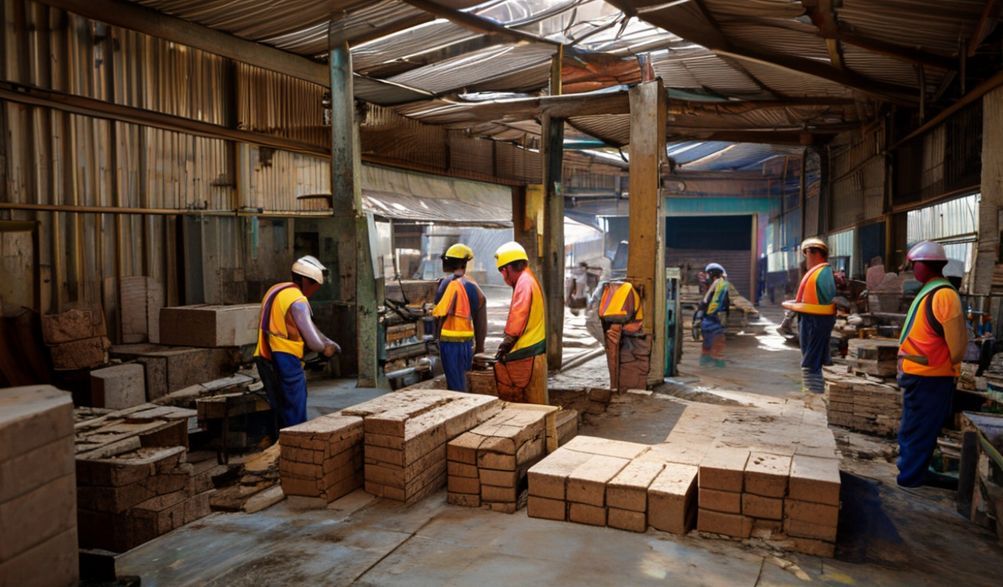
The Ultimate Guide to the QT4-22 Cement Brick Block Making Machine for Bangladesh
Entwodiksyon
Bangladesh’s skyline is transforming at a breathtaking pace. With the construction sector growing at over 8% annually and infrastructure projects worth billions of dollars underway, the demand for reliable, affordable building materials has never been higher. For over a decade, I’ve worked on the ground—from the dense urban projects in Dhaka to the industrial expansions in Chittagong—helping entrepreneurs and builders select and optimize machinery for this very boom. In that time, one workhorse has consistently proven its worth for those entering the block manufacturing industry: the semi-automatic QT4-22 cement brick block making machine.
This guide isn’t based on brochure specs alone. It’s written from hands-on experience installing, operating, and troubleshooting the QT4-22 in the unique conditions of Bangladesh. If you are a Bangladeshi entrepreneur, a growing construction firm, or a builder looking to vertically integrate your supply chain, this article is for you. We will cut through the sales jargon and provide a clear, practical, and locally-relevant analysis. You’ll get a deep understanding of the machine’s capabilities, a realistic cost and ROI breakdown for the local market, crucial operational tips for our climate, and trustworthy advice on navigating the purchase process.
Understanding the QT4-22 Block Making Machine: Specs and Capabilities
The QT4-22 is a stationary, semi-automatic concrete block machine. Its design strikes a perfect balance between automation for quality and manual operation for flexibility, making it a cornerstone for small to medium-scale production.
Espesifikasyon Teknik Debaz
Let’s break down the numbers that matter for your business plan:
- Pwodiksyon Pwodiksyon: In an efficient 8-hour shift, a well-operated QT4-22 can produce approximately 4,000 to 5,000 standard hollow blocks (200mm x 100mm x 400mm). Output varies with block type and crew skill.
- Versatile Block Sizes: By simply changing the mold, one machine can produce:
- Solid & Hollow Blocks
- Paver Blocks (for landscaping and walkways)
- Interlocking Blocks (for slope protection and retaining walls)
- Curbstones and other standard shapes.
- Egzijans Pouvwa: Typically offered in dual-power options crucial for Bangladesh:
- Elektrik 13.5 kW, compatible with standard Bangladeshi industrial voltage of 380V, 3-phase, 50Hz.
- Dizèl: A 12HP diesel engine option, a vital backup given occasional power fluctuations.
- Eleman Kle Yo: Features a strong 5.5kW vibration motor system and a reliable hydraulic pressure unit to ensure block density and strength.
- Dimansyon: The machine itself is robust but space-efficient, requiring a production shed area of roughly 6m x 4m.
How the QT4-22 Works: The Semi-Automatic Advantage
The “semi-automatic” label is its key advantage in our market. Here’s the cycle:
- Manje Manyèl: Workers feed the prepared concrete mix into the hopper.
- Automated Vibration & Compression: The mix is distributed into the mold. The powerful vibration motor compacts the concrete, followed by hydraulic pressure from above to form a dense block.
- Demolding & Pallet Handling: The machine automatically lifts the mold, leaving the fresh block on a wooden pallet. Workers then manually move these pallets to the curing area.
This process leverages automation for the critical task of forming strong, consistent blocks, while utilizing manual labor for feeding and handling—a cost-effective model perfectly suited to Bangladesh’s labor context.
Key Features for Durability and Output
- Robust Steel Structure: Built to withstand continuous use in a production environment.
- Sistèm Idwolik Pwèsyon Wo: Ensures blocks have high compressive strength, meeting and often exceeding local PWD standards.
- Wear-Resistant Molds: Made from high-quality steel and often chrome-plated, these molds withstand the abrasive concrete mix, ensuring long life and consistent block dimensions.
- Strong Vibration System: The core of quality. Effective vibration removes air pockets, creating a dense, non-porous, and durable block.
Why the QT4-22 is a Strategic Choice for the Bangladesh Market
Meeting Bangladesh’s Construction Material Demand
The shift is undeniable. Environmentally damaging fired clay bricks are being progressively phased out by government policy, while architects and engineers increasingly specify Cement Concrete Blocks (CCB). CCBs offer superior thermal insulation (reducing cooling costs), better fire resistance, and excellent compressive strength. The QT4-22 positions you directly in the middle of this sustainable and growing market demand.
Cost-Effectiveness and ROI Analysis
Let’s talk numbers. A realistic financial model is essential.
-
Initial Investment (Estimated Range):
- QT4-22 Machine (Local dealer, including basic molds): BDT 1,200,000 – 1,600,000.
- Additional Molds: BDT 40,000 – 80,000 each.
- Shed Construction & Foundation: BDT 200,000 – 400,000.
- Total Setup Cost (Approx.): BDT 1.5 – 2.2 Million.
-
Operational Cost per Block (Example):
- Raw Materials (Cement, Sand, Stone Dust): ~BDT 12-14
- Labor & Utilities: ~BDT 2-3
- Total Cost/Block: ~BDT 14-17
-
Revenue & Break-Even:
- Selling Price (Standard Hollow Block): BDT 22-25
- Profit per Block: BDT 5-8
- Daily Profit (at 4,000 blocks): BDT 20,000 – 32,000
- Estimated Break-Even Point: With consistent sales, the initial investment can often be recovered within 8 to 14 months.
Adaptability to Local Conditions
- Ideal for SMEs: Its scale is perfect for family-run businesses or small enterprises looking to establish a block yard.
- Pou Pi Fasil Entretni: The mechanical design is relatively simple, and most local mechanics can be trained to handle basic servicing.
- Disponiblite Pyès Depo: Common wear parts (springs, seals, hydraulic hoses) are increasingly available in Dhaka’s industrial markets like Tejgaon, reducing downtime.
Operational Guide: Running a QT4-22 Successfully in Bangladesh
Raw Material Preparation: Getting the Mix Right
The quality of your blocks is 50% machine and 50% mix design. For the Bangladeshi context:
- Siman: Use a reputable brand of Portland cement (e.g., CEM II/B-M).
- Aggregate: Use a well-graded mix of coarse sand (e.g., from Sylhet or local river sources) and stone chips (3/8″ or 10mm). Ensure they are clean and free of clay or organic matter.
- Standard Mix Ratio (by volume): A good starting point is 1 part Cement : 4 parts Mixed Aggregate (Sand + Stone Chips).
- Wòl dlo-siman: Aim for a 0.45 – 0.55 ratio. The mix should be cohesive, not soggy. Excess water drastically reduces final strength.
Step-by-Step Production Process
- Setup & Mixing: Ensure the machine is on a level, solid foundation. Mix raw materials in a pan mixer or concrete mixer until uniform.
- Manje & Moule: Feed the mix into the hopper and start the cycle. Ensure the mold is filled evenly.
- Curing (The Most Critical Step): After 24 hours on the pallet, carefully remove the green blocks and stack them for water curing. Keep them saturated for at least 7 days. The blocks gain most of their strength over the full 28-day curing period.
- Storage: Once cured, store blocks in a dry, covered area ready for dispatch.
Safety First: Always ensure workers wear gloves, safety glasses, and closed-toe shoes. Never place hands near the mold during the compression cycle.
Maintenance for Longevity in a Humid Climate
Bangladesh’s humidity is the biggest threat to machinery.
- Daily: Clean all concrete residue from the machine, mold, and pallets. Check hydraulic oil levels.
- Weekly: Lubricate all moving parts (guide rods, bearings) with grease. Inspect the mold for wear or damage.
- Monthly: Tighten all bolts and nuts. Check the hydraulic system for leaks. Apply a light oil or anti-rust spray on unpainted steel surfaces to prevent corrosion.
- Annual: Consider a full hydraulic oil change and a comprehensive inspection by a technician.
Navigating the Purchase: Suppliers and Key Considerations in Bangladesh
Local Dealers vs. Direct Import: Pros and Cons
| Aspect | Local Dealer (Dhaka/Chittagong) | Direct Import from China |
| :— | :— | :— |
| Pri | Higher upfront cost. | Potentially lower FOB price. |
| Warranty & Service | Key Advantage. Typically 1-year warranty with local service engineers. | Often difficult and costly to enforce. |
| Spare Parts | Readily available or can be sourced quickly. | Long lead times, import hassles. |
| Installation & Training | Usually included. | Self-arranged, extra cost and risk. |
| Customs & Logistics | Handled by dealer. | You bear all costs, paperwork, and risks of delay/damage. |
Recommendation: For your first machine, a reputable local dealer is almost always the wiser investment. The after-sales support is invaluable.
Essential Questions to Ask Your Supplier
- Do you have a local service engineer, and what is the response time?
- What is the exact warranty period and what components does it cover (e.g., hydraulic system, vibration motor)?
- Is on-site installation and operator training included in the price?
- Can you provide contact information for 2-3 of your existing QT4-22 clients in Bangladesh for a reference?
- What is the availability and cost of common spare parts like molds, springs, and hydraulic seals?
Site Preparation Checklist
Before your machine arrives, prepare your site:
* Production Shed: A covered, well-ventilated area of at least 6m (L) x 4m (W) x 3m (H).
* Curing Area: A shaded, accessible open space (can be 5-10 times the production area).
* Foundation: A level, reinforced concrete pad (approx. 150mm thick) as per the machine manual.
* Utilities: Reliable 380V 3-phase power connection or secure diesel storage. Ample water supply for mixing and curing.
* Raw Material Storage: Covered zones for cement (must be dry) and aggregates.
Frequently Asked Questions (FAQ) About QT4-22 in Bangladesh
Q1: What is the actual production output per day of the QT4-22 in a Bangladeshi setup?
A: With a skilled crew of 4-5 workers, you can realistically produce 4,000 to 5,000 standard hollow blocks in an 8-hour shift. Output depends on worker efficiency, mold type (solid blocks are faster), and mix preparation speed.
Q2: What is the total investment cost, including everything to start production?
A: A comprehensive setup, including machine, basic molds, shed construction, raw material stock for one month, and labor, typically requires a total investment between BDT 1.5 million and BDT 2.2 million. Always budget a 10% contingency.
Q3: How does the quality of blocks compare to traditional bricks?
A: QT4-22 blocks are superior in almost every way. They offer higher and more consistent compressive strength (often 5-7 MPa vs. 3-4 MPa for bricks), perfect dimensional accuracy (saving on mortar and plaster), and better thermal/sound insulation. They are also more seismically suitable.
Q4: Is technical training required to operate this machine?
A: While the machine is designed to be user-friendly, mandatory training from your supplier is crucial. Proper training ensures worker safety, maximizes production output, and guarantees the block quality needed to compete in the market. Most local workers become proficient within a week.
Q5: Where can I find reliable after-sales service and spare parts in Bangladesh?
A: This is why choosing the right supplier is key. Reputable dealers have their own service networks, often based in Dhaka (Tejgaon, Mirpur I/A) or Chittagong. Before buying, verify their service capability and spare parts inventory.
Konklizyon
The QT4-22 cement brick block making machine represents more than just a piece of equipment; it represents a viable, profitable entry point into Bangladesh’s vital construction materials sector. It balances automation with practicality, offering a path to produce high-quality blocks that meet modern construction demands.
Based on extensive field experience, a well-managed QT4-22 unit, with a focus on quality raw materials and proper curing, can indeed become the cornerstone of a successful and growing business. My final advice is to take the knowledge from this guide and apply it on the ground. Visit existing block plants, ask detailed questions, and insist on live demonstrations from your shortlisted suppliers. Conduct your due diligence with the confidence that this technology, when implemented correctly, has a proven track record of success across Bangladesh.
As your business grows, this semi-automatic machine can be the first step toward even larger, fully automatic production lines. Let this guide be your foundation for that journey.
About the Author:
Md. Arif Rahman is a Mechanical Engineer with over 12 years of hands-on experience in the construction machinery sector across South Asia. He has personally supervised the installation, commissioning, and optimization of more than 50 concrete block making plants in Bangladesh, focusing on practical efficiency and sustainable business growth for local entrepreneurs.