
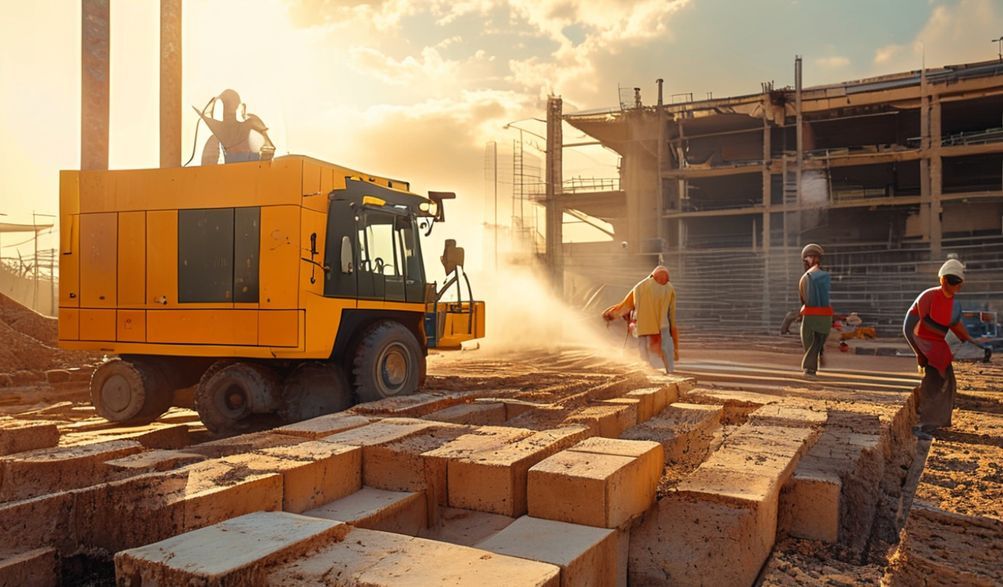
Gid Komplè ou pou Machin Fè Blòk ki Vann nan Kenya | Ekspètiz Soti nan FUDA Factory
Entwodiksyon
Peyizaj vil yo nan Kenya ap chanje. Soti nan Pwogram Loji Abòdab ki anbisye a rive nan devlopman prive nan sant iben k ap grandi, demann pou materyèl konstriksyon kalite a pa janm pi wo. Nan nannan eksplozyon konstriksyon sa a, gen yon eleman enpòtan: brik ak blòk modès, men esansyèl. Pou antreprenè yo, kontraktè yo, ak konpayi konstriksyon yo, desizyon pou envesti nan yon machin pou fè blòk se pa senpleman yon achte—se yon estrateji biznis kle ki ka detèmine pwofi, kalite, ak kwasans.
Gid sa a sèvi kòm resous konplè ak enpasyal ou pou navige nan mache machin fè blòk nan Kenya. Avèk eksperyans pwofond nan endistri a ki baze sou estanda fabrikasyon mondyal yo ak yon konpreyansyon espesifik sou kontèks operasyonèl inik Kenya a—soti nan varyete kondisyon tè a rive nan defi souplai elektrik la—objektif nou se ekipe ou ak konesans pratik ak ki baze sou reyalite. Nou pral diseke diferan kalite machin yo, analize vre pri posesyon yo, epi bay yon kad pou evalye founisè yo, ki gen ladan yon analiz detaye sou ofri manifakti etabli tankou faktori FUDA pou fè blòk. Nan fen an, ou pral gen yon wout klè pou fè yon envestisman konfyan ak byen enfòme ki bati plis pase mi; li bati biznis ou.
Konprann Mache Machin Blòk Kenya
Ogmantasyon nan demann pou machin fè blòk pa yon aksidan. Li se yon repons dirèk a fòs ekonomik ak sosyal pwisan ki ap fòme nasyon an. Konprann faktè sa yo ak nuanse lokal yo se premye etap pou yon envestisman entelijan.
Faktè ki Pouse Mache a: Poukisa Demann ap Ogmante nan Kenya
- Pwogram Gouvènman an pou Loje Abòdab:Pwojè prensipal sa a nan anba Ajanda Big Four la se yon motè prensipal, ki vize bay dè santèn de milye inite lojman. Sa kreye yon gwo demann ki dire lontan pou blòk estanda ak bon jan kalite.
- Ibanizasyon rapid ak Devlopman Enfrastrikti:Komin yo ap grandi, epi avèk yo vini nesesite pou nouvo kay, bilding komèsyal, wout, ak lekòl. Pwodiksyon blòk mekanize se kle pou satisfè echèl sa a avèk efikasite.
- Chanji soti nan Pwodiksyon Manyèl ale nan Pwodiksyon Mekanize:Gen yon rekonètman k ap grandi ke pwodiksyon manyèl se yon goulòt. Machin yo ofri yon konsistans siperyè, blòk ki pi fò, ak kapasite pou satisfè gwo lòd nan dat limit, sa ki bay biznis yo yon avantaj konpetitif.
Konsiderasyon Kle pou Kontèks Kenyan an
Achte yon machin ki fèt pou mache Ewopeyen an pap garanti siksè isit la. Kontèks Kenyan an mande adaptasyon espesifik.
- Matyè Premye Lokal Yo:Tè, sab, ak melanj siman Kenya yo ka varye anpil selon rejyon an. Yon bon kalite machin dwe gen anviwònman frekans vibwasyon ak presyon ki ka ajiste pou konpakte materyèl lokal sa yo avèk efikasite, pou pwodwi yon blòk dans ak solid chak fwa.
- Alimantasyon Kouran:Enstabilite rezo elektrik la nan kèk zòn se yon risk operasyonèl reyèl. Sa fè disponiblite nanmotè ki mache ak gaz dyezèloswamodèl ibrid (elektrik/dizèl)yon karakteristik enpòtan anpil. Toujou evalye fyab pouvwa ou epi chwazi yon machin ki pa pral rete san aktivite pandan pann kouran yo.
- Sipò Apre VannSa a se petèt faktè ki pi enpòtan an. Yon machin se yon byen alontèm. Ou dwe verifye disponiblite a nansipò teknik lokal, pyès detache fasilman disponib, ak fòmasyon konplè pou operatè yoPi bon machin nan pa vo anyen si li kraze epi li rete andomaje pandan plizyè semèn ap tann yon pyès ki soti lòt bò dlo.
Kalite Machin Fè Blòk: Kilès Ki Aprepou Pou Pwojè Ou?
Chwazi bon kalite machin depann sou echèl pwojè ou, bidjè ou, ak objektif pwodiksyon ou. Men yon deskripsyon kategori ki pi komen yo.
Machin Manyèl ak Semi-Otomatik
- Ideal Pou:Startups, ti bòs mason, pwojè kominotè (CBOs), ak moun ki gen bezwen pwodiksyon ki ba anpil chak jou (pa egzanp, mwens pase 500 blòk).
- Avantaj:
- Envestisman Inisyal Ba:Pwen antre ki pi abòdab nan pwodiksyon blòk.
- Senplisite ak PòtablFasil pou opere, kenbe, ak deplase nan yon sit.
- Egzijans Pouvwa Ba:Souvan sèlman bezwen travay manyèl oswa yon ti melanjè.
- Desavantaj:
- Gwo Entansite Travay: Requires significant physical effort, limiting output.
- Kalite Enkonsistan: Heavily dependent on operator skill, leading to potential variations in block size and density.
- Pi Piti Pwodiksyon: Not suitable for commercial supply or medium-to-large projects.
Machin Otomatik Konplèt Estasyonè
- Ideal Pou: Established block yards, suppliers to construction firms, and entrepreneurs targeting the medium-to-high-volume market (e.g., 2,000 to 10,000+ blocks per day).
- Avantaj:
- High Output & Efficiency: Automated processes (batching, mixing, molding, curing) enable consistent, high-volume production.
- Superior & Consistent Quality: Programmed settings ensure every block meets the same strength and dimensional standard.
- Reduced Labor Costs: Automates the most strenuous tasks, requiring fewer operators for a higher output.
- Desavantaj:
- Higher Capital Cost: Requires a more significant upfront investment.
- Requires Stable Setup Space: Needs a dedicated, prepared yard with space for curing and storage.
- Greater Technical Knowledge: Operators need proper training on the control systems and maintenance routines.
Mobile Block Machines (Egg Layers)
- Ideal Pou: Large-scale construction projects (like a new school or housing estate) where producing blocks directly on-site eliminates substantial transport costs.
- Avantaj:
- Excellent Mobility: Can be towed to different locations on a project site as needed.
- Cost-Effective for On-Site Work: Saves up to 30% or more on logistics by curing and using blocks where they are made.
- Simpler than Full Plants: Easier to set up and operate than a full stationary plant.
- Desavantaj:
- Pi Piti Pwodiksyon: Generally produces fewer blocks per hour than a large stationary automatic machine.
- Still Labor-Intensive: Often requires manual feeding and block removal, though more efficient than purely manual methods.
Spotlight: Evaluating FUDA Block Making Machines for the Kenyan Market
As you research, you’ll encounter various brands. FUDA is one established global manufacturer whose machines are available in Kenya. A balanced, informed evaluation is key.
Apèsi sou FUDA kòm yon manifakti
FUDA is a Chinese heavy machinery manufacturer with a significant global footprint in construction equipment, including concrete block making machines. They offer a range of models, from semi-automatic to fully automatic stationary plants and mobile egg layers. Their reputation is built on providing a balance of capability and cost-effectiveness. For the Kenyan market, models that emphasize durability and adaptability to local conditions are most relevant.
Key Features to Scrutinize in a FUDA Machine
If considering a FUDA machine, move beyond the brochure. Inspect these critical aspects:
- Build Quality & Durability: Examine the steel frame thickness and the robustness of the vibration system. High-frequency, high-amplitude vibration motors are essential for compacting Kenyan raw materials into strong blocks. Ask about the grade of steel used in the mold and press head—these are high-wear parts.
- Production Capacity & Versatility: Don’t just look at the “blocks per hour” for a standard hollow block. Verify what other products the machine can produce with a simple mold change—interlocking blocks, paving slabs, kerbstones, etc. Versatility future-proofs your investment against market shifts.
- Automation Level & Ease of Use: Understand the control system. Is it a simple button panel or a programmable logic controller (PLC)? A PLC offers more precision but may require more skilled maintenance. Ask about the daily and weekly maintenance routine—is it straightforward for your team to perform?
The Critical Importance of Local Dealer & Support
This point cannot be overstated. The FUDA machine you buy is only as reliable as the Kenyan dealer who sells and supports it.
- Verify the dealer has a physical workshop and showroom.
- Check their inventory of common spare parts (like vibration motors, seals, and mold liners). Long lead times for parts cripple production.
- Insist on details about their technical team. Are they factory-trained? Can they provide on-site installation and training?
- Mande poucontactable references from other local businesses who have purchased from them.
The Real Cost of Owning a Block Making Machine in Kenya
The purchase price is just the beginning. A savvy buyer plans for the Total Cost of Ownership (TCO).
Upfront Purchase Price vs. Total Investment
The initial outlay includes several components:
* Ex-Works Machine Price: The base cost from the factory or local stockist.
* Anbake ak Lojistik: Cost of transport to Mombasa port and then to your yard.
* Customs Duty & Taxes: Budget approximately 25-35% of the CIF value for import duty, VAT, and other levies. Consult a clearing agent for an exact estimate.
* Enstalasyon ak Komisyon: Some suppliers include this; others charge extra. Factor in costs for a level concrete foundation for stationary machines.
Operational Costs Breakdown
Your ongoing expenses determine profitability:
* Matyè Premye: Cement, sand, ballast, and water. The machine’s efficiency (waste percentage) directly impacts this cost.
* Travay Wages for operators, mixers, and those handling cured blocks.
* Power/Fuel: Electricity consumption for electric motors or diesel costs for engine-driven models.
* Antretyen ak Reparasyon: Regular servicing, replacement of wear parts (molds, pallets), and unexpected repairs. A machine with good local support minimizes downtime costs.
Kalkile Retou sou Envestisman (ROI) ou
A simple framework to estimate viability:
1. Calculate Total Investment: Sum all upfront costs (A).
2. Estimate Monthly Operational Cost: Add up all ongoing expenses (B).
3. Determine Monthly Revenue: (Monthly block output) x (Selling price per block) = (C).
4. Monthly Profit: C – B = D.
5. Break-Even Point (Months): A / D.
Egzanp: If your total investment is KES 2,000,000 and your monthly profit is KES 200,000, your simple payback period is 10 months. Always use conservative estimates for output and price.
A Step-by-Step Buyer’s Checklist
Follow this actionable plan to avoid costly mistakes.
Before You Contact a Seller (Needs Assessment)
Answer these questions first:
* What is my target daily output in blocks?
* What types of blocks do my target customers need? (Hollow, solid, interlocking, paving?)
* What is my total budget, including shipping, taxes, and installation?
* What are my site conditions? (Space, power access, raw material source?)
Questions to Ask Every Supplier (Including FUDA Dealers)
Arm yourself with this list:
* “What is the exact warranty period and what does it cover? Is it handled locally or from abroad?”
* “Can you provide comprehensive operator training on-site?”
* “May I have a list of 3-5 local clients I can visit or call for a reference?”
* “What is your standard lead time for critical spare parts? Do you stock them here in Kenya?”
* “What is included in the delivery price? (FOB, CIF, installed?)”
The Site Visit & Machine Test
Never buy blind.
* Insist on seeing a working machine. A video is not enough.
* Ideally, visit a current client’s yard to see the machine in operation and speak candidly with the owner about performance and support.
* If possible, conduct a test production run using a sample of your own raw materials to see the block quality firsthand.
Kesyon yo poze souvan (FAQ)
Q: What is the price range for a good quality block making machine in Kenya?
A: Prices vary dramatically. A simple manual machine can start from KES 150,000, a robust semi-automatic from KES 500,000, while a fully automatic stationary plant can range from KES 2 million to KES 10 million or more. Remember, the cheapest option often carries the highest long-term cost in repairs and downtime.
Q: Can FUDA machines produce interlocking stabilised soil blocks (ISSBs) popular in some Kenyan projects?
A: Producing high-strength ISSBs requires a machine capable of very high compression pressure. While some FUDA models may be adaptable, you must confirm the specific model’s pressure capability (measured in kN or ton-force) with the supplier and likely require a specialized mold. Always request a test with stabilized soil.
Q: How do I ensure I’m dealing with a legitimate supplier and not a scam?
A: 1) Visit their physical office and workshop. 2) Verify their registration with the Business Registration Service. 3) Demand and actually contact client references. 4) Be wary of prices that seem too good to be true. 5) Never make full payment upfront before delivery and installation. Use secure payment methods.
Q: What is the typical lead time from order to installation?
A: If the machine is in local stock, it could be 2-4 weeks for delivery and installation. For an ex-factory order from abroad, lead time is typically 60-90 days for manufacturing, plus 30-45 days for shipping and customs clearance. Always get a written timeline in your contract.
Konklizyon
Choosing the right block making machine is a strategic decision that hinges on a clear understanding of your business goals, a realistic assessment of costs, and, most importantly, the quality of local support available. From manual starters to fully automatic plants, the ideal machine is the one that reliably meets your production targets within your operational context.
Prioritize total value—where quality machinery meets exceptional after-sales service—over the allure of the lowest initial price tag. We encourage you to use the checklist and frameworks provided here as you visit multiple suppliers, inspect machines in operation, and speak with fellow builders.
Ready to take the next step? Use the knowledge in this guide to ask the right questions and evaluate your options thoroughly. For detailed specifications and quotes, engage with reputable local machinery suppliers who have a verifiable track record of supporting their clients in Kenya. Your informed due diligence today is the foundation for a profitable and sustainable business tomorrow.
<