
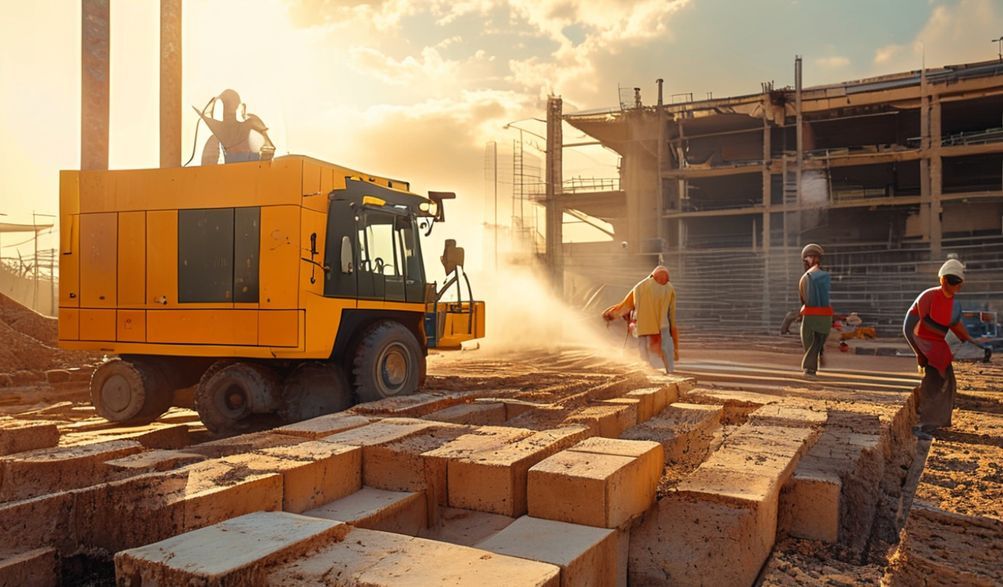
Seu Guia Definitivo para Máquinas de Fabricação de Blocos à Venda no Quênia | Perspectivas de Especialistas da Fábrica FUDA
Introdução
O horizonte do Quênia está se transformando. Desde o ambicioso Programa de Habitação Acessível até os empreendimentos privados em centros urbanos em expansão, a demanda por materiais de construção de qualidade nunca foi tão alta. No centro desse boom da construção está um componente crítico: o humilde, porém essencial, tijolo e bloco. Para empreendedores, empreiteiros e empresas de construção, a decisão de investir em uma máquina de fabricar blocos não é apenas uma compra – é uma estratégia de negócios fundamental que pode definir lucratividade, qualidade e crescimento.
Este guia serve como seu recurso abrangente e imparcial para navegar no mercado de máquinas de fabricação de blocos no Quênia. Baseados em profunda experiência no setor com padrões globais de fabricação e uma compreensão específica do cenário operacional único do Quênia—desde condições variáveis do solo até desafios no fornecimento de energia—nosso objetivo é munir você com conhecimento factual e prático. Vamos dissecar os diferentes tipos de máquinas, detalhar o custo real de propriedade e fornecer uma estrutura para avaliar fornecedores, incluindo uma análise detalhada das ofertas de fabricantes estabelecidos como a fábrica de blocos FUDA. Ao final, você terá um roteiro claro para fazer um investimento confiante e bem-informado que constrói mais do que apenas paredes; constrói o seu negócio.
Compreendendo o Mercado de Máquinas de Blocos no Quênia
O aumento na demanda por máquinas de fabricação de blocos não é por acaso. É uma resposta direta a poderosas forças econômicas e sociais que estão moldando o país. Compreender esses impulsionadores e as nuances locais é o primeiro passo para um investimento inteligente.
Fatores de Mercado: Por que a Demanda Está Crescendo no Quênia
- Agenda do Governo para Habitação Acessível:Este projeto carro-chefe da Agenda dos Quatro Grandes é um motor principal, visando fornecer centenas de milhares de unidades habitacionais. Isso gera uma demanda massiva e sustentada por blocos padronizados e de qualidade.
- Urbanização Rápida e Desenvolvimento de Infraestrutura:Os municípios estão crescendo, e com isso surge a necessidade de novas casas, edifícios comerciais, estradas e escolas. A produção mecanizada de blocos é fundamental para atender a essa escala com eficiência.
- Mudança da Produção Manual para a Mecanizada:Há um reconhecimento crescente de que a produção manual é um gargalo. As máquinas oferecem consistência superior, blocos de maior resistência e a capacidade de cumprir prazos para grandes encomendas, proporcionando às empresas uma vantagem competitiva.
Considerações-Chave para o Contexto Queniano
Comprar uma máquina projetada para o mercado europeu não garante sucesso aqui. O contexto queniano exige adaptações específicas.
- Matérias-Primas Locais:As misturas de solo, areia e cimento no Quênia podem variar significativamente de acordo com a região. Uma máquina de qualidade deve ter configurações ajustáveis de frequência de vibração e pressão para compactar esses materiais locais de forma eficaz, produzindo um bloco denso e resistente todas as vezes.
- Fonte de Alimentação:A instabilidade da rede em algumas áreas é um risco operacional real. Isso torna a disponibilidade demotores a dieseloumodelos híbridos (elétricos/diesel)Uma característica crucial. Sempre avalie a confiabilidade da sua energia e escolha uma máquina que não fique inativa durante interrupções.
- Suporte Pós-Venda:Este é talvez o fator mais crítico. Uma máquina é um ativo de longo prazo. Você deve verificar a disponibilidade desuporte técnico local, peças de reposição prontamente disponíveis e treinamento abrangente para operadoresA melhor máquina é inútil se quebrar e ficar parada por semanas aguardando uma peça do exterior.
Tipos de Máquinas de Blocos: Qual se Adequa ao Seu Projeto?
Escolher o tipo certo de máquina depende da escala do seu projeto, orçamento e objetivos de produção. Aqui está uma análise das categorias mais comuns.
Máquinas Manuais e Semiautomáticas
- Ideal Para:Startups, construtores de pequena escala, projetos baseados na comunidade (CBOs) e aqueles com requisitos de produção diária muito baixos (por exemplo, menos de 500 blocos).
- Prós:
- Baixo Investimento Inicial:O ponto de entrada mais acessível para a produção de blocos.
- Simplicidade e Portabilidade:Fácil de operar, manter e mover em um canteiro de obras.
- Baixo Requisito de Energia:Geralmente só precisa de mão de obra manual ou de um pequeno misturador.
- Contras:
- Alta Intensidade de Mão de Obra:Exige esforço físico significativo, limitando a produção.
- Qualidade Inconsistente:Fortemente dependente da habilidade do operador, levando a possíveis variações no tamanho e densidade do bloco.
- Saída Inferior:Não adequado para fornecimento comercial ou projetos de médio a grande porte.
Máquinas Estacionárias Totalmente Automáticas
- Ideal Para:Pátios de blocos estabelecidos, fornecedores para empresas de construção e empreendedores visando o mercado de médio a alto volume (por exemplo, 2.000 a 10.000+ blocos por dia).
- Prós:
- High Output & Efficiency: Automated processes (batching, mixing, molding, curing) enable consistent, high-volume production.
- Superior & Consistent Quality: Programmed settings ensure every block meets the same strength and dimensional standard.
- Reduced Labor Costs: Automates the most strenuous tasks, requiring fewer operators for a higher output.
- Contras:
- Higher Capital Cost: Requires a more significant upfront investment.
- Requires Stable Setup Space: Needs a dedicated, prepared yard with space for curing and storage.
- Greater Technical Knowledge: Operators need proper training on the control systems and maintenance routines.
Mobile Block Machines (Egg Layers)
- Ideal Para: Large-scale construction projects (like a new school or housing estate) where producing blocks directly on-site eliminates substantial transport costs.
- Prós:
- Excellent Mobility: Can be towed to different locations on a project site as needed.
- Cost-Effective for On-Site Work: Saves up to 30% or more on logistics by curing and using blocks where they are made.
- Simpler than Full Plants: Easier to set up and operate than a full stationary plant.
- Contras:
- Saída Inferior: Generally produces fewer blocks per hour than a large stationary automatic machine.
- Still Labor-Intensive: Often requires manual feeding and block removal, though more efficient than purely manual methods.
Spotlight: Evaluating FUDA Block Making Machines for the Kenyan Market
As you research, you’ll encounter various brands. FUDA is one established global manufacturer whose machines are available in Kenya. A balanced, informed evaluation is key.
Visão Geral da FUDA como Fabricante
FUDA is a Chinese heavy machinery manufacturer with a significant global footprint in construction equipment, including concrete block making machines. They offer a range of models, from semi-automatic to fully automatic stationary plants and mobile egg layers. Their reputation is built on providing a balance of capability and cost-effectiveness. For the Kenyan market, models that emphasize durability and adaptability to local conditions are most relevant.
Key Features to Scrutinize in a FUDA Machine
If considering a FUDA machine, move beyond the brochure. Inspect these critical aspects:
- Qualidade de Construção & Durabilidade: Examine the steel frame thickness and the robustness of the vibration system. High-frequency, high-amplitude vibration motors are essential for compacting Kenyan raw materials into strong blocks. Ask about the grade of steel used in the mold and press head—these are high-wear parts.
- Production Capacity & Versatility: Don’t just look at the “blocks per hour” for a standard hollow block. Verify what other products the machine can produce with a simple mold change—interlocking blocks, paving slabs, kerbstones, etc. Versatility future-proofs your investment against market shifts.
- Automation Level & Ease of Use: Understand the control system. Is it a simple button panel or a programmable logic controller (PLC)? A PLC offers more precision but may require more skilled maintenance. Ask about the daily and weekly maintenance routine—is it straightforward for your team to perform?
The Critical Importance of Local Dealer & Support
This point cannot be overstated. The FUDA machine you buy is only as reliable as the Kenyan dealer who sells and supports it.
- Verify the dealer has a physical workshop and showroom.
- Check their inventory of common spare parts (like vibration motors, seals, and mold liners). Long lead times for parts cripple production.
- Insist on details about their technical team. Are they factory-trained? Can they provide on-site installation and training?
- Peça porcontactable references from other local businesses who have purchased from them.
The Real Cost of Owning a Block Making Machine in Kenya
The purchase price is just the beginning. A savvy buyer plans for the Total Cost of Ownership (TCO).
Upfront Purchase Price vs. Total Investment
The initial outlay includes several components:
* Ex-Works Machine Price: The base cost from the factory or local stockist.
* Envio e Logística: Cost of transport to Mombasa port and then to your yard.
* Customs Duty & Taxes: Budget approximately 25-35% of the CIF value for import duty, VAT, and other levies. Consult a clearing agent for an exact estimate.
* Instalação e Comissionamento: Some suppliers include this; others charge extra. Factor in costs for a level concrete foundation for stationary machines.
Operational Costs Breakdown
Your ongoing expenses determine profitability:
* Matérias-primas: Cement, sand, ballast, and water. The machine’s efficiency (waste percentage) directly impacts this cost.
* Trabalho: Wages for operators, mixers, and those handling cured blocks.
* Power/Fuel: Electricity consumption for electric motors or diesel costs for engine-driven models.
* Manutenção e Reparos: Regular servicing, replacement of wear parts (molds, pallets), and unexpected repairs. A machine with good local support minimizes downtime costs.
Calculating Your Return on Investment (ROI)
A simple framework to estimate viability:
1. Calculate Total Investment: Sum all upfront costs (A).
2. Estimate Monthly Operational Cost: Add up all ongoing expenses (B).
3. Determine Monthly Revenue: (Monthly block output) x (Selling price per block) = (C).
4. Monthly Profit: C – B = D.
5. Break-Even Point (Months): A / D.
Exemplo: If your total investment is KES 2,000,000 and your monthly profit is KES 200,000, your simple payback period is 10 months. Always use conservative estimates for output and price.
A Step-by-Step Buyer’s Checklist
Follow this actionable plan to avoid costly mistakes.
Before You Contact a Seller (Needs Assessment)
Answer these questions first:
* What is my target daily output in blocks?
* What types of blocks do my target customers need? (Hollow, solid, interlocking, paving?)
* What is my total budget, including shipping, taxes, and installation?
* What are my site conditions? (Space, power access, raw material source?)
Questions to Ask Every Supplier (Including FUDA Dealers)
Arm yourself with this list:
* “What is the exact warranty period and what does it cover? Is it handled locally or from abroad?”
* “Can you provide comprehensive operator training on-site?”
* “May I have a list of 3-5 local clients I can visit or call for a reference?”
* “What is your standard lead time for critical spare parts? Do you stock them here in Kenya?”
* “What is included in the delivery price? (FOB, CIF, installed?)”
The Site Visit & Machine Test
Never buy blind.
* Insist on seeing a working machine. A video is not enough.
* Ideally, visit a current client’s yard to see the machine in operation and speak candidly with the owner about performance and support.
* If possible, conduct a test production run using a sample of your own raw materials to see the block quality firsthand.
Perguntas Frequentes (FAQ)
Q: What is the price range for a good quality block making machine in Kenya?
A: Prices vary dramatically. A simple manual machine can start from KES 150,000, a robust semi-automatic from KES 500,000, while a fully automatic stationary plant can range from KES 2 million to KES 10 million or more. Remember, the cheapest option often carries the highest long-term cost in repairs and downtime.
Q: Can FUDA machines produce interlocking stabilised soil blocks (ISSBs) popular in some Kenyan projects?
A: Producing high-strength ISSBs requires a machine capable of very high compression pressure. While some FUDA models may be adaptable, you must confirm the specific model’s pressure capability (measured in kN or ton-force) with the supplier and likely require a specialized mold. Always request a test with stabilized soil.
Q: How do I ensure I’m dealing with a legitimate supplier and not a scam?
A: 1) Visit their physical office and workshop. 2) Verify their registration with the Business Registration Service. 3) Demand and actually contact client references. 4) Be wary of prices that seem too good to be true. 5) Never make full payment upfront before delivery and installation. Use secure payment methods.
Q: What is the typical lead time from order to installation?
A: If the machine is in local stock, it could be 2-4 weeks for delivery and installation. For an ex-factory order from abroad, lead time is typically 60-90 days for manufacturing, plus 30-45 days for shipping and customs clearance. Always get a written timeline in your contract.
Conclusão
Choosing the right block making machine is a strategic decision that hinges on a clear understanding of your business goals, a realistic assessment of costs, and, most importantly, the quality of local support available. From manual starters to fully automatic plants, the ideal machine is the one that reliably meets your production targets within your operational context.
Prioritize total value—where quality machinery meets exceptional after-sales service—over the allure of the lowest initial price tag. We encourage you to use the checklist and frameworks provided here as you visit multiple suppliers, inspect machines in operation, and speak with fellow builders.
Ready to take the next step? Use the knowledge in this guide to ask the right questions and evaluate your options thoroughly. For detailed specifications and quotes, engage with reputable local machinery suppliers who have a verifiable track record of supporting their clients in Kenya. Your informed due diligence today is the foundation for a profitable and sustainable business tomorrow.
<