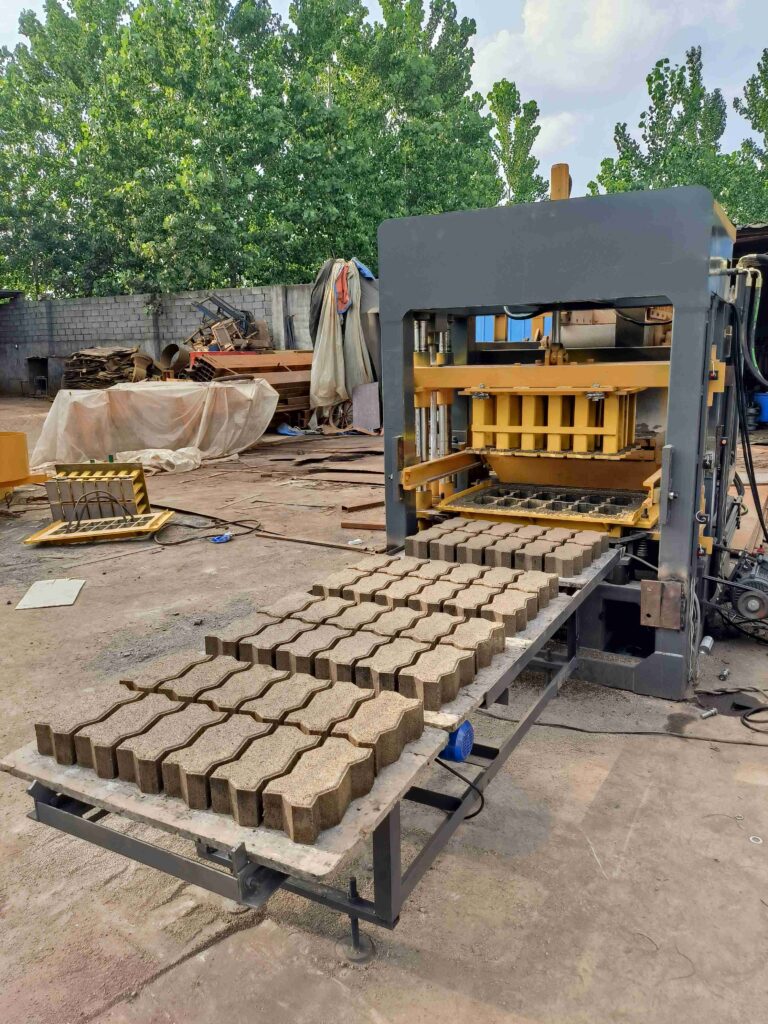
Teknologi Mutakhir yang Mendefinisikan Ulang Pembuatan Bata
1.1. Integrasi Otomatisasi Cerdas dan Industri 4.0
Lompatan paling signifikan dalam beberapa tahun terakhir adalah penerapan penuh prinsip-prinsip Industri 4.0. Pabrik-pabrik modern berkembang menjadi ekosistem yang saling terhubung dan digerakkan oleh data.
- Lini Produksi Otomatis Penuh dengan RobotikaDi luar sabuk konveyor dasar, sistem kontemporer menampilkan lengan robot untuk penanganan, penumpukan, dan pengemasan yang presisi. Robot-robot ini, yang dilengkapi dengan sistem visi canggih, dapat menyortir batu bata berdasarkan kualitas, menumpuknya di palet dengan stabilitas optimal, dan bahkan merakit muatan campuran tanpa campur tangan manusia. Hal ini meminimalkan kerusakan, mengurangi biaya tenaga kerja, dan memastikan hasil yang konsisten.
- Pemantauan Berbasis IoT dan Perawatan PrediktifSensor yang tertanam di seluruh mesin—pada sistem hidrolik, unit getaran, dan motor—secara terus-menerus mengumpulkan data tentang parameter kinerja. Data ini dikirimkan ke platform cloud di mana algoritma AI menganalisisnya secara real-time. Sistem ini dapat memprediksi kegagalan komponen sebelum terjadi, menjadwalkan perawatan selama waktu henti alami, dan memberi tahu operator tentang ketidakefisienan. Bagi dealer, ini berarti menawarkan mesin kepada klien dengan pengurangan drastis pada gangguan yang tidak direncanakan dan biaya operasional seumur pakai yang lebih rendah.
- Digital Twins dan Optimasi ProsesProdusen canggih sedang menerapkan teknologi kembaran digital. Replika virtual dan dinamis dari seluruh lini produksi mensimulasikan operasi. Insinyur dapat menguji resep bahan baku baru, menyesuaikan waktu siklus, atau mendesain ulang alur kerja dalam model digital untuk mengoptimalkan hasil dan konsumsi energi sebelum menerapkan perubahan di lantai fisik, sehingga menjamin hasil produksi maksimal.
1.2. Fleksibilitas Tinggi dalam Produksi dan Kustomisasi
Permintaan pasar akan keragaman arsitektur dan produk bangunan khusus telah mendorong kebutuhan akan mesin yang mampu memberikan fleksibilitas ekstrem.
- Sistem Pengubahan Cetakan CepatPerubahan cetakan tradisional dapat menghentikan produksi selama berjam-jam. Sistem baru menggunakan kereta cetakan atau kaset yang dapat diganti secara otomatis dan cepat. Cukup dengan menekan satu tombol, seluruh rakitan cetakan dapat diganti dalam hitungan menit, memungkinkan satu mesin memproduksi berbagai ukuran, tekstur, dan bentuk bata—dari paving lempung klasik hingga elemen fasad rumit yang dibuat khusus—dalam satu siklus produksi.
- Kontrol Drive Frekuensi Variabel (VFD) Tingkat Lanjut:Ketelitian di setiap tahap dicapai melalui VFD. Gaya tekan, amplitudo dan frekuensi getaran, serta kecepatan ekstrusi dapat disesuaikan secara presisi melalui antarmuka layar sentuh. Hal ini memungkinkan operator untuk menyetel proses secara optimal untuk berbagai konsistensi bahan baku, memastikan kepadatan dan kekuatan yang maksimal baik menggunakan tanah liat, beton, atau fly ash, tanpa mengorbankan integritas mesin.
1.3. Sustainable and Eco-Conscious Manufacturing Technologies
Environmental regulations and green building certifications are powerful market drivers. The latest machinery is designed to turn sustainability into a operational advantage.
- High-Pressure Compaction for Curing-Free Blocks: A groundbreaking development is the ability to produce high-strength concrete blocks without the need for energy-intensive steam curing. Utilizing ultra-high hydraulic pressure (exceeding 150 kg/cm²), these machines compress semi-dry mix so profoundly that blocks achieve structural strength immediately upon ejection. This eliminates the curing kiln, slashing energy consumption by up to 70% and reducing the factory footprint.
- Integration of Alternative and Recycled Materials: Modern machines are engineered to handle challenging feedstock. Advanced mixing and pre-processing attachments can effectively incorporate high percentages of industrial waste like fly ash, slag, foundry sand, construction and demolition waste (C&D), and even certain plastics. This not only reduces raw material costs for producers but also opens access to green tax incentives and appeals to environmentally conscious builders.
- Energy Recovery and Emission Control Systems: State-of-the-art plants feature closed-loop water systems and heat recovery units. Waste heat from compressors or other processes is captured and redirected for use in drying chambers or facility heating. Integrated dust collection and filtration systems are now standard, ensuring near-zero particulate emissions and providing a safer, cleaner working environment.
1.4. Enhanced Quality Control and Material Science Integration
Quality is now assured in-process, not just through final inspection.
- In-Line Laser Scanning and Vision Systems: As bricks exit the press or dryer, they pass under high-resolution laser scanners and cameras. These systems perform real-time dimensional checks for width, height, and length, and can detect surface flaws like cracks or chips. Sub-standard units are automatically diverted, ensuring only products meeting strict tolerances proceed to packaging.
- Adaptive Control Based on Raw Material Feedback: Some systems are beginning to incorporate feedback loops from raw material sensors. A moisture gauge in the mixer, for example, can automatically signal the central computer to adjust the water addition or compression time for the next batch, maintaining consistent product quality despite variations in incoming raw material moisture content.
Kesimpulan
The landscape of brick manufacturing technology has progressed from simple mechanization to a sophisticated, interconnected, and highly intelligent engineering domain. The key trends—intelligent automation and IoT, unparalleled production flexibility, a deep commitment to sustainable processes, and integrated real-time quality assurance—collectively represent a new paradigm. For distributors and procurement professionals, this evolution presents clear imperatives. The machinery of choice is no longer defined solely by output capacity, but by its data connectivity, its adaptability to diverse and eco-friendly materials, its contribution to a lower carbon footprint, and its ability to enable customized, value-added product lines. Investing in and supplying these advanced technologies positions B2B stakeholders as partners in progress, enabling their clients to build not just with brick and mortar, but with data, efficiency, and responsibility. The future of construction is being shaped at the production stage, and the latest brick making machines are at the forefront of this transformation.
Pertanyaan yang Sering Diajukan (FAQ)
Q1: How does the shift to automated and IoT-equipped machinery impact the total cost of ownership (TCO) for our clients?
While the initial capital investment is typically higher, the TCO is favorably impacted through multiple channels. Predictive maintenance prevents costly catastrophic failures and unplanned downtime. Energy-efficient designs and curing-free technology drastically reduce utility bills. Reduced labor requirements and lower rejection rates due to in-line quality control further enhance operational profitability. The ROI is realized through sustained, high-yield production and significantly lower operating expenses.
Q2: Are these advanced machines compatible with existing production lines, or do they require a completely new setup?
Modularity is a key design principle in newer equipment. Many automated components, such as robotic palletizers or IoT sensor kits, can be retrofitted to upgrade existing lines. However, to fully leverage synergies like data integration from mixer to stacker, a comprehensive system designed to work in unison is recommended. Suppliers often offer phased upgrade paths to spread investment over time.
Q3: With the ability to use recycled materials, is there a compromise on the final product’s strength and durability?
Not with properly calibrated modern technology. High-pressure compaction ensures that even with a significant proportion of alternative materials like fly ash or processed C&D waste, the resulting brick or block meets or exceeds relevant international standards (e.g., ASTM, EN). In many cases, certain industrial by-products can actually enhance specific properties like long-term compressive strength or reduce efflorescence.
Q4: What kind of technical support and training is required to operate and maintain these sophisticated machines?
Reputable manufacturers now provide comprehensive digital support packages alongside traditional services. This includes extensive operator and maintenance training programs, often with virtual reality (VR) simulations. Remote diagnostics via IoT connections allow technicians to troubleshoot issues from afar, and augmented reality (AR) glasses can guide on-site staff through complex repair procedures, minimizing expertise-related downtime.
Q5: How does the flexibility for customization impact production planning and minimum order quantities for brick producers?
The hyper-flexibility diminishes the economic constraints of small batch production. With rapid mold change systems, switching product lines is quick and economical. This allows producers to accept smaller, specialized orders for custom bricks without sacrificing overall plant efficiency, enabling them to cater to niche architectural markets and high-margin projects previously deemed unviable.