1. Mendefinisikan Mesin Blok Otomatis: Melampaui Otomatisasi Dasar
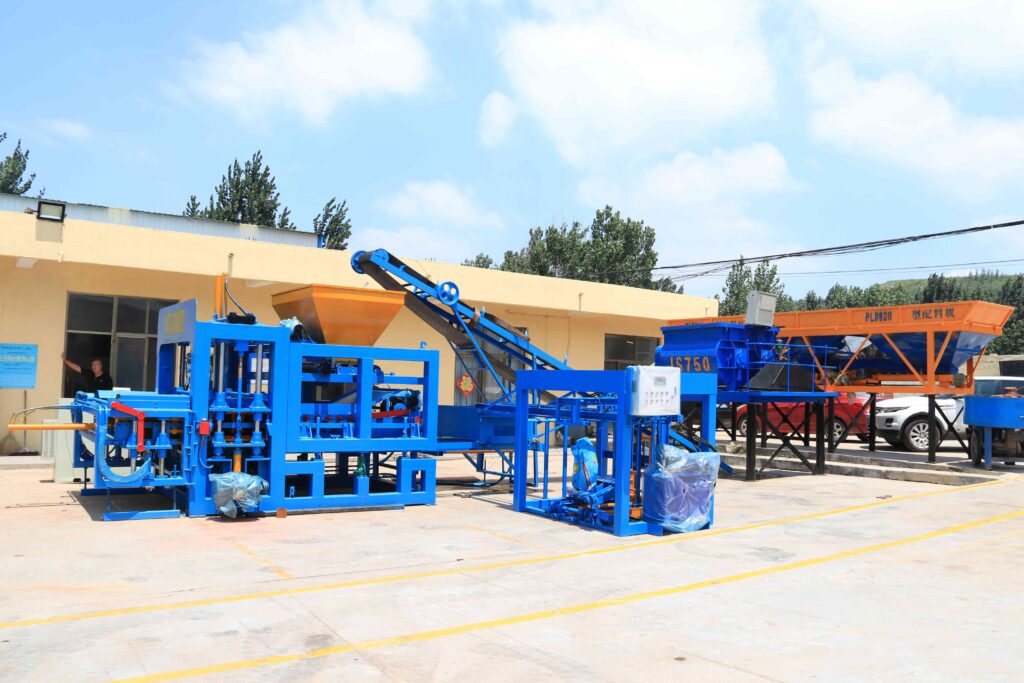
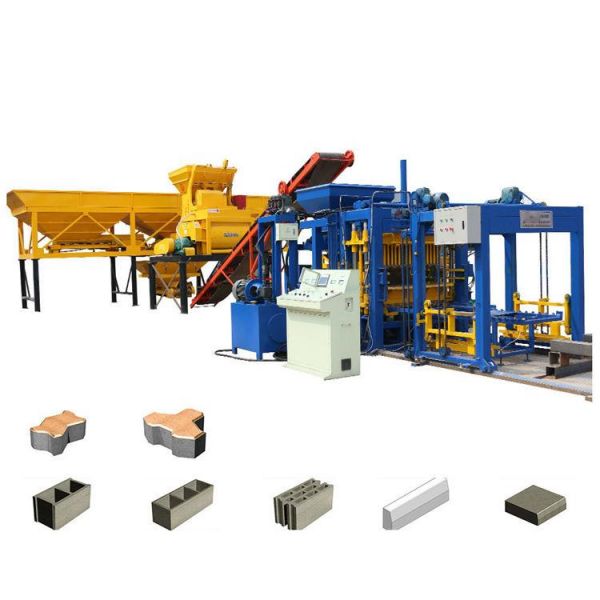
Mesin blok otomatis adalah sistem manufaktur terintegrasi komputer yang lengkap, dirancang untuk menjalankan seluruh siklus pembentukan blok—dari input bahan baku hingga pengeluaran produk jadi yang telah dipallet—dengan logika terprogram dan penanganan manual yang minimal. Penamaan "otomatis" berasal dari koordinasi tersinkronisasi semua subsistem tanpa memerlukan intervensi operator selama siklus produksi inti.
1.1. Pembeda Inti: Integrasi Proses Lingkar Tertutup
Berbeda dengan mesin semi-otomatis yang mungkin memerlukan pengumpanan campuran secara manual atau pengangkatan palet secara manual, sistem otomatis sejati menampilkan aliran material dan palet yang tertutup. Campuran mentah disuplai melalui konveyor otomatis dari pabrik penimbangan pusat, dan palet jadi dikonvey ke sistem perawatan tanpa disentuh oleh operator selama proses produksi standar. Peran manusia beralih dari tenaga fisik menjadi pengawasan kontrol dan pengawasan teknis.
2. Komponen Arsitektur Sistem Otomatis
Mesin ini adalah pusat dari ekosistem otomatis yang lebih besar. Kemampuan penuhnya terwujud melalui integrasi dengan beberapa subsistem kunci.
2.1. Unit Kontrol Pusat: Pusat Komando
- Pengendali Logika Terprogram (PLC):Ini adalah otak operasional. Otak ini menyimpan resep untuk berbagai jenis balok (waktu getaran, tekanan, tinggi kepala) dan mengatur urutan yang tepat dari semua tindakan mekanis.
- Antarmuka Manusia-Mesin (HMI)Panel layar sentuh yang memungkinkan operator memantau setiap aspek proses—penghitungan siklus, tekanan hidrolik, status motor vibrasi, alarm kesalahan—dan memulai pergantian produk dengan input parameter.
2.2. Subsistem Mekanik Inti
- Sistem Pemberian Pakan OtomatisTerdiri dari hopper penyimpanan atas dan kotak pengumpan bolak-balik. PLC mengontrol pergerakan dan kecepatan kotak pengumpan untuk memastikan setiap rongga cetakan menerima volume campuran beton yang identik dan optimal.
- Unit Kompresi/Getaran Presisi Tinggi:Meja cetakan dipasang pada motor getar yang tersinkronisasi secara kuat. Kepala kompresi hidrolik, yang dipandu oleh sensor linier, memberikan tekanan yang dapat diulang. Setiap siklus blok merupakan replikasi yang tepat antara gaya dan gerakan.
- Pallet Handling and Circulation System: This is a hallmark of full automation. An integrated conveyor indexes empty pallets into position beneath the mold with millimeter accuracy. After block ejection, another conveyor transfers the loaded pallet directly to the curing system. A return loop brings cleaned, empty pallets back to the feed position.
2.3. Integrated Peripheral Systems
- Pabrik Batching Otomatis: The machine is fed by a computer-controlled batching system that weighs aggregates, cement, water, and admixtures to a precise tolerance, ensuring mix consistency—the foundational element of product uniformity.
- Automated Curing System: Loaded pallets are typically conveyed into a low-pressure steam curing chamber (kiln) with automated temperature and humidity controls, managed by the same overarching control system or a linked one.
3. Operational Workflow and the Role of Human Oversight
The automatic cycle is a marvel of coordinated engineering, executed in a matter of seconds.
3.1. The Production Cycle Sequence
- Pallet Indexing: An empty, pre-oiled pallet is positioned on the machine table.
- Mold Charging: The feed box travels over the mold, precisely depositing the concrete mix.
- Pemadatan: The vibration motors energize, and the compression head descends, applying preset pressure for a set duration.
- Pengangkatan dan Pelepasan Cetakan: The head retracts, the mold lifts, and the blocks are stripped onto the pallet.
- Pallet Ejection & Transfer: The loaded pallet is pushed onto the outgoing conveyor, and the system immediately indexes the next empty pallet, initiating the next cycle.
3.2. The Shift in Human Responsibility
Operators are not cycle initiators but system supervisors. Their critical functions include:
- Monitoring: Watching the HMI for any deviations in pressure, cycle time, or motor load that might indicate a problem.
- Quality Sampling: Periodically checking block dimensions, weight, and appearance as per a statistical process control (SPC) plan.
- Responding to Alarms: Addressing fault conditions (e.g., pallet misalignment, low material in hopper) diagnosed by the PLC.
- Executing Changeovers: Inputting new product parameters and overseeing the mold change process, which may be semi-automated.
4. The Compelling Advantages for the Supply Chain
The investment in automatic technology delivers measurable benefits that resonate from the factory floor to the construction site.
4.1. Unmatched Product Consistency and Quality Assurance
- Dimensional Perfection: Eliminating human variability in feeding and handling results in blocks with near-identical dimensions. This is critical for modern masonry, enabling faster laying speeds, thinner mortar joints, and compatibility with prefabrication.
- Engineered Property Uniformity: Every block receives identical compaction energy, leading to uniform density, compressive strength, and absorption rates across the entire production run. This allows distributors to guarantee performance specifications with confidence.
4.2. Superior Production Economics and Scalability
- High Sustained Output: Automatic machines operate at optimal cycle times 24/7, with only planned maintenance pauses. They achieve a much higher “uptime” percentage than semi-automatic machines.
- Dramatically Reduced Labor Dependency: One or two operators can oversee an output that would require a large crew on a manual system. This mitigates labor cost inflation and skill shortages.
- Minimalkan Limbah: Precision in batching and forming drastically reduces raw material waste and the production of off-spec units.
4.3. Enhanced Data Traceability and Sustainability Credentials
- Production Data Logging: The PLC records data for every cycle or batch, creating an immutable record of production. This supports traceability and simplifies root-cause analysis for any quality inquiries.
- Support for Sustainable Mixes: The precision of automated systems allows for the reliable use of high percentages of recycled aggregates (like crushed glass or C&D waste) and supplementary cementitious materials (like fly ash), as the machine can compensate for minor variations with consistent force. This enables manufacturers to produce blocks with verified high recycled content and lower embodied carbon for green building projects.
5. Strategic Implications for Distributors and Procurement Professionals
Understanding this technology enables smarter sourcing strategies and client partnerships.
5.1. A Key Metric for Supplier Evaluation
A manufacturer’s investment in automatic machinery is a strong proxy for their commitment to quality, capacity, and long-term stability. It signals an operation built for scale and consistency, representing a lower supply risk for high-volume or specification-critical projects.
5.2. Foundation for Value-Added Services
The digital data from an automatic plant enables new services. Distributors can potentially provide clients with:
- Batch Certificates: Digitally linked to specific shipments.
- Custom BIM Objects: Precisely dimensioned digital models of blocks for Building Information Modeling.
- Environmental Product Declarations (EPDs): Reliable, data-backed documentation of environmental impact.
5.3. Future-Proofing the Supply Chain
Automatic machines are the platform upon which further innovations—such as artificial intelligence for predictive maintenance, integration with robotic cubing systems, and lights-out manufacturing—will be built. Partnering with automated producers aligns your supply chain with the future trajectory of industrial manufacturing.
Kesimpulan
The automatic block machine is the definitive technology for modern, high-volume concrete masonry unit production. It represents the synthesis of mechanical engineering, materials science, and digital control, creating a system where quality and efficiency are engineered into every cycle. For the distribution network, products originating from such a system carry inherent assurances of reliability, performance, and consistency. By prioritizing partnerships with manufacturers utilizing this technology, distributors and procurement specialists do more than secure a supply of blocks; they invest in a supply chain defined by precision, transparency, and resilience. In a market where the integrity of the building envelope is paramount, specifying machine-made blocks from an automated source is not just a purchasing decision—it is a commitment to built-environment excellence.
FAQ (Frequently Asked Questions)
Q1: What is the primary cost-benefit analysis for a manufacturer to choose an automatic over a semi-automatic machine?
A: The analysis hinges on volume, labor costs, and quality requirements. The higher capital expenditure of an automatic machine is justified by significantly lower per-unit labor costs, higher throughput, and reduced material waste. For a producer supplying large distributors or major projects where consistency and volume are critical, the return on investment is clear. Semi-automatic machines may remain viable for small, niche markets or regions with very low labor costs, but they cannot match the consistency or scale of an automatic system.
Q2: How does maintenance for an automatic machine differ from simpler models?
A: Maintenance becomes more predictive and scheduled, but also more technically sophisticated. While there are more sensors and components, the PLC provides detailed diagnostic information, allowing technicians to anticipate failures (e.g., a gradual drop in hydraulic pressure). Maintenance is less about reactive fixes and more about following a computerized schedule for lubrication, part inspection, and replacement based on cycle counts, ensuring maximum uptime.
Q3: Can automatic machines handle complex or custom block designs as easily as standard ones?
A: Yes, but with considerations. The machine’s versatility is defined by its mold and PLC programming. Changing to a complex design (e.g., an interlocking paver) requires a mold change and loading the appropriate recipe (vibration time, pressure profile). While changeover takes time, once running, the automatic machine will produce that complex shape with the same unwavering consistency as a standard block. The limitation is the mechanical feasibility of stripping the shape from the mold, not the automation itself.
Q4: Does “automatic” imply the entire plant is unmanned?
A: No. The term “automatic” specifically refers to the block-forming cycle. A fully unmanned “lights-out” plant is a theoretical future stage. Current automatic plants still require skilled personnel for material handling oversight, quality control sampling, mold changes, maintenance, and managing the upstream/downstream logistics (batching plant, curing kiln, cubing). The automation eliminates the heavy, repetitive manual labor from the core forming process.
Q5: As a distributor, what visible signs should I look for when visiting a supplier to confirm they operate a true automatic system?
A: Key indicators include:
- Sirkulasi Palet: Look for an integrated conveyor system moving pallets to and from the machine automatically, not via forklift.
- Control Room: A dedicated control station with a digital HMI showing real-time production data.
- Material Feed: Overhead enclosed conveyors feeding mix directly into the machine hopper from a separate batching plant.
- Minimal In-Bay Labor: During stable production, you should see very few people near the machine itself—perhaps one monitor. The activity will be focused on quality checks and peripheral system management.