1. Định Nghĩa Máy Khối Tự Động: Vượt Xa Tự Động Hóa Cơ Bản
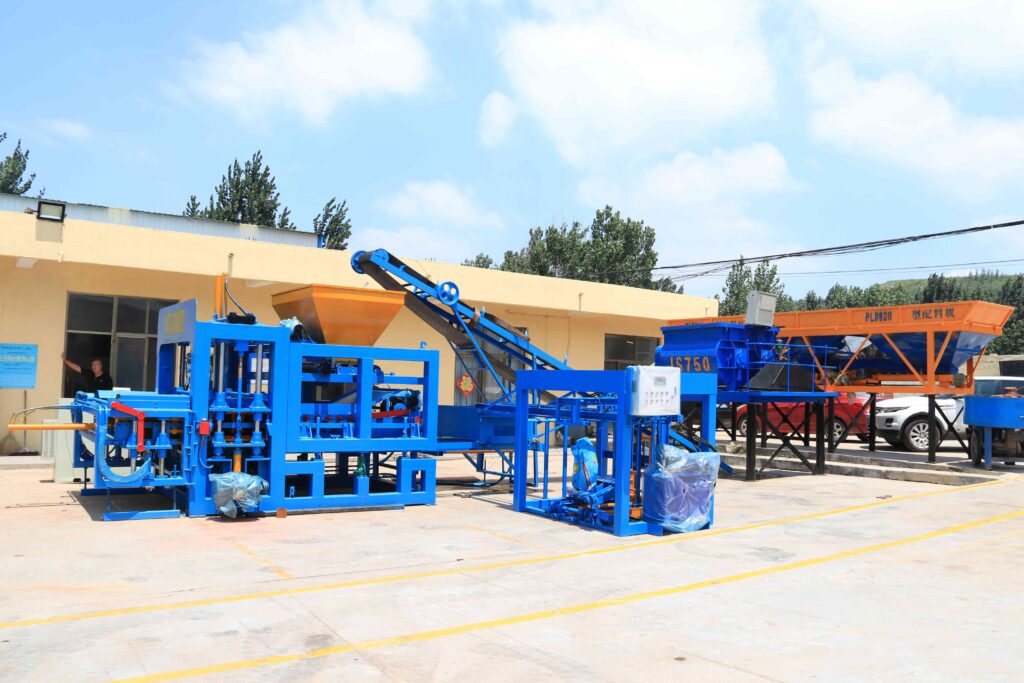
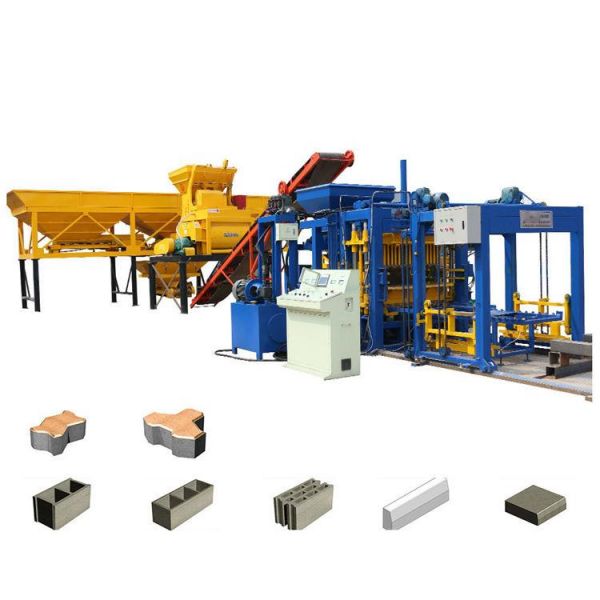
Một máy sản xuất gạch tự động là một hệ thống sản xuất hoàn chỉnh, tích hợp máy tính, được thiết kế để thực hiện toàn bộ chu trình tạo hình gạch—từ đầu vào nguyên liệu thô đến việc đẩy ra các sản phẩm hoàn thiện, đã xếp pallet—với logic được lập trình sẵn và xử lý thủ công tối thiểu. Danh hiệu "tự động" của nó bắt nguồn từ sự phối hợp đồng bộ của tất cả các hệ thống con mà không cần sự can thiệp của người vận hành trong suốt chu trình sản xuất chính.
1.1. Điểm Khác Biệt Cốt Lõi: Tích Hợp Quy Trình Khép Kín
Khác với các máy bán tự động có thể yêu cầu cấp liệu hỗn hợp thủ công hoặc tháo pallet bằng tay, một hệ thống tự động thực sự có dòng vật liệu và pallet khép kín. Hỗn hợp nguyên liệu được cung cấp qua băng tải tự động từ trạm trộn trung tâm, và các pallet thành phẩm được chuyển đi đến hệ thống bảo dưỡng mà không cần người vận hành chạm vào trong quá trình sản xuất tiêu chuẩn. Vai trò của con người chuyển từ lao động chân tay sang giám sát điều khiển và quản lý kỹ thuật.
2. Các Thành Phần Kiến Trúc của Hệ Thống Tự Động
Máy móc là trọng tâm của một hệ sinh thái tự động hóa lớn hơn. Khả năng đầy đủ của nó được phát huy thông qua sự tích hợp với một số hệ thống con quan trọng.
2.1. Đơn Vị Kiểm Soát Trung Tâm: Trung Tâm Chỉ Huy
- Bộ điều khiển logic khả trình (PLC):这里是操作大脑。它存储着不同砖块类型的配方(振动时间、压力、压头高度),并协调所有机械动作的精确顺序。
- Giao diện Người-Máy (HMI):一种触控屏面板,使操作员能够监控流程的各个方面——循环次数、液压压力、振动电机状态、故障警报——并通过参数输入启动产品更换。
2.2. Hệ thống cơ khí lõi
- Hệ thống Cấp Liệu Tự Động:包括一个顶部存储料斗和一个往复式进料箱。PLC控制进料箱的行程和速度,确保每个模具型腔获得相同且最优量的混凝土混合料。
- Bộ nén/dao động độ chính xác cao:Khuôn đúc được lắp đặt trên các động cơ rung đồng bộ công suất lớn. Đầu ép thủy lực, được dẫn hướng bằng cảm biến tuyến tính, tạo ra lực ép có thể lặp lại. Mỗi chu kỳ sản xuất gạch là một bản sao chính xác của lực và chuyển động.
- Hệ Thống Xử Lý và Lưu Thông Pallet:Đây là một dấu hiệu đặc trưng của tự động hóa hoàn toàn. Một băng tải tích hợp đưa các pallet rỗng vào vị trí bên dưới khuôn với độ chính xác đến từng milimet. Sau khi khối sản phẩm được đẩy ra, một băng tải khác chuyển pallet đã được chất tải trực tiếp đến hệ thống bảo dưỡng. Một vòng quay trả lại đưa các pallet sạch, rỗng trở lại vị trí tiếp liệu.
2.3. Hệ thống ngoại vi tích hợp
- Trạm Trộn Bê Tông Tự Động:Máy được cấp liệu bởi một hệ thống định lượng có điều khiển máy tính, cân chính xác cốt liệu, xi măng, nước và phụ gia đến dung sai chính xác, đảm bảo sự đồng nhất của hỗn hợp—yếu tố nền tảng của sự đồng đều sản phẩm.
- Hệ Thống Xử Lý Tự Động:装好的托板通常通过同一或关联的总控系统管理的自动温湿度控制,进入低压蒸汽养护室(窑)进行输送。
3. Quy trình vận hành và vai trò giám sát của con người
Chu trình tự động là một kỳ công của kỹ thuật phối hợp, được thực hiện trong vài giây.
3.1. The Production Cycle Sequence
- Pallet Indexing: An empty, pre-oiled pallet is positioned on the machine table.
- Mold Charging: The feed box travels over the mold, precisely depositing the concrete mix.
- Nén chặt: The vibration motors energize, and the compression head descends, applying preset pressure for a set duration.
- Mold Lifting & Stripping: The head retracts, the mold lifts, and the blocks are stripped onto the pallet.
- Pallet Ejection & Transfer: The loaded pallet is pushed onto the outgoing conveyor, and the system immediately indexes the next empty pallet, initiating the next cycle.
3.2. The Shift in Human Responsibility
Operators are not cycle initiators but system supervisors. Their critical functions include:
- Monitoring: Watching the HMI for any deviations in pressure, cycle time, or motor load that might indicate a problem.
- Quality Sampling: Periodically checking block dimensions, weight, and appearance as per a statistical process control (SPC) plan.
- Responding to Alarms: Addressing fault conditions (e.g., pallet misalignment, low material in hopper) diagnosed by the PLC.
- Executing Changeovers: Inputting new product parameters and overseeing the mold change process, which may be semi-automated.
4. The Compelling Advantages for the Supply Chain
The investment in automatic technology delivers measurable benefits that resonate from the factory floor to the construction site.
4.1. Unmatched Product Consistency and Quality Assurance
- Dimensional Perfection: Eliminating human variability in feeding and handling results in blocks with near-identical dimensions. This is critical for modern masonry, enabling faster laying speeds, thinner mortar joints, and compatibility with prefabrication.
- Engineered Property Uniformity: Every block receives identical compaction energy, leading to uniform density, compressive strength, and absorption rates across the entire production run. This allows distributors to guarantee performance specifications with confidence.
4.2. Superior Production Economics and Scalability
- High Sustained Output: Automatic machines operate at optimal cycle times 24/7, with only planned maintenance pauses. They achieve a much higher “uptime” percentage than semi-automatic machines.
- Dramatically Reduced Labor Dependency: One or two operators can oversee an output that would require a large crew on a manual system. This mitigates labor cost inflation and skill shortages.
- Chất thải được giảm thiểu: Precision in batching and forming drastically reduces raw material waste and the production of off-spec units.
4.3. Enhanced Data Traceability and Sustainability Credentials
- Production Data Logging: The PLC records data for every cycle or batch, creating an immutable record of production. This supports traceability and simplifies root-cause analysis for any quality inquiries.
- Support for Sustainable Mixes: The precision of automated systems allows for the reliable use of high percentages of recycled aggregates (like crushed glass or C&D waste) and supplementary cementitious materials (like fly ash), as the machine can compensate for minor variations with consistent force. This enables manufacturers to produce blocks with verified high recycled content and lower embodied carbon for green building projects.
5. Strategic Implications for Distributors and Procurement Professionals
Understanding this technology enables smarter sourcing strategies and client partnerships.
5.1. A Key Metric for Supplier Evaluation
A manufacturer’s investment in automatic machinery is a strong proxy for their commitment to quality, capacity, and long-term stability. It signals an operation built for scale and consistency, representing a lower supply risk for high-volume or specification-critical projects.
5.2. Foundation for Value-Added Services
The digital data from an automatic plant enables new services. Distributors can potentially provide clients with:
- Batch Certificates: Digitally linked to specific shipments.
- Custom BIM Objects: Precisely dimensioned digital models of blocks for Building Information Modeling.
- Environmental Product Declarations (EPDs): Reliable, data-backed documentation of environmental impact.
5.3. Future-Proofing the Supply Chain
Automatic machines are the platform upon which further innovations—such as artificial intelligence for predictive maintenance, integration with robotic cubing systems, and lights-out manufacturing—will be built. Partnering with automated producers aligns your supply chain with the future trajectory of industrial manufacturing.
Conclusion
The automatic block machine is the definitive technology for modern, high-volume concrete masonry unit production. It represents the synthesis of mechanical engineering, materials science, and digital control, creating a system where quality and efficiency are engineered into every cycle. For the distribution network, products originating from such a system carry inherent assurances of reliability, performance, and consistency. By prioritizing partnerships with manufacturers utilizing this technology, distributors and procurement specialists do more than secure a supply of blocks; they invest in a supply chain defined by precision, transparency, and resilience. In a market where the integrity of the building envelope is paramount, specifying machine-made blocks from an automated source is not just a purchasing decision—it is a commitment to built-environment excellence.
FAQ (Frequently Asked Questions)
Q1: What is the primary cost-benefit analysis for a manufacturer to choose an automatic over a semi-automatic machine?
A: The analysis hinges on volume, labor costs, and quality requirements. The higher capital expenditure of an automatic machine is justified by significantly lower per-unit labor costs, higher throughput, and reduced material waste. For a producer supplying large distributors or major projects where consistency and volume are critical, the return on investment is clear. Semi-automatic machines may remain viable for small, niche markets or regions with very low labor costs, but they cannot match the consistency or scale of an automatic system.
Q2: How does maintenance for an automatic machine differ from simpler models?
A: Maintenance becomes more predictive and scheduled, but also more technically sophisticated. While there are more sensors and components, the PLC provides detailed diagnostic information, allowing technicians to anticipate failures (e.g., a gradual drop in hydraulic pressure). Maintenance is less about reactive fixes and more about following a computerized schedule for lubrication, part inspection, and replacement based on cycle counts, ensuring maximum uptime.
Q3: Can automatic machines handle complex or custom block designs as easily as standard ones?
A: Yes, but with considerations. The machine’s versatility is defined by its mold and PLC programming. Changing to a complex design (e.g., an interlocking paver) requires a mold change and loading the appropriate recipe (vibration time, pressure profile). While changeover takes time, once running, the automatic machine will produce that complex shape with the same unwavering consistency as a standard block. The limitation is the mechanical feasibility of stripping the shape from the mold, not the automation itself.
Q4: Does “automatic” imply the entire plant is unmanned?
A: No. The term “automatic” specifically refers to the block-forming cycle. A fully unmanned “lights-out” plant is a theoretical future stage. Current automatic plants still require skilled personnel for material handling oversight, quality control sampling, mold changes, maintenance, and managing the upstream/downstream logistics (batching plant, curing kiln, cubing). The automation eliminates the heavy, repetitive manual labor from the core forming process.
Q5: As a distributor, what visible signs should I look for when visiting a supplier to confirm they operate a true automatic system?
A: Key indicators include:
- Tuần hoàn Pallet: Look for an integrated conveyor system moving pallets to and from the machine automatically, not via forklift.
- Control Room: A dedicated control station with a digital HMI showing real-time production data.
- Material Feed: Overhead enclosed conveyors feeding mix directly into the machine hopper from a separate batching plant.
- Minimal In-Bay Labor: During stable production, you should see very few people near the machine itself—perhaps one monitor. The activity will be focused on quality checks and peripheral system management.