
Panduan Utama Mesin Press Batu Trotoar Hidrolik: Efisiensi, Desain, dan Pemilihan
Pengantar
Bagi manajer konstruksi, insinyur sipil, dan kontraktor perkerasan, sedikit hal yang membuat frustrasi seperti penundaan proyek dan pembengkakan anggaran akibat pasokan material. Metode tradisional dalam memperoleh batu tepi jalan, batu bata perkerasan, dan tepian beton seringkali melibatkan waktu tunggu yang lama, kualitas yang tidak konsisten antar batch, serta biaya transportasi yang signifikan untuk produk pra-cetak yang berat. Masalah logistik ini dapat menghentikan proyek jalan, meledakkan anggaran lansekap, atau mengorbankan hasil akhir dari pengembangan komersial kelas atas.
Solusi untuk masalah industri yang meresap ini tidak terletak pada rantai pasokan, melainkan pada produksi di lokasi atau produksi lokal. Masuklah ke eramesin press bata batu tepi jalan hidroliksebuah peralatan transformatif yang memberdayakan bisnis untuk mengendalikan manufaktur produk beton mereka. Teknologi ini memungkinkan produksi volume tinggi yang efisien untuk kerb, paving block, dan bata yang padat, presisi, dan tahan lama tepat di lokasi dan waktu yang dibutuhkan.
Panduan komprehensif ini dirancang sebagai sumber ahli Anda. Dengan mengacu pada prinsip-prinsip teknik dan praktik terbaik industri, kami akan menguraikan semua yang perlu Anda ketahui tentang mesin press hidrolik untuk pembuatan bata beton. Mulai dari operasi inti dan keunggulan tak terbantah hingga faktor pembelian kritis dan hal-hal wajib perawatan, panduan ini bertujuan membekali Anda dengan pengetahuan untuk membuat keputusan investasi yang sangat terinformasi guna meningkatkan produktivitas, kualitas, dan keuntungan Anda.
Apa itu Mesin Press Batu Trotoar Hidrolik? (Definisi dan Fungsi Inti)
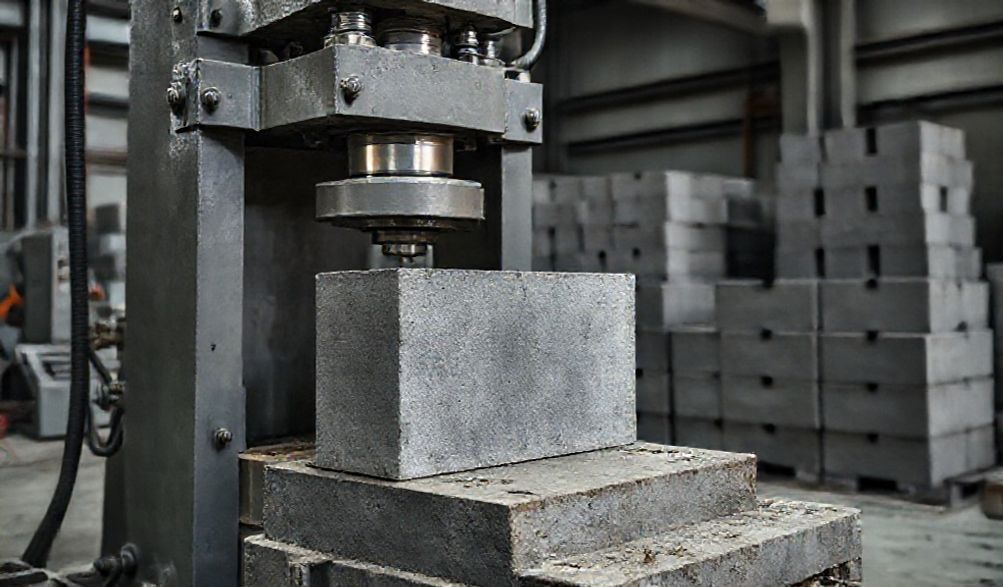
Intinya, mesin press batu tepi jalan berbahan bata hidrolik adalah sistem manufaktur presisi yang dirancang untuk memadatkan campuran beton semi-kering menjadi bentuk tertentu yang mengeras menggunakan gaya hidrolik yang sangat besar. Berbeda dengan metode slipform atau cor basah, mesin ini menghasilkan produk beton "tertekan hidrolik" yang dikenal karena kepadatan, kekuatan, dan akurasi dimensinya yang luar biasa.
Prinsip Kerja Inti
Prosesnya elegan, sederhana, namun sangat kuat:
1. Pemberian Makan:Sejumlah campuran beton semi-kering (perpaduan semen, pasir, agregat, dan air minimal) yang diukur dengan tepat dimasukkan ke dalam rongga cetakan, atau die.
2. Pemadatan:Sebuah ram hidrolik, yang digerakkan oleh unit tenaga yang kokoh, menerapkan tekanan terkendali yang intens—sering kali diukur dalam ton—ke dalam campuran di dalam cetakan.
3. Pembentukan:Tekanan ini memadatkan campuran, mengeluarkan rongga udara dan menciptakan balok berdensitas tinggi yang saling terkunci erat.
4. Pengusiran:Sistem hidrolik kemudian menarik kembali, dan balok yang baru terbentuk dan stabil dikeluarkan dari cetakan, siap untuk segera diawetkan.
Metode pemadatan melalui tekanan murni ini, berbeda dengan getaran, adalah kunci dari karakteristik unggul produk tersebut.
Komponen Utama dan Peran Mereka
Memahami anatomi mesin sangatlah penting:
* Unit Tenaga Hidrolik & Silinder:"Jantung" dari mesin. Ini menghasilkan tenaga fluida yang menggerakkan ram kompresi utama dan gerakan lainnya, menentukan tonase mesin dan gaya tekan.
* Rangka Baja Kokoh dan Sistem Cetakan/Die:"Kerangka dan cetak biru." Rangka baja las memberikan stabilitas di bawah tekanan tinggi. Cetakan, atau die, adalah komponen yang dirancang khusus yang menentukan bentuk, ukuran, dan tekstur produk akhir (misalnya, kerb bullnose, batu paving berbentuk batu bulat).
* Panel Kontrol:"Otak." Mulai dari tuas manual sederhana hingga sistem pengontrol logika terprogram (PLC) untuk mesin otomatis penuh, ia mengatur siklus pengepresan, waktu, dan interlock keamanan.
* Sistem Pemberian dan Pengeluaran: These can be manual, semi-automatic (using a feed hopper and box), or fully automatic (with conveyor belts and robotic arms), directly impacting the machine’s output speed and labor requirements.
Types of Machines
Machines are broadly categorized by their mobility and automation level:
* Tanaman Stasioner: High-output, often fully automatic systems installed in factories for continuous, large-scale production.
* Mesin Bergerak: Mounted on trailers, these are the champions of on-site production. They can be transported directly to road construction or large landscaping projects, eliminating transport costs for finished goods.
* Manual vs. Automatic: Manual presses require an operator to feed mix and remove blocks each cycle. Semi- and fully-automatic machines automate part or all of this process, drastically increasing output and reducing labor.
Key Advantages of Using a Hydraulic Press for Kerb & Brick Production
Investing in this technology delivers a cascade of benefits that address the core challenges of traditional methods.
Kualitas dan Konsistensi Produk yang Unggul
- High Density & Strength: Hydraulic pressure produces blocks with extremely low porosity, resulting in compressive strengths often exceeding 40 MPa or more. This translates to exceptional durability, freeze-thaw resistance, and longevity.
- Precise Dimensions: Every block from the same mold is identical. This ensures perfect alignment during installation, reducing labor time and creating a professionally finished appearance.
- Permukaan Akhir yang Sangat Baik The smooth, dense surface from the polished mold face requires no secondary finishing and is naturally resistant to staining and weathering.
Remarkable Production Efficiency & Output
- Kecepatan Tinggi: A medium-sized semi-automatic press can easily produce 300-500 blocks per hour, depending on the block size and cycle time.
- Pengurangan Ketergantungan Tenaga Kerja: Automation streamlines the process. One or two operators can manage a semi-automatic machine that outputs thousands of blocks per shift.
- 24/7 Capability: Designed for demanding industrial environments, these machines can operate multiple shifts to meet tight project deadlines.
Significant Cost Savings & ROI
- Raw Material Efficiency: The semi-dry mix and precise filling minimize waste. There is no spillage or slurry as with wet-cast methods.
- Pengurangan Biaya Tenaga Kerja: Higher output with fewer personnel directly lowers the cost per produced block.
- Transportation Elimination: On-site production cuts out the enormous cost of transporting heavy pre-cast concrete from a distant factory to the project site.
- Long-Term Asset: A well-maintained hydraulic press is a durable asset that will produce for decades, providing a continuous return on investment.
Unmatched Design Flexibility
This is a game-changer. Changing a mold can take as little as 30 minutes. With a library of molds, one single machine can produce:
* Various kerb profiles (straight, radiused, drainage)
* Different paving bricks (interlocking, cobble, rectangular)
* Garden edging and tree surrounds
* Landscape retaining blocks
* Specialized concrete products for niche markets
Critical Factors to Consider Before Purchasing
A hydraulic press is a significant investment. Careful evaluation ensures you select the right tool for your business.
Menilai Kebutuhan Produksi Anda
- Kapasitas Output yang Diperlukan: Calculate your average and peak daily block requirements. Do you need 2,000 blocks per day or 20,000? This will dictate machine size and automation level.
- Portofolio Produk: List all the kerb profiles, brick dimensions, and other products you plan to manufacture. Ensure your chosen supplier can provide or custom-make these molds.
- Project Scale & Model: Are you a small landscaping business supplying local projects, or a civil contractor bidding on major infrastructure? Your operational model (fixed factory vs. mobile on-site) is the first decision point.
Spesifikasi Mesin Tinjauan Mendalam
- Kapasitas Tekanan (Tonase): This directly correlates to block density and strength. A 150-ton press will produce a stronger block than a 60-ton press from the same mix. Match the tonnage to your product strength requirements.
- Tingkat Otomasi: Balance your budget with labor costs and output needs.
- Panduan: Lowest cost, highest labor, lowest output.
- Semi-Otomatis: Optimal balance for most businesses. Operator feeds mix, but the press cycle and ejection are automated.
- Sepenuhnya Otomatis: Highest output, lowest direct labor, highest initial investment. Ideal for large-scale factory production.
- Mold Quality & System: Molds should be made from hardened, precision-machined steel. Investigate the cost, lead time, and process for ordering additional or custom molds.
Supplier Evaluation Checklist
Your relationship with the manufacturer is critical for long-term success.
* Reputation & Experience: Choose a supplier with a proven track record, not just a trader. How long have they been building these machines? Can they provide references or case studies?
* Technical & After-Sales Support: Do they offer installation supervision, comprehensive operator training, and a clear maintenance guide? This is non-negotiable.
* Spare Parts & Warranty: Is there a local stock of critical spare parts (seals, hoses, sensors)? What does the warranty cover, and for how long? A reliable supplier stands behind their product for the long haul.
Operational Best Practices & Maintenance Guidelines
Proper operation and care are the keys to longevity, safety, and consistent product quality.
Optimal Concrete Mix Design
The press requires a specific “semi-dry” mix. A typical starting ratio is 1 part cement : 3 parts sand : 3 parts aggregate (6-8mm). The moisture content is critical—usually between 4-7%. The mix should hold its shape when squeezed in your hand but crumble when poked. Admixtures like pigments or plasticizers can be added as needed.
Safe and Efficient Daily Operation
- Pemeriksaan Pra-Mulai: Inspect the machine for loose parts, check hydraulic oil levels, and ensure the mold is clean and secure.
- Running Procedure: Follow the trained cycle: feed the mix, initiate the press, allow for pressure hold time, eject the block. Consistently fill the mold with the same volume of mix.
- Shutdown: At the end of the shift, clean the machine thoroughly, especially all mold surfaces, to prevent concrete buildup.
Essential Maintenance Schedule
- Daily/Weekly: Check hydraulic oil level and for leaks; clean the machine and mold; inspect and tighten bolts and fittings.
- Monthly/Quarterly: Check and clean hydraulic oil filters; inspect cylinder rods and seals for wear; lubricate all moving pins and bearings.
- Annually: Consider a full system check by a qualified technician, including oil analysis and replacement, and a comprehensive inspection of the electrical and hydraulic systems.
Applications and End-Use Projects
The versatility of the hydraulic press makes it a cornerstone machine for diverse sectors.
Road Construction & Civil Infrastructure
- Highways & City Roads: Producing standard and custom kerbs, drainage channels (linear drains), and concrete barriers.
- Drainage Systems: Manufacturing swale blocks, ditch liners, and other water management products.
Urban Landscaping & Public Spaces
- Parks & Plazas: Creating decorative paving bricks for pathways, tactile paving for accessibility, and edging stones for flower beds.
- Pedestrian Walkways & Cycle Paths: Supplying durable, attractive pavers and kerbing for municipal projects.
Commercial & Residential Developments
- Housing Estates: Producing driveway pavers, patio stones, and kerbing for roads within the development.
- Commercial Properties: Manufacturing heavy-duty paving for parking lots, loading bays, and pedestrian areas around offices and retail spaces.
Pertanyaan yang Sering Diajukan (FAQ)
What is the typical production output of a medium-sized hydraulic kerb press?
A standard semi-automatic machine with a 2-3 operator team can typically produce between 2,500 to 4,000 standard kerbstones in an 8-hour shift, depending on the specific block size and cycle time.
Can one machine produce different shapes and sizes of blocks?
Absolutely. This is one of its greatest advantages. By changing the mold/die (a process that can take 30-90 minutes), the same press can produce an entirely different product. This allows a business to respond flexibly to market demands.
What is the difference between a hydraulic press and a vibration press for concrete blocks?
Vibration tables use high-frequency shaking to settle concrete mix into a mold, often used for hollow blocks. Hydraulic presses apply direct, powerful pressure. The key difference is in the final product: hydraulically pressed blocks are significantly denser, stronger, and have a smoother finish, making them ideal for high-wear, high-visibility applications like kerbs and paving.
What kind of after-sales support should I expect from a reliable supplier?
Expect comprehensive support: detailed installation drawings or supervised installation, thorough on-site training for your operators and maintenance staff, a complete operation and maintenance manual, a clear warranty (at least 12 months on major components), and prompt availability of spare parts and technical advice.
What are the most common operational challenges and how can they be avoided?
- Inconsistent Mix: This causes variable block strength and poor ejection. Solution: Use a consistent, batched semi-dry mix and control moisture content rigorously.
- Mold Sticking or Block Damage: Solution: Apply a recommended mold release agent regularly and keep molds impeccably clean. Ensure the mix is not too wet.
- Hydraulic System Issues (Overheating, Low Pressure): Solution: Follow the preventive maintenance schedule, use the correct grade of hydraulic oil, and keep filters clean.
Kesimpulan
Themesin press bata batu tepi jalan hidrolik represents a paradigm shift in concrete product manufacturing. It moves production from a distant, centralized factory to the point of need, offering unprecedented control over quality, cost, and schedule. By delivering superior product strength, remarkable operational efficiency, and unparalleled design versatility, it is an investment that pays dividends in both the short term of a single project and the long-term growth of a business.
Your path to success lies in a methodical approach: clearly define your production needs, scrutinize machine specifications against those needs, and, most importantly, partner with a reputable, experienced manufacturer who offers robust after-sales support. Invest in proper training for your team and adhere to a strict maintenance regimen.
As the construction industry continues to prioritize efficiency, sustainability, and localized supply chains, the role of on-site manufacturing with technology like the hydraulic press will only grow. It is not just a machine for today’s projects, but a foundational asset for a more resilient and profitable future.
Ready to transform your concrete product supply chain? Contact leading manufacturers today to discuss your specific requirements, request detailed quotations, and—where possible—arrange a factory visit to see a mesin press bata batu tepi jalan hidrolik in action. A live demonstration is the best way to witness its capabilities firsthand.
<