
우간다의 흙벽돌 제조 기계 최종 가이드 (2026년)
소개
우간다는 건설 중이다. 캄팔라의 번화한 교외 지역부터 구루와 음바라라의 성장하는 도시들까지, 건설 붐이 국가의 풍경을 재구성하고 있다. 이 급증은 증가하는 인구, 도시화, 그리고 저렴한 주택에 대한 절실한 필요에 의해 주도된다. 그러나 이러한 진전에는 중요한 도전 과제가 따른다: 전통적인 건축 자재의 치솟는 비용과 환경적 대가이다.
세대를 거쳐 가장 널리 사용된 재료는 소성 점토 벽돌과 콘크리트 블록이었습니다. 그러나 소성 벽돌은 가마에 엄청난 양의 땔감이 필요하기 때문에 우간다에서 심각한 문제인 산림 벌채에 크게 기여합니다. 또한 에너지 집약적이며 유해한 연기를 배출합니다. 콘크리트 블록은 강도는 높지만 시멘트와 골재의 높은 비용으로 인해 가격이 비싸고, 생산 과정에서 상당한 탄소 발자국을 남깁니다.
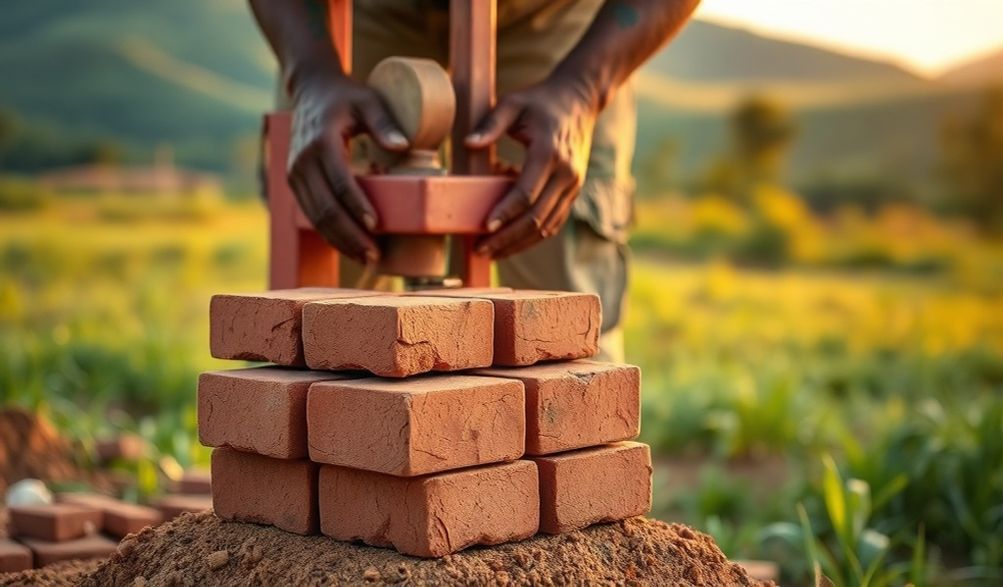
변혁적인 해결책을 제시합니다:우간다의 흙 벽돌 제조 기계이 기술은 인터로킹 안정화 토양 블록(ISSB) 프레스 또는 압축 토양 블록(CEB) 기계로도 알려져 있으며, 우간다인들의 건축 방식을 혁신하고 있습니다. 현지에서 구할 수 있는 흙을 고품질 건축 블록으로 변환함으로써, 경제적이고 내구성이 뛰어나며 환경 친화적인 건축의 길을 열어줍니다.
이 가이드는 여러분의 확실한 참고 자료가 되도록 설계되었습니다. 실용적인 산업 지식과 우간다 건설 부문의 특수한 상황을 바탕으로, 신뢰할 수 있는 전문적이고 실행 가능한 정보를 제공합니다. 우리는 압도적인 이점을 탐구하고, 이용 가능한 기계의 종류를 분석하며, 비용을 따져보고, 성공을 위한 핵심 단계를 설명할 것입니다. 집주인이든, 야심 찬 기업가이든, 프로젝트 매니저이든, 이 가이드는 여러분이우간다의 흙 벽돌 제조 기계지속 가능하고 수익성 있게 구축하기 위해.
우간다 건설에 토양 벽돌 제조 기계를 선택하는 이유는 무엇인가요?
흙벽돌 기술을 채택하는 것은 단순한 건축 선택이 아닙니다. 이는 여러분의 지갑, 지역사회, 그리고 환경에 광범위한 이점을 가져오는 전략적 결정입니다.
비용 효율성 및 경제적 자립
흙벽돌의 경제성은 기존 재료와 근본적으로 다릅니다.
* 급격한 재료비 절감주요 원료인 흙은 현장에서 구할 수 있거나 현지에서 최소 비용으로 조달할 수 있습니다. 이로 인해 소성 벽돌이나 구입한 골재의 높은 비용이 제거됩니다.
* 낮은 운영 비용기계는 단순한 수동 레버에서 유압 시스템에 이르기까지 다양합니다. 연료 연소가 필요하지 않으며, 수동 프레스의 경우 전기나 디젤도 필요 없어 지속적인 생산 비용을 현저히 낮게 유지합니다.
* 사업 및 일자리 창출한 대의 기계가 작은 기업의 씨앗이 될 수 있습니다. 이는 기계 운전사, 토양 공급업자, 그리고 인터록킹 벽돌 쌓기 기술을 습득한 석공들에게 기회를 창출함으로써 지역 사회 내 경제적 역량 강화를 촉진합니다.
환경 지속가능성과 보전
환경 보존이 중요한 국가에서 흙벽돌 기술은 책임 있는 대안을 제시합니다.
* 산림 벌채 중단불을 때는 가마의 필요성을 완전히 없앰으로써, ISSB 생산은 우간다에서 산림 벌채와 산림 황폐화의 주요 원인 중 하나를 직접적으로 해결합니다.
* Zero Emissions from Production: There is no burning process. This means no smoke, no air pollution, and a dramatic reduction in the carbon footprint associated with your building project.
* Low Transport Impact: Utilizing on-site or locally sourced subsoil drastically cuts down the fuel and emissions from transporting heavy materials like sand and aggregate over long distances.
Structural Integrity & Durability
Do not mistake “earth” for “weak.” Properly made soil bricks are formidable building components.
* 높은 압축 강도: When the correct soil mix is stabilized with a small amount of cement or lime and highly compressed, it achieves compressive strength that meets and often exceeds that of traditional fired bricks.
* Seismic Resistance & Strength: The interlocking design creates a mechanical bond between bricks, resulting in walls with exceptional tensile strength. This makes them highly resistant to cracking and perform well in seismic conditions. Walls can be built with minimal or no mortar, further saving cost.
* 뛰어난 단열 성능: The density and composition of compressed earth provide excellent thermal mass. Buildings stay cooler during the day and warmer at night, reducing the need for artificial cooling and enhancing comfort—a major advantage in Uganda’s climate.
Types of Soil Brick Making Machines Available in Uganda
Choosing the right machine depends entirely on your scale, budget, and power availability. Here’s a breakdown of the common types found in the Ugandan market.
Manual Press Machines (Most Common for Startups)
These are the workhorses of small-scale and community-based projects.
* 이상적인 대상: Individual homeowners, self-build groups, NGOs, community projects, and small-scale entrepreneurs starting out.
* 주요 특징: They are entirely human-powered via a lever system. They are highly portable, affordable, and require no electricity or fuel.
* Output Reality: A dedicated 2-3 person team can realistically produce 300 to 500 high-quality bricks in an 8-hour day. This is perfect for building a single home or undertaking small commercial projects.
Hydraulic or Diesel-Powered Machines (For Medium-Scale Production)
When you need higher output for a business or a larger construction project, these machines are the next step.
* 이상적인 대상: Small to medium-sized block-making enterprises, real estate developers, and larger institutional builds like schools or clinic complexes.
* 주요 특징: These use a hydraulic system, powered by a diesel engine or an electric motor (where grid power is reliable). They apply greater, more consistent pressure, leading to higher brick density and uniformity.
* 고려 사항: Output can reach several thousand bricks per day. Factor in the costs of diesel, maintenance, and potentially a generator if grid power is unstable.
Fully Automated Electric Machines (For Large-Scale Production)
These are for industrial-level production and established block yards.
* 이상적인 대상: Large construction companies, major block suppliers, and large-scale housing projects requiring vast, consistent brick supplies.
* 주요 특징: They feature automated feeding, compression, and ejection systems. Output is the highest, with perfect uniformity, and labor requirements are reduced primarily to machine operation and material handling.
* Key Challenge: The capital investment is significant. They also depend entirely on a reliable and powerful electricity supply, often necessitating a large industrial generator as a backup, which adds to operational complexity and cost.
Key Considerations Before Buying a Machine in Uganda
Success with soil bricks starts long before the machine arrives. Careful planning in these areas is non-negotiable.
Soil Testing & Stabilization: The Critical First Step
This is the most important advice any expert will give you. The failure of a soil brick project almost always traces back to poor soil science.
* Suitable Soil: The ideal soil is a mix of clay (as the binder), silt, and sand (for granular strength). Pure clay will crack; pure sand will not bind.
* The Role of Stabilizers: A small percentage of stabilizer—typically 5-8% cement or 3-5% lime—is mixed with the soil. This chemically stabilizes the brick, giving it lasting strength and water resistance. The correct type and amount depend entirely on your soil test results.
* Where to Test: Do not guess. Invest in a professional soil test. Affordable testing services are available at institutions like Makerere University’s Department of Civil Engineering or other regional construction material labs. This report is your blueprint for success.
Project Scale & Required Output
Be realistic about your needs.
* Define Your Goal: Are you building your own house? Starting a business to supply bricks? Equipping a community project? Your goal dictates the machine type.
* Calculate Brick Needs: A typical 3-bedroom house may require 8,000-12,000 bricks. Compare this to the daily output of a manual (300/day) vs. a hydraulic machine (2000/day) to understand your project timeline.
Budget & Total Investment Cost
Look beyond the machine’s price tag.
* Total Cost Breakdown:
* Machine Cost (Primary investment)
* Soil Testing Fees
* Cost of Stabilizer (Cement/Lime)
* Tools (Sieves, mixing trays, moisture testers)
* Training for your team
* Transportation and setup
* Critical Factor: Prioritize suppliers who can guarantee after-sales service and spare part availability within Uganda or East Africa. A cheap machine with no support can become a very expensive paperweight.
Supplier Reliability & After-Sales Support
Your relationship with the supplier is key to long-term success.
* Choose Reputable Partners: Opt for suppliers with a verifiable track record in Uganda or the East African region. Look for those who understand local conditions.
* Essential Questions to Ask:
* What is the warranty period and what does it cover?
* Do you provide on-site installation and training?
* Where are your spare parts stocked, and what is the typical lead time?
* Can you provide references from past clients in Uganda?
Operational Guide: Making Quality Bricks in Ugandan Conditions
With the right soil and machine, producing excellent bricks is a methodical process.
Step-by-Step Production Process
- Sourcing & Sieving: Excavate soil from below the topsoil (which contains organic matter). Sieve it through a 10mm mesh to remove stones, roots, and debris.
- Proportional Mixing: Measure your sieved soil and the required percentage of stabilizer (e.g., 95% soil, 5% cement) by volume. Mix them dry until the color is uniform.
- Moisture Content Control: Gradually add water while mixing. The ideal moisture is critical—use the “drop test.” A handful of the mix should form a ball that holds its shape but crumbles when poked. Too wet, and bricks will stick; too dry, and they won’t bind.
- Compression & Ejection: Load the mix into the machine’s mold and apply compression. For manual machines, this means using the lever fully. Eject the brick carefully onto a pallet.
- 치유: This is where bricks gain strength. Stack them under a shade (plastic sheeting or a shed) and keep them moist by sprinkling water lightly 2-3 times a day for 14 to 28 days. Protect them from direct rain and harsh sun during this period.
Common Challenges & Troubleshooting
- Bricks Cracking After Ejection: Usually caused by soil being too dry or having too much clay. Re-test soil and adjust moisture; consider adding a little more sand.
- Bricks Sticking in the Mold: The mix is too wet. Reduce water and ensure the mold is clean and lightly oiled (with used engine oil) between presses.
- Low Final Strength: Insufficient compaction (not pressing hard enough), incorrect stabilizer percentage, or improper curing. Review each step.
- Adapting to Seasons: In the dry season, you’ll need to add more water and cure diligently. In the rainy season, protect your soil stockpile and curing bricks from heavy downpours; you may need less added water.
The Business Case: Starting a Soil Brick Enterprise in Uganda
For the entrepreneur, a soil brick machine is not just a tool; it’s a business-in-a-box.
Market Analysis & Potential Clients
The market is diverse and growing:
* Individual Homeowners: Seeking affordable, quality building materials.
* 부동산 개발사: Looking to reduce construction costs for housing projects.
* NGOs & Aid Organizations: Needing sustainable, community-friendly building solutions for schools, clinics, and sanitation projects.
* Government & Municipalities: For public housing and infrastructure under affordable housing initiatives.
* Commercial Builders: For offices, warehouses, and hotel complexes where thermal comfort is a selling point.
Basic Financial Modeling
Let’s model a simple manual press business:
* Cost per Brick (Estimate):
* Soil: Negligible
* Cement (5% stabilizer): ~UGX 50
* Labor & Overheads: ~UGX 30
* Total Cost: ~UGX 80-100 per brick
* Selling Price: ISSBs typically sell for UGX 150 – 250 each, depending on region and quality.
* 이익률: A clear UGX 70-150 profit per brick. A small team producing 400 bricks/day creates significant income potential. Your break-even point on a manual machine investment can be as short as a few months.
Success Stories & Case Studies
The proof is in the buildings. Across East Africa, ISSB technology has proven itself:
* School Projects: Numerous primary and secondary schools in Uganda and Kenya have been built with ISSBs, often by NGOs, due to their low cost and community-involvement model.
* Housing Cooperatives: Groups like the Nyakaana Housing Cooperative in Uganda have utilized this technology for member homes, drastically cutting costs.
* Commercial Use: Guest lodges and demonstration centers, such as those promoted by Build Your Future Uganda and other social enterprises, showcase the aesthetic and practical viability of soil brick construction.
FAQ Section
Q1: What is the typical price range for a soil brick making machine in Uganda?
A: Prices vary widely. A basic manual press can range from UGX 2 million to UGX 10 million. Hydraulic machines start around UGX 15 million and can go up to UGX 50 million or more for larger, diesel-powered models. Fully automated electric lines are a significantly larger investment. Always get detailed quotations from multiple suppliers.
Q2: Can I use the soil from my own plot in Kampala/Mbarara/Gulu, etc.?
A: There’s a very high chance you can. The red clay soils common in much of Uganda are often excellent for brick making. However, you must test it first. A simple test can confirm suitability and tell you exactly what stabilizer and proportion you need.
Q3: How many bricks can I make per day with a manual machine?
A: With an efficient 2-3 person team (one mixing, one pressing, one stacking/curing), you can realistically produce 300 to 500 bricks in an 8-hour workday. Output depends on workflow organization and soil preparation.
Q4: Are soil bricks approved for construction by Ugandan authorities?
A: Approval often depends on the local municipal or district council. The key is to present the technology professionally. Come with your soil test report, brick compressive strength test results (which you can get from a lab), and photos/references of existing approved structures built with ISSBs. Engage with building inspectors early in your planning process.
Q5: Where can I get training on using these machines in Uganda?
A: Reputable machine suppliers often provide basic training. For more comprehensive training, look to technical institutes offering construction courses or NGOs focused on sustainable building, such as Good Earth Trust또는Habitat for Humanity, which sometimes run workshops. The Uganda Institute of Professional Engineers (UIPE) may also have resources.
결론
그우간다의 흙 벽돌 제조 기계 represents more than just a piece of equipment; it symbolizes a smarter, more sustainable, and self-reliant future for Ugandan construction. It directly tackles the triple challenges of high cost, environmental damage, and the need for durable housing. This technology empowers individuals to build their own homes and entrepreneurs to build thriving businesses, all while preserving Uganda’s precious natural resources.
The path forward is clear. Start with the foundational step: get your soil tested. Use that knowledge to engage with reputable suppliers who offer not just a machine, but the training and support necessary for long-term success. The buildings of Uganda’s future can be stronger, cooler, cheaper, and greener. The tool to build that future is already here.
Ready to explore your project? Contact a reputable supplier today to discuss your soil testing and machine options.
Have experience with soil bricks in Uganda? Share your insights in the comments below to help others in our community.
For more guides on sustainable building in East Africa, subscribe to our newsletter.
<