
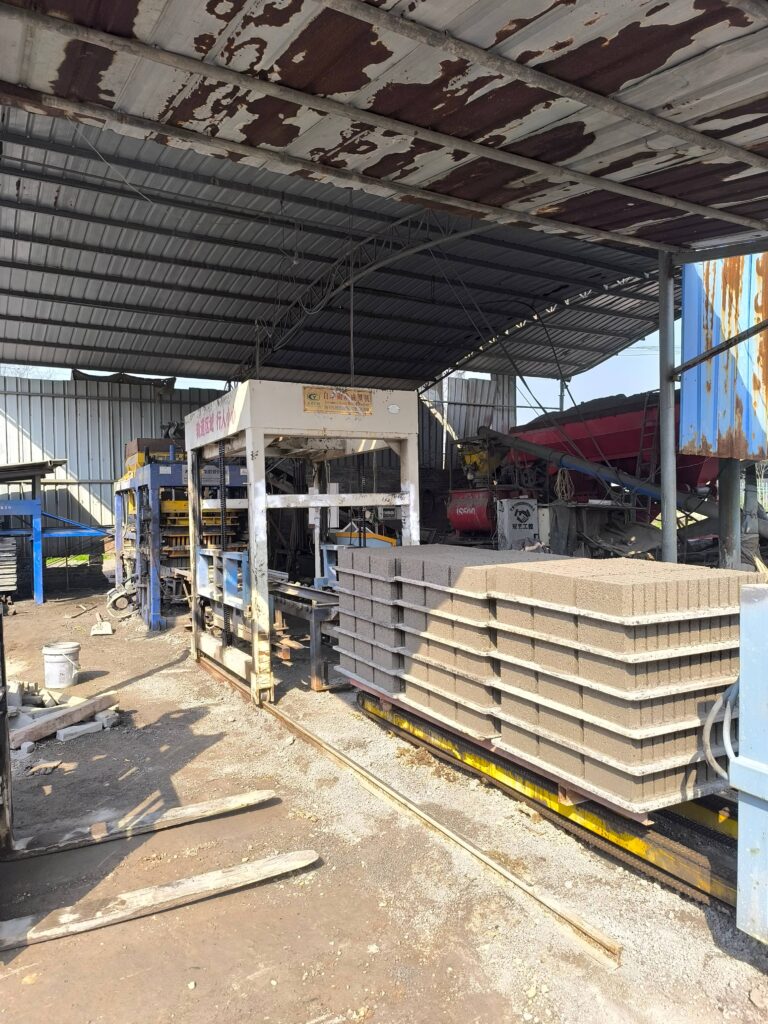
고체 블록 제조 기계
소개
벽돌 및 블록 생산 장비의 다양한 생태계에서 고체 블록 기계는 중요한 위치를 차지하며, 기본 건축 구성 요소인 고체 콘크리트 블록의 대량 생산을 위해 설계되었습니다. 유통업자, 딜러 및 조달 전문가에게 이 특정 기계 분야에 대한 깊은 이해는 지속적이고 수요가 높은 시장을 대응하는 데 필수적입니다. 고체 블록은 최대 압축 강도와 내구성이 필수적인 기초, 내력벽, 포장 및 인프라 프로젝트의 중추 역할을 합니다.
핵심 정의와 기능적 특화
实心砖机是一种专用型液压或振动压实设备,专为生产无空腔的实心混凝土砌块而设计。其核心特征在于模具内不设芯体成型机构,所有施加的能量均集中于材料整体的均匀密实。与可适配多种空心产品的通用机械不同,该类设备通常针对单一高价值产品类型进行优化设计,以实现其最佳性能。
- 최대 고밀도의 필수성
- 주요 엔지니어링 목표는 완성된 블록에서 최대한 높은 부피 밀도를 달성하는 것입니다. 단단한 블록은 질량과 골재 입자의 긴밀한 결합으로부터 구조적 가치를 얻습니다. 따라서 기계는 표준 중공 블록 생산에 사용되는 것보다 종종 더 높은 극도로 높은 압밀 압력을 전달하고 유지하도록 설계되어, 공극을 제거하고, 다공성을 줄이며, 전체 유닛 전반에 걸쳐 시멘트 결합재를 활성화합니다. 이는 우수한 압축 강도, 낮은 투수성, 그리고 충격 및 풍화에 대한 향상된 저항성을 초래합니다.
- 소재 시스템 최적화
- These machines are typically paired with a specific range of concrete mix designs. The optimal mix for solid block production often features a well-graded aggregate blend with a controlled sand-to-cement ratio, optimized for maximum density under pressure rather than for flow around cores. The machinery’s feeding and compaction systems are calibrated to handle this stiffer, often zero-slump mix efficiently, ensuring consistent fill and uniform pressure distribution across the entire mold cavity.
- Distinction from Hollow Block and Paver Machinery
- While overlapping in basic technology, key differentiators exist:
- Vs. Hollow Block Machines: The absence of complex core rods and related ejection mechanisms simplifies the mold design and maintenance. The machine’s full pressing force is directed onto a solid material column, allowing for different frame and hydraulic system optimizations.
- Vs. Paver Machines: Pavers require high pressure but are typically thinner. Solid block machines are built to compact a much deeper mass of material, requiring longer stroke lengths, greater platen stability, and sometimes modified vibration protocols to ensure density is consistent from top to bottom of the block.
- While overlapping in basic technology, key differentiators exist:
Technical Architecture and Operational Dynamics
The efficiency of a solid block machine is a product of its integrated subsystems, each contributing to the goal of producing a flawless, high-density unit.
- The Press Frame and Stability System
- Given the extreme forces involved, the structural integrity of the machine’s frame is paramount. It is constructed from heavy-duty steel plate or reinforced box sections to resist deflection under full load. This rigidity ensures that the compaction force is applied perfectly vertically and evenly, preventing minute distortions that could lead to variations in block height or density. A stable, massive frame is the non-negotiable foundation for precision.
- High-Pressure Hydraulic and Compression System
- The heart of the machine is a high-tonnage hydraulic system. It features a powerful pump, large-diameter cylinders, and a robust valve block capable of generating and holding pressures significantly higher than those used for lighter units. The compression cycle often includes a pre-compaction phase to settle material, followed by a sustained main pressure phase with a “dwell time” to allow stress relaxation within the compacted matrix, resulting in a more stable green block.
- Mold Design for Solid Block Production
- The mold assembly is simplified yet must be exceptionally robust. It consists of a solid-walled mold box and a single, flat, or slightly profiled compression head. The internal surfaces are hardened and often chrome-plated to reduce friction with the sticky concrete mix and facilitate smooth ejection. Without cores, the focus is on achieving perfect internal corners and consistent block dimensions across the entire production run. Quick-release mechanisms allow for efficient mold changes between different solid block sizes (e.g., 4-inch, 6-inch, 8-inch thicknesses).
- Feeding and Material Metering Mechanism
- Consistency begins with the feed. The machine employs a volumetric feeder—a feed drawer or box—that travels over the empty mold, depositing an exact amount of the dry or semi-dry concrete mix. The accuracy of this metering is critical; too little material results in an under-filled, weak block, while too much can cause over-pressurization, mold damage, or inconsistent block height. Advanced systems may include a pre-compaction or leveling device within the feeder to ensure an even initial distribution of material in the mold.
Product Output and Application Spectrum
The specialization of this machinery yields a product with distinct advantages for targeted construction applications.
- Foundation and Sub-Structural Work
- Solid blocks are the material of choice for footing courses, basement walls, and retaining structures due to their high load-bearing capacity and resistance to moisture penetration from soil. The machine’s output is engineered to meet the stringent strength requirements (often ASTM C90 Grade N or S) for these critical, below-grade applications.
- High-Strength Load-Bearing Walls
- In multi-story construction or industrial buildings, solid blocks provide the necessary compressive strength for load-bearing walls. The uniformity and dimensional accuracy from a dedicated machine ensure level courses and predictable structural performance.
- Paving, Flooring, and Heavy-Duty Surfaces
- Solid blocks produced on these machines, when formulated with wear-resistant aggregates, are used as heavy-duty paving blocks, factory flooring units, and in port or logistics yard surfacing. Their monolithic structure withstands point loads and abrasion far better than hollow units.
- Specialized Infrastructural Components
- The machinery can be adapted to produce solid blocks for specific infrastructural uses, such as sound barrier walls, security barriers, or large-format landscaping units, where mass and durability are key functional requirements.
Strategic Commercial and Operational Considerations
For the distributor, positioning a solid block machine requires highlighting its specialized value proposition.
- Economic Rationale for Specialization
- A client whose primary market is foundational work or heavy construction may find a dedicated solid block machine more efficient and cost-effective than a versatile machine that compromises on peak solid block performance. The higher output rate, lower maintenance (no core systems), and optimized wear parts for a single product type can lead to a lower cost per unit and faster return on investment for this specific niche.
- Operational Simplicity and Reliability
- The relative mechanical simplicity compared to hollow block machines—with fewer moving parts in the mold area—often translates to higher uptime, easier operator training, and reduced maintenance complexity. This reliability is a powerful selling point for production environments where consistent output is critical to fulfilling large contracts.
- Quality Assurance and Market Reputation
- A machine dedicated to solid blocks is perceived as a tool for producing a premium, high-specification product. This enhances the manufacturer’s reputation for quality and reliability in the market, allowing them to command better prices for a superior structural component. Distributors can leverage this to help clients build a strong brand in the construction sector.
결론
The solid block machine exemplifies the principle of optimization through specialization in construction equipment. It is not a generic press but a precision instrument engineered to solve a specific problem: the efficient, high-volume production of maximally dense and strong concrete masonry units. Its value lies in its focused design—from its massively stable frame and high-pressure hydraulics to its simplified yet robust mold system—all converging to deliver a product of uncompromising structural integrity.
For the astute distributor, success lies in identifying clients whose business strategy aligns with this specialization. This includes foundation contractors, suppliers to large-scale infrastructural projects, and manufacturers aiming to dominate the market for high-strength building components. By articulating the technical advantages, operational efficiencies, and superior product economics of a dedicated solid block machine, distributors provide more than just equipment; they offer a strategic pathway to capturing a loyal and profitable segment of the construction materials market. In an industry where strength and reliability are paramount, this machinery stands as a foundational technology for building the physical world.
자주 묻는 질문 (FAQ)
Q1: Can a solid block machine also produce hollow blocks with a simple mold change?
A: Generally, no. A true solid block machine lacks the mechanical and control systems necessary for hollow block production. These include:
- Core Rods and their attachment points within the mold.
- The synchronized ejection system to retract cores before lifting the mold box.
- Specific vibration settings to ensure material flows around cores.
Converting a solid block machine to produce hollow blocks would require extensive, costly redesign, essentially building a new machine. It is purpose-built for solid products.
Q2: What is a typical compressive strength range for blocks produced on a dedicated solid block machine?
A: With a proper mix design (adequate cement content and well-graded aggregates) and sufficient machine pressure, dedicated solid block machines can consistently produce blocks with compressive strengths ranging from 7 MPa (1000 psi) to over 20 MPa (2900 psi). For comparison, this often meets or exceeds the strength of standard hollow blocks and is suitable for the most demanding structural applications.
Q3: Does the lack of cavities affect the curing process of solid blocks?
A: Yes, it requires careful management. Solid blocks have a much larger mass-to-surface-area ratio than hollow blocks. This means moisture trapped in the center takes longer to equilibrate with the environment. Proper curing—keeping the blocks moist under cover for a sufficient period (often 7-14 days)—is even more critical to prevent surface cracking from rapid drying and to ensure full strength development throughout the entire depth of the block.
Q4: Is the energy consumption per block higher for a solid block machine compared to a hollow block press?
A: Typically, yes, on a per-unit basis. Compacting a solid mass of material to very high density requires more mechanical energy than compacting a hollow block of the same face dimensions. However, this is offset by the higher product value and the fact that the machine may have a faster cycle time for a solid block (no complex core movements), potentially leading to higher overall energy efficiency in terms of production output per kilowatt-hour.
Q5: What are the key maintenance focus areas for this type of machine?
A: Maintenance priorities center on the systems承受ing extreme stress:
- 유압 시스템: Regular monitoring of fluid quality, filter changes, and inspection of hoses and seals for high-pressure leaks.
- Mold and Compression Head: Inspection for wear on the hardened surfaces and ensuring all clamping mechanisms are secure to prevent flash.
- 급식 시스템 Ensuring the volumetric feeder delivers consistent amounts and does not wear unevenly.
- Guide Columns and Bushings: Regular lubrication and inspection for alignment, as any play here directly affects block dimensional accuracy.
