
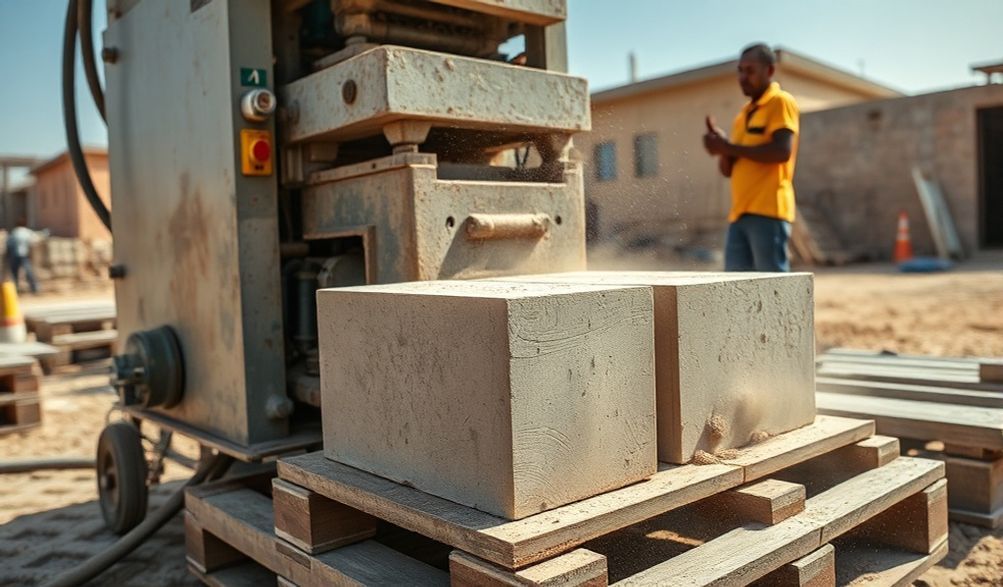
Panduan Utama Anda untuk Mesin Pembuat Blok di Ethiopia: Jenis, Harga & Pembekal
Pengenalan
Ethiopia sedang membangun masa depannya, secara harfiah. Dari proyek-proyek infrastruktur ambisius di Addis Ababa hingga meningkatnya permintaan perumahan terjangkau di seluruh wilayahnya, sektor konstruksi negara ini mengalami pertumbuhan yang belum pernah terjadi sebelumnya. Di dasar ledakan ini—secara harfiah—adalah blok beton sederhana. Kualitas, ketersediaan, dan biaya blok-blok ini secara langsung memengaruhi kekuatan, kecepatan, dan kelayakan setiap proyek konstruksi. Di sinilah investasi strategis dalam sebuahmesin pembuatan blok di Ethiopiaberubah daripada pembelian peralatan mudah kepada keputusan perniagaan yang penting.
Panduan komprehensif ini direka untuk menjadi sumber rujukan muktamad anda. Tujuan kami adalah untuk menembusi kekeliruan dan menyediakan kontraktor, pembina, serta usahawan yang bercita-cita dengan maklumat terperinci dan tidak berat sebelah yang diperlukan untuk mengharungi pasaran. Analisis kami berasaskan tren pasaran semasa, spesifikasi teknikal, dan yang paling penting, pandangan praktikal yang disesuaikan dengan peluang dan cabaran unik dalam konteks Ethiopia. Kami komited untuk menyampaikan pengetahuan faktual dan terkini bagi membolehkan anda membuat pelaburan yang yakin dan berinformasi. Dalam bahagian seterusnya, kami akan menyelami secara mendalam tentangjenis-jenis mesin pembuatan bloktersedia, dedahkan misterikos dan struktur penetapan hargaNilai pembekal, dan berikan kebijaksanaan operasi untuk memastikan usaha anda—sama ada projek peribadi atau perusahaan komersial—dibina atas asas yang kukuh.
Mengapa Melabur dalam Mesin Pembuat Blok di Ethiopia?
Memahami "mengapa" adalah penting sebelum meneroka "bagaimana." Melabur dalam mesin pengeluaran blok di Ethiopia bukan sekadar membeli alat; ia tentang memanfaatkan keperluan nasional dan menjamin kelebihan daya saing.
Kemeriahan Pembinaan: Permintaan Infrastruktur dan Perumahan Ethiopia
Angka-angka bercakap sendiri. Ethiopia secara konsisten menduduki ranking antara ekonomi yang paling pesat berkembang di Afrika, dengan pelaburan awam dan swasta yang besar dalam jalan raya, landasan kereta api, taman perindustrian, dan pembangunan bandar. Inisiatif perumahan kerajaan bertujuan untuk menangani defisit yang ketara, mendorong permintaan yang tidak henti-henti untuk bahan binaan. Ini mewujudkan peluang berganda: memastikan bekalan yang stabil dan berkualiti untuk projek pembinaan anda sendiri atau menubuhkan perniagaan yang menguntungkan dengan membekalkan pasaran yang pesat berkembang ini.
Kelebihan Ekonomi: Penjimatan Kos, Keberuntungan, dan Peluang Perniagaan
Bagi kontraktor, pengeluaran blok secara dalaman mengurangkan kos bahan sebanyak 30-50% berbanding pembelian dari pihak ketiga. Ia menghapuskan kelewatan rantaian bekalan, memberi anda kawalan sepenuhnya ke atas jadual projek. Bagi usahawan, ia membuka jalan yang jelas kepada keuntungan. Permintaan jauh mengatasi bekalan teratur di banyak kawasan, menjadikan halaman blok sebagai perusahaan kecil dan sederhana yang berdaya maju dan tahan lasak. Anda bukan sekadar menjual blok; anda menyediakan penyelesaian kritikal untuk pertumbuhan komuniti anda.
Quality Control: Producing Durable, Standardized Blocks for Your Projects
Relying on inconsistent external suppliers can compromise your building’s integrity. With your own machine, you control the mix design, vibration, and curing process. This means producing blocks that meet or exceed ES (Ethiopian Standard) specifications for compressive strength and dimensional accuracy. Stronger, uniform blocks lead to safer buildings, less mortar usage, and a superior final product—enhancing your reputation for quality.
Types of Block Making Machines Available in Ethiopia
The market offers a spectrum of technology, from simple hand-operated units to fully automated plants. Your choice depends on your budget, required output, and labor model.
Manual Block Making Machines: Operation, Output, and Ideal Use Cases
- Bagaimana Mereka Berfungsi: Operated entirely by human labor. The operator fills the mold, compresses the mix using a lever, and then manually ejects the block.
- Output: Typically 200-500 blocks per 8-hour day.
- Sesuai Untuk: Small-scale personal projects (building a home, compound wall), very low-budget startups, or remote areas with no electricity. They are the most affordable entry point but are labor-intensive and produce lower volumes.
Semi-Automatic Machines: Balancing Affordability and Productivity
- Bagaimana Mereka Berfungsi: These machines use a mechanical or hydraulic system (often powered by electricity or diesel) to provide the compression and vibration. Operators still feed the raw mix and may handle block removal, but the core forming process is powered.
- Output: Can range from 800 to 2,500 blocks per 8-hour shift, depending on model and crew size.
- Sesuai Untuk: Most small to medium-sized block production businesses and mid-sized construction firms. They offer the best balance, providing a significant productivity boost over manual machines without the complexity and cost of full automation.
Fully Automatic Block Making Plants: For Large-Scale Production
- Bagaimana Mereka Berfungsi: These are complete systems with automated material feeding, mixing, molding, curing, and stacking. They require minimal human intervention, primarily for supervision and maintenance.
- Output: Can produce 5,000 to 20,000+ blocks per day.
- Sesuai Untuk: Large block manufacturing plants supplying major cities, contractors, and government projects. They represent a major capital investment but offer the lowest cost per block at very high volumes.
Mobile vs. Stationary Block Machines: Which is Right for Your Site?
- Mesin Blok Mudah Alih: Mounted on a trailer, these can be towed directly to a construction site. This eliminates block transportation costs and is perfect for large, remote projects like dams, road construction camps, or large farm developments.
- Mesin Blok Stesen: Set up in a fixed location (a block yard). They are generally more robust, can be part of a larger system (like a conveyor), and are the standard choice for a dedicated production business.
Key Features to Consider Before Buying
Look beyond the basic type. These features determine how well the machine will perform in your specific situation.
Production Capacity (Blocks Per Hour): Matching Output to Your Needs
Don’t just buy the biggest machine you can afford. Calculate your current and projected demand. An underutilized automatic plant is a money-loser. Key questions:
* What is the cycle time (time to produce one batch of blocks)?
* Is the stated output based on a single mold or with multiple mold cavities?
* Does the output account for loading, curing, and stacking time?
Block Types and Molds: Hollow, Solid, Interlocking, Pavers, etc.
Versatility adds value. Ensure the machine can produce the block types in demand in your target market:
* Blok Berongga: Standard for walls, offering good strength with less material.
* Blok Pejal: For foundations, columns, and high-load areas.
* Blok Saling Kunci: Gaining popularity for their mortar-less construction speed.
* Pavers and Kerbstones: For landscaping and road projects.
Check the cost and availability of different mold sets from the supplier.
Power Source: Electric, Diesel, or Hybrid Models for Ethiopian Utilities
- Elektrik: Cleaner, quieter, and cheaper to run, but vulnerable to Ethiopia’s frequent power fluctuations. A generator backup is often essential.
- Diesel: Fully independent of the grid, ideal for areas with unreliable power. Higher fuel costs and more noise.
- Hibrid: Can run on either electricity or a diesel engine, offering maximum flexibility and business continuity.
Durability and After-Sales Service: Critical Factors for Long-Term Operation
The machine’s build quality is paramount. Look for:
* Rangka Keluli Tugas Berat: To withstand constant vibration.
* Quality Hydraulic System: The heart of the machine; reputable components matter.
* Vibration Motor Quality: Ensures proper block compaction.
In Ethiopia, after-sales service is arguably more important than the initial price. A cheap machine with no local technical support or spare parts will become a costly scrap metal.
Understanding the Cost: Block Making Machine Prices in Ethiopia
Prices vary wildly based on type, brand, and origin. Be prepared for additional costs beyond the machine’s sticker price.
Price Range Breakdown (Manual, Semi-Auto, Fully Auto)
- Mesin Pembuatan Blok Manual: ETB 15,000 – ETB 80,000.
- Mesin Semi-Automatik: ETB 200,000 – ETB 1,500,000+. The wide range depends on capacity, brand, and automation level.
- Tumbuhan Sepenuhnya Automatik: ETB 2,500,000 and can go up to ETB 10,000,000+ for large, imported systems.
Factors Influencing Cost: Brand, Automation, Capacity, and Import Duties
- Brand: Well-known international brands (e.g., Zenith, Hess, Prensoland) command a premium over generic or Chinese-made machines.
- Tahap Automasi: Each step of automation (auto-feeding, auto-stacking) adds cost.
- Kapasiti: Higher output = higher price.
- Import Duties: Machines imported directly or by distributors are subject to Ethiopian customs duties, which significantly affect the final landed cost.
Total Cost of Ownership: Beyond the Purchase Price (Maintenance, Spares, Training)
Your real investment includes:
1. Shipping and Installation.
2. Foundation and shed for the machine.
3. Initial stock of spare parts (wear parts like mold liners, springs).
4. Operator training.
5. Routine maintenance costs (hydraulic oil, grease, filter changes).
6. Raw material inventory (cement, aggregate).
Finding Reliable Suppliers and Brands in Ethiopia
Navigating the supplier landscape is critical to your long-term success.
Local Ethiopian Distributors and Dealers: Pros and Cons
- Kelebihan: Easier communication, potential for faster service calls, may offer training in local languages, might have showrooms for demonstration.
- Keburukan: Prices may be marked up, may have limited model options, dependent on their own supply chain for spares.
International Manufacturers: How to Navigate Direct Imports
- Kelebihan: Potentially lower factory prices, widest selection of models.
- Keburukan: Logistical complexity (shipping, customs clearance), high minimum order quantities, difficult to arrange after-sales service, language barriers. Recommended only for very large, well-capitalized buyers.
Vetting Suppliers: Checklist for Warranty, Service Support, and Spare Parts Availability
Before signing a contract, ask:
* What is the warranty period and what does it cover?
* Do you have a service engineer based in Ethiopia? What is the typical response time?
* Do you stock critical spare parts locally? Can you provide a list of parts with prices?
* Can you provide references from other customers in Ethiopia?
* Do you offer installation and on-site training?
Popular & Reliable Brands in the Ethiopian Market
While you must conduct your own due diligence, brands that have established a presence include:
* International: German-engineered brands (like Zenith) are known for high quality. Various Turkish and Chinese manufacturers (like QGM, Hongfa) offer a range of options.
* Local Assembly: Some suppliers assemble machines locally using imported components, which can offer a good cost-service balance.
Operational Guide and Best Practices
Owning the machine is step one. Operating it efficiently is where the profit is made.
Raw Material Preparation: Ideal Mix for Cement, Sand, and Aggregate in Ethiopia
Quality blocks start with a consistent mix. A common standard mix ratio is 1 part cement to 6 parts aggregate (a blend of sand and crushed stone). The sand should be coarse and clean. The aggregate size should be between 5-10mm for smooth block faces. Always test your local materials and adjust the mix and water content for optimal strength and workability.
Step-by-Step Operation and Safety Procedures
- Persediaan: Ensure the machine is on a level, solid foundation. Check oil and fuel levels.
- Mencampurkan: Combine raw materials in a pan mixer until uniform.
- Pemberian Makan: Fill the machine’s hopper with the mixed concrete.
- Pembentukan: Activate the machine cycle (vibration and compression happen here).
- Penyembuhan: Gently transfer fresh blocks to a curing area. Keep them moist and covered for at least 7 days for proper strength development. SAFETY: Always wear gloves, safety glasses, and sturdy boots. Never place hands in the mold area during operation. Lock out power before any maintenance.
Maintenance Tips to Maximize Your Machine’s Lifespan
- Daily: Clean the machine thoroughly after use. Check for loose bolts.
- Weekly: Grease all moving joints and bearings.
- Monthly: Check hydraulic oil level and condition. Inspect mold liners for wear.
- Annually: Consider a full service by a qualified technician.
Troubleshooting Common Issues with Block Making Machines
- Blocks Breaking When Ejected: The mix is too dry, or vibration time is insufficient.
- Poor Surface Finish: The mix is too wet, or the mold liners are worn out.
- Machine Losing Pressure: Check for hydraulic oil leaks, a dirty filter, or pump issues.
- Uneven Block Height: The mold is not properly balanced or the feeding is inconsistent.
Soalan Lazim (FAQ)
Q: What is the cheapest type of block making machine available in Ethiopia?
A: Manual block making machines are the most affordable, with prices starting around ETB 15,000. They are suitable for very small-scale or personal use.
Q: How many blocks can a standard semi-automatic machine produce per day?
A: A typical single-horsepower semi-automatic machine with a 4-block mold can produce between 1,200 to 2,000 blocks in an 8-hour shift with a skilled crew, depending on the block type and workflow.
Q: Can I get training on how to operate the machine from local suppliers?
A: Reputable local suppliers almost always provide basic on-site installation and operational training. This is a key question to ask before purchasing.
Q: What are the main challenges of running a block making business in Ethiopia?
A: Key challenges include securing consistent, affordable cement supply; managing costs amid inflation; dealing with power interruptions (requiring a generator); and navigating local logistics and market competition.
Q: Are there any government regulations or standards for block production?
A: Yes. The Ethiopian Standards Agency (ESA) sets standards for concrete hollow blocks (e.g., ES 1171). Blocks should meet specified compressive strength levels. Adhering to these standards is crucial for quality and credibility.
Q: How do I calculate the return on investment (ROI) for a block machine?
A: Calculate: 1) Your total investment (machine + setup + operating capital). 2) Your estimated monthly production volume. 3) Your selling price per block minus your cost per block (materials, labor, utilities, rent). The time it takes for your net profit to equal your total investment is your payback period.
Kesimpulan
Choosing the right mesin pembuatan blok di Ethiopia is a strategic decision that hinges on carefully balancing your project scale, budget, and the crucial need for reliable after-sales support. This guide has walked you through the market landscape—from the driving forces behind the investment to the technical specifics of operation.
Our final, critical recommendation is to prioritize total value over the lowest sticker price. A slightly more expensive machine backed by a supplier with a strong service network and local spare parts will save you immense cost and stress in the long run, ensuring your productivity and profitability.
Use this guide as your reference point. Contact multiple reputable suppliers, ask them the detailed questions outlined here, and request site visits to see their machines in operation if possible. By making an informed decision, you are not just acquiring a piece of equipment; you are investing in a tool that will build your business and contribute to the very fabric of Ethiopia’s growing cities and communities. Make that foundation a strong one.
<