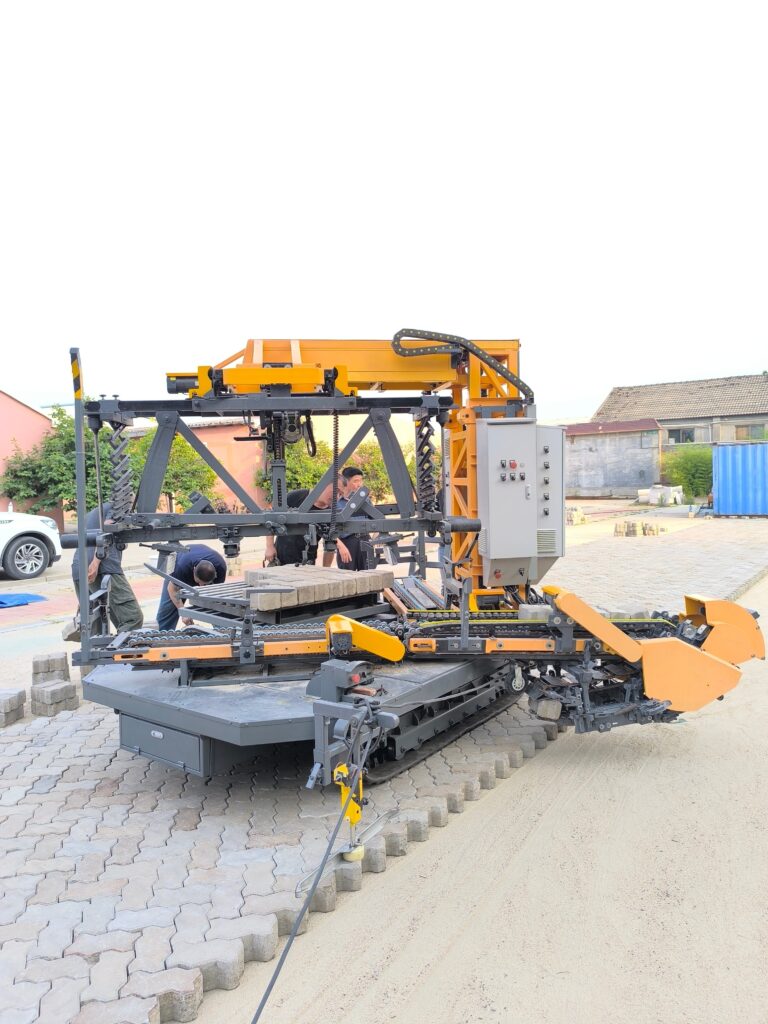
1. Introdução
O pavimento manual tradicional — que depende de mão de obra qualificada para assentar tijolos, blocos ou pavimentadoras um a um — não só consome muito tempo, como também é propenso a inconsistências, desperdício de materiais e altos custos de mão de obra. Com a expansão da urbanização, projetos de infraestrutura (como estradas, calçadas, praças e estacionamentos) exigem prazos de execução mais curtos sem comprometer a qualidade. É aqui que entram as máquinas automáticas e semiautomáticas de assentamento de blocos e pavimentadoras: elas agilizam o processo de pavimentação, reduzem a dependência da mão de obra manual e proporcionam resultados uniformes e duráveis, atendendo aos padrões modernos de construção.
2. Corpo Principal
2.1 Definição de Máquinas Automáticas e Semiautomáticas para Assentamento de Tijolos e Blocos de Pavimentação
Máquinas de pavimentação projetadas para assentamento de tijolos e blocos são equipamentos especializados projetados para automatizar ou semiautomatizar o processo de colocação de unidades de pavimentação (tijolos, blocos de concreto, pavers intertravados, etc.) em padrões precisos e uniformes. Diferente das máquinas gerais de assentamento na construção civil, esses modelos são otimizados para superfícies horizontais, com características adaptadas às demandas específicas da pavimentação—como alinhamento de padrões, nivelamento da superfície e precisão de intertravamento.
2.1.1 Máquinas Automáticas de Pavimentação com Blocos de Tijolo
As máquinas de pavimentação automática são sistemas totalmente integrados que exigem intervenção humana mínima uma vez programadas. Elas combinam robótica, controles computadorizados e sistemas de manuseio de materiais para executar todo o processo de pavimentação—desde o carregamento dos pavimentos até a colocação final—com precisão consistente. As características principais incluem:
- Capacidades de padrões pré-programados (por exemplo, espinha de peixe, trama de cesto, ligação corrida) que eliminam erros de layout manual.
- Alimentação automatizada de pavimentadoras por meio de esteiras ou tremonhas, reduzindo a necessidade de levantamento e posicionamento manual.
- Detecção e ajuste de nível em tempo real para garantir uma superfície plana e uniforme (crítico para drenagem e segurança).
- Altas taxas de produção, tipicamente 1.000–3.000+ pavimentadoras por hora, dependendo do modelo.
- Compatibilidade com vários tamanhos de pavimentadoras (por exemplo, 100x100mm, 200x200mm, 250x250mm) e materiais (argila, concreto, pavimentadoras permeáveis).
Essas máquinas são projetadas para projetos de grande escala, onde velocidade, consistência e economia de mão de obra são prioridades máximas. Elas operam por meio de uma combinação de GPS, orientação a laser e plantas digitais, garantindo que o padrão de pavimentação siga as especificações exatas do projeto.
2.1.2 Máquinas Semi-Automáticas de Assentamento de Blocos de Tijolo para Pavimentação
Máquinas de pavimentação semiautomáticas equilibram automação com supervisão manual, tornando-as ideais para projetos de médio porte ou locais com espaço limitado. Elas automatizam as tarefas principais de colocação e alinhamento de pavimentos, mas exigem intervenção humana para alimentar os pavimentos, ajustar configurações ou navegar em áreas complexas. As características principais incluem:
- Alimentação manual ou semiautomática de pavimentadoras (operadores carregam as pavimentadoras em um funil ou bandeja de alimentação).
- Posicionamento e alinhamento automatizados utilizando sistemas mecânicos ou hidráulicos, reduzindo o erro humano.
- Programação de padrões básicos (opções pré-definidas com personalização limitada) ou orientação manual de padrões.
- Production rates of 300–1,000 pavers per hour, depending on operator skill and machine design.
- Compact, maneuverable design for use in tight spaces (e.g., narrow sidewalks, courtyard areas).
Semi-automatic models are more affordable than fully automatic machines and offer greater flexibility for projects with varying patterns or irregular shapes. They are a popular choice for small to medium paving contractors who want to improve efficiency without investing in high-end automation.
2.2 Core Operational Workflows: How They Differ
The operational processes of automatic and semi-automatic paving machines differ significantly in terms of automation level, labor requirements, and setup complexity. Below is a detailed breakdown of each machine’s workflow to help you understand their practical application:
2.2.1 Workflow of Automatic Paving Machines
- Pre-Operation Setup:
- Digital blueprint integration: Operators upload project plans (including paving area, pattern, paver size, and spacing) into the machine’s control system.
- Site calibration: The machine uses GPS and laser sensors to map the paving area, detect obstacles, and establish reference points for levelness and alignment.
- Material loading: Pavers are loaded into a large hopper (capacity: 500–2,000 pavers) via a conveyor system, which feeds them to the placement mechanism.
- Mortar/ sand preparation (if required): Some models integrate a sand or mortar spreading system to ensure proper bedding for pavers, with automated thickness control (typically 20–30mm).
- Automated Paving Process:
- Paver retrieval: A robotic arm or vacuum gripper retrieves individual pavers from the hopper, ensuring gentle handling to avoid damage.
- Pattern alignment: The control system guides the paver to its exact position based on the pre-programmed pattern, adjusting for any site irregularities detected by sensors.
- Placement and compaction: The paver is placed on the bedding material, and a built-in compaction plate applies pressure (5–10 kPa) to secure it in place.
- Continuous progression: The machine moves forward incrementally (at 0.5–1 m/min) as each section is completed, maintaining alignment with the blueprint.
- Post-Operation Quality Control:
- The machine’s sensors conduct real-time checks for levelness, spacing, and pattern consistency, alerting operators to any deviations.
- Excess sand or mortar is automatically swept or removed, reducing the need for manual finishing.
- Data logging: The system records production metrics (e.g., number of pavers laid, area covered, time elapsed) for project tracking and invoicing.
2.2.2 Workflow of Semi-Automatic Paving Machines
- Pre-Operation Setup:
- Manual pattern layout: Operators mark the paving area with chalk lines or stakes to guide the machine’s pattern (some models offer basic digital pattern selection).
- Site preparation: The machine is positioned at the start of the paving area, and level adjustments are made manually using built-in spirit levels or laser guides.
- Material loading: Operators load pavers into a small hopper (capacity: 50–200 pavers) or feed them one by one into the placement mechanism.
- Semi-Automated Paving Process:
- Paver feeding: The operator places pavers into the machine’s feeding tray, which aligns them for placement.
- Automated placement: The machine uses hydraulic or mechanical pressure to push the paver into position, ensuring uniform spacing (typically 2–5mm) between units.
- Manual navigation: The operator guides the machine along the marked pattern, adjusting direction for curves or obstacles. Some models have wheeled or tracked bases for easier maneuvering.
- Compaction: A manual or semi-automatic compaction tool (attached to the machine) secures the paver in place, with the operator controlling the pressure.
- Post-Operation Quality Control:
- The operator inspects each section for levelness and pattern consistency, making manual adjustments as needed.
- Excess bedding material is swept away manually, and any misaligned pavers are repositioned by hand.
2.3 Key Technical Differences Between Automatic & Semi-Automatic Models
To help distributors and purchasers differentiate between the two types of machines, below is a comparison of their core technical features, performance metrics, and operational requirements:
| Feature | Automatic Paving Machines | Semi-Automatic Paving Machines |
|---|---|---|
| Production Rate | 1,000–3,000+ pavers/hour | 300–1,000 pavers/hour |
| Requisito de Mão de Obra | 1–2 operators (supervision only) | 2–3 operators (feeding, navigation) |
| Pattern Customization | High (unlimited via digital blueprints) | Low (pre-set patterns or manual layout) |
| Paver Size Compatibility | Wide (100x100mm to 300x300mm) | Limited (standard sizes only) |
| Leveling Accuracy | ±1mm (laser/GPS guided) | ±3mm (manual/laser auxiliary) |
| Fonte de Energia | Electric (380V/480V) or diesel (for large models) | Electric (220V/380V) or manual (small models) |
| Weight & Mobility | Heavy (1,000–5,000kg), tracked base for large areas | Light (200–1,000kg), wheeled for maneuverability |
| Setup Time | 1–2 hours (blueprint integration, calibration) | 30–60 minutes (manual layout, positioning) |
| Maintenance Requirements | Moderate (robotic components, sensors) | Low (mechanical parts, minimal electronics) |
These differences directly impact the machine’s suitability for specific projects. For example, automatic machines are ideal for highway rest areas, shopping mall parking lots, or large plazas, where speed and consistency are critical. Semi-automatic machines excel in residential driveways, small sidewalks, or historic district paving projects, where flexibility and precision in tight spaces are more important.
2.4 Critical Features to Prioritize for Distribution & Purchase
When evaluating automatic and semi-automatic paving machines for resale or investment, certain features directly influence customer satisfaction, operational efficiency, and long-term durability. Below are the key features to prioritize, based on feedback from paving contractors and industry experts:
2.4.1 Paving Precision & Consistency
- Leveling Technology: Automatic machines should have laser or GPS-guided leveling systems to ensure a flat surface (critical for drainage and compliance with paving standards). Semi-automatic models should include at least a manual laser guide for basic alignment.
- Pattern Accuracy: The machine’s ability to maintain consistent spacing (2–5mm) and pattern alignment across large areas reduces rework and material waste. Automatic models with digital pattern locking are preferred for complex designs.
- Paver Handling: Gentle gripping mechanisms (vacuum or rubberized clamps) prevent chipping or cracking of pavers, which is a major concern for contractors (damaged pavers increase material costs).
2.4.2 Durability & Reliability
- Build Quality: The frame should be constructed from high-strength steel to withstand the rigors of construction sites (dust, vibrations, heavy loads). Look for corrosion-resistant coatings for use in outdoor or wet environments.
- Component Quality: Key components (motors, hydraulics, sensors) should be durable and readily available for replacement. Avoid machines with proprietary parts that are difficult to source.
- Weather Resistance: IP54+ rating for electronics to protect against dust and water, ensuring year-round operation in various climates.
2.4.3 Versatility & Adaptability
- Paver Compatibility: The machine should accommodate a range of paver sizes, shapes (square, rectangular, hexagonal), and materials (concrete, clay, permeable, interlocking). This expands the machine’s utility for different project types.
- Terrain Adaptability: Automatic machines with tracked bases can handle uneven terrain, while semi-automatic models with wheeled bases should have adjustable suspension for small irregularities.
- Pattern Flexibility: Automatic machines should support custom pattern uploads (CAD files), while semi-automatic models should offer multiple pre-set patterns (at least 5–10 options) to cater to diverse client preferences.
2.4.4 User-Friendliness & Safety
- Control Interface: Intuitive touchscreen or remote control for easy programming and operation. Automatic machines should have clear visual indicators for system status (e.g., low paver supply, sensor errors).
- Safety Features: Emergency stop buttons, collision detection sensors, and operator presence sensors to prevent accidents. For semi-automatic models, ergonomic design (adjustable height, lightweight handles) reduces operator fatigue.
- Training Requirements: Minimal training time (1–3 days for automatic models, 1 day for semi-automatic) ensures that contractors can start using the machine quickly, reducing downtime.
2.4.5 Cost-Efficiency & ROI
- Energy Efficiency: Electric models should have low power consumption (10–20 kWh/hour for automatic, 5–10 kWh/hour for semi-automatic) to reduce operational costs. Diesel models should have fuel efficiency ratings (L/hour) clearly specified.
- Maintenance Costs: Low-cost replacement parts, easy access to components for servicing, and a simple maintenance schedule (e.g., monthly lubrication, quarterly sensor calibration) improve long-term cost-efficiency.
- Resale Value: Machines from manufacturers with a reputation for reliability hold their value better, which is important for purchasers who may want to upgrade later.
2.5 Application Scenarios: Matching Machines to Market Needs
Understanding the ideal application scenarios for each machine type is critical for distributors to target the right customers and for purchasers to select the right equipment. Below is a breakdown of the most common project types and the corresponding machine recommendations:
2.5.1 Large-Scale Infrastructure Projects
- Project Examples: Highway sidewalks, airport parking lots, municipal plazas, shopping center pavements.
- Machine Type: Automatic paving machines.
- Rationale: These projects require high production rates (1,000+ pavers/hour) to meet tight deadlines, and consistent quality to comply with municipal or federal standards. Automatic machines reduce labor costs by replacing 4–6 manual workers, and their digital precision ensures that the paving meets drainage and safety requirements. For example, a 10,000 sq. meter parking lot can be paved in 3–5 days with an automatic machine, compared to 10–14 days with manual labor.
2.5.2 Medium-Scale Commercial & Residential Projects
- Project Examples: Office park walkways, residential subdivision streets, school playgrounds, restaurant patios.
- Machine Type: Semi-automatic paving machines.
- Rationale: These projects balance speed and flexibility. Semi-automatic machines offer production rates that are 2–3 times faster than manual labor, while their compact design allows them to navigate tight spaces (e.g., between buildings, around landscaping). They are also more cost-effective for contractors who take on multiple small to medium projects throughout the year. For example, a 1,000 sq. meter residential driveway can be paved in 1–2 days with a semi-automatic machine, compared to 3–4 days manually.
2.5.3 Specialized Paving Projects
- Project Examples: Historic district restorations, permeable paving systems, custom pattern projects (e.g., decorative plazas).
- Machine Type: Dependent on complexity—automatic for custom patterns, semi-automatic for tight spaces.
- Rationale: Historic districts often require precise replication of traditional patterns, which automatic machines can achieve via digital blueprints. Permeable paving systems (which require exact spacing for drainage) benefit from the consistent placement of automatic machines. Semi-automatic machines are preferred for projects with irregular shapes or limited access (e.g., narrow alleyways in historic areas).
2.5.4 Emerging Market Applications
- Project Examples: Rural road paving, affordable housing developments, small-town infrastructure.
- Machine Type: Semi-automatic (primary) and entry-level automatic (secondary).
- Rationale: Emerging markets (Asia, Africa, Latin America) often have limited access to skilled labor and budget constraints. Semi-automatic machines are more affordable (lower upfront cost) and require less technical expertise to operate. Entry-level automatic machines (with basic features) are suitable for larger government projects in these regions, where labor savings can offset the higher investment.
2.6 Market Trends & Opportunities for Distributors & Purchasers
The global market for brick block laying paving machines is growing at a CAGR of 7–9%, driven by urbanization, infrastructure development, and the need for labor-saving solutions. Below are the key trends shaping the market and the opportunities they present for trade partners:
2.6.1 Rising Demand for Permeable Paving Solutions
Permeable paving (which allows water to seep through to the soil, reducing runoff) is gaining traction due to environmental regulations and climate change concerns. Automatic and semi-automatic machines are being adapted to handle permeable pavers, which require precise spacing and alignment to ensure drainage efficiency. Distributors can capitalize on this trend by stocking machines with specialized attachments for permeable paving, as well as partnering with paver manufacturers to offer bundled solutions (machine + permeable pavers).
2.6.2 Integration of Smart Technology
Modern paving machines are incorporating IoT (Internet of Things) technology to enhance performance and connectivity. Key smart features include:
- Remote monitoring: Operators can track production metrics, machine status, and maintenance needs via a mobile app or web portal.
- Predictive maintenance: Sensors detect potential component failures (e.g., low hydraulic fluid, worn grippers) and alert operators before breakdowns occur.
- BIM (Building Information Modeling) integration: Automatic machines can directly import BIM files, streamlining the setup process for large projects.
Distributors who offer smart-enabled machines can command higher margins and attract tech-savvy contractors who value data-driven decision-making.
2.6.3 Growth in Rental & Leasing Models
Many small to medium paving contractors prefer to rent or lease paving machines rather than purchase them outright, especially for seasonal projects. Distributors can expand their business by offering rental services, along with maintenance and training support. This model provides recurring revenue and allows contractors to test the equipment before making a purchase decision.
2.6.4 Focus on Sustainability & Energy Efficiency
Manufacturers are developing more energy-efficient machines (e.g., electric models with lithium-ion batteries, solar-powered attachments) to meet sustainability goals. These machines not only reduce operational costs (lower energy/fuel consumption) but also appeal to contractors working on green building projects (LEED-certified or equivalent). Distributors should prioritize eco-friendly models, as they are likely to be in high demand in both developed and emerging markets.
2.6.5 Expansion in Emerging Markets
Countries like India, China, Brazil, and Nigeria are investing heavily in infrastructure development, creating a large market for paving machines. Distributors who establish local partnerships (e.g., with regional contractors, government agencies) can tap into this growth. Key strategies for entering emerging markets include:
- Offering affordable, entry-level models (semi-automatic or basic automatic).
- Providing on-site training and maintenance support (critical for regions with limited technical expertise).
- Adapting machines to local conditions (e.g., diesel-powered models for areas with unreliable electricity).
2.7 Selection Criteria for Distributors & Purchasers
To ensure that you select the right automatic or semi-automatic paving machine for your business (whether for resale or personal use), follow this step-by-step selection framework:
2.7.1 Step 1: Define Project Requirements
- Project Scale: Determine the typical size of projects (small: <1,000 sq. meters; medium: 1,000–10,000 sq. meters; large: >10,000 sq. meters) to match the machine’s production capacity.
- Paver Type & Size: Identify the most common paver sizes and materials used in your target market (e.g., concrete pavers are popular in North America, clay pavers in Europe).
- Pattern Complexity: Assess whether clients require custom patterns (automatic machines) or basic pre-set patterns (semi-automatic).
2.7.2 Step 2: Evaluate Cost & ROI
- Upfront Cost: Automatic machines range from $50,000–$200,000+, while semi-automatic models cost $10,000–$50,000.
- Operational Costs: Calculate energy/fuel consumption, labor savings, and maintenance costs to determine the ROI period (typically 6–24 months for automatic, 12–36 months for semi-automatic).
- Custo Total de Propriedade (TCO): Include training, spare parts, and potential downtime in your cost analysis.
2.7.3 Step 3: Assess Manufacturer Support
- Garantia: Look for a minimum 1-year warranty on the main machine and 6 months on wear parts (grippers, sensors).
- Spare Parts Availability: Ensure that replacement parts are readily available (local warehouse or fast shipping) to minimize downtime.
- Training & Technical Support: Manufacturers should offer on-site or online training for operators and maintenance staff, as well as 24/7 technical support for emergencies.
2.7.4 Step 4: Test the Machine
Whenever possible, arrange a demo or trial run of the machine to evaluate:
- Production rate (actual vs. advertised).
- Precision and consistency of paver placement.
- Ease of operation and setup.
- Durability in real-world conditions.
3. Conclusion
Automatic and semi-automatic brick block laying paving machines are revolutionizing the paving industry by delivering faster, more consistent, and cost-effective results than traditional manual methods. For distributors, distributors, and purchasers, these machines represent a high-growth opportunity to meet the evolving needs of the construction sector—from large-scale infrastructure projects to small residential driveways.
The key to success in this market is understanding the differences between automatic and semi-automatic models, matching them to the right application scenarios, and prioritizing features that drive customer value (precision, durability, versatility, and user-friendliness). By staying informed about market trends—such as the rise of permeable paving, smart technology integration, and emerging market growth—trade partners can position themselves as leaders in the paving equipment space.
For distributors, the ability to offer a range of machines (from entry-level semi-automatic to high-end automatic) and complementary services (training, maintenance, rental) will set you apart from competitors. For purchasers, investing in a machine that aligns with your project needs and offers a clear ROI will enhance your operational efficiency and profitability.
As the paving industry continues to embrace automation and sustainability, the demand for these machines will only increase. By making informed decisions based on the insights in this guide, you can capitalize on this growth and build a successful business in the dynamic paving equipment market.
4. FAQ
Q1: What is the difference in upfront cost between automatic and semi-automatic paving machines?
Automatic paving machines typically range in price from $50,000 to $200,000+, depending on production capacity and features (e.g., smart technology, large hopper capacity). Semi-automatic models are more affordable, costing $10,000 to $50,000, with entry-level manual-fed models at the lower end and semi-automated feeding systems at the higher end. The price difference reflects the level of automation, production rate, and technical complexity.
Q2: Can these machines handle irregularly shaped pavers (e.g., hexagonal, curved)?
Most automatic machines can handle irregular shapes if the pavers are consistent in size and weight. The machine’s gripper or placement mechanism may need to be customized to fit the paver shape. Semi-automatic machines are less flexible with irregular shapes, as they rely on manual feeding and basic alignment—though some models can be adjusted for simple irregular shapes (e.g., rectangular with rounded edges). It’s important to confirm paver compatibility with the manufacturer before purchase.
Q3: How long does it take to train operators to use these machines?
Training time varies by machine type:
- Máquinas semiautomáticas: 1–2 days of training to learn feeding, navigation, and basic pattern setup. Most operators with paving experience can become proficient quickly.
- Automatic machines: 3–5 days of training to cover blueprint integration, calibration, sensor monitoring, and troubleshooting. Operators may need basic computer skills to use the control system.Manufacturers typically include training as part of the purchase package, and some offer ongoing support for complex projects.
Q4: What is the average lifespan of an automatic or semi-automatic paving machine?
With proper maintenance, automatic paving machines have a lifespan of 8–12 years, while semi-automatic models last 10–15 years (due to fewer complex components). Key factors affecting lifespan include:
- Frequency of use (daily vs. seasonal operation).
- Maintenance schedule (regular lubrication, component checks).
- Operating conditions (extreme weather, rough terrain).
- Quality of components (durable motors, hydraulics, and sensors).
Q5: Are these machines suitable for use in cold or wet weather?
Most modern paving machines are designed to operate in temperatures ranging from -5°C to 45°C. For cold weather, ensure that the machine has heated components (e.g., hydraulic fluid heaters) to prevent freezing. In wet weather, look for IP54+ rated electronics to protect against water damage. However, paving in heavy rain is not recommended, as it can affect the bedding material (sand/mortar) and paver adhesion.
Q6: What after-sales support should I expect from the manufacturer?
Reputable manufacturers offer the following after-sales support:
- A 1–3 year warranty on the main machine and 6–12 months on wear parts (grippers, sensors, belts).
- Local or regional spare parts distribution for quick replacement (3–7 day delivery).
- On-site or remote technical support (24/7 for emergency issues).
- Operator and maintenance training (included in the purchase price or available for a fee).
- Software updates for automatic machines to add new features or improve performance.
Q7: Can semi-automatic machines be upgraded to automatic in the future?
Some semi-automatic machines are designed with upgradeability in mind, allowing you to add features like automated feeding, digital pattern programming, or laser leveling at a later date. However, not all models support upgrades—this depends on the machine’s frame design and control system. If future upgradeability is important, confirm this with the manufacturer before purchase.
Q8: What is the typical production rate for these machines, and how does it compare to manual labor?
- Automatic machines: 1,000–3,000 pavers per hour (equivalent to 4–6 manual workers).
- Máquinas semiautomáticas: 300–1,000 pavers per hour (equivalent to 2–3 manual workers).
- Manual labor: 100–200 pavers per hour per worker.For example, a 5,000 sq. meter project using 200x200mm pavers (25 pavers/sq. meter = 125,000 pavers total) would take:
- 4–12 hours with an automatic machine.
- 12–42 hours with a semi-automatic machine.
- 625–1,250 hours with manual labor (3–6 workers).