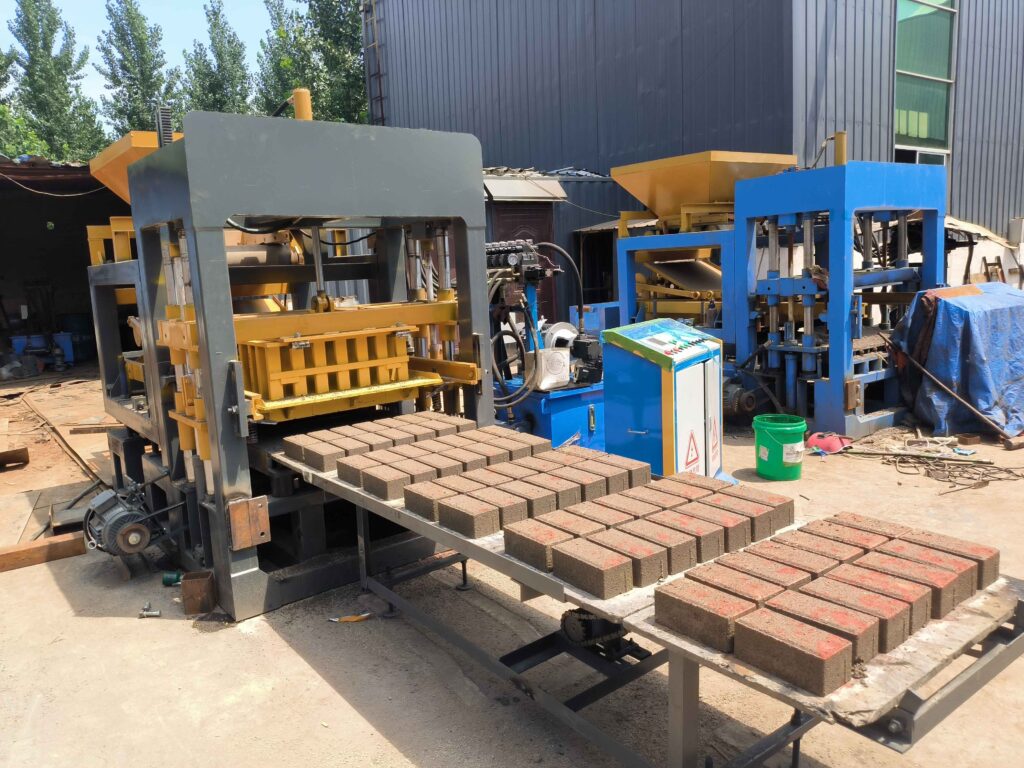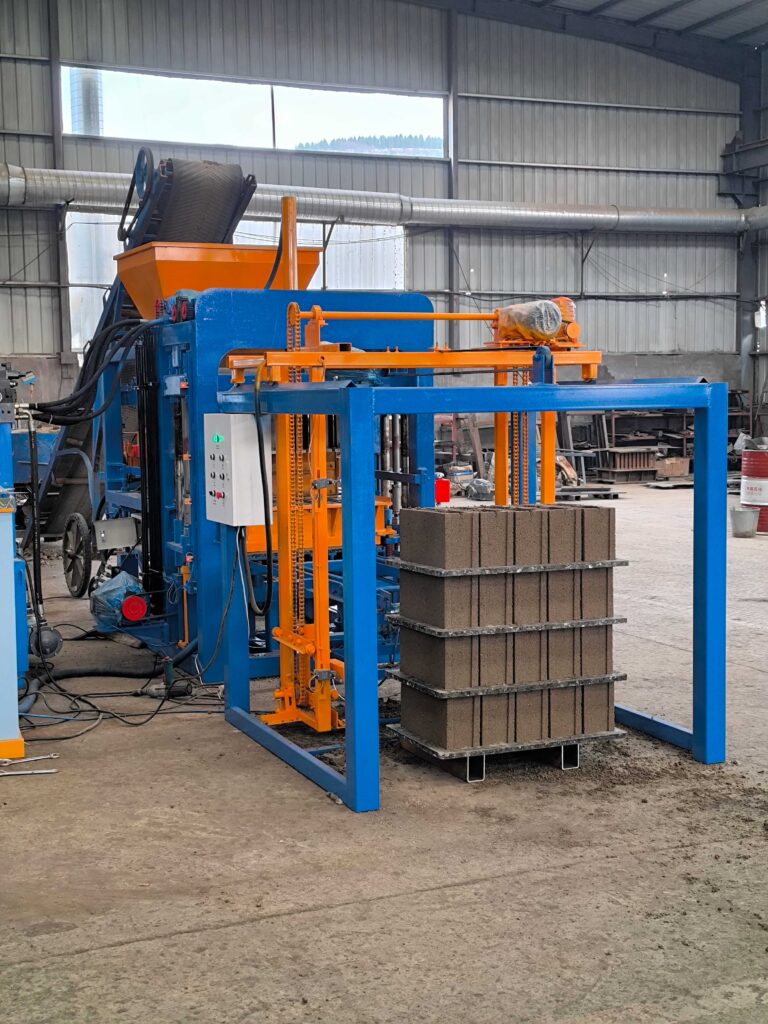
1. Раскрытие возможностей машины для производства зольного кирпича: Функции и ключевые технологии
Машина для производства зольных кирпичей — это специализированное промышленное оборудование, предназначенное для изготовления строительных кирпичей с использованием основной смеси из золы-уноса (тонкодисперсного порошка — побочного продукта сжигания угля на тепловых электростанциях), цемента, извести, гипса и воды. В отличие от традиционного производства глиняных кирпичей, данный процесс основан на холодном связывании, что исключает необходимость обжига в печах, сокращает потребление ископаемого топлива и предотвращает деградацию плодородного слоя почвы.
1.1. Основной принцип производства:
Технология в основном опирается на процессвибрация и уплотнениеСырье точно дозируется и смешивается для получения полусухого бетона. Затем эта смесь подается в форму внутри машины. После этого машина прилагает два ключевых усилия:
- Высокочастотная вибрация:Это действие делает бетонную смесь текучей, позволяя частицам плотно оседать и устраняя захваченные воздушные пустоты.
- Механическое или гидравлическое давление:После или одновременно с вибрацией на смесь оказывается значительное давление. Это давление химически активирует золу-уноса и известь, запуская пуццолановую реакцию, которая играет ключевую роль в прочности кирпича, и уплотняет материал в твердый блок точной формы.
Комбинированное воздействие вибрации и давления приводит к получению кирпича, который является плотным, прочным, имеет точные размеры и гладкую поверхность, готовый к отвердению.
1.2. Преимущество Конечного Продукта:
Кирпичи, производимые этими машинами, обладают явными преимуществами, которые стимулируют рыночный спрос:
- Высокая прочность на сжатие:Они часто прочнее традиционных красных глиняных кирпичей.
- Одинаковый размер и форма:Это приводит к более тонким слоям штукатурки, сокращая время строительства и затраты на материалы.
- Экологическая устойчивость:Они используют промышленные отходы, способствуя циклической экономике и часто получая право на сертификацию экологичного строительства.
- Отличная теплоизоляция:Зольные кирпичи обладают лучшей термостойкостью по сравнению с глиняными кирпичами, что способствует энергосбережению в зданиях.
2. Подробный обзор категорий и ценовых уровней машин для производства кирпича из золы
Рынок машин для производства зольного кирпича сегментирован, причем цены напрямую зависят от уровня автоматизации, производственной мощности и функциональных возможностей. Понимание этих уровней необходимо для правильного таргетинга на соответствующие сегменты клиентов.
2.1. Ручные и полуавтоматические машины: сегмент начального уровня и малого и среднего бизнеса
Эта категория представляет собой наиболее доступную точку входа для малых предпринимателей и характеризуется значительной долей ручного труда.
- Ключевые характеристики:
- Операция: Manual feeding of raw materials and removal of finished bricks.
- Власть: Often equipped with a single electric motor to drive the vibration mechanism.
- Мобильность: Some models are mounted on wheels for easy movement around a worksite.
- Вывод: Typically ranges from 500 to 2,000 bricks per 8-hour shift.
- Pricing Range: This category is the most cost-sensitive. Prices can range from $1,000 to $8,000.
- Факторы формирования затрат:
- Качество сборки: Thickness of steel in the frame and mold.
- Motor Power and Brand: Quality of the vibration motor.
- Качество пресс-формы: Hardness and precision of the mold steel.
- Уровень автоматизации: Semi-automatic models with hydraulic assistance for de-molding will be at the higher end of this range.
2.2. Fully Automatic Stationary Machines: The Core of Commercial Production
This is the most popular and versatile category for serious businesses focused on commercial brick production. These machines strike a balance between high output, consistent quality, and a manageable capital investment.
- Ключевые характеристики:
- Операция: Integrated systems with conveyors or automatic feeders for raw material. The entire cycle—filling, vibrating, compacting, and ejecting—is automated.
- Control: Often feature a Programmable Logic Controller (PLC) for precise control over vibration time and pressure.
- Вывод: Designed for high-volume production, typically from 2,500 to 10,000 bricks per 8-hour shift.
- Pricing Range: This is the broadest and most competitive segment. Prices generally fall between $15,000 and $60,000.
- Факторы формирования затрат:
- Производственные мощности: A machine rated for 4,000 bricks/day will be less expensive than one rated for 8,000 bricks/day.
- Гидравлическая система: The quality, number, and power of hydraulic pumps and cylinders are a major cost component.
- Система управления: A simple relay-based system is cheaper than a PLC with a touch-screen interface.
- Level of Integration: Machines that include an integrated pan mixer or automatic pallet feeder will command a higher price.
2.3. High-Capacity Automatic Production Lines: Industrial-Scale Manufacturing
For large-scale entrepreneurs and established block yards supplying major construction projects, fully integrated production lines represent the pinnacle of ash brick manufacturing technology.
- Ключевые характеристики:
- Операция: These are complete systems comprising automatic batching plants, conveyors, high-pressure brick machines, automatic stackers, and curing system handling.
- Вывод: Capable of producing 15,000 to 40,000+ bricks per day with minimal human intervention.
- Sophistication: Feature advanced PLC controls, data logging, and remote monitoring capabilities.
- Pricing Range: As a significant capital investment, these lines start from $80,000 and can exceed $250,000.
- Факторы формирования затрат:
- Степень автоматизации: The cost of robotic pallet handling and product stacking systems.
- Batching Plant Capacity: The size and automation level of the raw material batching system.
- Overall Throughput: The designed capacity of the entire line is the primary determinant of price.
3. Beyond the Sticker Price: The Total Cost of Ownership and Value Analysis
A shrewd procurement strategy looks beyond the initial machine price to evaluate the Total Cost of Ownership (TCO), which directly impacts the end-user’s profitability and, by extension, their satisfaction with your product.
3.1. Operational Expenditures (OpEx):
- Потребление электроэнергии: Machines with efficient hydraulic systems and well-balanced motors will have lower electricity costs per brick produced.
- Трудовые затраты: A fully automatic machine may have a higher price tag but will require only 2-3 operators, whereas multiple manual machines would be needed to achieve the same output, significantly increasing labor costs.
- Raw Material Consumption: A high-quality machine with precise feeding and compaction control produces bricks with consistent density and strength, preventing over-use of cement and optimizing the mix design cost.
3.2. Maintenance and Spare Parts:
- Mold Lifespan: The mold is a consumable item. A higher initial investment in a machine with a high-chromium, hardened steel mold will result in a lower long-term cost, as it will withstand millions of cycles before needing replacement.
- Availability of Spare Parts: A machine with locally available, standardized parts (e.g., common hydraulic seals, standard bearing sizes) will have lower downtime and maintenance costs compared to one requiring proprietary, imported parts with long lead times.
3.3. Return on Investment (ROI) Calculation:
The ultimate value of the machine is determined by its ROI. A distributor must be able to articulate this to their customers. The calculation is straightforward:
- Revenue: (Selling Price per Brick) x (Daily Production) x (Operating Days)
- Стоимость: (Raw Material Cost per Brick + Labor + Power + Maintenance) x (Total Bricks) + Initial Machine Price
A higher-priced, more efficient automatic machine will often pay for itself faster than a cheaper, labor-intensive manual model due to its superior output and lower operating costs.
4. Strategic Sourcing and Procurement Considerations
For distributors, the relationship with the manufacturer is as important as the machine itself.
4.1. Evaluating a Manufacturer:
- Техническая поддержка Does the manufacturer provide comprehensive installation, commissioning, and operator training?
- Warranty and Service: The length and terms of the warranty, and the manufacturer’s ability to provide timely technical support, are critical.
- R&D Capability: A manufacturer that continually improves its designs will provide you with a competitive product portfolio over the long term.
4.2. Customization and Market-Specific Needs:
- Типы кирпичей: Can the machine be easily adapted to produce different types of bricks (solid, hollow, pavers, interlocking) by simply changing the mold?
- Local Standards: Ensure the machine produces bricks that meet the specific compressive strength and dimensional standards of your target market (e.g., ASTM, IS, BS).
Conclusion: Positioning for Profit in a Green Market
The market for ash brick machines is not merely about equipment sales; it is about enabling a sustainable and profitable business model for your clients. The pricing of these machines is a direct reflection of their capability, durability, and the economic value they unlock. For the astute distributor, success lies in moving beyond price-based competition to a value-based sales approach.
This requires a deep understanding of the cost-benefit analysis, the ability to educate clients on TCO and ROI, and the foresight to partner with manufacturers who offer robust technical and after-sales support. By positioning your company as a provider of comprehensive business solutions—from the right machine at the right price point to the support that ensures its success—you will not only capitalize on the current demand for sustainable construction but also build a resilient and reputable distribution business for the future.
Frequently Asked Questions (FAQ)
Q1: What is the primary factor that causes the wide price variation between machines with similar output claims?
The disparity often lies in the quality of core components. A machine using a standard hydraulic pump, generic PLC, and lower-grade steel for its frame and mold will be cheaper than one employing premium, energy-efficient hydraulics, a renowned-brand PLC, and hardened, abrasion-resistant steel molds. The latter ensures higher longevity, lower maintenance, and more consistent product quality, justifying the higher initial investment.
Q2: For a new entrepreneur, is it better to start with a low-cost manual machine or invest more in a semi-automatic model?
While a manual machine has a lower entry cost, we generally recommend a semi-automatic model for anyone serious about commercial production. The higher initial output, superior brick quality consistency, and lower physical labor requirements of a semi-automatic machine typically lead to a faster ROI and greater business scalability, allowing the entrepreneur to grow their client base and reinvest profits more rapidly.
Q3: How significant is the cost of auxiliary equipment?
It is a critical part of the budget. A single machine cannot operate in isolation. Auxiliary equipment like a concrete mixer (pan or planetary type), a pallet feeder, and brick carts can add 15-30% to the total project cost. For a fully automatic line, the cost of the auxiliary equipment (batching plant, stackers) can sometimes rival or even exceed the cost of the brick-making machine itself.
Q4: What are the typical payment terms when sourcing from a manufacturer?
Terms can vary but a common structure is a 30-50% advance payment with the purchase order, with the balance paid before shipment or against a copy of the Bill of Lading. For larger orders, some manufacturers may offer a Letter of Credit (LC) as a secure payment method for both parties. It is crucial to clarify these terms upfront.
Q5: Can one machine produce different sizes and types of bricks?
Yes, this is a key feature. This is achieved by changing the mold set. The flexibility to produce hollow blocks, solid bricks, and paving stones from the same machine base is a major selling point. When procuring, inquire about the cost and lead time for additional molds and the ease with which changeovers can be performed.
Q6: What is the single most important after-sales consideration?
The availability of spare parts is paramount. Downtime in a production business is a direct loss of revenue. Ensure your supplier maintains a robust inventory of critical wear parts, especially molds, hydraulic seals, and vibration motors, and has a proven logistics system to get them to you quickly. A long-term, reliable spare parts supply agreement is a hallmark of a quality manufacturer.