
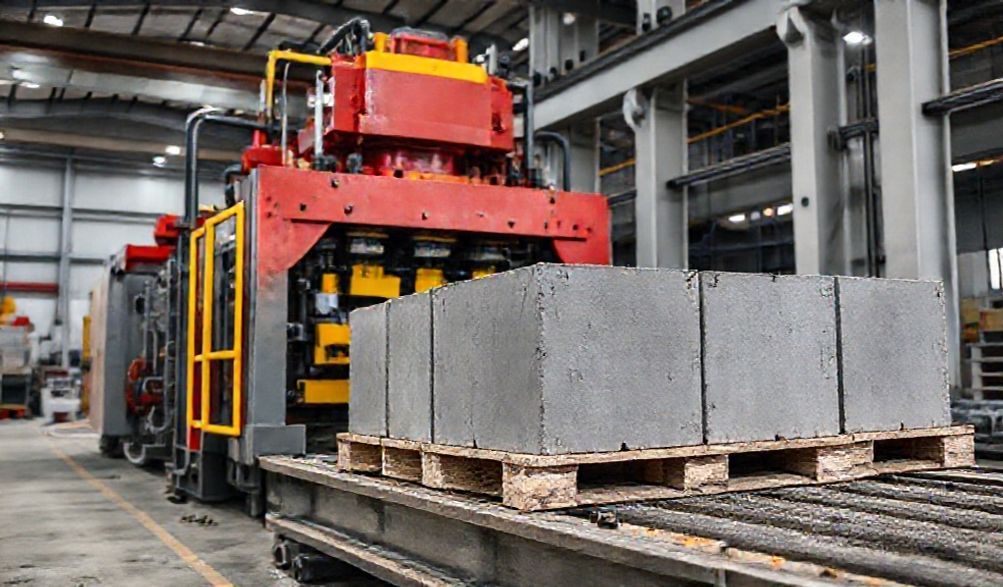
Hagaha Ugu Wanaagsan ee Mashiinka Sameynta Boodhka Qalabka QT4-18
Warshada dhismaha aduunka oo dhan waxay la dagaallantaa caqabad aan la qaban karin: baahida loo qabo qalab dhismo tayo sare leh, qiimo jaban, oo lagu soo saaro xawaaraha lagu buuxinayo baahida korodhaysa. Warshadaha sameeya blookooyinka, tani waxay ka dhigan tahy cadaadis weyn oo loo baahan yahay in la kordhiyo soo saarista, la ilaaliyo isku midka, la dhowro kharashyada, iyadoo la dagaallamayo baahi ugu jirta shaqaalaha xirfad leh. Xalku wuxuu ku jiraa horumarinta teknolojiyadda. Halkaasaa ayay soo gashay mashiinka si toos ah u sameeya blookada koonkiriinta, qalab isbeddel leh oo ka dhigaya macdanta dabiiciga ah faa'iido si sax ah iyo cabbir. Kuwaas waxaa ka mid ah,QT4-18 oo dhammaystiran oo si toos ah u sameeya qalabka dhiska boolooyinka kirada boolooyinka boolooyinkawaxay ugaadhsatay sida modelka ugu sarreeya, loo habeeyay si loo hubiyo aamin iyo soo saar heer sare ah.
This guide serves as a comprehensive, expert analysis of the QT4-18. We’ll move beyond sales brochures to provide plant managers, business owners, and investors with the detailed, unbiased information needed to make a sound investment decision. You will gain a clear understanding of its specifications, operational workflow, true costs, and the critical factors that separate a profitable purchase from a costly mistake.
Waa maxay QT4-18 Makinada Qalabka Isku-dhafka ee Isku-dhafka oo Toos ah?
QT4-18 waxay aasaas u tahay makiinad dhismeed oo joogto ah, kaas oo ku shaqeeya tamar biyoodhac iyo gariir, loogu talagalay soo saarista joogtada ah ee tirada badan oo buraashada simento. Waxay matalaan tallaabo weyn oo ka baxday hababka gacanta ama kuwo nus-awtomaatig ah, iyadoo ay isku darsay habka sameynta qaabka nidaam isku mid ah oo awtomaatig ah. Falsafada naqshadeynta makiinadani waxay ku dhex taagan tahay adkeysiga, dib-u-soo celinta, iyo fudaydda hawlgalka, taas oo noqon karta qalbiga warshad casri ah oo soo saarta buraasho.
Faa'iidada Aasaasiga ah iyo Falsafada Nakhshadeynta
QT4-18 waxay ka shaqeysaa mabda' lagu dhigo qasab qalabka simento ee la diyaariyay qaab sax ah iyadoo la isticmaalayo gariir isku mid ah iyo cadaadis hydraulik ah. Qaabkeeda adag ee birta la gubay waxaa ku jira qaybo muhiim ah oo iskaashi ku shaqeeya:
- Habka Quudinta:Hoobka iyo qaybiyaha oo si sax ah u cabiraa isku-darka simenta ee ku jira goobta qalabka.
- Nidaamka Qaabista ("Qalbiga"):Tani waxaa ka mid ah qaabka lafteeda—qalabka isbadalaya ee qeexaya qaabka goobada—iyo mootooyinka gariirka awoodda badan iyo riyooyinka haydiroolik ee ku dhufteeya walxaha.
- Nidaamka Hydraulic:Waxaa bixiyaa xoogga cadaadis sare ee loo baahan yahay si loo cufo iyo dhaqdhaqaaqa qaybo kala duwan sida miiska qaabka iyo madaxa la kala saaro.
- Nidaamka Gawaarida Pallet-ka:Wuxuu u dhaqaaqaa palletoyinka birta ama qoryaha (kuwaas oo qaata buraashada cusub ee la sameeyay) gudaha mashiinka si sax ah, oo loo qeexay.
- Khabiirka PLC ee Guddiga Xakameynta:Mashinka "maskaxda." Kontaroolerka loojik ee barnaamijka ahi wuxuu u dhoweeyaa dhammaan wareegga, wuxuu ilaaliyaa hawlgallada, wuxuuna bixiyaa isku xirka isticmaalayaasha.
Fasiraadda Magaca Qaabka: QT4-18 Qeexitaannada
Magaca qaabka "QT4-18" waa kood ka muujiya awoodda ugu muhiimsan. Isticmaalka caadiga ah ee magacyada:
* "QT"waxaa loo tarjumay silsilada mashiniyada, oo guud ahaan u taagan, makiinadaha tooska ah ee haydiroolik.
* “4”wuxuu muujinayaa tirada libaaxyo cabbirka caadiga ah (400mm x 200mm) ee ay soo saari karto hal wareeg marka la adeegsanayo qalabka isku midka ah.
* “18” refers to the nominal cycle time in seconds, from feeding to ejection.
Here are the key technical specifications that define its performance:
| Qeexitaan | Faahfaahin |
| :— | :— |
| Production Capacity (Theoretical) | Up to 4,320 blocks per 8-hour shift (based on a 400x200mm block, 18-second cycle) |
| Wakhtiga wareegga | 15-18 seconds (adjustable based on product type) |
| Moulding Pressure | High hydraulic pressure (specific tonnage varies by manufacturer) |
| Khadkaadka Korontada | Approximately 30-40 kW (for the main host machine) |
| Nidaamka Gariirka | Dual-axis, high-frequency vibration with hydraulic pressure |
| Nidaamka Maamulka | PLC with color touchscreen interface |
| Miishinka Miisaanka | ~6,000 kg (varies with configuration) |
| Overall Dimensions (LxWxH) | ~6.5m x 2.5m x 3.2m (approx.) |
Qoraal Muhiim ah: The “blocks per shift” figure is a theoretical maximum under ideal conditions. Real-world output depends on raw material quality, product type, and operational efficiency.
Astaamaha Muhiimka ah iyo Faa'iidooyinka Teknoolajiyada
Full Automation and PLC Intelligent Control
The term “full automatic” signifies a profound shift in plant operation. While the QT4-18 machine itself automates the moulding process, it is designed to be the centerpiece of a fully automated line. This line can include automatic batching, mixing, conveying, curing, and stacking systems. The PLC control is the cornerstone of this automation.
- Precision & Repeatability: Every cycle is identical, eliminating human error in timing and pressure application.
- La'aanta Shaqada: Typically, only 1-2 workers are needed to monitor the control panel and manage pallets, compared to 5-8 for equivalent semi-automatic output.
- Diagnostics & Safety: The PLC monitors system health, provides fault alarms, and includes safety interlocks to protect both the machine and operators.
High-Pressure Vibration and Superior Block Quality
Block strength and finish are non-negotiable for market acceptance. The QT4-18 employs a dual-compaction strategy:
1. Guryaha Xawaare sare: Fluidizes the concrete mix, allowing it to flow into every corner of the mould.
2. Simultaneous Hydraulic Pressure: Compacts the vibrated material from the top, removing air pockets and achieving high density.
This combination produces blocks with:
* High compressive strength (readily meeting or exceeding common standards like ASTM C90).
* Excellent dimensional accuracy and sharp edges.
* A smooth, consistent surface finish that requires less plastering.
Versatility in Production: Beyond Standard Bricks
A significant advantage of the QT4-18 is its product flexibility. By simply changing the mould—a task that can often be completed in under an hour—the same machine can produce a diverse product portfolio:
- Qeybaha Dusha sare ee Dhismaha (Hollow Blocks): (e.g., 4″, 5″, 6″, 8″)
- Goobooyad Adag
- Dhagaxyo La Dabaqay & Buulooyin Isku Xidhan
- Dhagaxyo Xadid
- Grass Blocks
It is also compatible with a wide range of raw materials, allowing for cost optimization and sustainable practices: Portland cement, sand, gravel/crushed stone, fly ash, slag, and other industrial by-products.
Operational Workflow and Production Line Integration
From Raw Material to Finished Block: A Step-by-Step Process
Understanding the workflow within a typical plant setup clarifies the machine’s role:
- Diyaarinta Alaabta Asalka ah Aggregates, cement, and water are batched and mixed in a pan or planetary mixer to achieve a uniform, semi-dry concrete consistency.
- Cunto-siin: The mix is conveyed (via belt conveyor or forklift) into the QT4-18’s feed hopper.
- Moulding Cycle: The PLC initiates the automated cycle: the feed box distributes mix into the mould cavity on a pallet; the mould table rises into vibration; hydraulic pressure is applied; the mould descends, and the freshly formed block is stripped onto the pallet.
- Pallet Ejection & Curing: The loaded pallet is pushed onto a roller conveyor, moving to a brick stacker which places blocks onto curing racks. These racks are transferred to a curing chamber (steam or ambient) for strength development.
- Return Cycle: The empty pallet is cleaned and conveyed back to the start of the QT4-18, completing the loop.
Essential Auxiliary Equipment for a Complete Plant
The QT4-18 is the core, but not a standalone solution. For a functional and profitable plant, it must be integrated with auxiliary equipment:
- Qalabka Isku Dhista Simento: A compulsory partner for consistent mix quality.
- Koorinta Suulka For efficient material transport to the hopper.
- Block Stacker: Automatically places green blocks onto curing racks.
- Brick Forklift / Pallet Truck: For moving heavy racks of blocks.
- Pallet Return System: A network of rollers or chains that returns empty pallets.
- Nidaamka Daweynta: Can range from simple sheltered yards to automated steam curing rooms.
Investing in the right supporting equipment is as crucial as choosing the main block moulding machine.
Analyzing the Investment: Costs, ROI, and Market Potential
Understanding the Initial Investment and Operating Costs
The price of a QT4-18 is influenced by several factors: the manufacturer’s brand and reputation, the quality of components (e.g., Siemens vs. generic PLCs), the level of automation in the specific configuration, and shipping costs to your location.
Beyond the capital expenditure, responsible planning must account for ongoing operational costs:
* Dayactirka Regular lubrication, inspection, and replacement of wear parts (like mould liners, vibration mounts, and hydraulic seals).
* Isticmaalka Tamarta The main machine and entire line’s power draw.
* Shaqo: Reduced but still present for supervision, maintenance, and handling.
* Raw Materials & Pallets: The recurring cost of goods sold.
Calculating Your Return on Investment (ROI)
A simplified ROI framework can guide your decision:
- Estimate Daily Production: Use a realistic output (e.g., 70% of theoretical max) for your primary product.
- Determine Local Market Price: Research the selling price per block in your region.
- Calculate Cost Per Block: Sum all variable costs (materials, energy, labor, maintenance) per block.
- Analyze Gross Profit: (Selling Price – Cost Per Block) x Daily Production = Estimated Daily Gross Profit.
- Project Payback Period: (Total Plant Investment Cost) / (Estimated Daily Gross Profit x Operating Days/Year).
Key ROI Drivers: The primary financial benefits of the QT4-18 come from its waxti (more blocks per hour) and dramatic labor savings. It also reduces waste through consistency and improves your competitive position with higher-quality products.
Critical Factors for Choosing the Right Supplier
Evaluating Manufacturer Expertise and After-Sales Service
The supplier you choose can make or break your project. Prioritize manufacturers with:
* Proven Experience: Look for companies with a decade or more in heavy machinery manufacturing.
* Comprehensive Service: They must offer installation supervision (or detailed guidance), operator training, and readily available technical support.
* La Helitaanka Qaybaha Gadaal Ensure they stock and can quickly ship critical wear parts for the block moulding machine.
Quality Benchmarks: What to Look For in the Machinery
During your evaluation, go beyond the sales pitch:
* Qaybta Qaab-dhismeedka Inspect the thickness of steel plates, the quality of welding, and the robustness of the frame.
* Component Brands: Reputable manufacturers use known brands for critical parts (e.g., Siemens/Delta PLCs, Schneider electrics, Rexroth hydraulics, WEG motors).
* Warranty Terms: A clear, comprehensive warranty (typically 1 year for parts) is a sign of confidence.
* Xaqiijinta: Always ask for customer references and, if feasible, visit an existing plant to see the machine in operation. Videos from the supplier are useful but not a substitute for independent verification.
Su'aalaha Inta Badan La Is Weydiiyo (FAQ)
Q1: What is the actual production capacity of the QT4-18 machine per day?
A: While the theoretical capacity is ~4,300 blocks/8 hours, a practical, sustainable output for hollow blocks is between 2,800 and 3,500 blocks, accounting for mould changes, maintenance breaks, and material handling.
Q2: How many workers are needed to operate this full automatic brick making machine?
A: For the core moulding process, 1-2 workers are sufficient to monitor the PLC, manage pallet flow, and perform basic checks. A complete plant with mixing and stacking may require 3-4 personnel per shift.
Q3: What is the difference between the QT4-18 and semi-automatic or manual block machines?
A: Manual machines require constant physical labor for every cycle. Semi-automatic machines mechanize some steps (like vibration) but require manual feeding and block removal. The QT4-18 is fully automatic, running continuous cycles with minimal human intervention, leading to exponentially higher output and consistency.
Q4: Can this machine use fly ash or other industrial waste as raw material?
A: Yes, absolutely. The QT4-18 is well-suited for using fly ash, slag, or even certain types of construction waste. These materials can reduce costs and improve block workability, but mix design ratios must be tested for optimal strength.
Q5: How do I source and change the moulds for different block types?
A: Moulds are purchased from your machine supplier or specialized mould makers to ensure perfect compatibility. Changing a mould involves loosening bolts, removing the old mould, positioning the new one, and re-aligning—a task trained operators can do in 30-60 minutes.
Q6: What kind of foundation and factory space is required for installation?
A: A solid, level concrete foundation (approx. 300mm thick) is mandatory to absorb vibration. The total plant space needed, including area for raw materials, mixing, curing, and block storage, is typically a minimum of 1,500-2,000 square meters for efficient operation.
Q7: What are the most common maintenance points for ensuring long machine life?
A: Daily: Clean the machine and check for loose parts. Weekly: Lubricate all moving joints and check hydraulic oil levels. Periodically: Inspect and replace wear parts—mould liners, conveyor rollers, vibration motor mounts, and hydraulic seals—as needed.
Gabagabo
The QT4-18 full automatic concrete block making machine represents a robust, efficient, and intelligent solution for entrepreneurs and companies aiming to establish or upgrade a medium-to-large-scale block production facility. Its blend of high-pressure vibration, PLC automation, and product versatility makes it a powerful engine for profitability.
However, success hinges on more than just purchasing a well-specified machine. It requires thorough due diligence: selecting a reputable supplier with strong after-sales support, carefully planning the integration of all auxiliary equipment, and conducting a realistic analysis of your local market demand and cost structure. View your investment as a complete production line ecosystem, with the QT4-18 as its core.
Call to Action: Before making a decision, consult with multiple suppliers, request detailed quotations that break down every component and cost, and insist on speaking to their existing customers. Arm yourself with information to ensure your investment builds a foundation for long-term success.
<