
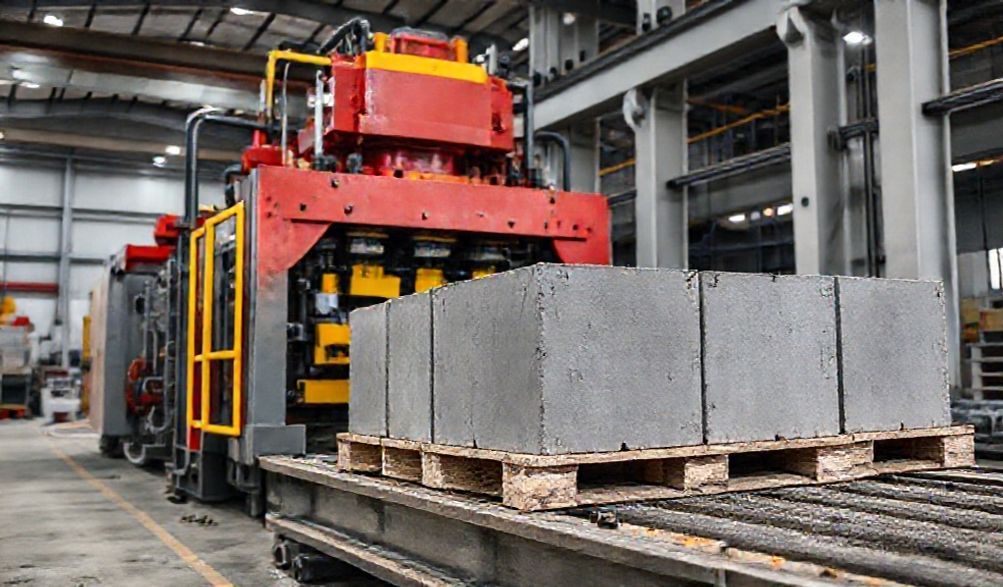
Hướng Dẫn Toàn Diện Về Máy Làm Gạch Bê Tông Tự Động Hoàn Toàn QT4-18
Ngành xây dựng toàn cầu đang đối mặt với một thách thức không ngừng: nhu cầu về vật liệu xây dựng chất lượng cao, giá cả phải chăng, được sản xuất với tốc độ đáp ứng nhu cầu ngày càng tăng cao. Đối với các nhà sản xuất khối xây, điều này đồng nghĩa với áp lực khổng lồ trong việc tăng sản lượng, duy trì tính đồng nhất và kiểm soát chi phí, tất cả trong bối cảnh thiếu hụt lao động lành nghề. Giải pháp nằm ở sự tiến bộ công nghệ. Máy làm khối bê tông tự động hoàn toàn ra đời, một thiết bị mang tính đột phá, biến nguyên liệu thô thành lợi nhuận với độ chính xác và quy mô lớn. Trong số đó,Máy đúc khối bê tông tự động hoàn toàn QT4-18nổi bật như một mô hình hàng đầu, được thiết kế cho độ tin cậy và sản xuất khối lượng lớn.
Hướng dẫn này là một phân tích chuyên sâu và toàn diện về máy QT4-18. Chúng tôi sẽ vượt ra ngoài những tài liệu quảng cáo thông thường để cung cấp cho các quản lý nhà máy, chủ doanh nghiệp và nhà đầu tư những thông tin chi tiết, khách quan cần thiết để đưa ra quyết định đầu tư đúng đắn. Bạn sẽ hiểu rõ về thông số kỹ thuật, quy trình vận hành, chi phí thực tế, cùng những yếu tố then chốt phân biệt giữa một giao dịch mua bán sinh lời và một sai lầm tốn kém.
Máy Đúc Khối Tự Động Hoàn Toàn QT4-18 là gì?
Về cốt lõi, QT4-18 là một máy ép rung thủy lực cố định, được thiết kế để sản xuất liên tục với khối lượng lớn các khối bê tông. Nó đánh dấu một bước nhảy vọt đáng kể so với các phương pháp thủ công hoặc bán tự động bằng cách tích hợp quy trình đúc khuôn vào một hệ thống tự động đồng bộ hóa. Triết lý thiết kế của máy tập trung vào độ bền, khả năng lặp lại và dễ vận hành, tạo thành trung tâm của một nhà máy sản xuất khối hiện đại.
Chức năng Cốt lõi và Triết lý Thiết kế
QT4-18 hoạt động dựa trên nguyên lý nén hỗn hợp bê tông đã được chuẩn bị vào một khuôn hình chính xác thông qua sự kết hợp đồng bộ giữa rung động và áp suất thủy lực. Khung thép hàn chắc chắn của máy chứa đựng nhiều hệ thống con quan trọng hoạt động nhịp nhàng với nhau.
- Hệ thống cho ăn:Một phễu và bộ phận phân phối định lượng chính xác hỗn hợp bê tông vào khoang khuôn.
- Hệ Thống Khuôn (Trái Tim của Máy Ép Nhựa):Điều này bao gồm chính khuôn mẫu—công cụ có thể thay thế để định hình khối—cùng với các động cơ rung mạnh mẽ và xi lanh thủy lực dùng để nén chặt vật liệu.
- Hệ thống thủy lực:Cung cấp lực áp suất cao cần thiết cho việc nén và vận hành các bộ phận khác nhau như bàn khuôn và đầu đẩy.
- Hệ thống băng tải Pallet: Moves the steel or wooden pallets (which carry the freshly molded blocks) through the machine in a precise, indexed fashion.
- PLC Intelligent Control Cabinet: The machine’s “brain.” This programmable logic controller automates the entire cycle, monitors operations, and provides an interface for operators.
Decoding the Model Name: QT4-18 Specifications
The model name “QT4-18” is a code that reveals its core capability. In industry-standard nomenclature:
* "QT" denotes the machine series, typically representing stationary, hydraulic block machines.
* "4" indicates the number of standard-sized bricks (400mm x 200mm) it can produce in a single cycle when using the corresponding mould.
* “18” refers to the nominal cycle time in seconds, from feeding to ejection.
Here are the key technical specifications that define its performance:
| Thông số kỹ thuật | Chi tiết |
| :— | :— |
| Production Capacity (Theoretical) | Up to 4,320 blocks per 8-hour shift (based on a 400x200mm block, 18-second cycle) |
| Thời gian chu kỳ | 15-18 seconds (adjustable based on product type) |
| Moulding Pressure | High hydraulic pressure (specific tonnage varies by manufacturer) |
| Mức Tiêu Thụ Điện Năng | Approximately 30-40 kW (for the main host machine) |
| Hệ thống Rung | Dual-axis, high-frequency vibration with hydraulic pressure |
| Hệ thống điều khiển | PLC with color touchscreen interface |
| Machine Weight | ~6,000 kg (varies with configuration) |
| Overall Dimensions (LxWxH) | ~6.5m x 2.5m x 3.2m (approx.) |
Lưu Ý Quan Trọng: The “blocks per shift” figure is a theoretical maximum under ideal conditions. Real-world output depends on raw material quality, product type, and operational efficiency.
Đặc điểm chính và lợi thế công nghệ
Full Automation and PLC Intelligent Control
The term “full automatic” signifies a profound shift in plant operation. While the QT4-18 machine itself automates the moulding process, it is designed to be the centerpiece of a fully automated line. This line can include automatic batching, mixing, conveying, curing, and stacking systems. The PLC control is the cornerstone of this automation.
- Precision & Repeatability: Every cycle is identical, eliminating human error in timing and pressure application.
- Giảm Lao Động Typically, only 1-2 workers are needed to monitor the control panel and manage pallets, compared to 5-8 for equivalent semi-automatic output.
- Diagnostics & Safety: The PLC monitors system health, provides fault alarms, and includes safety interlocks to protect both the machine and operators.
High-Pressure Vibration and Superior Block Quality
Block strength and finish are non-negotiable for market acceptance. The QT4-18 employs a dual-compaction strategy:
1. Rung động tần số cao: Fluidizes the concrete mix, allowing it to flow into every corner of the mould.
2. Simultaneous Hydraulic Pressure: Compacts the vibrated material from the top, removing air pockets and achieving high density.
This combination produces blocks with:
* High compressive strength (readily meeting or exceeding common standards like ASTM C90).
* Excellent dimensional accuracy and sharp edges.
* A smooth, consistent surface finish that requires less plastering.
Versatility in Production: Beyond Standard Bricks
A significant advantage of the QT4-18 is its product flexibility. By simply changing the mould—a task that can often be completed in under an hour—the same machine can produce a diverse product portfolio:
- Gạch rỗng: (e.g., 4″, 5″, 6″, 8″)
- Khối rắn
- Đá lát và Khối liên kết
- Lề đường
- Grass Blocks
It is also compatible with a wide range of raw materials, allowing for cost optimization and sustainable practices: Portland cement, sand, gravel/crushed stone, fly ash, slag, and other industrial by-products.
Operational Workflow and Production Line Integration
From Raw Material to Finished Block: A Step-by-Step Process
Understanding the workflow within a typical plant setup clarifies the machine’s role:
- Chuẩn bị nguyên liệu thô: Aggregates, cement, and water are batched and mixed in a pan or planetary mixer to achieve a uniform, semi-dry concrete consistency.
- Cho ăn: The mix is conveyed (via belt conveyor or forklift) into the QT4-18’s feed hopper.
- Moulding Cycle: The PLC initiates the automated cycle: the feed box distributes mix into the mould cavity on a pallet; the mould table rises into vibration; hydraulic pressure is applied; the mould descends, and the freshly formed block is stripped onto the pallet.
- Pallet Ejection & Curing: The loaded pallet is pushed onto a roller conveyor, moving to a brick stacker which places blocks onto curing racks. These racks are transferred to a curing chamber (steam or ambient) for strength development.
- Return Cycle: The empty pallet is cleaned and conveyed back to the start of the QT4-18, completing the loop.
Essential Auxiliary Equipment for a Complete Plant
The QT4-18 is the core, but not a standalone solution. For a functional and profitable plant, it must be integrated with auxiliary equipment:
- Máy trộn bê tông: A compulsory partner for consistent mix quality.
- Băng tải: For efficient material transport to the hopper.
- Block Stacker: Automatically places green blocks onto curing racks.
- Brick Forklift / Pallet Truck: For moving heavy racks of blocks.
- Pallet Return System: A network of rollers or chains that returns empty pallets.
- Hệ thống đóng rắn Can range from simple sheltered yards to automated steam curing rooms.
Investing in the right supporting equipment is as crucial as choosing the main block moulding machine.
Analyzing the Investment: Costs, ROI, and Market Potential
Understanding the Initial Investment and Operating Costs
The price of a QT4-18 is influenced by several factors: the manufacturer’s brand and reputation, the quality of components (e.g., Siemens vs. generic PLCs), the level of automation in the specific configuration, and shipping costs to your location.
Beyond the capital expenditure, responsible planning must account for ongoing operational costs:
* Maintenance: Regular lubrication, inspection, and replacement of wear parts (like mould liners, vibration mounts, and hydraulic seals).
* Tiêu thụ Năng lượng The main machine and entire line’s power draw.
* Lao động Reduced but still present for supervision, maintenance, and handling.
* Raw Materials & Pallets: The recurring cost of goods sold.
Calculating Your Return on Investment (ROI)
A simplified ROI framework can guide your decision:
- Estimate Daily Production: Use a realistic output (e.g., 70% of theoretical max) for your primary product.
- Determine Local Market Price: Research the selling price per block in your region.
- Calculate Cost Per Block: Sum all variable costs (materials, energy, labor, maintenance) per block.
- Analyze Gross Profit: (Selling Price – Cost Per Block) x Daily Production = Estimated Daily Gross Profit.
- Project Payback Period: (Total Plant Investment Cost) / (Estimated Daily Gross Profit x Operating Days/Year).
Key ROI Drivers: The primary financial benefits of the QT4-18 come from its hiệu quả (more blocks per hour) and dramatic labor savings. It also reduces waste through consistency and improves your competitive position with higher-quality products.
Critical Factors for Choosing the Right Supplier
Evaluating Manufacturer Expertise and After-Sales Service
The supplier you choose can make or break your project. Prioritize manufacturers with:
* Proven Experience: Look for companies with a decade or more in heavy machinery manufacturing.
* Comprehensive Service: They must offer installation supervision (or detailed guidance), operator training, and readily available technical support.
* Sẵn có Phụ tùng Thay thế: Ensure they stock and can quickly ship critical wear parts for the block moulding machine.
Quality Benchmarks: What to Look For in the Machinery
During your evaluation, go beyond the sales pitch:
* Chất Lượng Xây Dựng: Inspect the thickness of steel plates, the quality of welding, and the robustness of the frame.
* Component Brands: Reputable manufacturers use known brands for critical parts (e.g., Siemens/Delta PLCs, Schneider electrics, Rexroth hydraulics, WEG motors).
* Warranty Terms: A clear, comprehensive warranty (typically 1 year for parts) is a sign of confidence.
* Xác minh: Always ask for customer references and, if feasible, visit an existing plant to see the machine in operation. Videos from the supplier are useful but not a substitute for independent verification.
Các Câu Hỏi Thường Gặp (FAQ)
Q1: What is the actual production capacity of the QT4-18 machine per day?
A: While the theoretical capacity is ~4,300 blocks/8 hours, a practical, sustainable output for hollow blocks is between 2,800 and 3,500 blocks, accounting for mould changes, maintenance breaks, and material handling.
Q2: How many workers are needed to operate this full automatic brick making machine?
A: For the core moulding process, 1-2 workers are sufficient to monitor the PLC, manage pallet flow, and perform basic checks. A complete plant with mixing and stacking may require 3-4 personnel per shift.
Q3: What is the difference between the QT4-18 and semi-automatic or manual block machines?
A: Manual machines require constant physical labor for every cycle. Semi-automatic machines mechanize some steps (like vibration) but require manual feeding and block removal. The QT4-18 is fully automatic, running continuous cycles with minimal human intervention, leading to exponentially higher output and consistency.
Q4: Can this machine use fly ash or other industrial waste as raw material?
A: Yes, absolutely. The QT4-18 is well-suited for using fly ash, slag, or even certain types of construction waste. These materials can reduce costs and improve block workability, but mix design ratios must be tested for optimal strength.
Q5: How do I source and change the moulds for different block types?
A: Moulds are purchased from your machine supplier or specialized mould makers to ensure perfect compatibility. Changing a mould involves loosening bolts, removing the old mould, positioning the new one, and re-aligning—a task trained operators can do in 30-60 minutes.
Q6: What kind of foundation and factory space is required for installation?
A: A solid, level concrete foundation (approx. 300mm thick) is mandatory to absorb vibration. The total plant space needed, including area for raw materials, mixing, curing, and block storage, is typically a minimum of 1,500-2,000 square meters for efficient operation.
Q7: What are the most common maintenance points for ensuring long machine life?
A: Daily: Clean the machine and check for loose parts. Weekly: Lubricate all moving joints and check hydraulic oil levels. Periodically: Inspect and replace wear parts—mould liners, conveyor rollers, vibration motor mounts, and hydraulic seals—as needed.
Conclusion
The QT4-18 full automatic concrete block making machine represents a robust, efficient, and intelligent solution for entrepreneurs and companies aiming to establish or upgrade a medium-to-large-scale block production facility. Its blend of high-pressure vibration, PLC automation, and product versatility makes it a powerful engine for profitability.
However, success hinges on more than just purchasing a well-specified machine. It requires thorough due diligence: selecting a reputable supplier with strong after-sales support, carefully planning the integration of all auxiliary equipment, and conducting a realistic analysis of your local market demand and cost structure. View your investment as a complete production line ecosystem, with the QT4-18 as its core.
Call to Action: Before making a decision, consult with multiple suppliers, request detailed quotations that break down every component and cost, and insist on speaking to their existing customers. Arm yourself with information to ensure your investment builds a foundation for long-term success.
<