
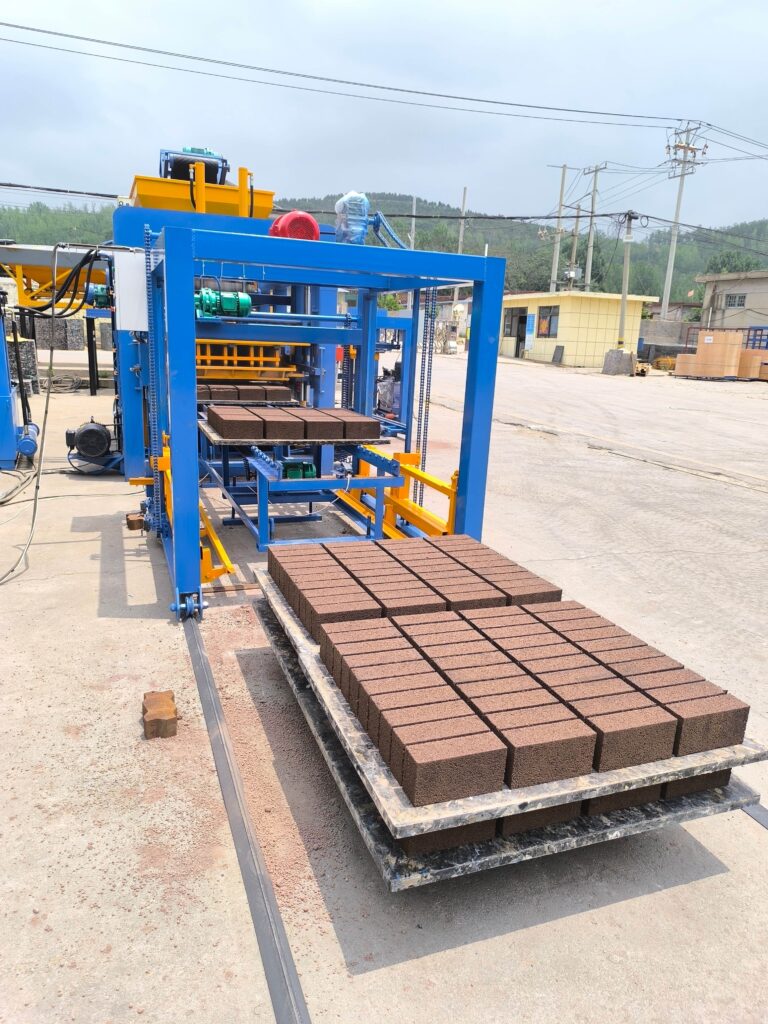
The Determinants of Block Strength: A Process Analysis
The compressive strength of a concrete masonry unit is not inherent to the idea of “machine” or “hand” but is a direct result of the processes that govern its creation. Three factors are paramount: mix consistency, compaction force, and curing control.
- 1.1. Consistency of Raw Material Integration
- Machine Production: Modern batching systems deliver a high degree of precision. Cement, aggregates, and water are measured by weight or volume with electronic accuracy, ensuring an identical water-to-cement ratio—the single most critical factor for final strength—for every batch. This eliminates the variability inherent in manual proportioning.
- Hand-Made Production: Relies on volumetric proportioning (e.g., shovels, buckets), which is susceptible to significant variation. Moisture content in aggregates is rarely accounted for scientifically, leading to fluctuating water-cement ratios. This inconsistency directly translates to a wide range of potential strengths within a single production run.
- 1.2. Compaction: The Application of Force
- Machine Production: Utilizes calibrated, high-frequency vibration combined with controlled pressure from a hydraulic or mechanical head. This dual action thoroughly consolidates the mix, eliminating entrapped air voids and forcing the paste to fully coat all aggregate particles. The result is a denser, more homogeneous matrix. The vibration time and pressure are consistent for every single unit.
- Hand-Made Production: Relies on manual tamping or table vibration. While skilled artisans can achieve good compaction, the force applied is neither measurable nor perfectly consistent from one block to the next. The likelihood of unconsolidated areas or voids within the block is significantly higher, creating points of weakness.
- 1.3. Curing and Quality Assurance
- Machine Production: Integrated into a system where blocks are systematically moved to controlled curing environments (steam chambers, mist rooms, or covered yards). This ensures optimal temperature and humidity for strength development. Crucially, production is tied to formal Quality Assurance (QA) protocols, with regular sampling and destructive testing in certified labs to verify compliance with published strength standards (e.g., ASTM C90).
- Hand-Made Production: Curing is often ambient and subject to weather fluctuations—drying winds or freezing temperatures can critically impair strength gain. QA is typically visual and experiential, lacking the empirical, third-party-verifiable data that governs industrial production.
2. The Verdict: Quantifiable Strength vs. Variable Craft
When analyzing these factors, a clear, technical distinction emerges.
- 2.1. The Benchmark of Minimum Specified Strength
Machine-made blocks are engineered to meet or exceed minimum specified compressive strengths (e.g., 2,000 psi, 2,500 psi, 3,000 psi) as defined by international building codes. Each pallet is part of a lot that has been tested, and the manufacturer provides a warranty of compliance. The strength is a guaranteed, documented characteristic. - 2.2. The Nature of Hand-Made Block Strength
A well-made hand-formed block, produced by a highly skilled worker under ideal conditions, can achieve considerable strength. However, its performance represents a point estimate, not a guaranteed minimum. The average strength of a batch may be lower, and the standard deviation—the range from weakest to strongest block—will be far wider. In structural design, engineers must account for the lowest strength in the batch, a factor that is unknown and unverified without systematic testing.
3. Commercial and Specification Implications for the Supply Chain
This technical analysis has direct consequences for sourcing, sales, and application.
- 3.1. Meeting Engineering and Code Requirements
For any load-bearing application in commercial, industrial, or public infrastructure projects, specifications will mandate compliance with recognized standards (ASTM, ISO, etc.). Only machine-produced blocks with accompanying test reports can reliably meet these contractual and legal requirements. Distributors supplying such projects must provide this documentation. - 3.2. Market Positioning and Value Proposition
- Machine-Made Blocks: The value proposition is predictable performance, code compliance, and structural efficiency. They are the default choice for engineered masonry.
- Hand-Made Blocks: Their value lies primarily in aesthetic character—irregular textures, subtle color variations, and heritage appeal for restoration or high-end architectural projects. Here, they are selected as a finish material, often with their structural role supplemented or validated by other means.
- 3.3. Risk Management for Dealers and Specifiers
Supplying or specifying hand-made blocks for primary structural purposes carries inherent liability risk due to the lack of verifiable, consistent strength data. For a distributor, aligning product type with appropriate applications is a critical aspect of professional responsibility and risk mitigation.
Netije
The question of strength is decisively answered by the principles of controlled manufacturing. Machine-made blocks are demonstrably and consistently stronger in the context that matters most to construction: guaranteed minimum compressive strength verified by standardized testing. The mechanized process masters the variables of mix design, compaction, and curing, delivering a uniform product that meets precise engineering specifications. Hand-made blocks, while possessing artisan value, cannot guarantee this level of consistent structural performance. Therefore, for load-bearing applications governed by modern building codes, machine-made blocks are not simply stronger on average; they are the only viable choice that provides the verifiable, reliable data required for safe and compliant structural design. For the supply chain professional, this understanding is essential for correct product positioning, accurate technical advising, and effective risk management.
FAQ
Q1: Can a hand-made block ever be as strong as a machine-made block?
A: In a one-off comparison under perfect conditions, a meticulously crafted hand-made block could match the strength of a lower-grade machine-made block. However, this is an exception, not a replicable standard. The core issue is consistency; a machine guarantees a minimum strength for every block, while hand-made production cannot.
Q2: Why do some heritage structures built with hand-made blocks remain standing for centuries?
A: Historical structures often succeed due to significant factors of safety (massive wall thicknesses, robust mortars) and have endured because they are not subject to the same dynamic loads (e.g., high-rise wind shear, seismic codes) as modern buildings. Their longevity is a testament to conservative design and durable materials, not proof of consistent, quantifiable block strength by today’s engineering standards.
Q3: As a distributor, how should I respond if a client asks for hand-made blocks for a structural wall?
A: It is your professional duty to clarify the risks. Explain the lack of verifiable strength data and code compliance. Recommend a hybrid approach: using machine-made blocks for the structural core and a hand-made block veneer or special facing units for aesthetics. Always advise the client to consult with the project’s structural engineer before making a final decision.
Q4: Are there different strength grades within machine-made blocks?
A: Yes. Reputable manufacturers produce blocks in several strength grades (e.g., Normal Weight: 2,000 psi, 2,500 psi; Lightweight: 1,500 psi, 2,000 psi). The required grade is specified by the project engineer based on the structural design loads. This graded system is a further refinement of the precision offered by machine production.
Q5: Does the focus on compressive strength mean other properties are irrelevant?
A: Not at all. While compressive strength is the primary structural metric, other properties like density (affecting thermal and sound insulation), moisture absorption, and fire resistance are also important. Machine production allows for the precise engineering of these properties as well, through controlled mix designs and curing, ensuring a balanced suite of performance characteristics.
