
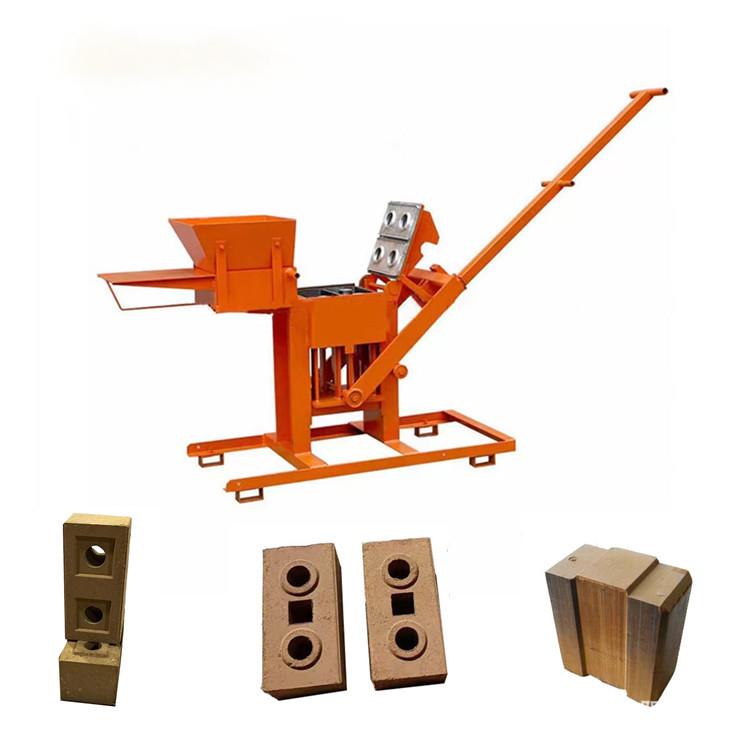
Önümçilik Arketaplary we Funksional Bölüşdürmeкол гончур блок машинасы
Dürli maşyn görnüşlerini düşünmek, soňky ulanyjylaryň zerurlyklaryna laýyk tehnologiýany saýlamak üçin möhümdir.
2.1. Lever-Press Mold Ulgamy
Bu iň köp ýaýran arhetipdir, onuň häsiýetli aýratynlygy durnukly galyby we düwmeli gysma plastinkasy bolýar.
- Mehanizm:Operator hazırlanan kerpici kalıp boşluğuna doldurýar, soňra uzyn bir düwmäni çekip, kerpiji gysyp ýerleşdirmek üçin bir plastinkany (ýa-da "izleýjini") kalypa ýerleşdirýär. Düzülen kerpiji çykarmak üçin köplenç ikinji bir düwme ýa-da eksantrik hereket ulanylýar.
- Çykyş:Adaty bir döwürde bir gaty kerpiç öndürýär. Ussat işgär bilen döwür wagty 30 sekuntdan 60 sekunda çenli dowam edýär.
- Iň Gowy:Ýeke-täk ussaly işgärler, has kiçi ölçegli başlangyç işewürlikler we ýönekeýlik we iň pes baha zerur bolan bilim beriş ýa-da görkeziş taslamalary.
2.2. Sürüşdirilen Guty ýa-da "Sandwiç" Kalýap Sistemasy
Bu dizaýn, kalyp we çykaryş stansiýalaryny bölüp, öndürijiligi artdyrýar.
- Mehanizm:Gaty gurşawy bolan bir ramada iki tagtanyň arasynda süýşýän gaby. Gap bir tarapda palçyk bilen doldurylýar, gysylýar, soňra bu gabyň tutuşlygyna gapyň garşy tarapyna süýşürilýär we ol ýerde arassalanyp taýýarlanan pallet ýa-da tagta ýerleşdirilýär. Garşy tarapdan edilen ikinji gysma işlenen kerpijini pallete çykarýar, şol bir wagtyň özünde täze kerpiji döredýär.
- Çykyş:Has işiniň iňlisli we yzygiderli geçmegini üpjün edýär. Bir operator, ýönekeý düwmeli pres bilen deňeşdirilende has ýokary we yzygiderli önüm alýar.
- Iň Gowy:Kiçi maşgalanyň işleýän kärhanalary we kooperatiwler, gününe birnäçe ýüz kerpiç öndürýän ýarym söwda önümçilik derejesine göz tutýarlar.
2.3. Aýlanma Stol Multi-Stansiýa Ulgamy
Бул кол гүймиш керамика кыш технологиясының жогарғы деңжеси болуп, процессти бөлүш аркылы эмгекти оңдооуну камсыз кылады.
- Mehanizm: Features a central rotating table with 4 to 6 mold boxes mounted on it. Operators are stationed around the table, each performing a dedicated task: filling, preliminary tamping, final pressing, ejection, and mold cleaning/oiling. The table is rotated manually after each action.
- Çykyş: Significantly increases output by creating an assembly-line workflow. A well-coordinated team can produce 1,500-3,000 bricks per day.
- Iň Gowy: Established small-to-medium enterprises (SMEs) supplying local markets, larger self-build projects, or community-led housing initiatives requiring higher volume production.
3. Market Dynamics and End-User Profiling
3.1. Core Demand Drivers: Affordability, Autonomy, and Appropriateness
Demand is fueled by non-negotiable economic and practical realities:
- Capital Access Limitation: Eliminates the need for large loans or investor capital.
- Energetika garaşsyzlygy: Requires zero electricity or fossil fuels for operation.
- Local Resource Utilization: Leverages on-site or locally sourced clay, minimizing transport costs and import dependence.
- Skill Development: Provides a low-barrier entry into manufacturing, fostering local entrepreneurship and job creation.
3.2. Primary End-User Segments and Use Cases
- The Rural & Peri-Urban Entrepreneur: Individuals or families establishing a micro-business to supply their community.
- The Owner-Builder: Constructing their own home or farm structures, seeking to control cost, quality, and timing.
- NGOs & Development Agencies: Implementing housing, school, or clinic projects as part of community development programs, often emphasizing skill transfer.
- Specialist Architectural & Restoration Firms: Producing custom, historically accurate bricks for restoration projects where modern, wire-cut bricks are unsuitable.
3.3. Geographic and Economic Market Suitability
This technology is predominant in regions with:
- Abundant suitable clay deposits.
- A climate conducive to sun-drying (reliable dry seasons).
- A large segment of the population engaged in informal or small-scale construction.
- High costs or logistical challenges associated with transporting factory-made bricks to remote areas.
4. Technical Specifications, Materials, and Production Methodology
4.1. Critical Components: Frame, Mold, and Mechanism
- Çerçeve: Must be constructed from heavy-duty steel sections to withstand constant torsion and impact. Welds should be continuous and robust.
- Гыпсанна The core of quality. Best made from hardened steel plate with a smooth interior finish and slightly tapered sides for easy brick ejection. Removable liners facilitate maintenance.
- Ыкдырыш Механизми: Levers should provide a mechanical advantage of at least 15:1. Pivot points must use hardened steel pins and bronze or oil-impregnated bushings to reduce wear and friction.
4.2. Clay Preparation: The Science of the “Pug”
The machine is only as good as the clay prepared for it. The process is critical:
- Excavation and Weathering: Clay is dug and left exposed to rain and sun to break down lumps and improve plasticity.
- Tempering and Mixing: Water is added, and the clay is mixed—often by treading or with a simple paddle mixer—to achieve a uniform, plastic consistency without lumps or stones. Sand or sawdust may be added to reduce shrinkage cracks.
- Aging: The mixed clay (“pug”) is stored for days or weeks to homogenize moisture and improve workability.
4.3. The Production Cycle: From Mold to Drying Yard
- Mold Preparation: The mold is cleaned and lightly dusted with sand or dipped in water to prevent sticking.
- Filling and Pressing: Clay is thrown into the mold with force to avoid air pockets, then excess is struck off before final compression.
- Ejection and Handling: The green (unfired) brick is carefully ejected onto a drying pallet.
- Guratmak: Bricks are dried slowly in shaded, well-ventigated stacks for 2-4 weeks to remove most moisture before any firing (if required). Improper drying causes cracking.
5. Commercial and Strategic Analysis for B2B Stakeholders
5.1. The Business Case: Ultra-Low-Capex Manufacturing
This model is defined by minimal upfront investment and operational overhead.
- Sermaye goýumy: Limited to machine cost, basic hand tools, and site preparation.
- Cost Structure: Dominated by raw material (clay, water, possible additives) and labor. There is no energy cost for production.
- Profitability: Margins are strong when production is efficient, as the primary input (clay) is often free or very low cost. Profit is a direct function of labor productivity and market access.
5.2. Distribution Models: Volume, Value, and Vision
Successful distribution requires a nuanced approach:
- Volume-Based Model: For entry-level lever presses, focusing on wide market penetration through agricultural supply stores, hardware shops, and local dealers.
- Value-Added Model: For higher-end rotary table systems, involving direct sales to SMEs, NGOs, and government bodies, bundled with technical training and business mentoring.
- Project-Based Partnership: Acting as a supplier to large development or construction projects that plan to establish on-site brick production.
5.3. Risk Assessment and Mitigation in the Value Chain
- Risk: End-user failure due to poor clay preparation or drying.
- Mitigation: Provide comprehensive, pictorial manuals and basic testing kits (e.g., for clay plasticity). Offer on-site training services.
- Risk: Market perception of manual bricks as inferior.
- Mitigation: Educate on the quality potential: a well-made, sun-dried or clamp-fired clay brick can be extremely durable. Develop standards and promote success stories.
- Risk: Seasonal production limitations in rainy climates.
- Mitigation: Advise on the construction of simple drying sheds and promote business planning that accounts for seasonal cycles.
6. Conclusion
The manual clay brick making machine remains an indispensable tool in the global construction ecosystem. It represents a democratization of manufacturing, placing the means of production directly in the hands of communities and individuals. For the B2B professional, this sector offers a unique opportunity to engage in a business that is simultaneously profitable, scalable, and profoundly impactful. Success hinges on a deep understanding of the technology’s variations, a commitment to educating the market beyond the simple transaction, and a strategic approach to distribution that addresses real-world constraints and aspirations. By championing this appropriate technology, distributors do not just sell machines; they enable shelter, foster local enterprise, and contribute to the resilient, self-sufficient development of the markets they serve.
7. Frequently Asked Questions (FAQ) for Distributors and Investors
Q1: Can bricks made with these manual machines be used for permanent, load-bearing structures without firing?
A: For permanent external structures in most climates, some form of stabilization or firing is recommended. Sun-dried (adobe) bricks are susceptible to erosion from prolonged rain. For durability, options include: 1) Adding a chemical stabilizer like 5-8% cement to the clay mix to create Compressed Stabilized Earth Bricks (CSEBs). 2) Low-temperature firing in a clamp kiln or simple updraft kiln. Manual machines produce “green” bricks ideal for either subsequent firing or for stabilized earth construction, but pure, unstabilized sun-dried clay is best for internal partitions or arid climates with proper plaster protection.
Q2: What is the single most important factor in ensuring a client’s success with this technology?
A: Unquestionably, client education and training on clay preparation. The machine is a simple press; the quality is determined by the material fed into it. Distributors must emphasize that 80% of the effort is in preparing the right clay mix (tempering, aging, consistency). Providing clear guidance on clay testing—such as the simple “sausage test” for plasticity and the “drop test” for dryness—is more valuable than any machine feature.
Q3: How do we address competition from extremely low-cost, poorly fabricated machines that undermine the market?
A: Compete on quality, support, and total cost of ownership. Document and demonstrate the superior durability of your machines (e.g., thicker steel, better pivots), which translates to less downtime and longer service life. Offer a warranty and spare parts availability, which cheap importers do not. Calculate the cost of a broken machine—lost production, repair delays—to show that your higher upfront price offers lower risk and higher long-term value.
Q4: What ancillary products or services create recurring revenue alongside the machine sale?
A: A natural ecosystem includes:
- Replacement Wear Parts: Mold liners, lever pins, bushings, and compression plates.
- Specialized Tools: Clay spades, mixing tubs, drying pallets, and brick carriers.
- Testing & Quality Kits: Simple tools for measuring clay moisture and plasticity.
- Training Workshops: Charge for comprehensive on-site training in brick production and small business management.
- Kalıp Özelleştirme: Offering to fabricate custom mold sizes or shapes for specific client projects.
Q5: Is there a market for these machines in more developed economies, or are they solely for emerging markets?
A: A niche but growing market exists in developed economies:
- Sustainability and Natural Building Movements: DIY enthusiasts and eco-builders seeking to use local, unfired clay for custom homes, earth ovens, or landscape features.
- Historical Restoration: Producing period-accurate bricks for restoring old buildings.
- Educational Institutions: For engineering, archaeology, and sustainable design programs.
- Artisan and Sculptural Studios: For creating large-format clay blocks for artistic work.
Marketing in these regions focuses on the values of sustainability, craftsmanship, and material authenticity, rather than pure economic necessity.
