
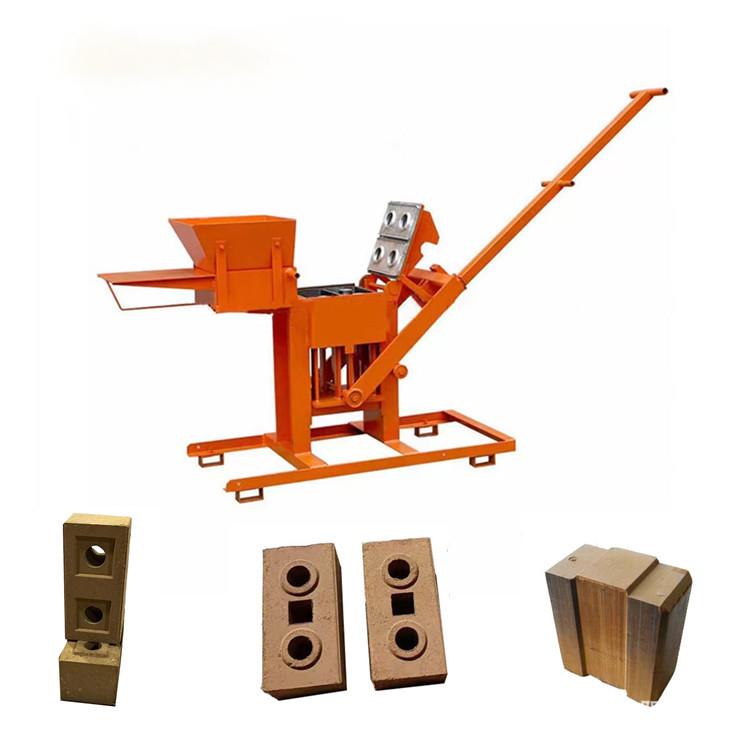
Mga Arketipo ng Produkto at Paghahati-hati ng Tungkulinng manu-manong makina ng bloke ng luad
Ang pag-unawa sa mga natatanging uri ng makina ay mahalaga para maiangkop ang tamang teknolohiya sa mga pangangailangan ng end-user.
2.1. Ang Sistema ng Molde ng Lever-Press
Ito ang pinakakaraniwang arketipo, na kilala sa pamamagitan ng isang static na kahon ng molde at isang plato ng pagpapatigas na pinapatakbo ng pingga.
- Mekanismo:Puno ng operator ang lukab ng hulma ng handang luwad, saka hinihila ang isang mahabang pingga para itulak ang isang plato (o "tagasunod") sa hulma, na nagpipikit sa luwad. Isang pangalawang pingga o aksiyon ng kamera ang karaniwang ginagamit upang itulak palabas ang nabuong ladrilyo.
- Output:Karaniwang gumagawa ng isang solido at matibay na ladrilyo bawat ikot. Ang oras ng bawat ikot ay mula 30 hanggang 60 segundo sa tulong ng isang bihasang operator.
- Pinakamainam Para Sa:Mga indibidwal na manggagawa, napakaliit na bagong negosyo, at mga proyektong pang-edukasyon o demonstrasyon kung saan ang pagiging simple at pinakamababang posibleng gastos ang pinakamahalaga.
2.2. Ang Sistema ng Dumudulas na Kahon o "Sandwich" na Molde
Pinahuhusay ng disenyong ito ang produktibidad sa pamamagitan ng paghihiwalay ng mga istasyon ng paghubog at pag-eject.
- Mekanismo:Binubuo ito ng isang kahong pangmolde na dumudulas sa pagitan ng dalawang plato sa isang matibay na balangkas. Ang luwad ay inilalagay sa kahon sa isang panig, pinipisil, at pagkatapos ang buong kahon ay idinudulas sa kabilang panig kung saan ipinapasok ang isang malinis na palyete o tabla. Ang pangalawang pagpiga mula sa kabilang panig ay naglulunsad ng tapos na ladrilyo sa palyete habang sabay-sabay na humuhubog ng bago.
- Output:Pinapagana nito ang mas ritmiko at tuloy-tuloy na daloy ng trabaho. Ang isang operator ay makakamit ng mas mataas at mas pare-parehong output kumpara sa paggamit ng pangunahing lever press.
- Pinakamainam Para Sa:Ang maliliit na negosyong pinatatakbo ng pamilya at mga kooperatiba na naglalayong makamit ang antas ng semi-komersyal na produksyon, kadalasang nakagagawa ng ilang daang brick bawat araw.
2.3. Ang Sistema ng Multi-Estasyon na Rotary Table
Ito ay kumakatawan sa pinakamataas na antas ng teknolohiya sa paggawa ng manual na laryong putik, na nag-o-optimize ng paggawa sa pamamagitan ng paghihiwa-hiwalay ng proseso.
- Mekanismo: Features a central rotating table with 4 to 6 mold boxes mounted on it. Operators are stationed around the table, each performing a dedicated task: filling, preliminary tamping, final pressing, ejection, and mold cleaning/oiling. The table is rotated manually after each action.
- Output: Significantly increases output by creating an assembly-line workflow. A well-coordinated team can produce 1,500-3,000 bricks per day.
- Pinakamainam Para Sa: Established small-to-medium enterprises (SMEs) supplying local markets, larger self-build projects, or community-led housing initiatives requiring higher volume production.
3. Market Dynamics and End-User Profiling
3.1. Core Demand Drivers: Affordability, Autonomy, and Appropriateness
Demand is fueled by non-negotiable economic and practical realities:
- Capital Access Limitation: Eliminates the need for large loans or investor capital.
- Kalayaan sa Enerhiya: Requires zero electricity or fossil fuels for operation.
- Local Resource Utilization: Leverages on-site or locally sourced clay, minimizing transport costs and import dependence.
- Skill Development: Provides a low-barrier entry into manufacturing, fostering local entrepreneurship and job creation.
3.2. Primary End-User Segments and Use Cases
- The Rural & Peri-Urban Entrepreneur: Individuals or families establishing a micro-business to supply their community.
- The Owner-Builder: Constructing their own home or farm structures, seeking to control cost, quality, and timing.
- NGOs & Development Agencies: Implementing housing, school, or clinic projects as part of community development programs, often emphasizing skill transfer.
- Specialist Architectural & Restoration Firms: Producing custom, historically accurate bricks for restoration projects where modern, wire-cut bricks are unsuitable.
3.3. Geographic and Economic Market Suitability
This technology is predominant in regions with:
- Abundant suitable clay deposits.
- A climate conducive to sun-drying (reliable dry seasons).
- A large segment of the population engaged in informal or small-scale construction.
- High costs or logistical challenges associated with transporting factory-made bricks to remote areas.
4. Technical Specifications, Materials, and Production Methodology
4.1. Critical Components: Frame, Mold, and Mechanism
- Kuwadro Must be constructed from heavy-duty steel sections to withstand constant torsion and impact. Welds should be continuous and robust.
- Kahon ng Molde: The core of quality. Best made from hardened steel plate with a smooth interior finish and slightly tapered sides for easy brick ejection. Removable liners facilitate maintenance.
- Mekanismo ng Kompresyon Levers should provide a mechanical advantage of at least 15:1. Pivot points must use hardened steel pins and bronze or oil-impregnated bushings to reduce wear and friction.
4.2. Clay Preparation: The Science of the “Pug”
The machine is only as good as the clay prepared for it. The process is critical:
- Excavation and Weathering: Clay is dug and left exposed to rain and sun to break down lumps and improve plasticity.
- Tempera at Paghahalo: Water is added, and the clay is mixed—often by treading or with a simple paddle mixer—to achieve a uniform, plastic consistency without lumps or stones. Sand or sawdust may be added to reduce shrinkage cracks.
- Aging: The mixed clay (“pug”) is stored for days or weeks to homogenize moisture and improve workability.
4.3. The Production Cycle: From Mold to Drying Yard
- Mold Preparation: The mold is cleaned and lightly dusted with sand or dipped in water to prevent sticking.
- Filling and Pressing: Clay is thrown into the mold with force to avoid air pockets, then excess is struck off before final compression.
- Ejection and Handling: The green (unfired) brick is carefully ejected onto a drying pallet.
- Pagpapatuyo: Bricks are dried slowly in shaded, well-ventigated stacks for 2-4 weeks to remove most moisture before any firing (if required). Improper drying causes cracking.
5. Commercial and Strategic Analysis for B2B Stakeholders
5.1. The Business Case: Ultra-Low-Capex Manufacturing
This model is defined by minimal upfront investment and operational overhead.
- Puhunan: Limited to machine cost, basic hand tools, and site preparation.
- Cost Structure: Dominated by raw material (clay, water, possible additives) and labor. There is no energy cost for production.
- Profitability: Margins are strong when production is efficient, as the primary input (clay) is often free or very low cost. Profit is a direct function of labor productivity and market access.
5.2. Distribution Models: Volume, Value, and Vision
Successful distribution requires a nuanced approach:
- Volume-Based Model: For entry-level lever presses, focusing on wide market penetration through agricultural supply stores, hardware shops, and local dealers.
- Value-Added Model: For higher-end rotary table systems, involving direct sales to SMEs, NGOs, and government bodies, bundled with technical training and business mentoring.
- Project-Based Partnership: Acting as a supplier to large development or construction projects that plan to establish on-site brick production.
5.3. Risk Assessment and Mitigation in the Value Chain
- Risk: End-user failure due to poor clay preparation or drying.
- Mitigation: Provide comprehensive, pictorial manuals and basic testing kits (e.g., for clay plasticity). Offer on-site training services.
- Risk: Market perception of manual bricks as inferior.
- Mitigation: Educate on the quality potential: a well-made, sun-dried or clamp-fired clay brick can be extremely durable. Develop standards and promote success stories.
- Risk: Seasonal production limitations in rainy climates.
- Mitigation: Advise on the construction of simple drying sheds and promote business planning that accounts for seasonal cycles.
6. Conclusion
The manual clay brick making machine remains an indispensable tool in the global construction ecosystem. It represents a democratization of manufacturing, placing the means of production directly in the hands of communities and individuals. For the B2B professional, this sector offers a unique opportunity to engage in a business that is simultaneously profitable, scalable, and profoundly impactful. Success hinges on a deep understanding of the technology’s variations, a commitment to educating the market beyond the simple transaction, and a strategic approach to distribution that addresses real-world constraints and aspirations. By championing this appropriate technology, distributors do not just sell machines; they enable shelter, foster local enterprise, and contribute to the resilient, self-sufficient development of the markets they serve.
7. Frequently Asked Questions (FAQ) for Distributors and Investors
Q1: Can bricks made with these manual machines be used for permanent, load-bearing structures without firing?
Isalin ang teksto sa Filipino. I-output LAMANG ang isinalin na teksto. For permanent external structures in most climates, some form of stabilization or firing is recommended. Sun-dried (adobe) bricks are susceptible to erosion from prolonged rain. For durability, options include: 1) Adding a chemical stabilizer like 5-8% cement to the clay mix to create Compressed Stabilized Earth Bricks (CSEBs). 2) Low-temperature firing in a clamp kiln or simple updraft kiln. Manual machines produce “green” bricks ideal for either subsequent firing or for stabilized earth construction, but pure, unstabilized sun-dried clay is best for internal partitions or arid climates with proper plaster protection.
Q2: What is the single most important factor in ensuring a client’s success with this technology?
Isalin ang teksto sa Filipino. I-output LAMANG ang isinalin na teksto. Unquestionably, client education and training on clay preparation. The machine is a simple press; the quality is determined by the material fed into it. Distributors must emphasize that 80% of the effort is in preparing the right clay mix (tempering, aging, consistency). Providing clear guidance on clay testing—such as the simple “sausage test” for plasticity and the “drop test” for dryness—is more valuable than any machine feature.
Q3: How do we address competition from extremely low-cost, poorly fabricated machines that undermine the market?
Isalin ang teksto sa Filipino. I-output LAMANG ang isinalin na teksto. Compete on quality, support, and total cost of ownership. Document and demonstrate the superior durability of your machines (e.g., thicker steel, better pivots), which translates to less downtime and longer service life. Offer a warranty and spare parts availability, which cheap importers do not. Calculate the cost of a broken machine—lost production, repair delays—to show that your higher upfront price offers lower risk and higher long-term value.
Q4: What ancillary products or services create recurring revenue alongside the machine sale?
Isalin ang teksto sa Filipino. I-output LAMANG ang isinalin na teksto. A natural ecosystem includes:
- Replacement Wear Parts: Mold liners, lever pins, bushings, and compression plates.
- Specialized Tools: Clay spades, mixing tubs, drying pallets, and brick carriers.
- Testing & Quality Kits: Simple tools for measuring clay moisture and plasticity.
- Training Workshops: Charge for comprehensive on-site training in brick production and small business management.
- Pasadyang Paghubog ng Molde: Offering to fabricate custom mold sizes or shapes for specific client projects.
Q5: Is there a market for these machines in more developed economies, or are they solely for emerging markets?
Isalin ang teksto sa Filipino. I-output LAMANG ang isinalin na teksto. A niche but growing market exists in developed economies:
- Sustainability and Natural Building Movements: DIY enthusiasts and eco-builders seeking to use local, unfired clay for custom homes, earth ovens, or landscape features.
- Historical Restoration: Producing period-accurate bricks for restoring old buildings.
- Educational Institutions: For engineering, archaeology, and sustainable design programs.
- Artisan and Sculptural Studios: For creating large-format clay blocks for artistic work.
Marketing in these regions focuses on the values of sustainability, craftsmanship, and material authenticity, rather than pure economic necessity.
