
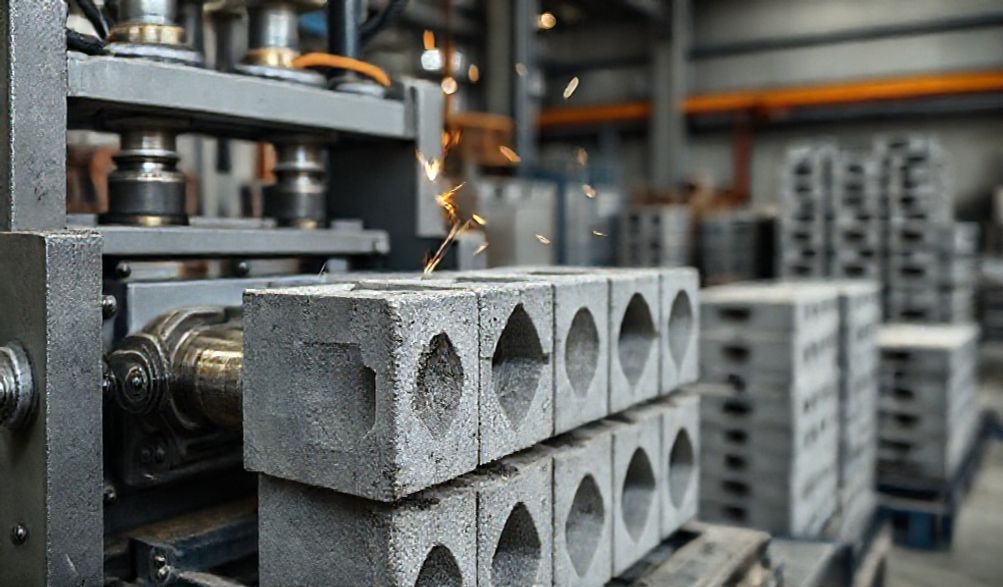
Ang Kumpletong Gabay sa Mga Makina ng Hollow Cement Block: Pagpili, Pagpapatakbo, at ROI
Panimula
Ang pandaigdigang pagtutulak para sa abot-kaya, mabilis, at matibay na konstruksiyon ay nagpatibay sa guwang na bloke ng semento bilang isang pangunahing bloke ng gusali sa modernong mundo. Mula sa mga tirahang bahay hanggang sa mga komersyal na kompleks, ang mga versatile na yunit na ito ay nag-aalok ng isang walang kapantay na kombinasyon ng lakas, kahusayan, at pagiging epektibo sa gastos. Gayunpaman, ang puso ng anumang matagumpay na negosyo sa pagmamanupaktura ng bloke ay hindi lamang ang mga hilaw na materyales—ito ay angmakina para sa guwang na bloke ng sementoAng pagpili ng tamang opsiyon ay isang kritikal at mahalagang desisyon sa kapital na maaaring magpasiya sa kinabukasan ng iyong negosyo.
Buhat sa mga dekada ng pinagsama-samang praktikal na karanasan ng mga beterano sa industriya, inhinyerong mekanikal, at bihasang mga operator ng planta, ang gabay na ito ay tumatalakay nang direkta sa gitna ng ingay sa merkado. Nauunawaan namin ang kalituhan at panganib na likas sa pamumuhunang ito. Ang isang mahinang pagpili ay maaaring magdulot ng malubhang pagkawala ng oras sa operasyon, substandard na mga bloke, at negatibong balik sa puhunan.
Ang artikulong ito ang iyong mapagkakatiwalaan at komprehensibong sanggunian. Lilampasan natin ang mga sales brochure upang maglahad ng makatotohanan at masusing pagsusuri na sumasaklaw sa mga uri ng makina, pangunahing prinsipyo ng operasyon, tunay na halaga ng pagmamay-ari, at malinaw na landas patungo sa kita. Bawat payo ay nakabatay sa mga teknikal na detalye, tunay na mga kaso sa industriya, at pinakamahuhusay na pamamaraan, upang matiyak na mayroon kang maaasahang impormasyon para sa pagtatayo ng matatag na pundasyon ng iyong negosyo.
Ano ang Hollow Cement Block Machine? Mga Pangunahing Prinsipyo at Pakinabang
Bago mag-invest, mahalagang maunawaan kung ano ang iyong binibili at ang halagang nililikha nito. Ang isang hollow cement block machine ay higit pa sa isang pindutin; ito ay isang sistema ng de-kalibreng inhenyeriya na idinisenyo upang gawing mga pamantayang, mataas ang lakas na bahagi ng konstruksyon ang mga hilaw na materyales.
Pagpapakahulugan sa Makina at ang Kinalabasan Nito
Sa puso nito, ang isang makina para sa guwang na bloke ng semento ay isang aparato na nagpapatigas ng isang mala-tuyong timpla ng semento, buhangin, at mga agregato (tulad ng durog na bato) sa isang partikular na hulma. Ang natatanging katangian nito ay ang pagkakaroon ng mga "ubod" o "pambutas" sa loob ng hulma na lumilikha ng mga kilalang guwang na espasyo sa tapos na bloke.
Ang mga kaluwang ito ay hindi tanda ng kahinaan kundi isang marka ng matalinong disenyo. Nagbibigay ang mga ito ng malaking benepisyo:
* Magaan:Binabawasan ang kabuuang patay na bigat ng isang istruktura, na nagpapahintulot ng mas magaan na mga pundasyon at mas madaling paghawak.
* Insulasyong Pang-init at Pang-tunog:Ang mga bulsa ng hangin sa loob ng mga bloke ay nagsisilbing hadlang sa init at ingay.
* Kahusayan sa Materyales: Uses less concrete for the same face area, lowering material costs per block.
* Utility Integration: The voids provide convenient channels for running electrical conduits and plumbing pipes.
How It Works: The Production Process
While machine complexity varies, the fundamental production process remains consistent. Understanding this flow demonstrates the machine’s role in each stage:
- Pagpapakain ng Hilaw na Materyal: Pre-measured quantities of cement, sand, and aggregate are loaded into the machine’s hopper.
- Paghahalo: The materials are blended thoroughly, often with a measured amount of water, to achieve a uniform, semi-dry consistency.
- Molding and Compaction: This is the machine’s critical function. The mix is fed into the mold box. Simultaneously, two forces act:
- Panginginig: High-frequency vibration removes air pockets and ensures the mix flows into every corner of the mold.
- Presyon ng Pagpiga: A hydraulic or mechanical ram applies intense pressure from the top, densifying the mixture to achieve the required block strength.
- Ejection and Curing: The freshly formed, green block is ejected onto a wooden or steel pallet. It is then moved to a curing area, where it gains strength over time through controlled hydration.
- Pagpapaleta: Once cured, blocks are stacked and prepared for transport.
Key Advantages Over Solid Blocks and Other Materials
Why choose hollow blocks over solid ones or traditional bricks?
* vs. Solid Concrete Blocks: Hollow blocks offer a superior strength-to-weight ratio, better insulation, and lower material cost per unit. They are easier for masons to handle and lay, speeding up construction time.
* vs. Fired Clay Bricks: The production of hollow blocks is faster, more energy-efficient (no kiln firing required), and less dependent on specific types of soil. They also typically offer larger unit sizes, leading to faster wall construction.
Types of Hollow Cement Block Machines: Finding Your Perfect Match
The market offers a spectrum of machines, from simple manual presses to fully automated production lines. Your choice must align with your business scale, budget, and labor strategy.
Manwal / Makinang Pinatatakbo ng Kamay
These are the most basic type, relying entirely on human leverage to compact the mix.
* Angkop Para Sa: Entrepreneurs testing the market, very small-scale projects (e.g., building your own home), or regions with extremely limited or unreliable power access.
* Mga Kalamangan: Very low initial investment, simple mechanics with minimal maintenance, portable, no electricity required.
* Mga Disbentahe: Extremely labor-intensive, very low output (typically 100-400 blocks per day), inconsistent block quality dependent on operator strength and technique, not suitable for commercial production.
Semi-Automaticong Makina
This category strikes the most popular balance for small to medium businesses (SMBs). They use electric power to drive a hydraulic system and vibration table, automating the most strenuous parts of the process.
* Angkop Para Sa: Growing startups and established SMBs aiming for consistent commercial production.
* Mga Kalamangan: Significantly higher and more consistent output than manual machines (e.g., 800-3000 blocks per 8-hour shift), better block density and strength due to powered vibration and pressure, reduces physical labor to feeding and palletizing.
* Mga Disbentahe: Requires a stable power supply, higher upfront cost than manual machines, requires basic operational training, and some manual intervention is still needed.
Ganap na Awtomatikong Makina sa Paggawa ng Bloke
These are complete production systems, often with robotic pallet handlers, conveyor belts, and computerized controls.
* Angkop Para Sa: Large-scale manufacturers, industrial plants supplying major construction projects, or businesses focused on maximizing output with minimal labor.
* Mga Kalamangan: Highest possible output (10,000+ blocks per day), exceptional consistency in block quality, minimal manual labor required (often just supervision and maintenance), can integrate with automated curing and stacking systems.
* Mga Disbentahe: Very high capital investment, requires significant space and industrial-grade power supply, complex maintenance requiring specialized technicians, lower flexibility for short production runs.
Nakatigil kumpara sa Mobile na Makina ng Bloke
This is another key distinction:
* Nakatigil na Makinarya: These are fixed installations, typically the semi-automatic and fully automatic types. They form the core of a block-making plant and are chosen for high-volume, centralized production.
* Mobile Machines (Block Making Plants on Wheels): These are smaller, trailer-mounted units designed for on-site production. They eliminate transport costs for blocks and are ideal for large, remote projects like dams, large housing estates, or infrastructure where transporting finished blocks is expensive.
Critical Factors for Choosing Your Machine (Buyer’s Checklist)
Armed with knowledge of machine types, use this authoritative checklist to evaluate specific models and suppliers. Prioritizing these factors is a lesson learned from countless successful (and unsuccessful) setups.
Pagsusuri sa Iyong Pangangailangan sa Produksyon
Answer these questions honestly before looking at any machine brochure:
* Daily/Shift Output: How many blocks do you need to produce to meet demand and be profitable? Be realistic about your market.
* Block Specifications: What are the standard block sizes (e.g., 4″, 6″, 8″) and types (hollow, solid, paving, interlocking) in demand in your region?
* Available na Espasyo: Do you have adequate covered space for the machine, raw material storage, and a curing area?
* Source ng Kuryente: What is your available electrical power (Voltage, Phase)? Can it support the machine’s motor?
Machine Specifications to Scrutinize
Don’t just look at the price tag; examine the engineering.
* Pressure & Vibration System: This is the engine of your machine. A high compaction force (measured in tons or kN) and a powerful, balanced vibration system are non-negotiable for producing dense, high-strength blocks that meet ASTM or IS codes. Ask about the vibration motor’s frequency and amplitude.
* Oras ng Ikot: How many blocks does the machine produce per hour? A faster cycle time means higher potential output. Compare this figure across models in the same category.
* Maraming Gamit na Molde: Can the machine easily accept different mold sets? How quickly can molds be changed? A versatile machine allows you to adapt to market demands for different block styles and paving slabs.
* Build Quality & Durability: Inspect the quality of steel used in the frame and mold. Are critical components like hydraulic cylinders and pumps from reputable brands? A machine built with inferior steel will wear out quickly under constant vibration and pressure, leading to frequent breakdowns.
Beyond the Machine: Total Cost of Ownership
The purchase price is just the beginning. A savvy buyer considers:
* Pagkakabit at Pagkakomisyon: Are these services included? Is technical support provided to get your first batch right?
* Pagsasanay: Is comprehensive operator training part of the deal? Proper training prevents costly mistakes and accidents.
* Mga Gastos sa Pagpapanatili: What is the cost and availability of spare parts (like mold liners, hydraulic seals, vibration motors)? A cheap machine with expensive, hard-to-find parts is a false economy.
* Pagkonsumo ng Enerhiya: Request the motor power ratings. A more efficient machine saves significant money on electricity over its lifespan.
Operating and Maintaining Your Machine for Longevity
Your machine is a productivity asset. Treating it with care, based on practical expertise, is the single best way to ensure a long service life and consistent block quality.
Raw Material Preparation: The Foundation of Quality Blocks
The best machine cannot compensate for poor raw materials. This is the most common on-site challenge.
* Mix Design: Follow a proven mix ratio (e.g., 1 part cement : 6 parts aggregate/sand blend is common for non-load-bearing blocks). The exact ratio depends on your desired block strength and local material properties.
* Kalidad ng Materyal: Use clean, sharp sand and well-graded aggregates. Avoid silt or organic matter. Cement must be fresh and stored properly.
* Water Content: This is critical. The mix should be semi-dry—just enough water to allow compaction but not so much that the block slumps after ejection. A simple “ball-in-hand” test (the mix should hold its shape when squeezed) is a classic operator technique.
Step-by-Step Operational Guide
- Pre-Start Check: Ensure all guards are in place, the hydraulic oil level is correct, and no tools are left on the vibration table.
- Lubrication: Grease all moving points as per the manual.
- Pagkarga ng Materyales Fill the hopper with a consistent, well-mixed batch.
- Pagsisimula ng Ikot: Start the machine cycle. The operator typically fills the mold, initiates vibration/compaction, and then removes the finished block onto a pallet.
- Post-Operation: Clean the mold, hopper, and feed system thoroughly before shutting down. Any leftover mix will harden and cause major issues.
Essential Maintenance Schedule
Preventive maintenance is far cheaper than repair downtime.
* Daily: Clean the machine thoroughly, especially the mold cavity. Check for loose bolts or nuts. Inspect hydraulic lines for leaks.
* Weekly: Check and tighten all electrical connections. Inspect the mold for wear or damage. Lubricate all bearings and guide rails.
* Monthly: Change hydraulic oil and filters as specified. Check the vibration motor mounts and alignment. Perform a thorough inspection of all safety devices.
Troubleshooting Common Issues
- Cracked Blocks: Usually caused by too much water in the mix, excessive vibration, or premature handling of green blocks.
- Poor Surface Finish/Sticking in Mold: Often due to an under-lubricated or worn-out mold, or a mix that is too wet.
- Machine Jam or Low Pressure: Check hydraulic oil level and filters. Look for a failed solenoid valve or a leaking hydraulic cylinder.
Calculating ROI and Building a Profitable Business
A hollow block machine is a business-in-a-box. Understanding the financials is as important as understanding the mechanics.
Initial Investment Breakdown
- Machine Cost: The largest variable, based on type and automation.
- Land & Shed: Cost for the production floor and curing area.
- Raw Material Inventory: Initial stockpile of cement, sand, and aggregates.
- Paggawa: Wages for operators and helpers.
- Utilities & Installation: Electrical work, water connection, and machine setup.
Operational Cost Analysis (Cost per Block)
This is your key metric. Break down the cost to produce one standard block:
* Mga Materyales: Cost of cement, sand, aggregate used in one block.
* Paggawa: (Total daily labor cost) / (Number of blocks produced per day).
* Kapangyarihan: (Machine’s hourly power consumption * hours run) / (Blocks produced).
* Maintenance & Depreciation: (Estimated annual maintenance cost + machine depreciation) / (Annual production volume).
Halimbawa: If your total cost per block is $0.50 and the market selling price is $0.80, your gross profit per block is $0.30.
Revenue Projections and Market Strategies
- Pricing: Research local market prices. Your price must cover your cost-per-block and provide a healthy margin while remaining competitive.
- Customers: Identify your target market: local contractors, real estate developers, hardware/construction material retailers, government housing projects.
- Marketing: Quality and consistency are your best advertisements. Offer samples to contractors. Ensure your blocks are neatly stacked and delivered on time.
Key Success Factors
Long-term profitability hinges on:
1. Uncompromising Block Quality: Consistently producing blocks that meet or exceed strength standards builds an unbeatable reputation.
2. Reliable Supply: Never miss a delivery deadline. Build a buffer stock to manage demand fluctuations.
3. Customer Relationships: Work closely with your clients. Understand their needs and be a reliable partner in their projects.
Mga Madalas Itanong (FAQ)
Q1: What is the average production capacity of a small-scale hollow block machine?
A: For a typical semi-automatic machine suitable for an SMB, expect a realistic output range of 800 hanggang 2,500 bloke bawat 8-oras na turno. This varies dramatically based on block size, operator speed, and machine model. Manual machines produce far less, while automatic systems produce far more.
Q2: Can one machine produce different sizes of blocks?
A: Yes, absolutely. This is achieved by changing the mold set. Reputable manufacturers offer a variety of interchangeable molds for different block sizes and styles (e.g., hollow, solid, paving). However, purchasing additional molds is an extra cost, and changing them requires time and care.
Q3: What is the curing time for blocks, and how should they be stored?
A: Blocks gain strength over time. They should remain in their molds on pallets for at least 24 hours before being carefully stacked. For full strength (as per ASTM C90), blocks require a 28-day curing period. Best practice involves keeping them moist (through water spraying or covered storage) for the first 7 days to ensure proper cement hydration.
Q4: Is special training required to operate a semi-automatic/automatic machine?
A: While suppliers provide basic operational training, investing in thorough training is crucial. Proper training ensures operator safety, maximizes production efficiency, minimizes raw material waste, and extends machine life by preventing misuse. It is not a step to be skipped.
Q5: How do I ensure the blocks meet local construction standards?
A: First, use a proven mix design and operate your machine within its specified parameters. Then, have samples of your blocks tested at a certified construction materials laboratory. They will test for compressive strength, water absorption, and dimensional tolerance against relevant standards (e.g., ASTM in the US, IS in India, BS in the UK). This certification is a powerful tool for marketing and building trust.
Konklusyon
Choosing the right hollow cement block machine is a strategic decision that hinges on a clear understanding of your production scale, budget, and long-term business goals. It’s an investment that goes beyond metal and motors—it’s an investment in your capability to supply the construction industry.
Our final, hard-earned advice from the field: due diligence is paramount. Whenever possible, visit the supplier’s factory or an existing client’s site to see the machine in operation. Listen to the sound of its operation, observe the blocks it produces, and ask current owners about after-sales service and parts availability. Remember, the cheapest machine can become the most expensive if it leads to downtime and poor-quality products.
Ready to move forward? Use the detailed checklist in Section 3 to crystallize your requirements. Then, approach reputable suppliers with clear, informed specifications. By investing in knowledge upfront, you lay the strongest possible foundation for a profitable, sustainable, and respected block manufacturing business.
<