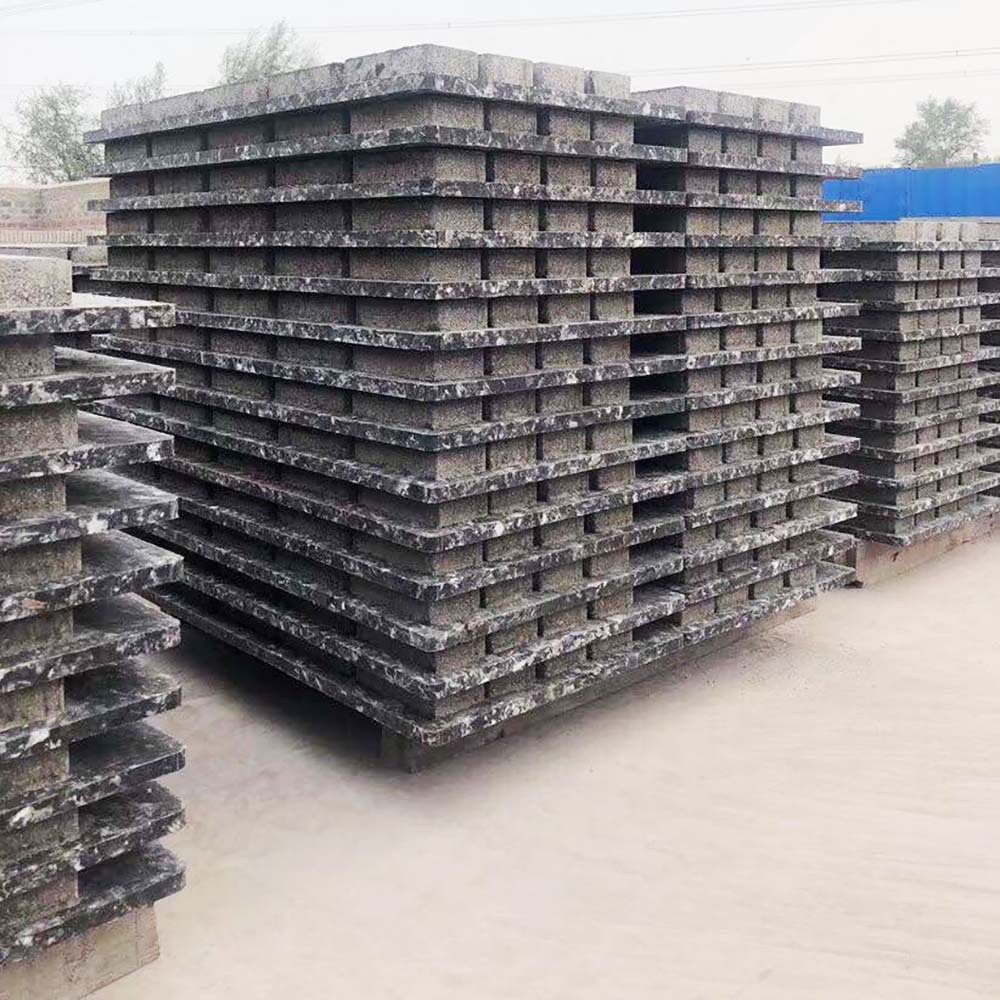
Phân Tích Dòng Thời Gian Sấy và Bảo Quản
Quá trình sau khi đúc một viên gạch bê tông được mô tả chính xác là một hành trình hai giai đoạn: đông kết ban đầu và tháo khuôn, tiếp theo là giai đoạn bảo dưỡng quan trọng. Thuật ngữ "làm khô" có phần gây hiểu lầm, vì mục tiêu không phải là loại bỏ toàn bộ độ ẩm mà là kiểm soát sự hiện diện của nó để thúc đẩy quá trình hydrat hóa hóa học của xi măng.
1. Khoa Học Của Quá Trình Đóng Rắn: Từ Nhựa Đến Sản Phẩm
Cường độ của gạch bê tông phát triển thông qua phản ứng hóa học giữa xi măng Portland và nước, được gọi là quá trình hydrat hóa. Phản ứng này tạo ra các cấu trúc tinh thể liên kết cốt liệu (cát, đá) thành một khối rắn chắc.
- Vai Trò Của Nước:Độ ẩm đủ phải được duy trì bên trong viên gạch để quá trình hydrat hóa tiếp tục đến khi hoàn tất. Việc làm khô sớm hoặc quá mức sẽ ngăn chặn phản ứng này, dẫn đến sản phẩm cuối cùng yếu, dễ bụi và thấm nước vĩnh viễn.
- Khái niệm "Sức mạnh xanh"Đây là độ cứng ban đầu cho phép gạch được tháo khuôn khỏi máy mà không bị biến dạng. Độ cứng này đạt được nhanh chóng, thường trong vòng vài phút đến vài giờ, nhờ vào quá trình đông kết ban đầu.
- Sự trưởng thành:高强度的完全发育是一个耗时数周的过程,尽管砖通常在达到规定的搬运强度后就会进行搬运和销售。
2. Các Yếu Tố Chính Chi Phối Thời Gian Bảo Dưỡng
Thời gian không phải là tùy tiện mà được quyết định bởi nhiều biến số có thể kiểm soát và môi trường.
2.1. Thiết kế hỗn hợp và Vật liệu thành phần
- Loại và Hàm Lượng Xi Măng:使用快硬(III型)水泥可加速早期强度增长,可能缩短搬运前的初始养护时间。水泥与骨料的比例也起作用;较富配合比的混合料可能凝结更快。
- Chemical Admixtures: The strategic use of admixtures is a primary lever for controlling production speed.
- Accelerators: These admixtures drastically speed up the hydration reaction, allowing for demolding in as little as 15-30 minutes in some high-speed systems and enabling early palletizing.
- Water Reducers/Plasticizers: By reducing the water content needed for workability, they result in a denser matrix that gains strength faster and has lower shrinkage.
- Curing Compounds: Internal curing agents can be added to the mix to provide a reservoir of moisture, supporting hydration even in lower-humidity environments.
2.2. Production Methodology and Machine Technology
- Machine Type – Static vs. Mobile: This is the most significant differentiator in curing logistics.
- Static Pallet Systems: Bricks are molded on large, heavy steel pallets (e.g., 12-15 per pallet). The entire pallet, weighing several tons, is moved by forklift to a curing chamber or yard. The bricks cure tại chỗ on the pallet for 18 to 36 hours minimum before they can be depalletized (stripped). This is a batch process with a longer initial cycle.
- Mobile Pallet Systems (Egg-Layers): The machine itself moves along a concrete slab, depositing (“laying”) a batch of bricks directly onto the curing floor. It then moves forward to produce the next batch. Bricks cure where they are laid for a period typically ranging from 24 to 48 hours before they are gathered (“picked”) by a separate machine for stacking. This method requires significant floor space but allows continuous production.
- High-Speed Cubing Systems: The most advanced lines integrate accelerators and specialized molds to achieve demolding strengths in minutes. Bricks are automatically stacked into cubes on wooden pallets within 1-2 hours of casting and moved to a controlled curing environment. This represents the fastest initial cycle time.
2.3. Curing Environment and Controlled Conditions
- Ambient Curing: Bricks are left in the production shed or yard. Time is heavily dependent on weather: high temperatures and wind accelerate moisture loss, risking poor curing; low temperatures slow hydration dramatically. In ideal conditions (70°F/21°C, high humidity), ambient curing to handling strength may take 3-7 days.
- Controlled Curing: This is the hallmark of a quality-focused, consistent producer.
- Steam Curing (Low-Pressure): Pallets or cubes of bricks are housed in a insulated chamber and exposed to low-pressure steam (typically 120°F – 160°F / 50°C – 70°C) and high humidity for 12 to 24 hours. This process accelerates hydration, allowing bricks to reach 70-80% of their 28-day strength in one day. It ensures consistency regardless of outside weather.
- Fog Rooms & Curing Tunnels: Enclosed spaces with automated misting and temperature control maintain a near-100% relative humidity environment, optimizing the curing process without heat.
2.4. The Target Strength and Final Moisture Content
- Handling & Shipping Strength: The minimum compressive strength required for safe depalletizing, cubing, wrapping, and transport. For distributors, this is the most critical milestone, as it dictates when the product can enter the supply chain. With accelerators and steam curing, this can be achieved in 18-24 hours.
- Final Specified Strength: The guaranteed strength, typically measured at 28 days under standard conditions. While most strength gain occurs in the first week, the product continues to cure slowly during storage and transit.
- Drying for Packaging: Before shrink-wrapping, bricks may require additional time to allow surface moisture to evaporate, preventing mold growth under the film.
3. A Comparative Timeline Framework for Business Planning
To translate this into practical logistics, consider these generalized production pathways:
Path A: Standard Static Plant with Ambient Curing
- Demolding/Stripping Time: 24 – 48 hours.
- Time to Handling Strength: 3 – 7 days.
- Time to Ready for Shipment: 5 – 10 days.
- Key Business Implication: Higher inventory holding costs on-site, weather-dependent variability, longer lead times.
Path B: Advanced Plant with Steam Curing & Accelerators
- Demolding/Stripping Time: 18 – 24 hours (for static pallets); 1-2 hours (for cubing systems).
- Time to Handling Strength: 18 – 24 hours.
- Time to Ready for Shipment: 2 – 3 days.
- Key Business Implication: Faster turnaround, consistent quality year-round, reduced footprint, ability to respond quickly to large orders.
Conclusion: Curing Time as a Metric of Operational Sophistication
For the construction materials distributor, the curing timeline of a concrete brick supplier is a powerful indicator of their operational efficiency, quality commitment, and reliability. A supplier who relies solely on ambient curing is subject to the whims of climate, leading to seasonal bottlenecks and potential inconsistency. In contrast, a supplier investing in controlled steam curing chambers and modern admixture technology is not just speeding up production; they are engineering a predictable, high-quality product and a reliable supply chain.
When evaluating suppliers or negotiating contracts, move beyond asking “how long does it take?” Instead, ask specific questions:
- “Do you use controlled steam curing or ambient yard curing?”
- “What is your standard lead time from production to load-out for a full truckload?”
- “How do you adjust your mix and process in winter versus summer to maintain consistency?”
The answers will reveal the sophistication of the operation. A shorter, controlled curing time directly translates to your competitive advantage: the ability to guarantee supply, fulfill urgent orders, and provide your customers with a product of verified and uniform quality. In the business of concrete bricks, time is not just money—it is strength, consistency, and market trust.
FAQ
Q1: Why do some suppliers quote a 28-day lead time for concrete bricks if they are hard in a few days?
A: The 28-day period is the standard testing age for specified compressive strength. A conservative supplier may quote this to ensure the product has fully matured before shipment, especially if using ambient curing. However, with modern curing methods, bricks reach shipping strength much sooner. The quoted lead time often includes production scheduling, curing to handling strength, quality control testing, and logistics, not just the chemical cure.
Q2: How does curing time impact the brick’s long-term durability and performance?
A: Proper curing is absolutely critical for durability. Inadequately cured bricks have higher permeability, allowing water and de-icing salts to penetrate more easily. This leads to reduced freeze-thaw resistance, potential efflorescence, and lower overall longevity. A faster cure through controlled conditions (steam) is superior to a slow, uneven ambient cure that risks premature drying.
Q3: We receive bricks that are sometimes damp or have a whitish powder (efflorescence). Is this related to curing?
A: Directly. Damp bricks indicate they were wrapped and shipped before excess surface moisture evaporated, a sign of rushed curing or improper scheduling. Efflorescence is caused by soluble salts migrating to the surface with water. Inadequate curing (too dry too fast) can leave unreacted cement particles near the surface that later react, while improper water drainage during curing can also concentrate salts. Consistent, controlled curing minimizes both issues.
Q4: Can bricks be used immediately upon delivery, or do they need further curing on-site?
A: Bricks shipped after reaching their handling strength (typically >70% of 28-day strength) are ready for immediate installation in most applications. The 28-day strength is a guarantee that will be achieved over time in the wall. It is crucial, however, to store them on-site on dry, flat ground and protect them from contamination and excessive wetting before use.
Q5: What is the single most important question I can ask a potential supplier about their curing process?
A: Ask: “Do you use a controlled, accelerated curing system (like steam), and what is your standard process time from molding to the brick being stable enough for palletizing and wrapping?” This question cuts to the heart of their technology, consistency, and understanding of their own production cycle, giving you a clear picture of their capability and reliability.