
Le Guide Ultime des Machines à Fabriquer des Briques en Terre en Inde (2026)
Introduction
Le paysage urbain de l'Inde s'élève à un rythme sans précédent, mais à quel prix ? Le secteur de la construction, pilier de cette croissance, contribue aussi de manière significative aux défis environnementaux du pays. Considérez ceci : l'industrie traditionnelle de la brique d'argile cuite consommerait plus de 24 millions de tonnes de charbon par an et émettrait près de 42 millions de tonnes de CO2. Alors que l'Inde avance vers ses objectifs de développement durable, une révolution silencieuse prend forme sur le terrain — littéralement. La recherche de matériaux de construction abordables, écologiques et résilients ramène constructeurs, architectes et entrepreneurs à une ressource fondamentale : la terre.
Le problème des briques rouges conventionnelles est multiple. Leur production est énergivore, polluante et implique souvent l'exploitation abusive de la couche arable fertile. Ajoutez à cela des coûts volatils et un contrôle réglementaire croissant, et le besoin d'une alternative n'a jamais été aussi urgent. Voici la machine à fabriquer des briques en terre – une merveille technologique qui transforme la terre humble en blocs de construction solides et durables.
Ce guide complet est conçu pour aller à l'essentiel. Élaboré à partir de recherches approfondies sur l'industrie, d'analyses techniques et d'une connaissance approfondie du paysage du marché indien, il constitue une ressource incontournable. Que vous soyez un constructeur cherchant à réduire les coûts, un architecte défendant une conception écologique ou un entrepreneur repérant une opportunité commerciale, ce guide vous fournira les connaissances nécessaires pour prendre une décision éclairée. Nous examinerons en détail le fonctionnement de ces machines, leurs avantages considérables, les types disponibles, les principaux fabricants indiens, le processus de production et les facteurs essentiels à considérer avant d'investir.
Qu'est-ce qu'une machine à fabriquer des briques en terre ?
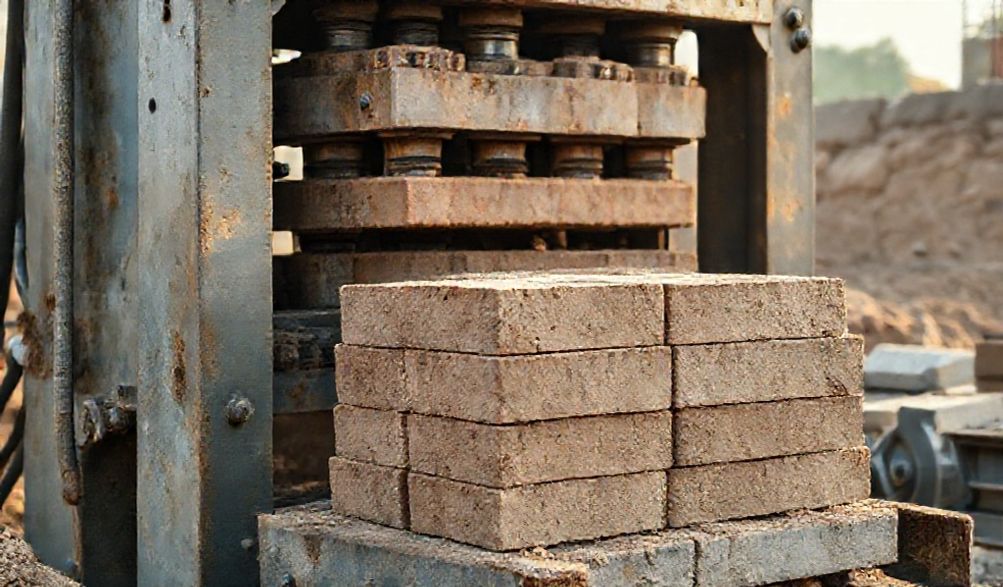
Une machine à fabriquer des briques en terre est un dispositif conçu pour produire des blocs de terre comprimée stabilisée (BTC). Elle représente une fusion entre un principe simple et une ingénierie robuste, offrant une voie moderne vers l’un des plus anciens matériaux de construction de l’humanité.
Technologie de base expliquée
Au cœur de cette technologie se trouve un principe d'une élégante simplicité. Une machine à BTC comprime un mélange humide de terre, d'une faible proportion de stabilisant (généralement 5 à 10 % de ciment ou de chaux) et d'eau sous une pression extrêmement élevée. Ce procédé, qui peut exercer des forces de 2 à plus de 40 tonnes, ne repose pas sur la chaleur. Il compacte mécaniquement les particules, créant ainsi un lien dense et cohésif. Le stabilisant agit comme un liant, réagissant chimiquement pour conférer à la brique une résistance à long terme et une imperméabilité. Le résultat est une brique uniforme et de haute qualité, prête pour la construction après une période de cure.
Comment cela diffère de la fabrication traditionnelle de briques
Le contraste avec les méthodes traditionnelles est frappant :
* Contre les briques d'adobe séchées au soleil :Bien qu’Adobe utilise également de la terre, elle est simplement moulée et séchée au soleil. Les BTC (blocs de terre comprimée) sont quant à eux compressés mécaniquement, ce qui les rend beaucoup plus denses, résistants et durables. Ils offrent également une précision dimensionnelle supérieure.
* Contre les briques d'argile cuites au four :C'est la différence la plus significative. Les briques cuites nécessitent des températures de 900°C à 1100°C pendant plusieurs jours, ce qui brûle d'énormes quantités de charbon ou de bois. Le procédé des BTC (blocs de terre comprimée) élimine complètement cette étape de cuisson. Cela signifie quezéro émissions provenant de la combustion de carburantce qui permet une économie d'énergie allant jusqu'à 90 % et une réduction drastique de l'empreinte carbone de la brique elle-même.
Principaux avantages de l'utilisation d'une machine à briques de terre en Inde
Adopter la technologie des briques de terre n'est pas seulement un choix écologique; c'est une décision économique et pratique intelligente, offrant des avantages étendus.
Avantages économiques
- Investissement en capital faible :La mise en place d'une unité de production de BTC (bloc de terre comprimée) nécessite une fraction du capital requis pour une briqueterie conventionnelle. Il n'y a pas besoin de fours coûteux, de cheminées ou de grandes parcelles de terre pour l'extraction d'argile.
- Coût minimal des matériaux :La matière première principale – le sol – est souvent disponible sur place ou localement à un coût minime. Les stabilisants comme le ciment sont le seul intrant majeur à acheter.
- High-Profit Potential: With low operational costs and a growing market demand for green building materials, the profit margins for CSEB production can be very attractive for small and medium enterprises.
Environmental & Sustainability Benefits
The environmental case for CSEBs is compelling and backed by studies, including those from institutions like the Auroville Earth Institute. Their research highlights the dramatic reduction in embodied energy.
* Near-Zero Carbon Production: As mentioned, the absence of firing removes the largest source of CO2 emissions from brick manufacturing.
* Local & Natural: Using locally sourced soil drastically cuts down on transportation fuel and preserves topsoil for agriculture, as only sub-soil is used.
* Minimal Waste: There is no spoilage or wastage in production. Unused or broken blocks can be crushed, re-wetted, and reused.
Structural and Practical Benefits
- Isolation thermique supérieure : Earth blocks have excellent thermal mass. They absorb heat during the day and release it slowly at night, naturally regulating indoor temperatures. This can reduce air-conditioning costs by 30-40%.
- Proven Strength & Durability: When produced with the correct soil mix and stabilization, CSEBs can achieve compressive strengths exceeding those of standard clay bricks, making them perfectly suitable for load-bearing walls in low-rise construction.
- Built-In Safety: They are naturally fire-resistant, non-toxic, and offer good sound insulation. Their density also makes them resistant to termites and pests.
Types of Soil Brick Making Machines Available in India
The Indian market offers a spectrum of machines to suit different scales of operation and budgets.
Manual Press Machines
Ideal for community-led projects, rural housing initiatives, or very small-scale production.
* Avantages : Extremely low cost, completely portable, requires no electricity. Promotes self-help construction.
* Inconvénients : Labor-intensive, low output (typically 100-300 bricks per day), requires significant operator effort.
Machines semi-automatiques
A popular choice for small businesses, housing projects, and entrepreneurs. These often feature a hydraulic or mechanical lever system and may include a pan mixer.
* Avantages : Offers a good balance between output, cost, and ease of use. Significantly reduces manual labor compared to manual presses. Output can range from 500 to 1500 bricks per day.
* Inconvénients : Requires a skilled operator for consistent quality. Still involves some manual handling of materials.
Machines entièrement automatiques
Designed for commercial-scale production. These are integrated systems with automated soil feeding, mixing, compression, and brick ejection, often with conveyor belts.
* Avantages : High, consistent output (2000+ bricks per day), excellent product uniformity, minimal manual labor.
* Inconvénients : High initial investment, requires a reliable power supply (electricity or diesel), and more space.
Mobile vs. Stationary Units
A key consideration is mobility. Many manufacturers offer machines mounted on trailers.
* Mobile Units: Allow for on-site production, eliminating brick transportation costs entirely. Perfect for large, remote projects.
* Stationary Units: Set up in a dedicated production yard, supplying bricks to multiple sites within a region.
Top Factors to Consider Before Buying a Machine
A successful venture hinges on choosing the right equipment. Do not skip this due diligence.
Évaluation de vos besoins de production
Be clear about your objectives. Are you building a single house, a colony, or starting a commercial brick supply business? Your required daily output (e.g., 1000 vs. 5000 bricks) will directly dictate the type and capacity of machine you need.
Soil Suitability and Testing
This is the most critical, non-negotiable step. Not all soil is suitable. An investment can fail if the soil on your site is incompatible. Expertise here is paramount.
* The ideal soil has a balanced mix of clay (as a binder), silt, and sand (for skeletal structure).
* Always conduct a professional soil test before purchasing a machine. Reputable suppliers or local engineering colleges can guide you. The test will determine the exact proportion of stabilizer needed.
Machine Specifications & Features
- Taille et forme de la brique : Ensure the machine can produce the size (e.g., 230x190x100 mm) and interlocking shapes you require.
- Cote de pression : Measured in tonnes or PSI. Higher pressure generally produces denser, stronger bricks (aim for a minimum of 2-3 tonnes for standard blocks).
- Source d'alimentation : Choose based on your location’s power reliability—electric, diesel, or hybrid.
- Build Quality & Service: Inspect the machine’s robustness. Crucially, investigate the supplier’s after-sales service network, warranty, and spare parts availability. A machine breakdown without support can halt your entire operation.
Leading Manufacturers and Suppliers of Soil Brick Machines in India
The Indian market features a mix of pioneering domestic manufacturers and distributors of international brands.
Overview of the Indian Market Landscape
The demand for sustainable construction has spurred growth in this niche. Companies range from small-scale fabricators to established firms with extensive R&D and export operations.
Review of Reputable Indian Brands
Based on market presence, technical innovation, and product range, here are a few notable names (this is an informational overview, not an endorsement):
* Auram (Auroville Earth Institute): Considered pioneers in India. They offer a wide range of manual and hydraulic presses, backed by decades of research and training.
* Kathan Engineering: Known for robust and innovative hydraulic and automatic CSEB machines, catering to medium and large-scale production needs.
* Mardini Hydraulics: A manufacturer offering a variety of hydraulic press machines, from manual to fully automatic models.
* Bharath Industrial Works: Produces a range of soil block making machines, including mobile units for on-site production.
Tips for Vetting a Supplier
- Ask for Certifications & References: Request client testimonials, especially from projects in your region.
- Insist on a Live Demo: Never buy based on a brochure alone. Demand a demonstration using a sample of your own soil to see the machine’s performance and brick quality.
- Evaluate Support: Assess their willingness to provide installation guidance, operator training, and their response time for service queries.
The Soil Brick Production Process: A Step-by-Step Guide
Producing quality CSEBs is a systematic process.
Step 1: Soil Selection and Preparation
Excavate sub-soil (not fertile topsoil). Remove debris, vegetation, and large stones. The soil should be spread and allowed to weather if too wet.
Step 2: Sieving and Mixing
Sieving is crucial to remove pebbles and achieve a uniform grain size. The sieved soil is then mixed with the precise percentage of stabilizer (cement/lime) in a dry state to ensure even distribution. Water is then added gradually to achieve optimal moisture content (usually around 10-12%).
Step 3: Compression in the Machine
The moist mix is fed into the machine’s mold chamber and compressed at high pressure. The block is then ejected onto a pallet.
Step 4: Curing and Drying
This is vital for strength development. The fresh bricks are kept under a plastic sheet or sprayed with water for 7-14 days to allow the cement to hydrate fully. After curing, they are shaded dried for another 2-3 weeks before use in construction.
FAQ: Frequently Asked Questions About Soil Brick Machines
Q1: What is the average cost of a soil brick making machine in India?
A : Prices vary dramatically. A simple manual press can start from ₹25,000, semi-automatic hydraulic machines range from ₹1.5 lakh to ₹5 lakh, while high-capacity fully automatic plants can cost ₹10 lakh and above.
Q2: Can I use any soil from my land to make bricks?
A: No. Soil must be tested. Pure clay will shrink and crack; pure sand will not bind. Most soils need blending or stabilization. A simple sediment test can give a preliminary idea, but professional lab testing is recommended.
Q3: How strong are soil-stabilized bricks compared to red clay bricks?
A : Well-made CSEBs stabilized with 5-8% cement can easily achieve a compressive strength of 5-7 MPa, which meets or exceeds the strength of many traditional clay bricks (3-5 MPa) used in low-rise construction, as per Indian Standard IS 1725.
Q4: Is special training required to operate these machines?
A : Yes. While the operation is not overly complex, training is essential for understanding soil mix design, moisture control, machine maintenance, and curing procedures. Reputable suppliers should provide basic operational training.
Q5: What are the government regulations or BIS standards for these bricks?
A : The relevant standard is IS 1725:2013 (Compressed Stabilized Earth Blocks). For building approval, consult your local municipal corporation or town planning authority, as acceptance is growing but can vary by region. Using BIS-standard blocks strengthens your case.
Conclusion
Soil brick making technology is more than an alternative building method; it’s a paradigm shift towards a more sustainable, equitable, and cost-effective construction future for India. It empowers local entrepreneurship, conserves precious resources, and creates healthier living spaces. The potential to address both housing shortages and environmental concerns is immense.
However, success with this technology is not automatic. It demands careful planning, a scientific approach to soil, and a strategic investment in the right equipment. We encourage you to use this guide as a starting point for deeper research, site visits to existing projects, and consultations with technical experts.
Ready to build a sustainable future from the ground up? Contact us for a personalized consultation and soil testing recommendations.
Download our free checklist: ’10 Essential Questions to Ask Before Buying a Brick Making Machine in India’.
<