
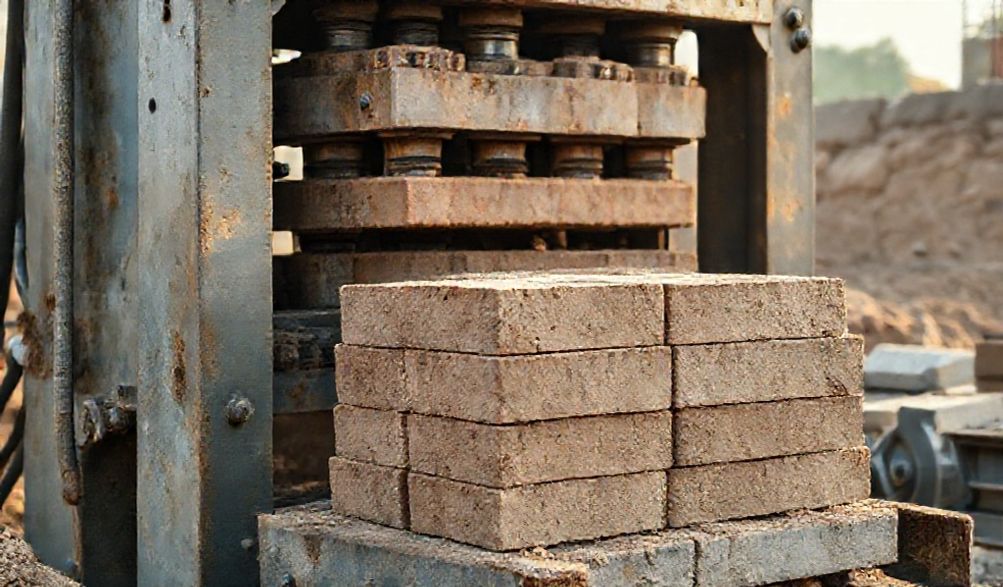
La Guía Definitiva de Máquinas para Hacer Ladrillos de Tierra en la India (2026)
Introducción
El perfil urbano de la India se eleva a un ritmo sin precedentes, pero ¿a qué costo? El sector de la construcción, pilar fundamental de este crecimiento, también contribuye significativamente a los desafíos ambientales del país. Considera esto: se estima que la industria tradicional de ladrillos de arcilla cocida consume más de 24 millones de toneladas de carbón al año y emite cerca de 42 millones de toneladas de CO2. Mientras la India avanza hacia sus objetivos de desarrollo sostenible, una revolución silenciosa está gestándose en el terreno—literalmente. La búsqueda de materiales de construcción asequibles, ecológicos y resistentes ha llevado a constructores, arquitectos y emprendedores de vuelta a un recurso fundamental: la tierra.
El problema con los ladrillos rojos convencionales es multifacético. Su producción es intensiva en energía, contaminante y a menudo implica la remoción explotadora de la capa superior fértil del suelo. Junto con costos volátiles y un escrutinio regulatorio cada vez mayor, la necesidad de una alternativa nunca ha sido más urgente. Entra en escena la máquina para hacer ladrillos de tierra: una maravilla tecnológica que transforma la humilde tierra en bloques de construcción resistentes y sostenibles.
Esta guía integral está diseñada para eliminar el ruido. Basada en una extensa investigación de la industria, análisis técnico y un profundo entendimiento del panorama del mercado indio, sirve como un recurso definitivo. Ya sea que seas un constructor que busca reducir costos, un arquitecto que promueve el diseño verde o un emprendedor que identifica una oportunidad de negocio, esta guía te proporcionará el conocimiento para tomar una decisión informada. Profundizaremos en la mecánica de estas máquinas, sus beneficios significativos, los tipos disponibles, los principales fabricantes indios, el proceso de producción y los factores críticos que debes considerar antes de invertir.
¿Qué es una Máquina para Hacer Ladrillos de Tierra?
Una máquina para hacer ladrillos de tierra es un dispositivo diseñado para producir Bloques de Tierra Comprimida y Estabilizada (BTCE). Representa una fusión de principio simple e ingeniería robusta, ofreciendo una vía moderna hacia uno de los materiales de construcción más antiguos de la humanidad.
Tecnología Central Explicada
En esencia, la tecnología es elegantemente simple. Una máquina de CSEB comprime una mezcla húmeda de suelo, un pequeño porcentaje de estabilizador (típicamente 5-10% de cemento o cal) y agua bajo una presión extremadamente alta. Este proceso, que puede ejercer fuerzas de 2 a más de 40 toneladas, no depende del calor. En su lugar, compacta mecánicamente las partículas, creando un vínculo denso y cohesivo. El estabilizador actúa como aglutinante, reaccionando químicamente para dar al bloque resistencia a largo plazo e impermeabilidad. El resultado es un ladrillo uniforme y de alta calidad que está listo para la construcción después de un período de curado.
Cómo se diferencia de la fabricación tradicional de ladrillos
El contraste con los métodos tradicionales es marcado:
* Versus Ladrillos de Adobe Secados al Sol:Mientras que el adobe también utiliza tierra, simplemente se moldea y se seca al sol. Los Bloques de Tierra Comprimida (BTC) se comprimen mecánicamente, lo que los hace mucho más densos, resistentes y duraderos. También tienen dimensiones más precisas.
* Contra los Ladrillos de Arcilla Cocidos en Horno:Esta es la diferencia más significativa. Los ladrillos cocidos requieren temperaturas de 900°C–1100°C durante días, quemando grandes cantidades de carbón o madera. El proceso de BTC elimina por completo esta etapa de cocción. Esto significa quecero emisiones por combustión de combustiblelo que resulta en un ahorro de energía de hasta el 90% y una reducción drástica en la huella de carbono del ladrillo en sí.
Principales Beneficios de Usar una Máquina para Fabricar Ladrillos de Tierra en India
Adoptar la tecnología de ladrillos de tierra no es solo una elección ecológica; es una decisión económica y práctica inteligente con ventajas de amplio alcance.
Ventajas Económicas
- Baja Inversión de Capital:Establecer una unidad de producción de CSEB requiere una fracción del capital necesario para un horno de ladrillos convencional. No hay necesidad de hornos costosos, chimeneas o grandes extensiones de tierra para la extracción de arcilla.
- Costo Mínimo de Material:La materia prima principal—la tierra—a menudo está disponible en el sitio o localmente a un costo mínimo. Los estabilizadores como el cemento son el único insumo importante que se adquiere.
- High-Profit Potential: With low operational costs and a growing market demand for green building materials, the profit margins for CSEB production can be very attractive for small and medium enterprises.
Environmental & Sustainability Benefits
The environmental case for CSEBs is compelling and backed by studies, including those from institutions like the Auroville Earth Institute. Their research highlights the dramatic reduction in embodied energy.
* Near-Zero Carbon Production: As mentioned, the absence of firing removes the largest source of CO2 emissions from brick manufacturing.
* Local & Natural: Using locally sourced soil drastically cuts down on transportation fuel and preserves topsoil for agriculture, as only sub-soil is used.
* Minimal Waste: There is no spoilage or wastage in production. Unused or broken blocks can be crushed, re-wetted, and reused.
Structural and Practical Benefits
- Aislamiento Térmico Superior: Earth blocks have excellent thermal mass. They absorb heat during the day and release it slowly at night, naturally regulating indoor temperatures. This can reduce air-conditioning costs by 30-40%.
- Proven Strength & Durability: When produced with the correct soil mix and stabilization, CSEBs can achieve compressive strengths exceeding those of standard clay bricks, making them perfectly suitable for load-bearing walls in low-rise construction.
- Built-In Safety: They are naturally fire-resistant, non-toxic, and offer good sound insulation. Their density also makes them resistant to termites and pests.
Types of Soil Brick Making Machines Available in India
The Indian market offers a spectrum of machines to suit different scales of operation and budgets.
Manual Press Machines
Ideal for community-led projects, rural housing initiatives, or very small-scale production.
* Pros: Extremely low cost, completely portable, requires no electricity. Promotes self-help construction.
* Contras: Labor-intensive, low output (typically 100-300 bricks per day), requires significant operator effort.
Máquinas Semiautomáticas
A popular choice for small businesses, housing projects, and entrepreneurs. These often feature a hydraulic or mechanical lever system and may include a pan mixer.
* Pros: Offers a good balance between output, cost, and ease of use. Significantly reduces manual labor compared to manual presses. Output can range from 500 to 1500 bricks per day.
* Contras: Requires a skilled operator for consistent quality. Still involves some manual handling of materials.
Máquinas Completamente Automáticas
Designed for commercial-scale production. These are integrated systems with automated soil feeding, mixing, compression, and brick ejection, often with conveyor belts.
* Pros: High, consistent output (2000+ bricks per day), excellent product uniformity, minimal manual labor.
* Contras: High initial investment, requires a reliable power supply (electricity or diesel), and more space.
Mobile vs. Stationary Units
A key consideration is mobility. Many manufacturers offer machines mounted on trailers.
* Mobile Units: Allow for on-site production, eliminating brick transportation costs entirely. Perfect for large, remote projects.
* Stationary Units: Set up in a dedicated production yard, supplying bricks to multiple sites within a region.
Top Factors to Consider Before Buying a Machine
A successful venture hinges on choosing the right equipment. Do not skip this due diligence.
Evaluando Sus Necesidades de Producción
Be clear about your objectives. Are you building a single house, a colony, or starting a commercial brick supply business? Your required daily output (e.g., 1000 vs. 5000 bricks) will directly dictate the type and capacity of machine you need.
Soil Suitability and Testing
This is the most critical, non-negotiable step. Not all soil is suitable. An investment can fail if the soil on your site is incompatible. Expertise here is paramount.
* The ideal soil has a balanced mix of clay (as a binder), silt, and sand (for skeletal structure).
* Always conduct a professional soil test before purchasing a machine. Reputable suppliers or local engineering colleges can guide you. The test will determine the exact proportion of stabilizer needed.
Especificaciones y Características de la Máquina
- Tamaño y Forma del Ladrillo Ensure the machine can produce the size (e.g., 230x190x100 mm) and interlocking shapes you require.
- Clasificación de Presión: Measured in tonnes or PSI. Higher pressure generally produces denser, stronger bricks (aim for a minimum of 2-3 tonnes for standard blocks).
- Fuente de Energía: Choose based on your location’s power reliability—electric, diesel, or hybrid.
- Build Quality & Service: Inspect the machine’s robustness. Crucially, investigate the supplier’s after-sales service network, warranty, and spare parts availability. A machine breakdown without support can halt your entire operation.
Leading Manufacturers and Suppliers of Soil Brick Machines in India
The Indian market features a mix of pioneering domestic manufacturers and distributors of international brands.
Overview of the Indian Market Landscape
The demand for sustainable construction has spurred growth in this niche. Companies range from small-scale fabricators to established firms with extensive R&D and export operations.
Review of Reputable Indian Brands
Based on market presence, technical innovation, and product range, here are a few notable names (this is an informational overview, not an endorsement):
* Auram (Auroville Earth Institute): Considered pioneers in India. They offer a wide range of manual and hydraulic presses, backed by decades of research and training.
* Kathan Engineering: Known for robust and innovative hydraulic and automatic CSEB machines, catering to medium and large-scale production needs.
* Mardini Hydraulics: A manufacturer offering a variety of hydraulic press machines, from manual to fully automatic models.
* Bharath Industrial Works: Produces a range of soil block making machines, including mobile units for on-site production.
Tips for Vetting a Supplier
- Ask for Certifications & References: Request client testimonials, especially from projects in your region.
- Insist on a Live Demo: Never buy based on a brochure alone. Demand a demonstration using a sample of your own soil to see the machine’s performance and brick quality.
- Evaluate Support: Assess their willingness to provide installation guidance, operator training, and their response time for service queries.
The Soil Brick Production Process: A Step-by-Step Guide
Producing quality CSEBs is a systematic process.
Step 1: Soil Selection and Preparation
Excavate sub-soil (not fertile topsoil). Remove debris, vegetation, and large stones. The soil should be spread and allowed to weather if too wet.
Step 2: Sieving and Mixing
Sieving is crucial to remove pebbles and achieve a uniform grain size. The sieved soil is then mixed with the precise percentage of stabilizer (cement/lime) in a dry state to ensure even distribution. Water is then added gradually to achieve optimal moisture content (usually around 10-12%).
Step 3: Compression in the Machine
The moist mix is fed into the machine’s mold chamber and compressed at high pressure. The block is then ejected onto a pallet.
Step 4: Curing and Drying
This is vital for strength development. The fresh bricks are kept under a plastic sheet or sprayed with water for 7-14 days to allow the cement to hydrate fully. After curing, they are shaded dried for another 2-3 weeks before use in construction.
FAQ: Frequently Asked Questions About Soil Brick Machines
Q1: What is the average cost of a soil brick making machine in India?
A: Prices vary dramatically. A simple manual press can start from ₹25,000, semi-automatic hydraulic machines range from ₹1.5 lakh to ₹5 lakh, while high-capacity fully automatic plants can cost ₹10 lakh and above.
Q2: Can I use any soil from my land to make bricks?
A: No. Soil must be tested. Pure clay will shrink and crack; pure sand will not bind. Most soils need blending or stabilization. A simple sediment test can give a preliminary idea, but professional lab testing is recommended.
Q3: How strong are soil-stabilized bricks compared to red clay bricks?
A: Well-made CSEBs stabilized with 5-8% cement can easily achieve a compressive strength of 5-7 MPa, which meets or exceeds the strength of many traditional clay bricks (3-5 MPa) used in low-rise construction, as per Indian Standard IS 1725.
Q4: Is special training required to operate these machines?
A: Yes. While the operation is not overly complex, training is essential for understanding soil mix design, moisture control, machine maintenance, and curing procedures. Reputable suppliers should provide basic operational training.
Q5: What are the government regulations or BIS standards for these bricks?
A: The relevant standard is IS 1725:2013 (Compressed Stabilized Earth Blocks). For building approval, consult your local municipal corporation or town planning authority, as acceptance is growing but can vary by region. Using BIS-standard blocks strengthens your case.
Conclusión
Soil brick making technology is more than an alternative building method; it’s a paradigm shift towards a more sustainable, equitable, and cost-effective construction future for India. It empowers local entrepreneurship, conserves precious resources, and creates healthier living spaces. The potential to address both housing shortages and environmental concerns is immense.
However, success with this technology is not automatic. It demands careful planning, a scientific approach to soil, and a strategic investment in the right equipment. We encourage you to use this guide as a starting point for deeper research, site visits to existing projects, and consultations with technical experts.
Ready to build a sustainable future from the ground up? Contact us for a personalized consultation and soil testing recommendations.
Download our free checklist: ’10 Essential Questions to Ask Before Buying a Brick Making Machine in India’.
<