
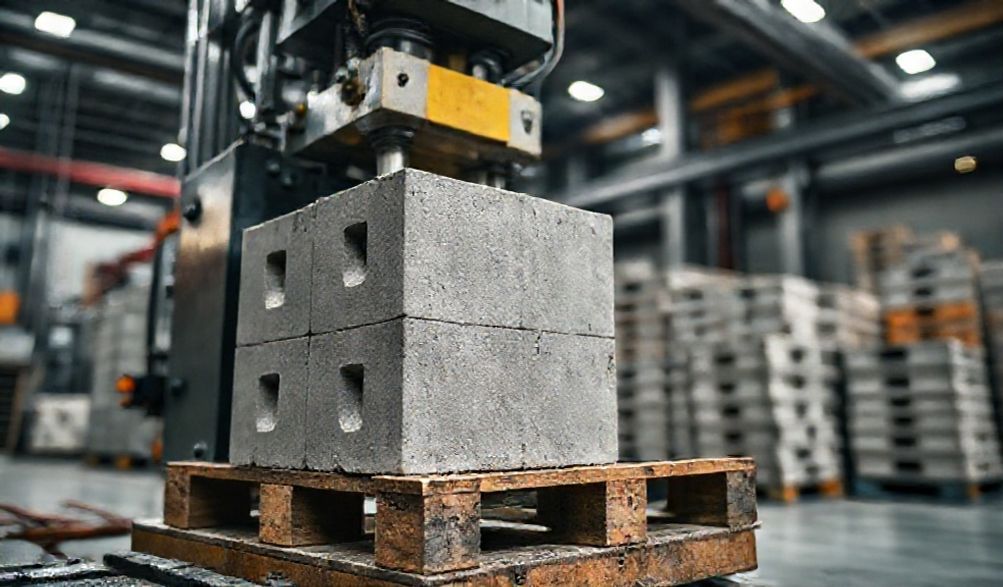
Jagorar Cikakke na Kayan Aikin Yin Tubalin Siminti na Siminti (2026)
Gabatarwa
Masana'antar ginin duniya wata kafar ci gaba ce mai karfi, wacce ke motsawa da bukatar da ba ta daina karuwa ba don kayan gini masu araha, masu dorewa, da kuma dorewa. A cikin ainihin gudanar da wannan babbar bukatar akwai wata muhimmin fasaha mai mahimmanci:machinery na yin bulo na siminti na kankareWannan kayan aiki suna canza kayan gini masu sauƙi da yawa zuwa muhimman abubuwan gidajenmu, ofisoshinmu, da ababen more rayuwa.
Wannan cikakken jagora an tsara shi ne don 'yan kasuwa, masu kasuwancin gine-gine, manajoji na ayyuka, da injiniyoyin farar hula. Ko kuna neman saka hannun jari a cikin injinanku na farko, haɓaka samarwa, ko kuma kawai fahimtar fasahar da ke tattare da ginin zamani, wannan albarkatun yana ba da cikakken bayani na ƙwararru. Za mu rarraba injinan bisa ƙayyadaddun masana'antu, mafi kyawun ayyuka, da la'akari da tattalin arzikin duniya na ainihi, don ba ku ikon yin yanke shawara mai inganci.
A cikin wannan jagorar, za ka koyi:
- Nau'ikan injina na asali da aikace-aikacen da suka dace da su.
* Siffofin mahimmanci waɗanda ke raba ingantaccen na'ura da abin da ke da alhaki.
* Duba tsarin samarwa mataki-mataki.
* Tsarin aiki don zaɓar mafi kyawun kayan aiki don takamaiman burin kasuwancin ku.
* Muhimman bayanai na aiki da kulawa don kare saka hannun jarin ku.
Fahimtar Injinan Yin Bulo: Ma'anoni da Aikace-aikace na Asali
Kafin mu nutse cikin cikakkun bayanai da farashi, yana da mahimmanci a fahimci abin da wannan injin yake yi da kuma dalilin da yasa yake kawo sauyi ga ayyukan gine-gine na kowane sikelin.
Menene Makinan Yin Tubalin Siminti na Kwalta?
A takaice dai,machinery na yin bulo na siminti na kankarena'urar kera tubalin gini ce ta musamman da aka tsara don sarrafawa da daidaita samar da tubalin gini. Tana yin haka ta hanyar haɗa kayan aiki daidai – da farko siminti, gauran gini (kamar dutsen da aka niƙa), yashi, da ruwa – sannan kuma tana gyare-gyare da matse wannan cakuda a ƙarƙashin matsi mai ƙarfi zuwa siffofi iri ɗaya.
Rawar wannan na'ura tana da muhimmanci. Ta maye gurbin hanyoyin aikin hannu masu ƙarfi da rashin daidaituwa tare da tsarin da ke tabbatar da:
* Inganci:Fitattunar yawan aikin da ake yi a kowace awa.
* Daidaito:Kowane toshe yana da girma iri ɗaya da yawa.
* Haɓakawa: Production can be matched precisely to project demands.
* Ƙarfi: Controlled compression creates blocks with reliable, engineered compressive strength.
Key Applications and Output Products
The versatility of this machinery is one of its greatest strengths. By simply changing the mold, a single machine can produce a wide array of products for different construction segments:
- Structural Blocks:
- Tubali Masu Ƙarfi & Masu Rami: The backbone of wall construction for residential and commercial buildings.
- Tubalan Masu Sauƙi Made with expanded clay or shale for improved insulation.
- Paving & Landscaping Products:
- Dutsen Shinge & Tubalin Masu Haɗin Kai:Don hanyoyin mota, hanyoyin tafiya, da baranda.
- Curb Stones & Edgers: For roadways and landscape definition.
- Siffofi na Musamman:
- Chimney Blocks, Ventilation Blocks, and Decorative Facade Elements.
This means your investment can serve multiple markets—from building a housing development to supplying materials for a municipal park renovation.
Types of Brick Making Machines: Choosing the Right Technology
The market offers a spectrum of machines, categorized by their level of automation and mobility. Your choice here is the most significant factor determining your production capacity, labor needs, and initial investment.
Na'urorin Yin Tubali na Hannu
- Bayanin: These are simple, lever-operated or hand-pressed machines with no electrical components. Filling the mold, compacting, and ejecting the block are all done by hand.
- Abubuwan da suka fi kyau:
- Very low initial cost and minimal maintenance.
- No electricity required, ideal for remote sites.
- Simple to understand and operate.
- Rashin Kyau:
- Extremely labor-intensive and slow (low output).
- Product consistency depends heavily on the operator’s skill.
- Not suitable for commercial-scale production.
- Ya Dace Da: Very small-scale projects, personal use, NGOs in low-infrastructure areas, or as a starter unit for a micro-business testing the market.
Matsarori na Yin Bulo na Semi-Automatic
- Bayanin: These machines strike a balance. Key processes like compaction (via vibration or hydraulic pressure) are mechanized, but tasks like feeding raw material and removing finished blocks are often manual. They typically use a single motor.
- Abubuwan da suka fi kyau:
- Fitattunawa da inganci mafi girma da kuma daidaito fiye da injunan hannu.
- Moderate investment cost.
- Good product quality due to mechanical compaction.
- Rashin Kyau:
- Still requires a steady labor crew for operation.
- Output is limited by the speed of manual handling stages.
- Ya Dace Da: Small to medium-sized businesses, local block supply yards, and contractors who need a dedicated on-site supply for projects.
Injinoyin Gina Tubali Masu Sarrafa Kansu Gabaɗaya
- Bayanin: These are complete production lines. They integrate automatic material feeding, mixing, molding, compaction, block transfer, curing, and stacking. Operation is managed via a Programmable Logic Controller (PLC) panel.
- Abubuwan da suka fi kyau:
- Very high, consistent output with minimal manual labor.
- Exceptional product uniformity and quality control.
- Dramatically lower labor costs per block produced.
- Rashin Kyau:
- Babban jarin kuɗi.
- Requires skilled technicians for maintenance and troubleshooting.
- Needs a stable power supply (often 3-phase) and more space.
- Ya Dace Da: Large-scale block manufacturing plants, industrial suppliers, and major construction firms with continuous, high-volume demand.
Matsar da Injin Kera Tubali (Stationary vs. Mobile Block Making Machines)
- Tsire-tsire Masu Tsayawa: These are fixed installations designed for maximum output in a dedicated location. They are the core of large block yards and supply businesses.
- Na'urorin Motsi: Mounted on a trailer, these units can be towed directly to a construction site. They produce blocks on-location, eliminating transport costs for the finished product. They are typically semi-automatic and perfect for large, remote infrastructure projects.
Critical Features and Components of a Quality Machine
Beyond automation level, the engineering of key components dictates performance, product quality, and machine lifespan.
The Heart of the Machine: Hydraulic System vs. Vibration System
The compaction method is fundamental.
* Tsarin Girgiza: Uses high-frequency vibrators to settle the concrete mix in the mold. Excellent for producing hollow blocks and lighter pavers. Generally more energy-efficient for certain products.
* Tsarin Hydraulic: Uses immense hydraulic pressure to compress the mix. Superior for producing high-density, high-strength solid blocks, paving stones, and curbs. Offers more consistent pressure control, leading to uniform strength.
The Verdict: For heavy-duty, high-strength products, hydraulic is often preferred. For standard hollow blocks, a robust vibration system is common. Many high-end machines combine both for optimal results.
Mold and Pallet Systems
The mold is the literal shape of your business.
* Kayan aiki: Molds must be made from high-grade, hardened steel to withstand constant abrasion and pressure.
* Daidaito: A poorly machined mold leads to blocks that are difficult to lay and have poor aesthetics.
* Interchangeability: The ability to quickly swap molds to produce different products is a key feature for business flexibility. Check the mold-changing mechanism’s ease of use.
Control Systems: From Manual Levers to PLC Panels
- Manual: Simple levers and switches. Prone to operator variance.
- Electro-Mechanical: Relays and timers for basic automation.
- PLC (Programmable Logic Controller): The brain of a fully automatic line. Allows for precise control over every parameter (pressure, vibration time, cycle time), stores recipes for different products, and provides diagnostic information. This is essential for top-tier consistency and efficiency.
Production Capacity and Cycle Time
Don’t just look at the “blocks per hour” claim in a brochure. Understand the lokacin zagayowar—the time to produce one pallet of blocks—and what block type that claim is based on.
* A machine might produce 1000 solid blocks/hour but only 600 complex interlocking pavers/hour.
* Real-world output is affected by raw material quality, operator speed (for semi-auto), and maintenance.
The Complete Production Process: From Raw Material to Finished Block
Understanding the full cycle highlights where quality is built into the product.
Raw Material Preparation: Mix Design Ratios
The machine can only work with what it’s given. A consistent, correct mix is non-negotiable.
* A typical mix might be 1 part cement, 3 parts sand, 5 parts aggregate (by volume), with just enough water for workability.
* Using clean, well-graded aggregates and consistent cement quality is critical. The water-cement ratio directly impacts final strength; too much water weakens the block dramatically.
The Manufacturing Cycle Step-by-Step
- Ciyarwa: Raw materials are loaded into the hopper (manually or via conveyor).
- Haɗawa: Materials are blended into a homogeneous concrete mix (in a pan mixer or planetary mixer).
- ƙirƙira / damƙa The mix is fed into the mold and compacted under vibration or hydraulic pressure.
- Fitowa & Warkewa: The green (un-cured) block is ejected onto a pallet and transferred to a curing area.
- Stacking/Packaging: After sufficient curing, blocks are stacked for storage or transport.
Curing Methods for Optimal Strength
Curing is the chemical process where cement hydrates and gains strength. Proper curing is not optional.
* Water Curing: Blocks are sprayed with water and kept under damp covers for 7-14 days. Low-cost but space-intensive.
* Kula da Tururi: Blocks are placed in a curing chamber and exposed to steam heat (60-80°C) for 8-24 hours. This accelerates strength gain, allowing blocks to be sold or used in just 1-2 days. Standard for high-output plants.
* Chemical Curing (Sealing): Membranes or sprays are used to retain moisture within the blocks.
How to Select the Best Machinery for Your Business
This is where research turns into a strategic investment.
Kimanta Bukatun Ku na Samarwa da Kasafin Ku
Ask these questions:
* What is my current and projected daily block requirement?
* What product types (solid, hollow, paver) will I sell the most?
* What is my total available investment (machine, setup, working capital)?
* What is my local power and water infrastructure?
Key Supplier Selection Criteria (Emphasizing E-E-A-T)
Your supplier is a long-term partner. Evaluate them rigorously:
* Kwarewa: How long have they been manufacturing? Can they provide a list of installed machines in your region or similar markets?
* Expertise & Authoritativeness: Do they provide detailed technical drawings and performance data? Are machines certified (CE, ISO)? Do their engineers understand local material conditions?
* Aminci: Wannan yana da muhimmanci. Insist on verifiable customer testimonials and contact references. What is the warranty period and what does it cover? Is there a clear after-sales service and spare parts policy? Our strongest advice: Physically visit a working plant using their machine or, at a minimum, demand real-time video proof of a machine in operation at their factory.
Binciken Farashin Mallaka Gabaɗaya
The purchase price is just the entry ticket. Factor in:
* Installation & Commissioning fees.
* Operator and technician training.
* Energy consumption (power of motors).
* Routine maintenance costs (oil, filters).
* Cost and lead time for spare parts and wear items (mold liners, pallets).
Mafi kyawun Ayyuka da Kulawa
Protect your investment with disciplined operation.
Essential Safety Protocols for Operators
- Mandatory use of safety glasses, gloves, steel-toe boots, and hearing protection.
- Never service or clear jams while the machine is powered on (Lock-Out/Tag-Out procedures).
- Keep the work area clean and free of slurry buildup.
Jadawalin Kulawa na Yau da Kullum
- Kullum: Clean the machine thoroughly, check hydraulic oil levels, inspect molds for damage, tighten any loose bolts.
- Mako-mako: Grease all moving joints, check vibrator mounts, inspect electrical connections.
- Kowane wata: Change hydraulic filters as recommended, perform a full system pressure check, calibrate sensors on automatic machines.
Troubleshooting Common Issues
- Blocks Breaking: Often caused by incorrect mix (too dry/too wet), insufficient compaction pressure, or improper handling during green state.
- Poor Surface Finish: Worn-out mold liners, dirty molds, or incorrect vibration time.
- Machine Jams: Foreign objects in the mix, overfilling the hopper, or misaligned pallets.
FAQ: Expert Answers on Brick Making Machinery
Q1: What is the average cost range for a concrete block making machine?
A: Prices vary enormously based on automation and capacity. Manual machines start around $2,000 – $5,000. Semi-automatic machines range from $15,000 – $50,000. Fully automatic production lines begin around $70,000 and can exceed $300,000 for large, high-capacity systems with curing racks and handling equipment.
Q2: What is the typical compressive strength of blocks produced by these machines?
A: Strength is primarily a function of mix design and compaction pressure. Standard non-load-bearing blocks may start around 3.5 MPa. Load-bearing structural blocks typically range from 7 MPa to 15 MPa or higher. High-pressure hydraulic machines can produce paving stones exceeding 50 MPa.
Q3: Can I produce different block sizes and shapes with one machine?
A: Absolutely. This is a key advantage. Machines are designed to work with interchangeable molds. The cost and ease of changeover vary; it’s simpler and faster on a semi-automatic machine than on a complex fully automatic line, where a mold change might require more recalibration.
Q4: How much space and what utilities are required to set up a block yard?
A: You need space for: 1) the machine and mixing area, 2) curing area (the largest section), 3) raw material storage, and 4) finished product storage. A small yard might need 5,000 sq ft, while a large plant requires acres. Utilities typically include a robust 3-phase electrical connection and a reliable water source.
Q5: What is the expected return on investment (ROI) for a brick making business?
A: ROI is highly location-specific. It depends on your local market price for blocks, your production efficiency, and your operating costs. As a framework, calculate: (Daily Output x Block Selling Price) – (Daily Operating Costs). A well-run semi-automatic plant in a growing market can often see a full ROI in 12-24 months.
Ƙarshe
Investing in machinery na yin bulo na siminti na kankare is a strategic decision that hinges on aligning technology with your business ambition. The journey from a manual start-up to a fully automated plant is a path of scaling efficiency and quality. Remember, the core tenets are: match the machine type to your realistic production scale, prioritize engineering quality and supplier reputation over the lowest upfront price, and fully understand the production cycle from raw material to cured block.
This machinery is more than a tool; it’s a long-term investment in the quality of construction and the growth of your enterprise. Partnering with a knowledgeable, trustworthy supplier and investing in proper training for your team are the final, crucial steps to ensuring this investment pays dividends for years to come.
Call to Action: Begin your selection process with thorough research. Create a detailed project requirement sheet. Contact multiple reputable suppliers, request comprehensive quotations with full technical specifications, and—most importantly—ask for and follow up on customer references from projects similar to your own.
<